October 21, 2026 · Denver · Buying · Selling · Property Taxes
Buying in Denver? The sidewalk fee, trash fee, and city service liens that come with the house
Denver bills property owners a Sidewalk Program service charge and a cart-size trash fee, and unpaid city charges can become service liens. What Denver's official pages say, and the questions buyers and sellers can ask before closing.
The short answer
In brief: Owning a Denver home comes with city charges billed separately from the property tax bill. Denver's Sidewalk Program says its service charge applies to all property owners and lists $150 per year for about 96% of them for 2026, and residential trash service is billed by cart size. Buyers can check for unpaid city service charges before closing.
Owning a home in Denver comes with some city charges that are billed separately from the property tax bill.
- Sidewalk service charge. Denver's Sidewalk Program FAQ says: "the service charge applies to all Denver property owners, including those with existing sidewalks in good condition." For 2026 it lists "$150 per year for approximately 96% of property owners."
- Trash fee. Denver's trash page says: "Customers are billed directly for residential waste services based on trash cart size. The smaller the trash cart, the lower the fee."
- Service liens. Denver Treasury says: "Many agencies and programs refer over past due amounts to the Treasury office for lien billing." It lists the most common as "Sidewalk Program," "Storm Drainage," "Sanitary Sewer," "Trash," and "Forestry."
Questions about unpaid charges on a specific property go to the closing company and Denver Treasury.
I am a licensed Colorado real estate broker with Call It Closed International Realty. I am not an attorney. This is not legal or tax advice.
Disclaimer. This article is general information only. It is not legal, tax, lending, insurance, appraisal, inspection, or financial advice, and reading it does not create a client, agency, or attorney-client relationship. Laws, rates, programs, and figures change. Confirm the official source, and talk with a licensed attorney, tax professional, lender, insurance agent, or inspector before you act. Joshua Wei is a Colorado real estate broker, not an attorney. He is an Associate Broker with Call It Closed International Realty, license FA.100108558. Equal Housing Opportunity.
 Full size (opens in a new tab)
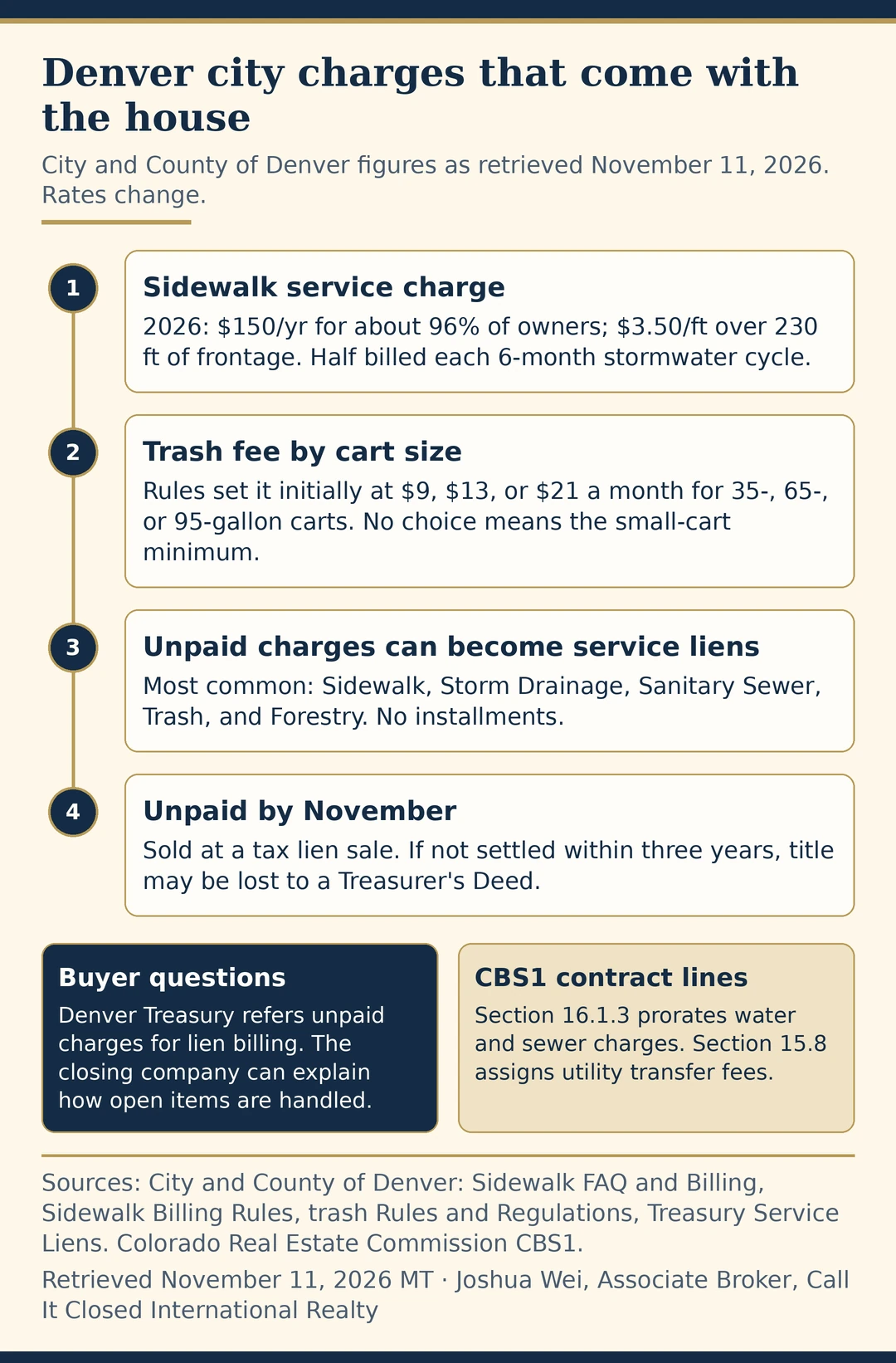
A vertical flow diagram, cream background with navy type and gold accents, titled Denver city charges that come with the house, with the subtitle City and County of Denver figures as retrieved November 11, 2026, and rates change. Four numbered steps: 1, sidewalk service charge, in 2026 150 dollars a year for about 96 percent of owners and 3 dollars 50 per foot over 230 feet of frontage, with half billed each 6-month stormwater cycle; 2, trash fee by cart size, which the rules set initially at 9, 13, or 21 dollars a month for 35-, 65-, or 95-gallon carts, and no choice means the small-cart minimum; 3, unpaid charges can become service liens, most commonly Sidewalk, Storm Drainage, Sanitary Sewer, Trash, and Forestry, with no installments; 4, unpaid by November, the liens are sold at a tax lien sale, and if not settled within three years title may be lost to a Treasurer's Deed. Two lower cards: buyer questions, Denver Treasury refers unpaid charges for lien billing and the closing company can explain how open items are handled; and CBS1 contract lines, section 16.1.3 prorates water and sewer charges and section 15.8 assigns utility transfer fees. Sources: City and County of Denver and Colorado Real Estate Commission. Retrieved November 11, 2026 MT.
Sources: Denver Sidewalk FAQ (opens in a new tab); Denver Treasury Service Liens (opens in a new tab)
Cream background, navy text, gold rules. Four numbered steps on a gold spine, two side-by-side cards, and a 28px source footer.
The diagram above summarizes the two recurring Denver charges and what Denver Treasury says happens when city service charges go unpaid. Figures are from the City and County of Denver's pages as retrieved.
How does Denver's sidewalk fee work?
Denver's Sidewalk Service Charges & Billing page (opens in a new tab) says: "Sidewalk service charges are included on all Denver property owners' stormwater bill, paying half of the annual fee in each 6-month billing cycle."
The Sidewalk FAQ (opens in a new tab) gives the 2026 rates:
- "$150 per year for approximately 96% of property owners"
- "Properties with more than 230 linear feet of frontage abutting the public right-of-way will pay $150 base rate, plus $3.50 per foot of frontage over 230 feet"
The billing page lists 2027 rates of $150.39 for the base service charge and $3.51 for the excess frontage impact fee.
On whether every owner pays, the FAQ says: "Yes, the service charge applies to all Denver property owners." That includes properties without a sidewalk.
What if the home is in an HOA?
The FAQ says: "If your HOA receives your semi-annual stormwater bill, then your HOA will receive the sidewalk bill as well."
Denver's Sidewalk Program billing rules (opens in a new tab) say that "if an account receives a Stormwater bill, the responsible entity for the sidewalk service charge shall match that of Stormwater billing."
The rules define a "Responsible entity" as "any natural person, legal entity, or organization that owns, manages, or exercises control over a property or shared property interest." The definition "includes but is not limited to homeowners' associations, condominium or cooperative associations, property management companies, partnerships, corporations, trustees, or contractual designees such as parties to a party-wall agreement."
Group accounts
Some parcels are billed together. Under the rules, parcels owned by the same owner that "together form a unified park, greenway, building, complex, or similar continuous user experience under the same name" are "assessed as a group account for purposes of sidewalk billing." Owners of separate parcels "contiguous or located within 300 feet of each other" may request to "establish a group account, provided that the parcels operate as a single, unified site or development (such as a mixed-use development, housing complex, or commercial center)."
The rules add timing limits. "Requests to enter or exit group accounts must be received by DOTI no less than sixty (60) days prior to the next scheduled bill date." And: "All charges and fees associated with accounts entering or exiting a group account must be paid in full by the current account owner before the account change can occur."
If you're buying in an HOA, ask the association how it handles the sidewalk charge.
How does Denver's trash fee work?
Denver's Rules and Regulations for trash, recycling, and compost (opens in a new tab) say authorized residences "will be charged a fee based on the size of the selected trash cart."
The rules set the fees initially at "$9/month for the small trash container (35-gallon), $13/month for the medium trash container (65-gallon), and $21/month for the large trash container (95-gallon)."
If no size is chosen, "the authorized residence will be charged a minimum fee based on the small trash cart."
The rules define "Authorized residence" as "owners or occupants of a housing structure used for human habitation located within the corporate limits of the City and County of Denver" in single-family homes, multi-unit buildings of "seven (7) units or less," and certain townhomes.
Bills are handled through Denver Utilities Online (opens in a new tab). That page says your Parcel ID and account number "are provided on the invoice for your service address."
Is there help with the trash fee?
The trash rules set up an affordability program. "The Department of Human Services (DHS) will offer an affordability program and verify instant rebates for eligible households. Instant rebates will be based on the Area Median Income for the City and County of Denver." The rules define the Instant Rebate as a credit "on the billing for the VolumeBased Trash Pricing Services Fee."
The rules' rebate table ties the credit to household income as a share of Area Median Income (AMI): 100% for 0–30% AMI, 75% for 31–50% AMI, and 50% for 51–60% AMI.
A few rules matter to a new owner:
- "Instant rebates will be effective for one (1) year, requiring residents to reapply or attest annually."
- "Approved applicants shall be required to submit a new application every other calendar year to maintain eligibility for the rebate."
- "Applicants must either be named on the billing parcel trash bill generated by the City, or provide other documentary proof, satisfactory to the program, that they are responsible for all of the bill or their pro rata share of the bill."
- "Applicants whose applications are not completed before the end of the billing cycle will not receive an instant rebate for that billing period, regardless of when the application was received."
A seller's rebate does not tell you whether you qualify. Eligibility questions go to the program.
What happens if city charges go unpaid?
The Sidewalk FAQ says: "The Denver Revised Municipal Code authorizes the city to place a lien on properties that are delinquent in the payment of fees."
Denver's sidewalk billing rules say liens "may be placed on accounts with unpaid sidewalk service charge balances that are more than 90 days overdue and exceed DOTI's established sidewalk service charge lien threshold." For 2025, that threshold "will be set at $150 and may be adjusted annually in accordance with rate changes or as otherwise deemed necessary by DOTI."
Denver Treasury's Service Liens page (opens in a new tab) explains what follows:
"Service lien delinquencies will continue to accrue interest and fees. Those that remain unpaid as of November of each year are sold at a tax lien sale. The City Treasurer will then file a tax lien against the property. If the tax lien and interest is not settled within three years from the date the tax lien is filed, title to the property may be lost to a Treasurer's Deed."
It also notes: "Service liens are not allowed to be split into installments like the property taxes due."
Who answers questions about a lien?
Treasury bills the lien but does not hold the account details. Its page says: "Treasury is responsible for billing and collecting the payment for a service lien once it has been referred by the issuing authority, but is unable to answer any questions related to the specific debt details or account information." For that, "you must contact the agency or program referring the service lien to Treasury."
Lien notices carry a date. Treasury says: "On the Service Lien notice there is a Figures good until date . After this date, additional interest may accrue and the amount shown in your lien online may not match the billing received."
Group accounts and third-party payers
The sidewalk billing rules address two situations a buyer may run into:
- "When a group account is liened, property owners of all parcels or lots within the group account will receive notice of intent to lien and must coordinate with the responsible entity to satisfy the outstanding balance."
- "If a property owner has designated another party to make payments on their behalf and a lien is placed on the property, notice of lien will be sent to the property owner, who remains responsible for the outstanding balance."
For group accounts, "the lien threshold is scaled based on the number of parcels within the account, with the sidewalk service charge lien threshold applying per lot or parcel."
How does the Colorado contract handle these charges?
The Colorado Real Estate Commission's residential contract (CBS1), on the Division of Real Estate's contracts and forms page (opens in a new tab), has related lines:
- Prorations. Section 16.1.3 lists "Water and sewer charges, propane, interest on continuing loan and" a blank for others.
- Transfer fees. Section 15.8 says: "Utility transfer fees can change. Any fees to transfer utilities from Seller to Buyer must be paid by" a checked party.
Two more CBS1 sections address liens and taxes. Contract quotations here are from the 2026 CBS1 PDF (opens in a new tab).
- Liens. Section 14 says that, "Unless otherwise agreed to in this Contract or by Buyer in writing, any amounts owed on any liens or encumbrances against the Property or Inclusions, including any governmental liens for special improvements installed as of the date of Buyer's signature hereon, whether assessed or not, and previous years' taxes, will be paid before Closing by Seller, at Closing from the proceeds of this transaction, or from any other source."
- Final prorations. Section 16.1.4 says: "Unless otherwise specified in Additional Provisions, these prorations are final."
- Tax certificate. Under section 8.5, a tax certificate "listing any special taxing or metropolitan districts that affect the Property (Tax Certificate) must be delivered to Buyer on or before Record Title Deadline." Under Colorado Revised Statutes section 10-11-122(3)(a) (opens in a new tab), before issuing a residential owner's policy, and unless the proposed insured instructs otherwise, the title company "shall obtain a certificate of taxes due from the county treasurer or the county treasurer's authorized agent."
Whether a specific open charge is a lien, and how a contract handles it, is a question for the closing company and a Colorado real estate attorney.
How is the sidewalk fee adjusted each year?
The billing rules say: "Pursuant to D.R.M.C. section 49-148, the annual sidewalk service charge shall be adjusted annually to account for inflation." The rules include a worked example in which "the following year's annual escalation is a blend of 16% of CPI and 84% of CCI." In that example, "The total annual rate increase would be set at 4%," and "The 4% increase would be applied to the base access fee and excess frontage fee for the following year." That 4% is the rules' example, not a forecast.
An invented example
This example is invented; it is not a real property or account.
A buyer is under contract on a Denver bungalow. The seller has not paid two cycles of the stormwater bill that carries the sidewalk charge.
- The buyer asks the closing company to check for open service liens with Denver Treasury.
- Treasury's records show a sidewalk lien referred by DOTI. The buyer's questions about how the balance was figured go to the program, since Treasury "is unable to answer any questions related to the specific debt details."
- Under CBS1 section 14, liens are paid by the seller before or at closing unless the buyer agrees otherwise in writing.
- After closing, the buyer sets up the stormwater and trash accounts through Denver Utilities Online.
Actual amounts and steps depend on the account; confirm with the closing company.
Buyer checklist for Denver city charges
- Ask the closing company to check for open service liens with Denver Treasury.
- Ask whether the property is in a group account or billed through an HOA.
- Note the trash cart size and the monthly fee that goes with it, and whether you may qualify for the trash rebate.
- Check frontage if the lot is large; the rate changes over 230 feet.
- Review CBS1 sections 14, 15.8, and 16.1.3 with your broker.
- After closing, confirm the accounts are in your name.
Who to ask:
- Open charges or liens. The closing company and Denver Treasury.
- Bills and accounts. Denver Utilities Online, per the city's billing page.
- Contract questions. A Colorado real estate attorney.
Related: Aurora property tax and metro district buyer checklist (opens in a new tab).
Frequently asked questions
Do I pay the sidewalk fee if my block has no sidewalk?
The FAQ says: "Properties without an existing sidewalk are also subject to the service charge."
Is there a rebate?
The FAQ says: "An instant rebate is available for households with an income at or below 60% of the Area Median Income (AMI)." The billing page says property owners "already receiving the instant rebate for solid waste management services will automatically receive the sidewalk rebate as well and need not reapply."
Are nonprofits exempt?
The FAQ says: "No, nonprofit organizations are not exempt from the sidewalk service charge and do not receive any reductions."
Will the sidewalk fee go up?
The billing page says it "will be adjusted annually to account for inflation" and lists 2027 rates.
Can I pay a service lien in installments?
Treasury says service liens "are not allowed to be split into installments." It also says: "You can pay any service lien in the same transaction as your property tax payment."
Can Treasury explain how a lien amount was calculated?
Treasury says it "is unable to answer any questions related to the specific debt details or account information," and that you must contact the referring agency or program.
What if someone else pays my sidewalk bill?
The billing rules say that if a lien is placed, "notice of lien will be sent to the property owner, who remains responsible for the outstanding balance."
Are the sidewalk and trash charges prorated at closing?
Section 16.1.3 of CBS1 names "Water and sewer charges, propane, interest on continuing loan and" leaves a blank for other items. It does not name the sidewalk or trash charge. If you want them prorated, talk with your broker about writing them into the blank, and ask the closing company how it will handle current-cycle bills.
Does this apply in Aurora?
This article covers only City and County of Denver programs. If you're buying in Aurora or elsewhere, check with that city.
Related notes
- Reading your title commitment: what Denver and Aurora buyers should check before the title objection deadline
- Who owns the tree by the curb? Denver street trees, owner duties, permits, and forestry liens for homebuyers
- Recent renovation? Mechanics' liens when you buy or sell a Colorado home
Sources and method
Official sources, retrieved November 11, 2026, America/Denver:
- City and County of Denver: Sidewalk FAQ (opens in a new tab), Sidewalk Service Charges & Billing (opens in a new tab), Sidewalk Program Billing Rules & Regulations (opens in a new tab) (effective 12/18/2025), Trash (opens in a new tab), trash, recycling, and compost Rules and Regulations (opens in a new tab), Denver Utilities Online (opens in a new tab), and Treasury Service Liens (opens in a new tab).
- Colorado Real Estate Commission CBS1 sections 15.8 and 16.1.3 (DRE contracts and forms (opens in a new tab)).
- Added November 13, 2026: CBS1 2026 PDF (opens in a new tab) sections 8.5, 14, 15.8, 16.1.3, and 16.1.4; further sections of the trash, recycling, and compost Rules and Regulations (affordability program); further sections of the Sidewalk Program Billing Rules & Regulations (opens in a new tab) (definitions, group accounts, adjustments, liens) and the Treasury Service Liens page (opens in a new tab); and Colorado Revised Statutes section 10-11-122 (opens in a new tab) (2026 Colorado Revised Statutes, Title 10).
Quotations are verbatim. Rates change, so check the city's pages for current figures.
This note is general education from a Colorado real estate broker with Call It Closed International Realty. If you're buying in Denver, I can help you put these questions on your closing checklist.
Disclaimer
This article is general information only. It is not legal, tax, lending, insurance, appraisal, inspection, or financial advice, and it is not a substitute for advice about your situation. Joshua Wei is a Colorado real estate broker, not an attorney. Reading this article does not create a client relationship, an agency relationship, or an attorney-client relationship with Joshua Wei or with Call It Closed International Realty.
Laws, program rules, interest rates, insurance terms, tax figures, and other details change. Examples in this article are hypothetical illustrations unless a source is named for a specific, dated figure. Information in this article is believed accurate as of November 13, 2026 and is not guaranteed. No result is promised, and you should not rely on this article as the last word for your situation.
Before you act, confirm the point with the official source linked or cited in this article, and talk with a licensed professional who can apply the rule to your facts. That may be a licensed attorney, a tax professional, a lender, an insurance agent, a home inspector, or another licensed professional, depending on the question. Links to third-party websites and publications are provided for reference only. They are not an endorsement, and their content can change.
If you already have a brokerage relationship with another broker, this is not a solicitation.
Joshua Wei, Associate Broker, Call It Closed International Realty, Colorado license FA.100108558. Equal Housing Opportunity.