September 27, 2026 · Denver · Aurora · Buying · Selling
Swelling soils in Denver and Aurora: Colorado’s most common geologic hazard, and what a buyer can actually check
The Colorado Geological Survey calls expansive soil the state’s most significant geologic hazard. A 2026 statute requires a soils report and a care publication on new residences when that hazard is recognized. What those official sources say — and what they do not say about a resale.
The short answer
In brief: The Colorado Geological Survey calls expansive, or swelling, soil Colorado's most significant geologic hazard and says these clays cause more property damage than any other natural hazard. For a new residence, Colorado Revised Statutes section 6-6.5-101 requires the developer or builder to provide a summary soils report at least fourteen days before closing. Resale buyers rely on disclosures and inspection rights.
The Colorado Geological Survey, a state scientific agency, does not treat expansive soil as a rare curiosity. On its official Expansive Soil and Rock (opens in a new tab) hazards page, retrieved November 10, 2026, CGS writes: "Innocuous as it sounds, Colorado’s most significant geologic hazard is expansive or swelling soil — that is, soil laced with layers of various clays. These clays cause more property damage than any other natural hazard." The same page states: "Bentonite and montmorillonite (weathered volcanic ash) clays—in the form of soils or soft bedrock—underlie many populated areas of Colorado. They can expand up to 20% by volume when exposed to water and exert a force of up to 30,000 pounds-per-square-foot, more than enough to break up any structure they encounter."
That is a geologic-hazard description, not a finding about any one Denver or Aurora lot, and not a prediction that a particular house is damaged. A later paragraph on the same page uses a broader range for the same phenomenon: "Soil volume may expand 10 percent or more as the clay becomes wet. The powerful force of expansion is capable of exerting pressures of 20,000 pounds-per-square-foot or greater on foundations, slabs or other confining structures." I am quoting both statements rather than blending them into a single invented number.
For a newly built residence, Colorado law also requires a disclosure. The official 2026 text of Colorado Revised Statutes section 6-6.5-101 (opens in a new tab), retrieved November 10, 2026 from the Office of Legislative Legal Services host linked at the 2026 CRS titles index (opens in a new tab), states: "At least fourteen days prior to closing the sale of any new residence for human habitation, a developer or builder or their representative shall provide the purchaser with a copy of a summary report of the analysis and the site recommendations. For a site where significant potential for expansive soils is recognized, the builder or the builder’s representative shall supply each buyer with a copy of a publication detailing the problems associated with such soils, the building methods to address these problems during construction, and suggestions for care and maintenance to address such problems." The same section creates a $500 civil penalty payable to the purchaser if that report or publication is not provided, and it states: "The requirements of this section do not apply to any individual constructing a residential structure for the individual’s own residence."
That statute is about a new residence. It is not a soils report on a 30-year-old house in Aurora. On a resale, the official paths are the seller’s disclosures, the buyer’s inspection rights, and, if you want it, a professional who actually looks at this foundation and this site. This article keeps those two paths separate.
I am a licensed Colorado real estate broker with Call It Closed International Realty. I am not an engineer, a geologist, an inspector, an attorney, or a tax advisor. I cannot tell you that a crack is or is not caused by swelling soil, and I cannot design a foundation repair.
Disclaimer. This article is general information only. It is not legal, tax, lending, insurance, appraisal, inspection, or financial advice, and reading it does not create a client, agency, or attorney-client relationship. Laws, rates, programs, and figures change. Confirm the official source, and talk with a licensed attorney, tax professional, lender, insurance agent, or inspector before you act. Joshua Wei is a Colorado real estate broker, not an attorney. He is an Associate Broker with Call It Closed International Realty, license FA.100108558. Equal Housing Opportunity.
 Full size (opens in a new tab)
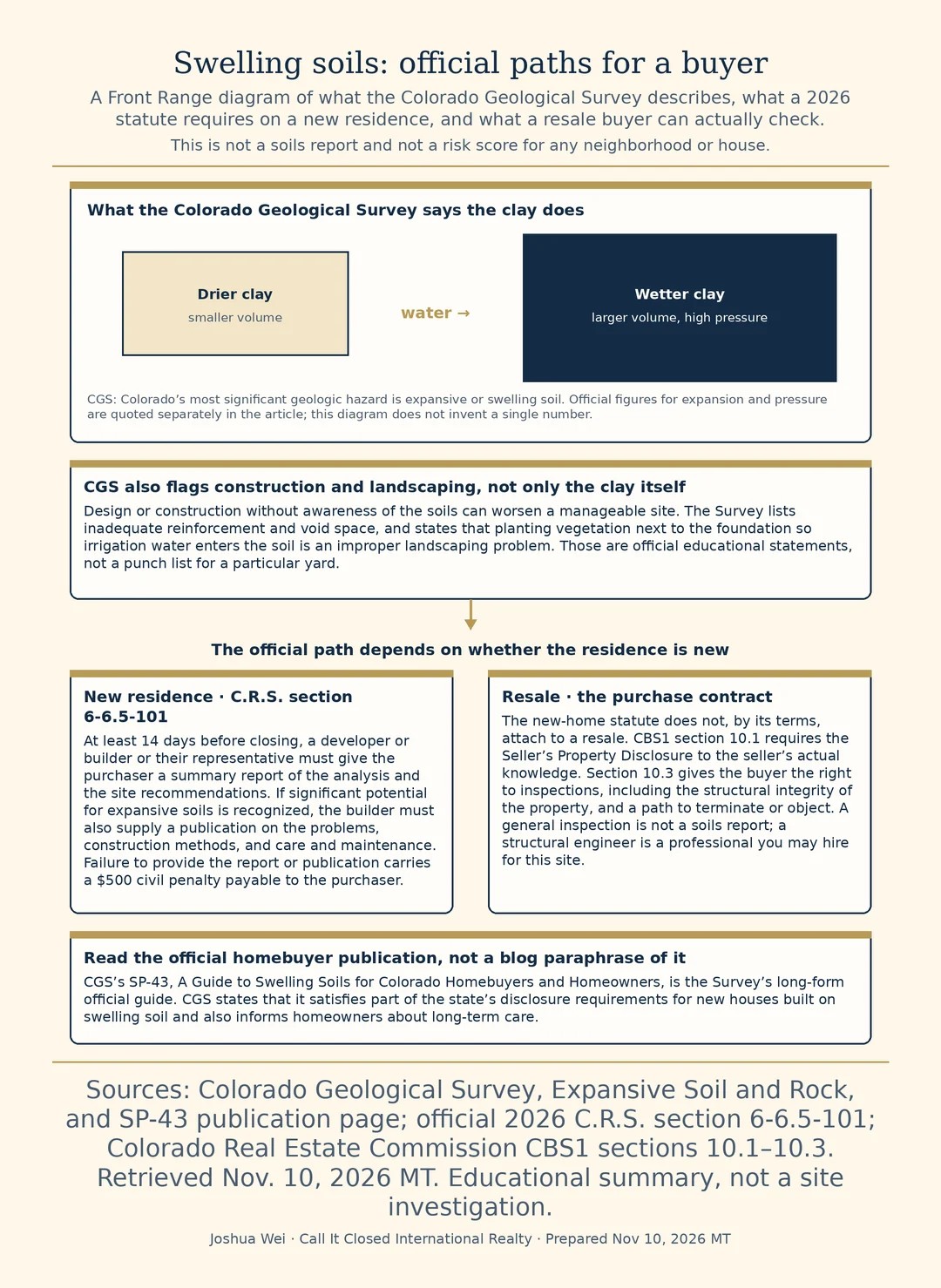
A vertical diagram, cream background and navy type, of official swelling-soil paths for a Denver or Aurora buyer. A comparison of a smaller drier-clay block and a larger wetter-clay block illustrates volume change with moisture, with a caption that the Colorado Geological Survey calls expansive soil the state’s most significant geologic hazard and that official expansion and pressure figures are quoted in the article rather than invented on the diagram. A middle card notes CGS cautions about construction and landscaping, including irrigation next to a foundation. Two lower cards split the official path: for a new residence, C.R.S. section 6-6.5-101 requires a soils-summary report at least 14 days before closing and, where significant expansive-soil potential is recognized, a care-and-construction publication, with a $500 civil penalty for failure to provide them; for a resale, the statute does not attach and the buyer uses the Seller’s Property Disclosure and inspection rights in CBS1 sections 10.1 through 10.3. A final card points to CGS publication SP-43. Retrieved November 10, 2026 MT.
Sources: Colorado Geological Survey, Expansive Soil and Rock (opens in a new tab); CGS, SP-43 publication page (opens in a new tab); Official 2026 C.R.S. Title 6 (includes section 6-6.5-101) (opens in a new tab); Colorado Division of Real Estate, broker contracts and forms (opens in a new tab)
Cream background, navy text, gold rules. A dry-versus-wet clay volume illustration, a CGS landscaping-and-construction card, two side-by-side path cards for a new residence versus a resale, and a pointer to official publication SP-43. Footer cites official sources at 28px, prepared November 10, 2026 MT.
The diagram above is a map of official sources, not a soils report. It shows how clay changes volume with moisture, the new-residence disclosure required by Colorado Revised Statutes section 6-6.5-101, and the resale path through the seller’s disclosures and the buyer’s inspection rights. It does not grade any neighborhood and it does not assign a risk score to any house.
What is swelling soil, according to the Survey?
CGS’s hazards page, already quoted, describes clays that absorb water and change volume. In a section headed "Characteristics," it states: "Expansive soils contain a high percentage of certain kinds of clay particles that are capable of absorbing large quantities of water." It then makes a point that matters on a construction site and on a landscaped lot: "Subsurface expansive soils on Colorado tend to remain at a constant moisture content in their natural state and are usually relatively dry at the outset of the disturbance that construction causes on them. Exposure to natural or human-sourced water during or after development results in expansion. In many instances the soils do not regain their original dryness after construction, but remain somewhat moist and expanded due to the changed environment."
The same page describes the kinds of damage the agency associates with the hazard, including "severe structural damage, cracked driveways, sidewalks and basement floors, heaving of roads and highway structures, condemnation of buildings, and disruption of pipelines and sewer lines." It states that "The destructive forces may be upward, horizontal, or both." Those are official descriptions of a class of problems. They are not a diagnosis of a stair-step crack you saw on a Sunday open house.
CGS also describes how design, construction, and landscaping can make a manageable site worse. "Design and construction of structures without an awareness of the existence and behavior of expansive soils can significantly worsen what might have been a readily manageable situation." On construction, the page lists "lack of reinforcing steel, insufficient or improperly placed reinforcing steel, mushroom-topped drilled piers, and inadequate void space between soils and grade beams," and it states: "Building without allowance for basement or ground floor movement in known expansive soils areas is a very common source of property damage." On landscaping, it states: "Improper landscaping problems include inadequate management of surface drainage and planting vegetation next to the foundation so irrigation water enters the soil." Those sentences are educational. They are not a punch list I can apply to your yard, and they are not a finding that a builder failed to follow them.
The Survey’s long-form official publication for buyers and owners is SP-43, A Guide to Swelling Soils for Colorado Homebuyers and Homeowners (opens in a new tab), second edition, 2007. CGS’s publication page, retrieved November 10, 2026, states that the guide "satisfies part of the disclosure requirements of the State of Colorado for new houses built on swelling soil, as well as to inform homeowners on strategies for the long-term care of their homes." I am pointing you to that official publication. I am not reprinting its checklist from memory, and I am not substituting this article for it.
What does the 2026 statute require — and what does it not require?
Colorado Revised Statutes section 6-6.5-101, already quoted, is short and specific. The official 2026 Colorado Revised Statutes text, including the 2026 amendment noted in the official source line as L. 2026, (HB 26-1426), effective August 12, is the text I am using. The duty sits on "a developer or builder or their representative." The document is "a copy of a summary report of the analysis and the site recommendations," delivered "At least fourteen days prior to closing the sale of any new residence for human habitation." If "significant potential for expansive soils is recognized," the builder or representative must also supply "a publication detailing the problems associated with such soils, the building methods to address these problems during construction, and suggestions for care and maintenance to address such problems."
The statute then states: "In addition to any other liability or penalty, any builder or developer failing to provide the report or publication required by subsection (1) of this section shall be subject to a civil penalty of five hundred dollars payable to the purchaser." It also states: "The requirements of this section do not apply to any individual constructing a residential structure for the individual’s own residence."
Three limits follow from that official text, and they matter in Denver and Aurora, where most listings are not brand-new. First, the trigger is the sale of a new residence, not every resale. Second, the expansive-soils publication is required when significant potential for expansive soils is recognized, in addition to the summary report of the analysis and site recommendations. Third, the statutory penalty described here is the $500 civil penalty in subsection (2). The statute itself says that penalty is "In addition to any other liability or penalty." What other claims, if any, might exist is a question for an attorney. I am not going to enlarge the statute into a general warranty on every foundation in the metro area.
If you are buying a new home, ask for the report and, where the site condition requires it, the publication, in time to read them before closing — the statute’s own clock is at least fourteen days prior to closing. CGS identifies SP-43 as a publication that can satisfy part of that disclosure. Whether the document you were handed is the right one, and whether it was timely, is a fact and legal question. I can help you ask for it. I cannot give you a legal opinion about a missing packet.
What about a resale in Denver or Aurora?
The official path is the purchase contract and the professionals you hire, not section 6-6.5-101. The Colorado Real Estate Commission’s Contract to Buy and Sell Real Estate (Residential), CBS1, mandatory beginning January 1, 2026, and retrieved November 10, 2026 from the Division of Real Estate contracts and forms page (opens in a new tab), gives the buyer, acting in good faith, the right to inspections "by one or more third parties, personally or both," at the buyer’s expense. Section 10.3 expressly includes "the physical condition of the Property, including, but not limited to, the roof, walls, structural integrity of the Property." A general inspector may note cracks, sticking doors, uneven floors, or drainage toward the foundation. A structural engineer or a foundation specialist may be the third party you hire if you want an opinion about this structure and this site. I am not going to tell you that every buyer must hire an engineer. I am also not going to tell you that a general inspection is a soils report.
The seller’s disclosures are a separate official input, and they are limited to actual knowledge. Section 10.1 of CBS1 requires the seller to deliver "the most current version of the applicable Colorado Real Estate Commission’s Seller’s Property Disclosure form completed by Seller to Seller’s actual knowledge and current as of the date of the Seller’s Property Disclosure Deadline." Section 10.2 requires written disclosure of "any adverse material facts actually known by Seller," including facts discovered after the contract date, and it gives the buyer a right to terminate based on a new disclosure on the earlier of Closing or five days after receipt. The same subsection states: "Except as otherwise provided in this Contract, Buyer acknowledges that Seller is conveying the Property, Inclusions, and included Leased Items to Buyer in an “As Is” condition, “Where Is” and “With All Faults.”" A blank or a "do not know" on a disclosure form is not a clean soils report.
If an inspection is unsatisfactory, in the buyer’s sole subjective discretion, the form’s two paths still apply. Section 10.3.1 allows a written termination, provided the buyer did not already deliver an Inspection Objection. Section 10.3.2 allows a written objection describing a condition the buyer requires the seller to correct, which then follows the resolution deadline. Those clocks are dates the parties fill in. They are not a statutory fourteen-day soils packet.
Drainage and landscaping, which CGS flags in the sentences already quoted, are often visible without excavating the lot: grading that holds water against a foundation, downspouts that empty next to a wall, dense plantings tight to the stem wall. Noticing those conditions is not the same thing as an engineering opinion about the clay under the slab. If a report or a site visit raises a structural question, the next professional is an engineer or another licensed inspector, not a broker’s paraphrase of a CGS pamphlet.
What this article does not do
It does not map swelling-soil severity by Denver or Aurora neighborhood, and it does not say that a house west of a particular boulevard is safe or unsafe. CGS states that these clays "underlie many populated areas of Colorado." That is not a lot-level map. It does not interpret a crack, a floor slope, or a prior foundation repair. It does not tell you how to water a lawn or where to plant a tree as if I were issuing maintenance instructions. The official care-and-maintenance publication referenced in the statute, and CGS’s SP-43 guide, are the documents written for that purpose. It does not advise you about a construction-defect claim or a homeowners-association reserve. Those are attorney and association questions. One insurance point is worth knowing before you close: do not assume a homeowners policy will pay to repair a foundation that moves because of the soil. The Colorado Division of Insurance says perils such as landslides, mudslides, and sinkholes are not usually covered, and it tells consumers to read the policy or ask the agent for the complete list of excluded perils. Ask an insurance professional how the policy you are quoted treats earth movement and settling, and do it before your inspection and insurance deadlines pass.
Frequently asked questions
Does every Denver or Aurora lot have swelling soil?
CGS states that these clays "underlie many populated areas of Colorado" and that expansive or swelling soil is "Colorado’s most significant geologic hazard." That is not the same statement as "every lot" or "this lot." A site investigation or a current professional inspection is how a particular property gets reviewed.
Does a resale seller have to give me the same soils report a new-home builder must give?
Colorado Revised Statutes section 6-6.5-101, already quoted, applies to the sale of a new residence and places the duty on a developer or builder or their representative. A resale is on the contract’s disclosure and inspection path, including the Seller’s Property Disclosure completed to the seller’s actual knowledge. If a prior soils report happens to be in the seller’s files, it may be useful; it is not, by that statute, the same required packet.
What if I am buying a newly built home and I have not received a soils summary?
The official statute requires a summary report of the analysis and the site recommendations at least fourteen days before closing, and, where significant potential for expansive soils is recognized, a publication on the problems, construction methods, and care. Ask for those documents in time to read them. Whether a late or missing packet has legal consequences beyond the $500 civil penalty described in the statute is a question for an attorney.
Is a foundation crack proof of swelling-soil damage?
No, not from a photograph and not from this article. CGS lists cracked floors, structural damage, and related problems among the losses associated with the hazard. Other causes exist. A licensed inspector or a structural engineer is the professional who can give you an opinion about a specific crack.
Can I object to soil or foundation conditions in the purchase contract?
Section 10.3 of CBS1 gives the buyer, acting in good faith, inspection rights that expressly include the structural integrity of the property, and it lets the buyer terminate or object if the physical condition is unsatisfactory, in the buyer’s sole subjective discretion. The dates and the path — termination versus objection — have to be read on your contract. That is not a finding that any particular condition is a defect the seller must repair.
Where can I read the state’s official homebuyer publication?
CGS publishes SP-43, A Guide to Swelling Soils for Colorado Homebuyers and Homeowners (opens in a new tab). The publication page states that it satisfies part of the state’s disclosure requirements for new houses built on swelling soil and that it also informs homeowners about long-term care. Read that official guide rather than relying on a summary in a blog post.
Related notes
- Sewer scopes and roof inspections in Denver and Aurora: what they catch that a general inspection can miss
- Buying a new-build home in Denver or Aurora: the builder's contract, the 2026 legal-advice rule, and Colorado's defect-claim process
- Outside the floodplain is not the whole answer: an Aurora homebuyer's water-risk checklist
Sources and method
Geologic-hazard statements, including the "most significant geologic hazard" sentence, the volume and pressure figures quoted separately as they appear, the characteristics and landscaping paragraphs, and the damage descriptions, are from the Colorado Geological Survey’s Expansive Soil and Rock (opens in a new tab) page, retrieved November 10, 2026. The description of SP-43 is from CGS’s official publication page (opens in a new tab) for that guide, retrieved the same day. The new-residence disclosure duty, the expansive-soils publication requirement, the $500 civil penalty, and the owner-builder exception are quoted from the official 2026 text of Colorado Revised Statutes section 6-6.5-101 (opens in a new tab), Colorado Revised Statutes 2026, Title 6, downloaded from the Office of Legislative Legal Services host linked at the 2026 CRS titles index (opens in a new tab) on November 10, 2026. The official source line in that text records an amendment of subsections (1) and (3) by L. 2026, (HB 26-1426), effective August 12. Contract language is from the Colorado Real Estate Commission’s CBS1, Adoption Date August 5, 2025, Mandatory Use Date January 1, 2026, downloaded from the Division of Real Estate contracts and forms page (opens in a new tab) on November 10, 2026, including sections 10.1, 10.2, and 10.3. This is an educational summary of those official sources, not a soils report, not a site investigation, and not legal or engineering advice.
This note is general education from a Colorado real estate broker with Call It Closed International Realty. If you are looking at a Denver or Aurora house, I can help you ask for the right documents, schedule the inspections in the contract, and tell you when a question belongs with an engineer, a geologist, or an attorney.
Added November 19, 2026, after an expert review, and checked that day: Colorado Division of Insurance, My homeowners insurance doesn’t cover what? (opens in a new tab).
Disclaimer
This article is general information only. It is not legal, tax, lending, insurance, appraisal, inspection, or financial advice, and it is not a substitute for advice about your situation. Joshua Wei is a Colorado real estate broker, not an attorney. Reading this article does not create a client relationship, an agency relationship, or an attorney-client relationship with Joshua Wei or with Call It Closed International Realty.
Laws, program rules, interest rates, insurance terms, tax figures, and other details change. Examples in this article are hypothetical illustrations unless a source is named for a specific, dated figure. Information in this article is believed accurate as of November 19, 2026 and is not guaranteed. No result is promised, and you should not rely on this article as the last word for your situation.
Before you act, confirm the point with the official source linked or cited in this article, and talk with a licensed professional who can apply the rule to your facts. That may be a licensed attorney, a tax professional, a lender, an insurance agent, a home inspector, or another licensed professional, depending on the question. Links to third-party websites and publications are provided for reference only. They are not an endorsement, and their content can change.
If you already have a brokerage relationship with another broker, this is not a solicitation.
Joshua Wei, Associate Broker, Call It Closed International Realty, Colorado license FA.100108558. Equal Housing Opportunity.