September 14, 2026 · Denver · Parking · Buyers · Condos · Investors
Denver residential parking permits: what buyers should check before counting on street parking
In parts of Denver, street parking near home depends on a Residential Parking Permit. Who's eligible, how many permits an address can get, why a garage counts even if it's a gym, and why some newer condo buildings and non-resident owners can't get one.
The short answer
In brief: If a Denver house or condo sits on a block with posted time limits, check whether the address can get a Residential Parking Permit before counting on street parking. Denver's program page says a permit exempts a resident or guest vehicle from the posted on-street time limit restrictions only in a designated area, so eligibility depends on the address.
If the house or condo sits on a Denver block with posted time limits, check whether the address can get a Residential Parking Permit (RPP) before you count on parking on the street.
Denver's Residential Parking Permit Program page (opens in a new tab) says an RPP "exempts a resident or guest vehicle from the posted, on-street parking time limit restrictions ONLY in a designated Block or Area Zone." It also says "an eligible address is an address located on a street with Parking Time Limits or No Parking, Permit Excepted Restrictions."
Two types exist:
- Vehicle Specific Parking Permit (VSPP): "assigned to one vehicle's license plate," with a "$20 administrative fee."
- Flex Parking Permit (FPP): "intended for residential guests, service providers, or additional residents' vehicles," with a "$25 administrative fee," and "Only one FPP may be active per household."
I am a licensed Colorado real estate broker with Call It Closed International Realty. I am not an attorney.
Disclaimer. This article is general information only. It is not legal, tax, lending, insurance, appraisal, inspection, or financial advice, and reading it does not create a client, agency, or attorney-client relationship. Laws, rates, programs, and figures change. Confirm the official source, and talk with a licensed attorney, tax professional, lender, insurance agent, or inspector before you act. Joshua Wei is a Colorado real estate broker, not an attorney. He is an Associate Broker with Call It Closed International Realty, license FA.100108558. Equal Housing Opportunity.
 Full size (opens in a new tab)
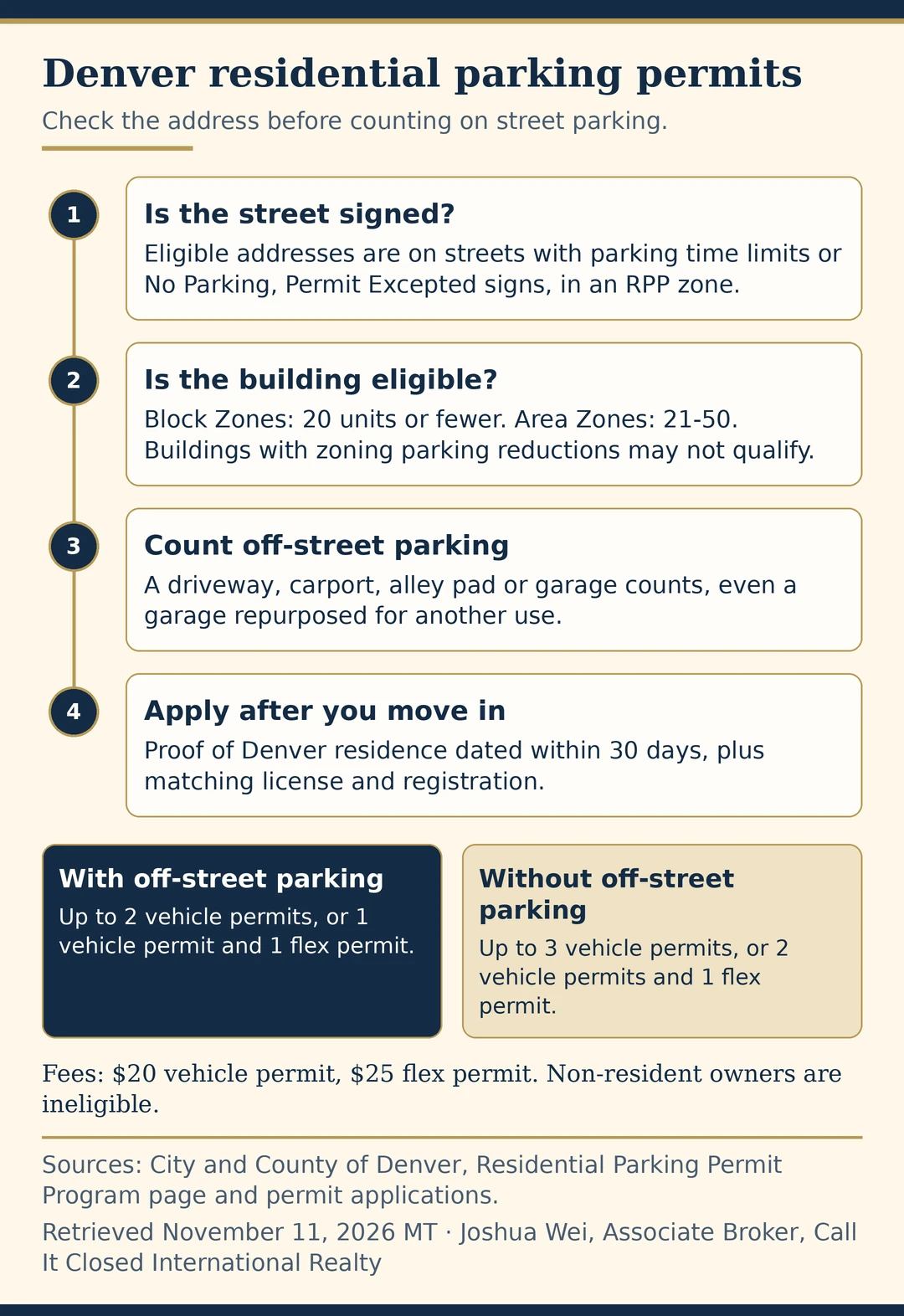
A vertical flow diagram, cream background with navy type and gold accents, titled Denver residential parking permits. Subtitle: Check the address before counting on street parking. 4 numbered steps: 1, Is the street signed?: Eligible addresses are on streets with parking time limits or No Parking, Permit Excepted signs, in an RPP zone; 2, Is the building eligible?: Block Zones: 20 units or fewer. Area Zones: 21-50. Buildings with zoning parking reductions may not qualify; 3, Count off-street parking: A driveway, carport, alley pad or garage counts, even a garage repurposed for another use; 4, Apply after you move in: Proof of Denver residence dated within 30 days, plus matching license and registration. Two cards: With off-street parking: Up to 2 vehicle permits, or 1 vehicle permit and 1 flex permit; and Without off-street parking: Up to 3 vehicle permits, or 2 vehicle permits and 1 flex permit. A note says: Fees: $20 vehicle permit, $25 flex permit. Non-resident owners are ineligible. Sources: City and County of Denver, Residential Parking Permit Program page and permit applications. Retrieved November 11, 2026 MT. Joshua Wei, Associate Broker, Call It Closed International Realty.
Sources: Denver RPP program (opens in a new tab)
Cream background, navy text, gold rules. Numbered navy circles on a gold spine with white step cards, two branch cards (navy and tan), a note, and a source footer.
The figure above shows the eligibility questions and the permit caps.
What the program is for
Denver's page says the program "is designed to improve resident parking access to their primary residence in areas near commercial, industrial, institutional, or event-based land uses." The city "establishes RPP Zones in neighborhoods and issues RPPs to more efficiently manage the public right-of-way." It also says "RPP Zones are typically implemented through a Curbside Access Plan."
The program covers blocks the city has already zoned. An address on an unsigned street isn't eligible, because eligibility depends on "Parking Time Limits or No Parking, Permit Excepted Restrictions" being posted.
Block Zones and Area Zones
The city's Rules and Regulations (opens in a new tab) for the program, adopted June 12, 2023, define the two zone types. In a Block Zone, "RPPs are only valid on the blocks (both sides of the street) where the RPP holder resides." In an Area Zone, "RPP holders can park on any block within a designated boundary." A "Block" is "One side of a street between two consecutive intersecting streets."
The rules also explain what a sign means:
- Parking Time Limits, RPP Excepted. "Valid RPP holders are exempt from non-paid parking time limits posted within an RPP Zone." Street sweeping and the 72-hour rule "still apply."
- No Parking, RPP Excepted. "Parking of a motor vehicle without a valid RPP is prohibited." On those blocks, guests without a permit can't park at all.
- Unrestricted Parking. "On-street parking with no parking time limits or RPP restrictions."
For buildings over 50 units, the rules say "Eligibility of multi-unit buildings with more than 50 addresses will be determined through the CAP process."
The rules tie eligibility to where you live. A "Primary Residence" is "The place in which a person's habitation is fixed and is the person's usual place of return," and "A person can have only one primary residence."
How the permits work day to day
Both permits are virtual. The VSPP is "issued annually and assigned to one vehicle's license plate. The license plate serves as the permit." The application PDF says "Enforcement is conducted by license plate readers" and "You will not receive a physical permit for your vehicle." Only one VSPP may be active "per licensed driver."
The FPP "may be assigned to any valid license plate selected by the permit holder." The city's page says "Physical hangtag placards are no longer issued or required for Flex Parking Permits. The FPP is now virtual and managed through your online permit portal." The mail-in Flex application, marked "Updated Jan 2025," still mentions a hang tag, so follow the program page and the portal. A Flex permit doesn't come with a VSPP: "A Flex Parking Permit (FPP) is a separate virtual permit that requires its own application and a $25 administrative fee."
How many permits can an address get?
It depends on off-street parking:
- "Off-Street Parking Available: Eligible addresses may obtain up to two (2) VSPPs or one (1) VSPP and one (1) FPP."
- "Off-Street Parking Unavailable: Eligible addresses may obtain up to three (3) VSPPs or two (2) VSPPs and one (1) FPP."
Off-street parking includes "addresses with a driveway, garage (whether used for vehicle storage or repurposed for another use), carport, or alley access (with space for a parking pad)." So a garage converted to a gym or office still counts as off-street parking for the cap.
Denver adds that "Address eligibility and maximum number of permits an address can obtain are subject to change."
For condo and apartment buyers, the definition also covers "apartment/condominium buildings with a parking lot or garage access (paid or unpaid)." If your building has a garage, the unit falls under the lower cap even if you don't rent a space in it.
What a permit doesn't do
The conditions of use printed on both applications set limits that surprise people:
- A permit "does not guarantee or imply the availability of an on-street parking space."
- Permits "are not valid at parking meters, pay stations, loading zones, or areas signed for No Parking Any Time or Street Sweeping restrictions."
- A permit "does not exempt vehicle from parking in the same space for more than 72 hours. (DRMC Sec. 54-465)." Denver's parking ordinances page (opens in a new tab) quotes that section: it's unlawful to leave a vehicle "parked in the same place on a public street continuously for a period in excess of seventy-two (72) hours."
- Permits "cannot be used on storage containers, food trucks, boats, trailers, RVs, or campers, even if attached to a permitted vehicle. They cannot be issued to large vehicles over 22 feet."
- "Unpaid/unresolved parking citations shall be grounds for denial."
- Misuse "may result in citations and/or revocation of all permits issued to the household."
The VSPP application also says a permit is valid only "on the block or within the area which the permit was issued" and doesn't "grant privileges at another location." A permit for your old address doesn't move with you.
Which addresses may not qualify?
Several situations matter for buyers:
- Larger buildings. Block Zones cover structures "consisting of 20 units/addresses or less," and Area Zones cover "21-50 units/addresses." Large multi-unit buildings "may be ineligible for RPPs when the number of units is significantly greater than the immediate on-street parking supply."
- Parking-reduced developments. "buildings, developments, and/or address that have received on-site off-street parking exemptions (or reductions) per the Denver Zoning Code may not be eligible for RPPs."
- Group living. The number of permits "is based on the address, not on the number of households or licensed drivers residing at a given address."
- ADUs. They "May be eligible" for permits "if a separate address exists for the ADU."
- Second homes. Second homeowners "May be eligible for a Flex Parking Permit only."
- Short-term rentals. They "May be eligible for Residential Parking Permits."
The city's page says the large-building problem "typically occurs within Downtown, General Urban, Multi-Unit, Residential Mixed-Use, Mixed-Use, Main Street, and Urban Center Zoning Districts," and eligibility for those buildings "will be determined though a CAP," meaning a Curbside Access Plan.
Can an investor or landlord get one?
Not for themselves. Denver says "Property Owners (not residing at the address): Are ineligible for Vehicle Specific Parking Permits and Flex Parking Permits." Tenants who live there apply with their own proof of residence. A "Fully executed lease signed and dated by all parties within the last 90 days" is on the list of proof-of-residence documents.
The applications add a limit for owners with more than one property: "Property owners that rent or temporarily reside at an address are not eligible for multiple parking permits. Only one residential property is eligible for permitting at a time."
What do I need to apply after closing?
For a VSPP, Denver asks for proof of Denver residence "dated within the last 30 days," such as a "Utility bill," a "Property tax document," or a homeowners insurance statement showing an active policy. It also asks for a Colorado driver license and vehicle registration matching the address and displaying "DENVER COUNTY."
If the car isn't in your name, the city says "the applicant will need to provide a 'permission to use' letter from the registered owner," which "must be signed, dated, and a phone number provided by the vehicle owner." The mail-in applications say "medical and financial documents are not accepted" as proof of residence, and "Post Office (PO) boxes are not acceptable."
The city lists exceptions to the Colorado license and registration rules. Non-resident college students who are at least 16, have a valid home-state license, and provide proof of full-time enrollment don't need a Colorado license or Denver registration. "Active-duty U.S. military personnel and their spouses are exempt from switching to a Colorado driver license and Colorado vehicle registration."
Moving from out of state? "Temporary Vehicle Specific Parking Permits are available only to those moving from OUT OF STATE to allow time for updating documents to Colorado." They're "valid for up to 90 days." The city adds: "Temporary Flex Parking Permits will not be issued."
Plan on time. The mail-in applications say to "Allow up to six (6) weeks for permit processing," and the city says applying online "will expedite the permit process." The city's page says "Walk-in service is not available. Residential parking permits can be applied for online or by mail only." Fees "shall be paid annually and may be prorated to the nearest full month," and "All parking permits are revocable and non-refundable." The city's Entrance Requirements (opens in a new tab) say "Permits are valid for one year from the date the permit is issued," and list "Temporary Parking Permits: $20." They also say temporary permits are "effective for a maximum of 90 days, and cannot be extended." If an application is denied, "the applicant will receive justification via email or by USPS mail if no email address was provided."
How does this fit a purchase?
Street parking isn't part of what you buy. If parking matters, look at the posted signs, ask the seller how they park, and check the address against Denver's rules before your inspection deadline. If the condo is in a newer building with reduced parking, ask the HOA whether residents can get permits.
Can a neighborhood get a zone added?
Yes, through the city's process. The page says "The establishment of RPP Zones is accomplished through a Curbside Access Plan (CAP) or Block Modification." CAPs "are typically implemented within 12-18 months." Block-based changes "Typically" include "no more than six blocks," and "Public outreach and notification are part of this process." Residents who want parking management "please submit a Denver 311 Help Center request." A buyer can't count on a zone appearing after closing.
Two hypotheticals
These are invented, to show how the caps work.
A rowhouse near a stadium with no garage. A couple buys a rowhouse on a signed block, with no driveway, garage, carport or alley pad. Under the "Off-Street Parking Unavailable" cap, the address can get up to three VSPPs, or two VSPPs and one FPP. Each of them can hold one VSPP, and the FPP covers a guest or a contractor's truck. Neither permit works on game days at meters or where No Parking Any Time is posted, and each car still has to move under the 72-hour rule.
A bungalow whose garage is a gym. A buyer with three cars buys a house on a signed block. The detached garage was converted into a home gym. Denver counts a garage "whether used for vehicle storage or repurposed for another use," so the address is under the lower cap: two VSPPs, or one VSPP and one FPP. The third car needs off-street space or unrestricted parking nearby.
Questions to ask the seller
- Do you hold a VSPP or FPP for this address now, and how many?
- Is the block a Block Zone or an Area Zone?
- Has the city told you about any planned Curbside Access Plan changes?
- For a condo: does the HOA know whether the building got a parking exemption or reduction under the zoning code?
The Entrance Requirements say permits "are provided for a permittee's residence," so the new owner applies with their own documents.
A pre-offer checklist for parking
- Photograph the signs on the block and note whether they say "Permit Excepted."
- Count the off-street spaces, including a converted garage or an alley pad.
- In a condo, ask the HOA whether the building got a zoning parking reduction and whether residents hold permits.
- If you're moving from out of state, gather documents for the temporary VSPP.
- If you're buying a rental, plan for tenants to apply themselves.
Frequently asked questions
What does a Denver RPP cost?
$20 for a Vehicle Specific Parking Permit and $25 for a Flex Parking Permit, per Denver's page.
Does my garage count against me if I don't park in it?
Yes. Denver counts a garage "whether used for vehicle storage or repurposed for another use."
Can a landlord get a permit for a rental?
No. Non-resident owners are ineligible.
Can guests use my permit?
The Flex Parking Permit is meant for guests, service providers, or additional residents' vehicles.
Are new apartment and condo buildings eligible?
Not always. Buildings with zoning parking exemptions or reductions may not be eligible.
Can I use my permit on a street-sweeping day?
No. The conditions of use say permits "are not valid" in "areas signed for No Parking Any Time or Street Sweeping restrictions."
Can I park my trailer on the street with a permit?
No. Permits "cannot be used on storage containers, food trucks, boats, trailers, RVs, or campers."
If I live in a Block Zone, can I park around the corner?
Only if that block is also part of your zone. In a Block Zone, permits are valid "only" on the blocks "(both sides of the street) where the RPP holder resides." In an Area Zone, holders "can park on any block within a designated boundary."
Where do my guests park on a "No Parking, Permit Excepted" block?
On those blocks, parking without a valid permit "is prohibited." A guest needs your Flex permit assigned to their plate, or a spot off the block.
Is there a temporary option for people moving to Denver?
Yes, a one-time temporary VSPP of up to 90 days for people moving from out of state.
Related notes
- Buying in Denver? The sidewalk fee, trash fee, and city service liens that come with the house
- Can I park my RV or trailer at home in Denver or Aurora? What buyers should check
- Buying in a Denver historic district? Landmark review, past unpermitted work, and demolition checks, explained
Sources and method
Official sources, retrieved November 11 and 13, 2026, America/Denver:
- City and County of Denver, Residential Parking Permit Program (opens in a new tab)
- Denver, Vehicle Specific Parking Permit application (opens in a new tab)
- Denver, Residential Flex Parking Permit application (opens in a new tab)
- Denver DOTI, Rules and Regulations for the Residential Parking Permit Program (opens in a new tab) (effective June 12, 2023)
- Denver DOTI, Residential Parking Permit Program Entrance Requirements (opens in a new tab)
- City and County of Denver, Parking Ordinances (opens in a new tab): section 54-465
Fees, zones, and rules are set by Denver's Department of Transportation and Infrastructure and can change. Aurora isn't covered. The hypotheticals are invented.
This note is general education from a Colorado real estate broker with Call It Closed International Realty. For an address-specific answer, contact Denver's permit office. I'm glad to help you build parking into a home search.
Disclaimer
This article is general information only. It is not legal, tax, lending, insurance, appraisal, inspection, or financial advice, and it is not a substitute for advice about your situation. Joshua Wei is a Colorado real estate broker, not an attorney. Reading this article does not create a client relationship, an agency relationship, or an attorney-client relationship with Joshua Wei or with Call It Closed International Realty.
Laws, program rules, interest rates, insurance terms, tax figures, and other details change. Examples in this article are hypothetical illustrations unless a source is named for a specific, dated figure. Information in this article is believed accurate as of November 13, 2026 and is not guaranteed. No result is promised, and you should not rely on this article as the last word for your situation.
Before you act, confirm the point with the official source linked or cited in this article, and talk with a licensed professional who can apply the rule to your facts. That may be a licensed attorney, a tax professional, a lender, an insurance agent, a home inspector, or another licensed professional, depending on the question. Links to third-party websites and publications are provided for reference only. They are not an endorsement, and their content can change.
If you already have a brokerage relationship with another broker, this is not a solicitation.
Joshua Wei, Associate Broker, Call It Closed International Realty, Colorado license FA.100108558. Equal Housing Opportunity.