November 6, 2026 · Denver · Condos · Buying · Selling · Energy
Energize Denver for condo and small-building buyers: what to ask before you buy
Energize Denver covers Denver commercial and multifamily buildings of 5,000 square feet and up, including many condo buildings. Which buildings are covered, what sellers must disclose, the city's Compliance Status Letter, penalties and liens, and questions for the HOA.
The short answer
In brief: Energize Denver is the city's building performance policy for commercial and multifamily buildings of 5,000 square feet and larger, which can include condo buildings. Under its Rules and Regulations, effective August 27, 2026, section 6 requires the owner of a covered building to disclose its compliance status and penalties to a prospective buyer before the sale.
Energize Denver is Denver's building performance policy for larger buildings, which can include condo, apartment and mixed-use buildings. The city says it "applies to commercial and multifamily buildings in Denver that are 5,000 square feet and larger."
The Energize Denver Rules and Regulations (opens in a new tab) took effect August 27, 2026. Section 6, "Disclosure Upon Sale," says the owner of a covered building "shall disclose the building’s current compliance status ... and any penalties assessed to a prospective buyer prior to the sale." The city will also issue a Compliance Status Letter on request.
I am a licensed Colorado real estate broker with Call It Closed International Realty. I am not an attorney or an energy engineer.
Disclaimer. This article is general information only. It is not legal, tax, lending, insurance, appraisal, inspection, or financial advice, and reading it does not create a client, agency, or attorney-client relationship. Laws, rates, programs, and figures change. Confirm the official source, and talk with a licensed attorney, tax professional, lender, insurance agent, or inspector before you act. Joshua Wei is a Colorado real estate broker, not an attorney. He is an Associate Broker with Call It Closed International Realty, license FA.100108558. Equal Housing Opportunity.
 Full size (opens in a new tab)
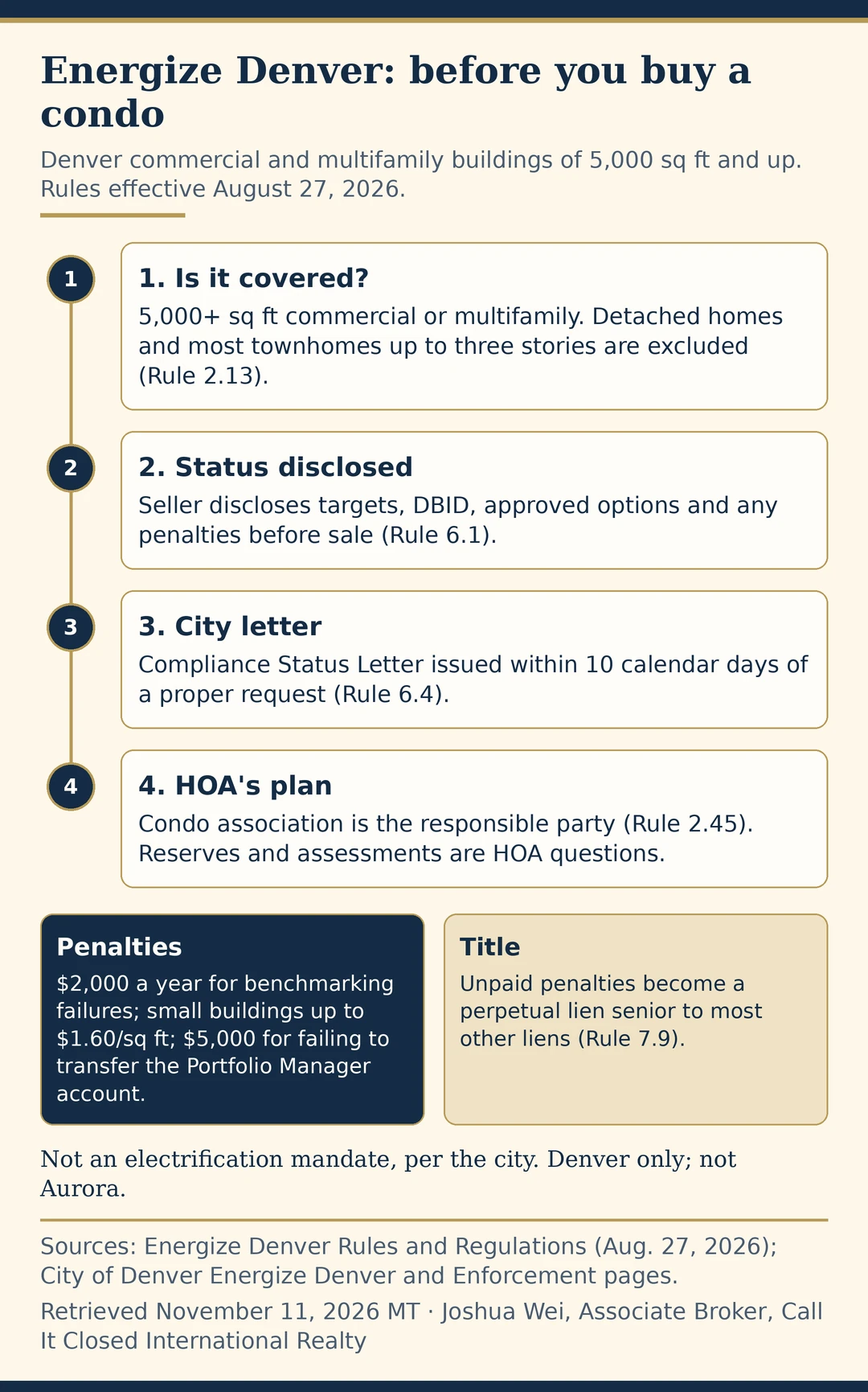
A vertical flow diagram, cream background with navy type and gold accents, titled Energize Denver: before you buy a condo. Subtitle: Denver commercial and multifamily buildings of 5,000 sq ft and up. Rules effective August 27, 2026. 4 numbered steps: 1, 1. Is it covered?: 5,000+ sq ft commercial or multifamily. Detached homes and most townhomes up to three stories are excluded (Rule 2.13); 2, 2. Status disclosed: Seller discloses targets, DBID, approved options and any penalties before sale (Rule 6.1); 3, 3. City letter: Compliance Status Letter issued within 10 calendar days of a proper request (Rule 6.4); 4, 4. HOA's plan: Condo association is the responsible party (Rule 2.45). Reserves and assessments are HOA questions. Two cards: Penalties: $2,000 a year for benchmarking failures; small buildings up to $1.60/sq ft; $5,000 for failing to transfer the Portfolio Manager account; and Title: Unpaid penalties become a perpetual lien senior to most other liens (Rule 7.9). A note says: Not an electrification mandate, per the city. Denver only; not Aurora. Sources: Energize Denver Rules and Regulations (Aug. 27, 2026); City of Denver Energize Denver and Enforcement pages. Retrieved November 11, 2026 MT. Joshua Wei, Associate Broker, Call It Closed International Realty.
Sources: Energize Denver Rules and Regulations (opens in a new tab); Energize Denver (opens in a new tab)
Cream background, navy text, gold rules. Numbered navy circles on a gold spine with white step cards, two branch cards (navy and tan), a note, and a source footer.
The figure above lays out the buyer steps in order: whether the building is covered, its compliance status, the city's letter, and the HOA's plan.
Is my building covered?
The city's Energize Denver page (opens in a new tab) splits covered buildings into "Small buildings: 5,000–24,999 square feet" and "Large buildings: 25,000 square feet and larger."
Rule 2.13 of the Rules and Regulations excludes "a detached one- or two-family dwelling or townhouse not more than three stories above grade plane height with a separate means of egress." The city can confirm whether a specific building is covered.
For a condo building, Rule 2.45 says "the responsible party shall be the association." How compliance costs reach unit owners, through dues or assessments, is a question for the HOA.
The rules also define "Owner" broadly. Rule 2.36 says it "means the person or entity having a legal or equitable interest in real property and its fixtures and appurtenances, which shall explicitly include but not be limited to a homeowner's association." Rule 2.12 defines "Common Space" as "the entire common interest development except the separate interests therein," and says it "includes any part of a building or complex that is not owned by one specific resident."
Each covered building has a Denver Building ID, or DBID. The DBID is the number to give the city when you ask about a building, and it appears in the disclosure items in Rule 6.1.
What does the policy require?
The city describes Energize Denver as "An energy efficiency requirement." It is also clear about what the policy is not: "A requirement to electrify heating or cooling systems" or "A mandate to replace HVAC equipment before the end of its useful life."
- Small buildings follow a compliance schedule in Rule 5.2. Examples: "December 31, 2027: buildings 15,000-19,999 square feet" and "December 31, 2029: buildings 5,000-9,999 square feet."
- Large buildings work toward performance targets, with a final target in 2030.
Small buildings: the prescriptive choices
Rule 5.1 applies to buildings of 5,000 to 24,999 square feet "that had received their Certificate of Occupancy or Temporary Certificate of Occupancy on or before November 22, 2021." Those owners "must complete one of the following prescriptive requirements":
- Lighting: "Certify that a minimum of ninety percent (90%) of the Covered Building's total Lighting Load is provided by LED lights, or that a minimum of ninety-seven percent (97%) of the fixtures are LED lights, or that all lighting meets 2019 Denver Building and Fire Code for Lighting Power Density."
- Renewable energy: "Utilize on- or off-site Renewable Energy generation to meet a minimum of twenty percent (20%) of the Covered Building's Annual Site Energy Usage."
- Alternate: "Meet compliance through an alternate compliance option listed in Rules Section 5.3."
The full schedule in Rule 5.2 runs by size: "December 31, 2026: buildings 20,000-24,999 square feet in Gross Floor Area," then 15,000-19,999 square feet by December 31, 2027, "December 31, 2028: buildings 10,000-14,999 square feet in Gross Floor Area," and 5,000-9,999 square feet by December 31, 2029.
Large buildings: benchmarking every year
Rule 3.1 says owners of buildings of 25,000 square feet or more "shall Benchmark the building's energy usage annually using the ENERGY STAR Portfolio Manager tool, or other platform as CASR may designate, and by June 1 each year, Owners shall accurately report energy performance information to CASR for the previous calendar year." CASR is the city's Office of Climate Action, Sustainability, and Resiliency.
The rules include options for condo associations. Under Rule 5.3.B, a small covered condo building can comply by putting LED lighting and occupancy sensors in all common spaces, and "No actions would be required for individual condominium units." Rule 4.7.D lets large condo associations apply for an adjusted target or a timeline extension. One stated reason for an extension is that "extra time is needed to raise funding through dues or special assessments."
The small-building condo option in detail
Under Rule 5.3.B, "The association or a group of condominium Owners of a Covered Building that meets the definition of a Residential Condominium may perform specific energy efficiency measures listed below in all Common Spaces." The measures are "100% of the Lighting Load of Common Spaces provided by LED lights," and "Occupancy sensors (with or without step-dimming) installed on all lighting in Common Spaces as allowed by the City and County of Denver's Building and Fire Codes." Compliance is shown with "documentation from a certified third-party lighting professional."
The large-building condo option in detail
Rule 4.7.D lets the association of a covered residential condominium building "apply to adjust their 2030 target, change the target to a prescriptive pathway, and/or extend the compliance timeline."
- Target adjustment: eligibility "is limited to Covered Buildings that meet the definition of a Residential Condominium and have a Gross Floor Area between 25,000 and 49,999 square feet," or larger condo buildings that "do not share central systems that provide hot water or space heating or cooling" to all units. Under the performance option, "The Covered Building's 2030 target can be adjusted to a 15% maximum energy reduction from the baseline year EUI."
- Timeline extension: eligibility includes a building where "the capital reserves fund is less than thirty percent (30%) of the Covered Building's Capital Reserve Study," or where extra time is needed to raise funds. The application includes "A plan and timeline for how the HOA will raise the needed funds if low capital reserves are the reason."
- Notice: an approved application "will result in a new compliance notice that will outline the adjusted performance timeline or target, the list of prescriptive projects to be completed, deadlines," and "penalties that may be assessed if the plan is not completed as approved."
That notice is a document to ask the HOA for.
Rule 4.7.E describes a separate 2025 option: "The extension will shift the 2024 target to 2028, eliminate the 2027 target, and shift the 2030 target to 2032." Whether a building took it is a question for the HOA or the city.
What does the seller have to disclose?
Section 6 of the rules covers this.
- Rule 6.1: compliance status, "including all performance targets, DBID, any approved alternate compliance options documentation, and any penalties assessed."
- Rule 6.3: disclosure "in all documentation or advertising concerning the sale of the building including, but not limited to, any listings, notices, advertisements of sale, term sheets, and contracts of sale."
- Rule 6.2: buildings of 25,000 square feet or more must also transfer the ENERGY STAR Portfolio Manager account "to the buyer at the time of sale."
The rules refer to "the sale of the building." How they apply when one condo unit sells is a question for the city or a Colorado real estate attorney; the HOA is the responsible party under Rule 2.45.
How do I get the Compliance Status Letter?
Under Rule 6.4, the city's letter will "Be issued within ten (10) calendar days of a properly-made request by the buyer, Owner, or their representatives." Contract deadlines are set in each purchase contract.
Rule 6.4.B says the letter will "Include a summary of CASR's records on the Covered Building's compliance status with D.R.M.C. section 10-403 through section 10-405." Rule 6.5 adds that "the compliance status letter or other instrument transferring the same information will serve as the primary documents required for compliance disclosure at the time of sale."
The city's policy page describes another route: "You can satisfy this disclosure requirement with a screenshot from the city's Look Up Tools. Capture the full record for your building and share it with prospective buyers. If the building has an approved timeline extension, include the compliance plan as well." It says "Owners, buyers, and their representatives can also request a compliance status letter," and "Letters are issued within 10 calendar days of a submitted request."
What happens when a building is out of compliance?
The city's enforcement page (opens in a new tab) says a Notice of Violation comes first, and "Upon receiving an NOV, a 90-calendar-day cure period begins automatically." Penalties under Section 7 of the rules include:
- "A two thousand dollar ($2,000) civil penalty may be assessed annually" for benchmarking failures.
- For small buildings, "up to one dollar and sixty cents ($1.60) per square foot of Gross Floor Area" for failing to certify compliance.
- "A five thousand dollar ($5,000) civil penalty" for failing to transfer the Portfolio Manager account to a new owner.
Under Rule 7.9, unpaid penalties become "a perpetual lien on the property, and will be superior and prior to all other liens, regardless of their dates of recordation, except for liens for general taxes and prior special assessments, until the civil penalty owed, delinquent interest, and recording fees have been paid in full." Whether any lien is recorded against a property is a question for the title company.
The enforcement timeline, step by step
The enforcement page lays out the sequence:
- Notice of Violation: "Receiving an NOV does not mean you have been fined." It "serves as an official notice to take action."
- Pausing the clock: "Submitting a complete Timeline Extension, ACO, or CAP application pauses (tolls) your 90-day clock while the city reviews your request." For large buildings, the listed options include a "Residential Condominium Option with a Timeline Extension."
- Citation: "If the 90-day cure period expires without resolving the non-compliance or establishing an approved alternative plan, CASR will officially issue an Administrative Citation." The page says: "Once you receive the citation, you have 30 days to appeal the citation."
- Payment deadlines: 30 calendar days for "Administrative and reporting violations (e.g., benchmarking, data verification, or failure to transfer Portfolio Manager accounts upon sale)," which "are not eligible for penalty reinvestment." For energy efficiency violations, "Full payment is due within 180 calendar days from the date of the Administrative Citation."
- Penalty reinvestment: "Building owners can apply to redirect 40% to 80% of their civil penalties directly back into building energy efficiency improvements rather than paying the full fine to the city."
- Lien: "Unpaid civil penalties or defaulted reinvestment plans 180 days after the citation was issued result in a perpetual property lien attached to the building's title until all penalties, interest, and recording fees are settled in full."
For a buyer, the questions are where the building sits in that sequence and whether any reinvestment plan is under way. The page says that if an owner defaults on an approved reinvestment plan, "The original 100% civil penalty becomes immediately due, minus any cash payments already remitted during Phase 1."
Questions buyers can bring to the HOA or seller
- Is the building covered, and what's its square footage and DBID?
- Is benchmarking current?
- Which target or prescriptive path applies, and by what date?
- Has the association applied for, or been approved for, a condo option or timeline extension?
- Have there been any notices of violation, citations or penalties?
- Does the reserve study or budget include the planned work? Has a special assessment been discussed?
- Can I see the city's Look Up Tool record or a Compliance Status Letter, and any compliance notice for an approved option?
- For a building of 25,000 square feet or more, was the June 1 benchmarking report filed?
- Is there a reinvestment plan under way, and what are its deadlines?
An invented example
This example is invented; the building, the HOA and the numbers are not real.
A buyer is under contract on a unit in a 12,000-square-foot Denver condo building. Under Rule 5.2, a building of that size has a December 31, 2028 date. The buyer's agent asks the HOA for its plan, and the buyer requests a Compliance Status Letter. The letter arrives within the ten days and shows no penalties. The HOA's board minutes show it chose the Rule 5.3.B condo option: LED lighting and occupancy sensors in all of the building's Common Spaces, with no work inside units. The buyer reads the budget to see whether the lighting work is funded from reserves or from a proposed special assessment, and asks her attorney how the Section 6 disclosure applies to a single-unit sale.
A buyer's checklist
- Confirm the size and coverage of the building with the city, using its DBID.
- Get the record: a Look Up Tool screenshot or a Compliance Status Letter.
- Find the deadline under Rule 5.2 or the large-building targets.
- Ask for any compliance notice for an approved condo option or extension.
- Ask about notices, citations and penalties, and any reinvestment plan.
- Read the reserve study and budget for the planned work.
- Ask the title company about any recorded lien.
Frequently asked questions
Does Energize Denver apply to my single-family house?
Rule 2.13 excludes detached one- or two-family dwellings, and townhouses up to three stories with a separate means of egress.
Does Energize Denver require me to switch my condo to electric heat?
The city says Energize Denver is not "A requirement to electrify heating or cooling systems."
Who's responsible in a condo building?
Rule 2.45 says "the responsible party shall be the association."
How fast does the city issue a Compliance Status Letter?
Within ten calendar days of a properly made request, under Rule 6.4.
Can an unpaid penalty affect title?
Rule 7.9 makes unpaid penalties a lien on the property "until the civil penalty owed, delinquent interest, and recording fees have been paid in full." Title questions go to the title company.
Does a condo owner have to upgrade inside the unit?
For the small-building condo option, Rule 5.3.B says "No actions would be required for individual condominium units." Requirements under other paths depend on the building's plan.
Can the HOA challenge a city decision?
Rule 5.6 allows a request for review of a Pre-compliance Decision. It "must be submitted in writing within thirty (30) calendar days from the date the initial CASR decision notice was issued."
Does Energize Denver apply in Aurora?
Energize Denver is a City and County of Denver policy.
Related notes
- Buying a Denver or Aurora condo: read the building before you price the unit
- Who oversees Colorado HOAs? What the state HOA Center can and can't do for Denver and Aurora owners and buyers
- A metro district is not an HOA: how Denver and Aurora buyers can tell them apart
Sources and method
Official sources, retrieved November 11, 2026, America/Denver:
- Energize Denver Rules and Regulations (effective August 27, 2026) (opens in a new tab), Rules 2.13, 2.45, 4.7.D, 5.2, 5.3.B, 6.1–6.4, 7.6, 7.9
- City and County of Denver, Energize Denver Building Performance Policy (opens in a new tab)
- City and County of Denver, Energize Denver Enforcement Details (opens in a new tab)
Added November 13, 2026: further passages of the Rules and Regulations (opens in a new tab) (Rules 2.12, 2.36, 3.1, 4.7.D, 4.7.E, 5.1, 5.2, 5.3.B, 5.6, 6.4.B, 6.5), the city's Energize Denver page (opens in a new tab) (selling a building, Look Up Tools) and the enforcement page (opens in a new tab) (NOV, tolling, citation, payment deadlines, penalty reinvestment, lien).
Quotations are verbatim. The rules can change through public hearing, so check the current version before you rely on it. I did not review the ordinance text itself, because the city's ordinance page did not load for my fetcher.
This note is general education from a Colorado real estate broker with Call It Closed International Realty. If you're buying or selling a condo in a Denver building of 5,000 square feet or more, I'll help you get the right documents early and bring in an attorney where needed.
Disclaimer
This article is general information only. It is not legal, tax, lending, insurance, appraisal, inspection, or financial advice, and it is not a substitute for advice about your situation. Joshua Wei is a Colorado real estate broker, not an attorney. Reading this article does not create a client relationship, an agency relationship, or an attorney-client relationship with Joshua Wei or with Call It Closed International Realty.
Laws, program rules, interest rates, insurance terms, tax figures, and other details change. Examples in this article are hypothetical illustrations unless a source is named for a specific, dated figure. Information in this article is believed accurate as of November 13, 2026 and is not guaranteed. No result is promised, and you should not rely on this article as the last word for your situation.
Before you act, confirm the point with the official source linked or cited in this article, and talk with a licensed professional who can apply the rule to your facts. That may be a licensed attorney, a tax professional, a lender, an insurance agent, a home inspector, or another licensed professional, depending on the question. Links to third-party websites and publications are provided for reference only. They are not an endorsement, and their content can change.
If you already have a brokerage relationship with another broker, this is not a solicitation.
Joshua Wei, Associate Broker, Call It Closed International Realty, Colorado license FA.100108558. Equal Housing Opportunity.