October 30, 2026 · Denver · Aurora · Selling · Taxes
Selling a Colorado home from out of state or abroad? FIRPTA and Colorado withholding at closing, explained
Two different withholding rules can take money out of a seller's proceeds at a Denver or Aurora closing. One is federal FIRPTA for foreign sellers. The other is Colorado withholding for sellers with an out-of-state address. What the IRS, Colorado statute, the Department of Revenue, and the purchase contract say.
The short answer
In brief: Two separate withholding rules can apply when a Colorado home is sold. The IRS says buyers of U.S. real property from foreign persons, and certain agents and settlement officers, must withhold 15% of the amount realized under FIRPTA. Colorado's C.R.S. 39-22-604.5 separately requires withholding of 2% of the sales price or net proceeds, whichever is less, in situations it describes.
Two separate rules can apply.
- Federal FIRPTA, for foreign sellers. The IRS FIRPTA Withholding page (opens in a new tab) says buyers of U.S. real property from foreign persons, "certain purchasers' agents, and settlement officers are required to withhold 15% (10% for dispositions before Feb. 17, 2016) of the amount realized on the disposition."
- Colorado withholding, for sellers with an out-of-state address. C.R.S. 39-22-604.5(1) requires the closing and settlement service to withhold "an amount equal to two percent of the sales price of the Colorado real property interest conveyed or the net proceeds resulting from such conveyance, whichever is less." This applies in the situations the statute describes, such as a seller with "a last-known street address outside the boundaries of this state."
Both have exceptions. The two rules are independent. A foreign seller who also has an out-of-state address can be subject to both in the same closing, with one amount remitted to the IRS and another remitted to the Colorado Department of Revenue, unless a separate exception or affirmation applies to each. Whether either rule or any exception applies to a particular seller is a question for a tax advisor.
I am a licensed Colorado real estate broker with Call It Closed International Realty. I am not providing tax or legal advice. I am not an attorney.
Disclaimer. This article is general information only. It is not legal, tax, lending, insurance, appraisal, inspection, or financial advice, and reading it does not create a client, agency, or attorney-client relationship. Laws, rates, programs, and figures change. Confirm the official source, and talk with a licensed attorney, tax professional, lender, insurance agent, or inspector before you act. Joshua Wei is a Colorado real estate broker, not an attorney. He is an Associate Broker with Call It Closed International Realty, license FA.100108558. Equal Housing Opportunity.
 Full size (opens in a new tab)
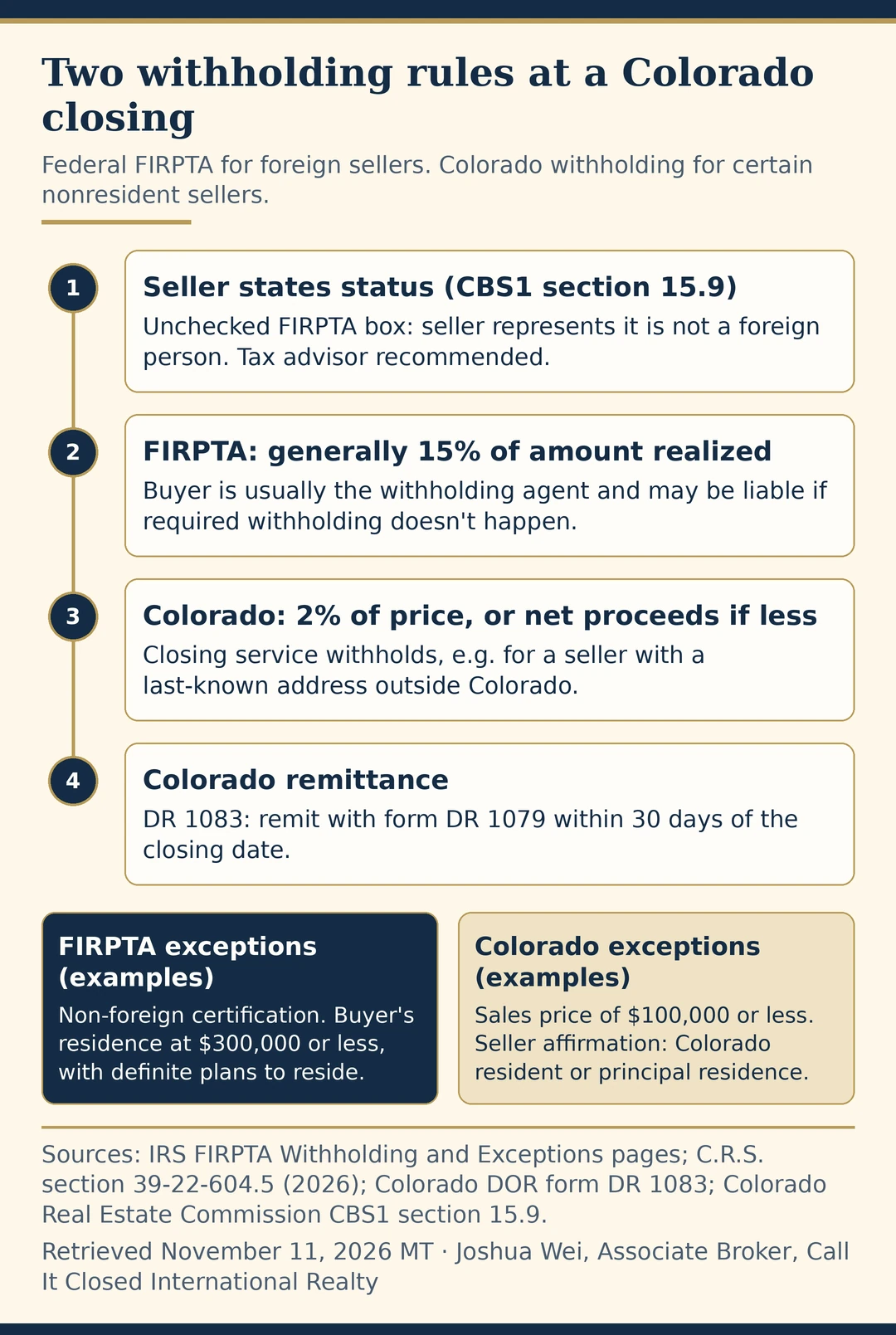
A vertical flow diagram, cream background with navy type and gold accents, titled Two withholding rules at a Colorado closing, with the subtitle federal FIRPTA for foreign sellers and Colorado withholding for certain nonresident sellers. Four numbered steps: 1, seller states status under CBS1 section 15.9, where an unchecked FIRPTA box means the seller represents it is not a foreign person, and a tax advisor is recommended; 2, FIRPTA, generally 15 percent of amount realized, where the buyer is usually the withholding agent and may be liable if required withholding does not happen; 3, Colorado, 2 percent of the sales price or the net proceeds if less, where the closing service withholds, for example for a seller with a last-known address outside Colorado; 4, Colorado remittance, where DR 1083 says to remit with form DR 1079 within 30 days of the closing date. Two lower cards: FIRPTA exceptions, examples include a non-foreign certification and a buyer's residence at 300,000 dollars or less with definite plans to reside; and Colorado exceptions, examples include a sales price of 100,000 dollars or less and a seller affirmation of Colorado residency or principal residence. Sources: IRS, Colorado Revised Statutes, Colorado Department of Revenue, Colorado Real Estate Commission. Retrieved November 11, 2026 MT.
Sources: IRS FIRPTA (opens in a new tab); Colorado DR 1083 (opens in a new tab)
Cream background, navy text, gold rules. Four numbered steps on a gold spine, two side-by-side cards, and a 28px source footer.
The diagram above sets the federal and Colorado rules side by side. It summarizes the official sources in this article and isn't a substitute for tax advice.
What does the Colorado contract say?
The Colorado Real Estate Commission's residential contract (CBS1), on the DRE contracts and forms page (opens in a new tab), addresses both rules in section 15.9.
Section 15.9.1 (FIRPTA): "The Internal Revenue Service (IRS) may require a substantial portion of the Seller's proceeds be withheld after Closing when Seller is a foreign person. If required withholding does not occur, the Buyer could be held liable for the amount of the Seller's tax, interest and penalties."
The seller represents their status by a checkbox. Section 15.9.1 says: "If the box in this Section is not checked, Seller represents that Seller is not a foreign person for purposes of U.S. income taxation."
Section 15.9.2 (Colorado): "The Colorado Department of Revenue may require a portion of the Seller's proceeds be withheld after Closing when Seller will not be a Colorado resident after Closing, if not otherwise exempt."
Both subsections say: "Seller should inquire with Seller's tax advisor to determine if withholding applies or if an exemption exists."
Both also say: "Seller agrees to cooperate with Buyer and Closing Company to provide any reasonably requested documents to verify Seller's" status, and "If withholding is required, Seller authorizes Closing Company to withhold such amount from Seller's proceeds." Section 15.9.1 adds the checked-box meaning: "If the box in this Section is checked, Seller represents that Seller IS a foreign person for purposes of U.S. income taxation." The contract is on the 2026 CBS1 PDF (opens in a new tab).
Note the wording. CBS1 section 15.9.2 describes the Colorado rule as applying "when Seller will not be a Colorado resident after Closing." The statute's trigger for a person is an address test: funds disbursed "to a transferor with a last-known street address outside the boundaries of this state at the time of the transfer of the title." The two describe the trigger differently. Ask your tax advisor and the closing company which facts they will use.
Who is responsible for FIRPTA withholding?
The IRS says: "In most cases, the buyer (transferee) is the withholding agent. The transferee must find out if the transferor is a foreign person. If the transferor is a foreign person and the transferee fails to withhold, the transferee may be held liable for the tax."
How much is withheld, and when is it sent?
The IRS Instructions for Form 8288 (opens in a new tab) (rev. January 2026) describe a reduced rate: "Withholding is required at a reduced rate of 10% in the case of a disposition of: A property that is acquired by the transferee for use by the transferee as a residence, and The amount realized for the property is $1 million or less." Below that, the $300,000 residence exception described next applies.
If the amount realized is more than $1 million, the 15 percent rate applies to the entire amount realized, even if the buyer will use the property as a residence. The Form 8288 instructions tell the filer to use the 15 percent line and to "Include withholding for the purchase of a residence with an amount realized of more than $1 million." The Internal Revenue Code, at 26 U.S.C. 1445(c)(4), allows the 10 percent rate only for a disposition "of property which is acquired by the transferee for use by the transferee as a residence," "with respect to which the amount realized for such property does not exceed $1,000,000," and to which the $300,000 residence exception does not already apply. Because that reduced rate is for use by the transferee as a residence, a buyer taking title in an LLC, a trust, or another entity should not rely on it. The individual-buyer rule for the $300,000 exception is quoted in the next section.
The instructions define "amount realized" as "The sum of the cash paid or to be paid (not including interest or original issue discount), the fair market value of other property transferred or to be transferred, and the amount of any liability assumed by the transferee or to which the USRPI is subject immediately before and after the transfer." They add: "Generally, the amount realized for purposes of this withholding is the sales or contract price."
On timing: "A transferee must file Form 8288 and transmit the tax withheld to the IRS by the 20th day after the date of transfer." And: "You must withhold even if an application for a withholding certificate is or has been submitted to the IRS on the date of transfer."
Who is an "agent" and a "qualified substitute"?
The instructions define an agent as "any person who represents the transferor or transferee in any negotiation with another person (or another person's agent) relating to the transaction or in settling the transaction." A qualified substitute is "The person (including any attorney or title company) responsible for closing the transaction, other than the transferor's agent; and The transferee's agent."
Under "Liability of Agents," if an agent "knows the document is false, the agent (or substitute) must notify you. If notification is not provided, the agent (or substitute) will be liable for the tax that should have been withheld, but only to the extent of the agent's (or substitute's) compensation from the transaction." The instructions also say a person is not treated as an agent if they only perform listed acts, including "Receiving and disbursing any part of the consideration," "Recording any document," and "Transmitting documents between the parties."
Which FIRPTA exceptions does the IRS list?
The IRS Exceptions from FIRPTA Withholding page (opens in a new tab) lists, among others:
- Certification of non-foreign status. "The seller (transferor) gives the transferee a certification stating, under penalties of perjury, that the transferor is not a foreign person."
- Buyer's residence at $300,000 or less. "The buyer (transferee) acquires the property for use as a residence and the amount realized (sales price) is not more than $300,000." The buyer or family must have "definite plans to reside at the property for at least 50% of the number of days the property is used by any person during each of the first two 12-month periods following the date of transfer." The same IRS page adds: "When counting the number of days that the property is used, do not count the days the property will be vacant. For this exception, the transferee must be an individual." The Form 8288 instructions say: "Do not take into account the number of days the property will be vacant in making this determination." They also say: "However, if you do not in fact use the property as a residence, the withholding tax may be collected from you." And: "However, this exception does not apply if the actual transferee (buyer) is not an individual, even if the property is acquired for an individual." A buyer taking title in an LLC, a trust, or another entity should not rely on this exception, even if an individual will live in the home.
The IRS also notes the certifications "are not effective if the transferee (or the qualified substitute) has actual knowledge or receives a notice from an agent (or substitute), that the certifications are false."
What goes in a certification of non-foreign status?
The Form 8288 instructions say: "Generally, no withholding is required if you receive a certification of nonforeign status from the transferor, signed under penalties of perjury, stating that the transferor is not a foreign person and containing the transferor's name, address, and TIN (social security number (SSN) or employer identification number (EIN))." They add: "A certification of nonforeign status includes a valid Form W-9 submitted by the transferor." The seller can give it to a qualified substitute, such as the closing company, which then gives the buyer "a statement, under penalties of perjury, that the certification is in the qualified substitute's possession."
For an LLC that is a disregarded entity: "A disregarded entity may not certify that it is the transferor for U.S. tax purposes. Rather, the owner of the disregarded entity is treated as the transferor of the property and must provide the certificate of nonforeign status to avoid withholding under section 1445."
If a false certification comes to light after closing: "you do not have to withhold on consideration paid before you received the notice. However, you must withhold the full 15% of the amount realized from any consideration that remains to be paid, if possible."
What are the Colorado exceptions?
Under C.R.S. 39-22-604.5(2), withholding isn't required "If the sales price of the Colorado real property conveyed does not exceed one hundred thousand dollars." The statute also describes written affirmations by the seller that a closing service may rely on in good faith. Two of the listed items are "That the transferor, if a person, is a resident of Colorado" and "That the Colorado real property being conveyed is the principal residence of the transferor."
The Department of Revenue's form DR 1083 (opens in a new tab) (rev. 10/01/25) says required withholding "must be remitted with form DR 1079 within 30 days of the closing date."
The form's principal-residence affirmation is narrower than the statute's two words "principal residence." Under "Affirmation of Principal Residence," the transferor must state that "immediately prior to the transfer it was my (our) principal residence which could qualify for the exclusion of gain provision of section 121 of the Internal Revenue Code." The form is "Signed under the penalty of perjury." Whether a particular sale qualifies under section 121 of the Internal Revenue Code is a question for a tax advisor. Do not sign this affirmation just because the house felt like a main home.
The full statutory list in (2)(c) has four affirmations: "(I) That the transferor, if a person, is a resident of Colorado; (II) That the transferor, if a corporation, has a permanent place of business in Colorado; (III) That the Colorado real property being conveyed is the principal residence of the transferor; or (IV) That the transferor will not owe tax reasonably estimated to be due pursuant to this article from the inclusion of the actual gain required to be recognized on the transaction in the gross income of the transferor." Subsection (2)(b) adds a foreclosure exception, for a lender that acquires the property "in judicial or nonjudicial foreclosure or by deed in lieu of foreclosure."
What DR 1083 adds
DR 1083 (rev. 10/01/25) lists five affirmations on its second page, one more than the statute: "4. The transferor is a partnership under section 761(a) of the Internal Revenue Code." The statute's (2)(c) list does not include a partnership item. Both are quoted here as written; ask the Department of Revenue or your tax advisor how the partnership item applies.
DR 1083 also says:
- Who must withhold: "anyone who provides closing and settlement services for the conveyance of a Colorado real property interest must comply with certain withholding and reporting requirements."
- How the address is read: withholding applies "if their last-known street address is outside Colorado at the time of the title transfer, as indicated by either of the following: • The IRS Form 1099-S for the transfer; or • The authorization for the disbursement of the funds resulting from the transaction."
- Credit: "Amounts withheld and remitted to the Department may be claimed by the transferor as a credit against tax on their Colorado income tax return for the tax year in which the transfer occurred."
- Spouses: "If the transferors are spouses at the time of closing, who held the property as joint tenants, tenants by the entirety, tenants in common, or as community property, treat them as a single transferor."
- Filing: "The withholding agent must file any required form DR 1083 within 30 days of the closing date of the transaction."
The 2026 DR 1079 payment form (opens in a new tab) says the payment "will be credited to the Colorado income tax account of the transferor, similar to wage withholding," and that "The transferor must claim credit for the payment on the Colorado income tax return." It also tells the filer to write "2026 DR 1079" on the check or money order. Use the payment form for the year of the closing; the 2025 DR 1083 information form (rev. 10/01/25) remains the current information form as of November 17, 2026.
What if the closing company doesn't withhold?
Subsection (3) says a title insurance company or its agent that fails to withhold "shall be liable for the greater of the following amounts for such failure to withhold: (a) Five hundred dollars; (b) Ten percent of the amount required to be withheld pursuant to this section, not to exceed two thousand five hundred dollars."
An invented example
This example is invented; it is not a real sale, and it is not tax advice.
A seller who moved to Arizona two years ago sells a Denver rental for $520,000. Her disbursement instructions list her Arizona street address. She is a U.S. citizen, so she signs a certification of non-foreign status, and the closing company keeps it as qualified substitute. In this invented fact pattern, federal FIRPTA withholding does not arise; only the Colorado rule is in play. A foreign seller with an out-of-state address could face both. On the Colorado side, the out-of-state address brings her within subsection (1)(a) unless an exception or affirmation applies. Two percent of $520,000 is $10,400. If her net proceeds were lower than that, the lesser amount would apply. The house is not her principal residence. Her tax advisor reviews whether the "will not owe tax" affirmation in (2)(c)(IV) fits her numbers. If no affirmation is signed, the closing company withholds and remits with DR 1079 within 30 days, and she claims the credit on her Colorado return.
A seller's checklist
- Tell the closing company early if you are a foreign person, or if your address will be outside Colorado at closing.
- Check the CBS1 section 15.9.1 box carefully; an unchecked box is a representation that you are not a foreign person.
- Ask your tax advisor whether an IRS exception, a withholding certificate, or a Colorado affirmation fits.
- If applying for a withholding certificate, note the IRS says a transferor "must notify the transferee in writing that the certificate has been applied for on the day of or the day prior to the transfer."
- Get copies of Form 8288-A, DR 1083 and DR 1079 for your tax return.
Who answers which question?
- Whether FIRPTA or Colorado withholding applies, and whether an exception or affirmation fits: a tax advisor. CBS1 section 15.9 itself says the seller "should inquire with Seller's tax advisor."
- How withholding is handled at closing and remitted: the closing company.
- Contract questions about the section 15.9 checkbox: a Colorado real estate attorney.
Frequently asked questions
Is FIRPTA a tax or a withholding?
The IRS says a disposition by a foreign person "is subject to the Foreign Investment in Real Property Tax Act of 1980 (FIRPTA) income tax withholding." In its FAQ it says a disposition "should be reported, for income tax purposes, in the year the disposition occurred." How it applies to a particular sale is a question for a tax advisor.
Does Colorado withholding apply if I'm moving out of state?
C.R.S. 39-22-604.5 ties it to situations like a seller with "a last-known street address outside the boundaries of this state." The statute's affirmations include one for a principal residence. Whether it fits a particular sale is a question for a tax advisor.
Who sends the Colorado withholding to the state?
The statute puts the duty on the closing and settlement service. DR 1083 says remittance is "with form DR 1079 within 30 days of the closing date."
What does the IRS say about joint sellers?
The IRS says that when foreign and U.S. persons sell jointly, "the amount realized is allocated among the transferors based on their capital contributions," and "a husband and wife are treated as having contributed 50% each." How that allocation applies to a particular sale is a question for a tax advisor.
The $300,000 residence exception is different: it is tested against the total amount realized, not each seller's share. In FAQ 17 on the IRS FIRPTA Withholding page, the IRS says a foreign seller "would not be exempt from FIRPTA withholding in the situation where the transferee intended to use the USRPI as a residence and the amount realized on a disposition of a USRPI is greater than $300,000 but each of the transferors' allocable portions of the amount realized is $300,000 or less." It explains that "amount realized" is "the sum of the total cash paid by the transferee, the total fair market value of property transferred by the transferee, and the total amount of debt or liability assumed by the transferee and not each transferors' allocable portion of the amount realized." And: "Therefore, if the amount realized on the disposition is greater than $300,000, this specific exemption is not applicable."
Can the withholding be reduced?
The IRS describes withholding certificates. For example, it says a nonresident alien "may request a withholding certificate" when withholding could exceed the tax. The IRS withholding certificates page (opens in a new tab) says "The IRS will generally act on these requests within 90 days after receipt of a complete application including the Taxpayer Identification Numbers (TIN's) of all the parties to the transaction." It lists grounds including that "The amount that must be withheld would be more than the transferor's maximum tax liability." Whether to request one is a question for a tax advisor.
Does Colorado withholding apply to a sale under $100,000?
No. Under C.R.S. 39-22-604.5(2)(a), withholding is not required "If the sales price of the Colorado real property conveyed does not exceed one hundred thousand dollars." DR 1083 says the form itself is not required when "The sales price, as defined above, is $100,000 or less."
Is the Colorado withholding the same as the tax owed?
No. DR 1079 describes it as a payment "credited to the Colorado income tax account of the transferor, similar to wage withholding." The seller claims it on the Colorado return. What tax is owed is a question for a tax advisor.
Does my broker decide whether withholding applies?
CBS1 section 15.9 points sellers to their own tax advisor. The IRS also describes a duty for agents who have "actual knowledge" that a certification is false.
Related notes
- Why you can't bring a personal check to closing: Colorado's good funds law for Denver and Aurora buyers and sellers
- The TD-1000 and Colorado's documentary fee: two closing items Denver and Aurora buyers ask about
- Closing costs in Denver and Aurora: what is set by law, what is negotiated, and what to read on the forms
Sources and method
Official sources, retrieved November 11, 2026, and rechecked November 17, 2026, America/Denver:
- IRS: FIRPTA Withholding (opens in a new tab) (including FAQ 17) and Exceptions from FIRPTA Withholding (opens in a new tab)
- IRS Instructions for Form 8288 (opens in a new tab) (rev. January 2026) and withholding certificates page (opens in a new tab)
- 26 U.S.C. 1445 (opens in a new tab) (2024 official compilation), including 1445(b)(5) and 1445(c)(4)
- Colorado Revised Statutes 2026, Title 39 (opens in a new tab), section 39-22-604.5
- Colorado Department of Revenue, DR 1083 (opens in a new tab) (rev. 10/01/25) and 2026 DR 1079 (opens in a new tab)
- Colorado Real Estate Commission CBS1 section 15.9 (DRE contracts and forms (opens in a new tab)); 2026 CBS1 contract PDF (opens in a new tab)
Added November 13, 2026: the full text of C.R.S. 39-22-604.5(1)–(6) (Title 39 (opens in a new tab)); the 2026 CBS1 contract PDF section 15.9; the IRS Instructions for Form 8288 and withholding certificates page; and further passages of DR 1083 and DR 1079. Rechecked November 17, 2026, against those same official sources, plus 26 U.S.C. 1445 and the 2026 DR 1079 payment form. The dollar figures in the example are invented.
The Colorado Department of Revenue's HTML pages returned errors to my automated check, so this article relies on the statute and the DR 1083 PDF. Quotations are verbatim.
This note is general education from a Colorado real estate broker with Call It Closed International Realty. If you're selling from out of state or abroad, I can help coordinate the timeline with your closing company and your tax advisor.
Disclaimer
This article is general information only. It is not legal, tax, lending, insurance, appraisal, inspection, or financial advice, and it is not a substitute for advice about your situation. Joshua Wei is a Colorado real estate broker, not an attorney. Reading this article does not create a client relationship, an agency relationship, or an attorney-client relationship with Joshua Wei or with Call It Closed International Realty.
Laws, program rules, interest rates, insurance terms, tax figures, and other details change. Examples in this article are hypothetical illustrations unless a source is named for a specific, dated figure. Information in this article is believed accurate as of November 17, 2026 and is not guaranteed. No result is promised, and you should not rely on this article as the last word for your situation.
Before you act, confirm the point with the official source linked or cited in this article, and talk with a licensed professional who can apply the rule to your facts. That may be a licensed attorney, a tax professional, a lender, an insurance agent, a home inspector, or another licensed professional, depending on the question. Links to third-party websites and publications are provided for reference only. They are not an endorsement, and their content can change.
If you already have a brokerage relationship with another broker, this is not a solicitation.
Joshua Wei, Associate Broker, Call It Closed International Realty, Colorado license FA.100108558. Equal Housing Opportunity.