October 4, 2026 · Denver · Aurora · Homeownership · Financing
When can you drop PMI? What the Homeowners Protection Act says for Denver and Aurora homeowners, and how FHA differs
Federal law gives homeowners with covered loans the right to cancel private mortgage insurance at 80% of original value, with automatic termination at 78%. What 12 U.S.C. 4901–4902 and the CFPB say, what "original value" means, and how FHA mortgage insurance follows different HUD rules.
The short answer
In brief: Under the federal Homeowners Protection Act, borrowers with covered loans can ask to remove private mortgage insurance once the balance reaches 80 percent of the home's original value, and the servicer must end it automatically when the balance is scheduled to reach 78 percent, or at the loan's midpoint, if payments are current. FHA mortgage insurance follows separate HUD rules.
If you bought a Denver or Aurora home with a conventional loan and a small down payment, you may be paying private mortgage insurance (PMI). The CFPB's What is private mortgage insurance? (opens in a new tab) page notes that "PMI protects the lender—not you—if you stop making payments on your loan." Federal law sets when it has to end. The Consumer Financial Protection Bureau's page When can I remove private mortgage insurance (PMI) from my loan? (opens in a new tab) puts it this way: "You have the right to remove PMI for many mortgages, once you have paid down your mortgage to a specified point."
Under the Homeowners Protection Act, the three dates that matter are:
- 80% by request. "You have the right to ask your servicer to cancel PMI on the date the principal balance of your mortgage is scheduled to fall to 80 percent of the original value of your home."
- 78% automatically. The CFPB says that "in general, your servicer must automatically terminate PMI on the date when your principal balance is scheduled to reach 78 percent of the original value of your home," if you are current on payments.
- The midpoint. "Your lender or servicer must end the PMI the month after you reach the midpoint of your loan's amortization schedule," again if you are current.
FHA loans are different. Their mortgage insurance follows HUD rules, not the Homeowners Protection Act.
I am a licensed Colorado real estate broker with Call It Closed International Realty. I am not a lender, loan officer, or attorney. Your servicer and your loan documents control the details for your loan.
Disclaimer. This article is general information only. It is not legal, tax, lending, insurance, appraisal, inspection, or financial advice, and reading it does not create a client, agency, or attorney-client relationship. Laws, rates, programs, and figures change. Confirm the official source, and talk with a licensed attorney, tax professional, lender, insurance agent, or inspector before you act. Joshua Wei is a Colorado real estate broker, not an attorney. He is an Associate Broker with Call It Closed International Realty, license FA.100108558. Equal Housing Opportunity.
 Full size (opens in a new tab)
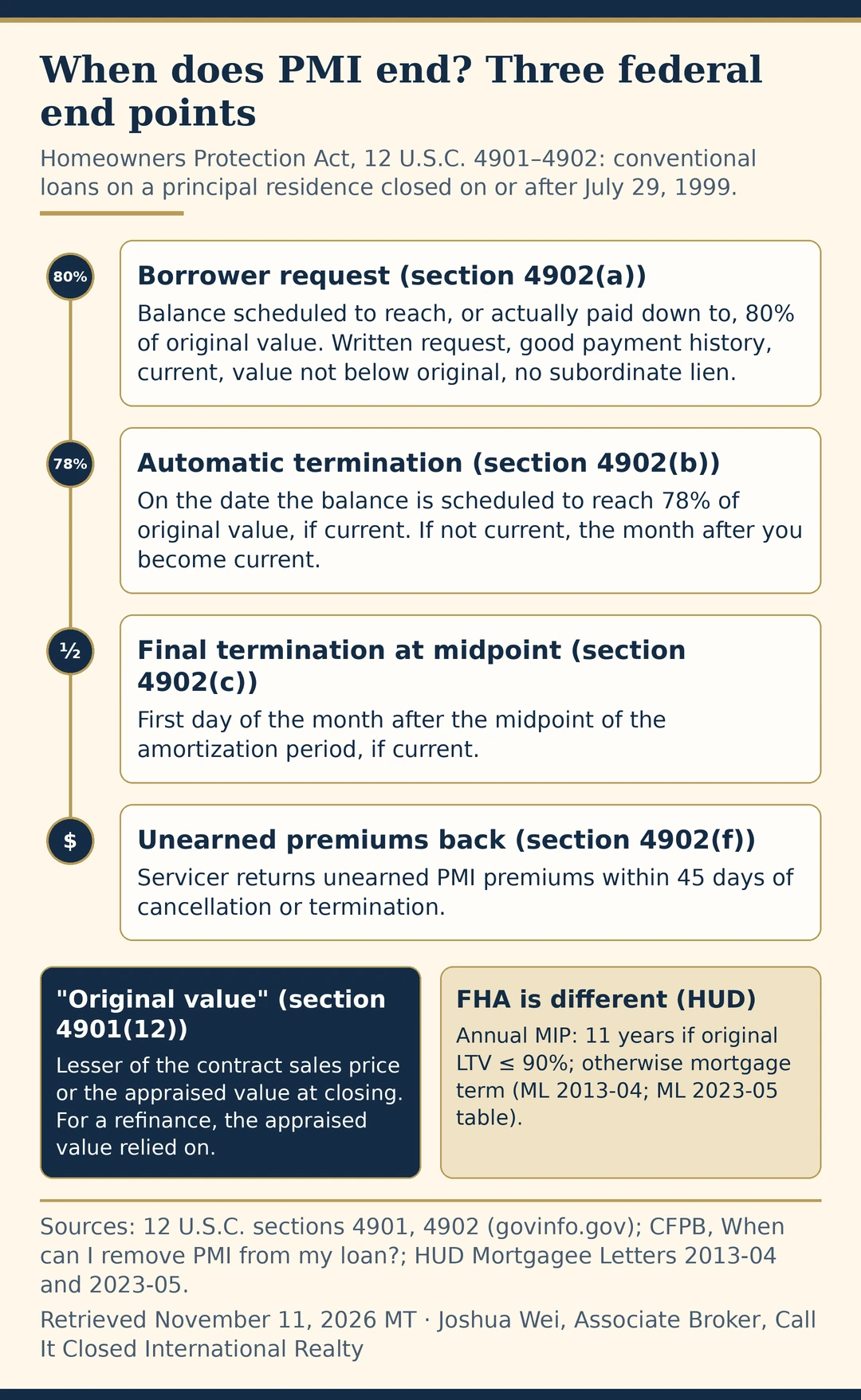
A vertical flow diagram, cream background with navy type and gold accents, titled When does PMI end? Three federal end points, with the subtitle Homeowners Protection Act, 12 U.S.C. 4901 to 4902, conventional loans on a principal residence closed on or after July 29, 1999. Four steps: 80 percent, borrower request under section 4902(a), when the balance is scheduled to reach or is actually paid down to 80 percent of original value, requiring a written request, good payment history, being current, value not below original, and no subordinate lien; 78 percent, automatic termination under section 4902(b) on the date the balance is scheduled to reach 78 percent of original value if current, or if not current the month after becoming current; one half, final termination at the midpoint under section 4902(c), the first day of the month after the midpoint of the amortization period if current; dollar sign, unearned premiums returned under section 4902(f) within 45 days of cancellation or termination. Two lower cards: original value under section 4901(12), the lesser of the contract sales price or the appraised value at closing, or for a refinance the appraised value relied on; and FHA is different, with HUD annual MIP lasting 11 years if original LTV is 90 percent or less and otherwise the mortgage term, per Mortgagee Letter 2013-04 and the 2023-05 table. Sources: 12 U.S.C. sections 4901 and 4902, CFPB, and HUD Mortgagee Letters. Retrieved November 11, 2026 MT.
Sources: 12 U.S.C. section 4902 (govinfo) (opens in a new tab); CFPB, When can I remove PMI? (opens in a new tab); HUD Mortgagee Letter 2013-04 (opens in a new tab)
Cream background, navy text, gold rules. Four steps on a gold spine, two side-by-side cards, and a 28px source footer.
The diagram above shows the three PMI end points under the Homeowners Protection Act, the four conditions for a borrower request, and how FHA annual mortgage insurance follows a separate HUD schedule.
Which loans does the federal PMI law cover?
The CFPB says the rules it describes "apply to mortgages for single-family principal residences that closed on or after July 29, 1999." It adds: "Mortgages through the Federal Housing Administration (FHA) or Department of Veterans Affairs (VA) have different requirements," and "If your lender is paying for your mortgage insurance, different rules apply."
The statute, 12 U.S.C. section 4901 (opens in a new tab), defines private mortgage insurance as "mortgage insurance other than mortgage insurance made available under the National Housing Act," title 38, or title V of the Housing Act of 1949. It defines a residential mortgage as one on "a single-family dwelling that is the principal residence of the mortgagor."
The statute also has exceptions for loans considered high risk. 12 U.S.C. section 4902(g)(1) (opens in a new tab) says "The termination and cancellation provisions in subsections (a) and (b) do not apply to any residential mortgage transaction that, at the time at which the residential mortgage transaction is consummated, has high risks associated with the extension of the loan." For loans within the conforming limit, high risk is "determined in accordance with guidelines published by" Fannie Mae and Freddie Mac. For other loans it is determined by the lender, with a fixed-rate loan terminating when it is "first scheduled to reach 77 percent of the original value." The midpoint rule still applies to high-risk loans; the lender must disclose "that in no case may private mortgage insurance be required beyond the date that is the midpoint of the amortization period of the loan, if the mortgagor is current" under section 4903(a)(2) (opens in a new tab). Ask your servicer whether an exception applies to your loan.
What does "original value" mean?
Every percentage is measured against "original value," not today's market value. Under 12 U.S.C. section 4901(12), original value means "the lesser of the sales price of the property securing the mortgage, as reflected in the contract, or the appraised value at the time at which the subject residential mortgage transaction was consummated." For a refinance of a principal residence, it "means only the appraised value relied upon by the mortgagee to approve the refinance transaction."
The 80% and 78% dates are tied to the loan's amortization schedule. For a fixed-rate loan, the termination date is when the balance, "based solely on the initial amortization schedule for that mortgage, and irrespective of the outstanding balance for that mortgage on that date, is first scheduled to reach 78 percent of the original value." For a cancellation request, the statute also counts the date the balance, "based solely on actual payments, reaches 80 percent of the original value." The CFPB says: "You can ask to cancel PMI ahead of the scheduled date, if you have made additional payments that reduce the principal balance of your mortgage to 80 percent of the original value of your home."
The CFPB notes: "The first date you can make the request should appear on your PMI disclosure form, which you received along with your mortgage."
What disclosures should I have?
The statute requires paperwork at closing and every year after.
At closing. For a fixed-rate loan, 12 U.S.C. section 4903(a)(1)(A) (opens in a new tab) requires the lender to give "a written initial amortization schedule" and written notice "that the mortgagor may cancel the requirement in accordance with section 4902(a) of this title indicating the date on which the mortgagor may request cancellation, based solely on the initial amortization schedule." The notice must also say the borrower "may request cancellation in accordance with section 4902(a) of this title earlier than provided for in the initial amortization schedule, based on actual payments," and state the automatic "termination date" for that mortgage. For an adjustable-rate loan, section 4903(a)(1)(B) requires a notice that "the servicer will notify the mortgagor when the cancellation date is reached."
Every year. Under section 4903(a)(3), the servicer must send "an annual written statement" with "the rights of the mortgagor under this chapter to cancellation or termination of the private mortgage insurance requirement" and "an address and telephone number that the mortgagor may use to contact the servicer." Section 4903(c) says this may appear on the annual escrow account statement. If you can't find your closing disclosure, the annual escrow statement is a place to look.
What do I need to request cancellation at 80%?
Under 12 U.S.C. section 4902(a) (opens in a new tab), PMI "shall be canceled" on the cancellation date or later once the borrower:
- "submits a request in writing to the servicer that cancellation be initiated;"
- "has a good payment history with respect to the residential mortgage;"
- "is current on the payments required by the terms of the residential mortgage transaction;" and
- satisfies the holder's requirements for evidence "that the value of the property securing the mortgage has not declined below the original value of the property" and for "certification that the equity of the mortgagor in the residence securing the mortgage is unencumbered by a subordinate lien."
"Good payment history" is defined in section 4901(4). In short, the borrower has not made a payment "60 days or longer past due" in the 12-month period beginning 24 months before the relevant date, and has not made one "30 days or longer past due" in the 12 months before it.
The CFPB says you need evidence that the value "hasn't declined below the original value of the home," and warns: "if it has, you may not be able to cancel PMI on schedule." What valuation evidence a servicer accepts is a question for the servicer.
Timing after a request. Under section 4902(e)(1), no premiums may be charged "more than 30 days after the later of" the date the request is received or "the date on which the mortgagor satisfies any evidence and certification requirements." Under 12 U.S.C. section 4904(a) (opens in a new tab), within 30 days after cancellation or termination the servicer must notify you in writing "that the private mortgage insurance has terminated and that the mortgagor no longer has private mortgage insurance" and "that no further premiums, payments, or other fees shall be due or payable." If the servicer says no, section 4904(b)(1) requires "written notice to the mortgagor of the grounds relied on to make the determination (including the results of any appraisal used to make the determination)."
Loan modifications. Under section 4902(d), if the loan is modified, "the cancellation date, termination date, or final termination shall be recalculated to reflect the modified terms and conditions of such loan."
Once PMI is canceled or terminated, section 4902(f)(1) says "all unearned premiums for private mortgage insurance shall be returned to the mortgagor by the servicer" within 45 days.
Can Fannie Mae or Freddie Mac loans drop PMI sooner?
The CFPB says: "Loan investors, including Fannie Mae and Freddie Mac, often create their own PMI cancellation guidelines. But these guidelines cannot be less favorable to the borrower than the ones above." It also notes: "Some lenders and servicers may allow removal of PMI under their own standards." Ask your servicer for its written requirements, which may depend on current value, loan age, and payment history.
Fannie Mae's rules for servicers are public. Its Servicing Guide B-8.1-04, Termination of Conventional Mortgage Insurance (opens in a new tab), lets a borrower ask to end MI based on the home's current value. For "a one-unit principal residence or second home," it says "the LTV ratio must be 75% or less, if the seasoning of the mortgage loan is between two and five years. 80% or less, if the seasoning of the mortgage loan is greater than five years." The two-year minimum can be waived for borrower improvements that raised the value, with an 80 percent limit; the guide says "Repairs that are made to keep the property maintained and fully functional are not considered improvements."
The same section requires "an acceptable payment record," meaning the loan "is current when the termination is requested," "has no payment 30 or more days past due in the last 12 months," and "has no payment 60 or more days past due in the last 24 months."
The borrower pays for the valuation. Fannie Mae's F-1-02 (opens in a new tab) lists "BPO $190" and "Restricted appraisal one-unit $450," and says the servicer "must only order the valuation after the servicer receives the applicable fee."
Two Fannie Mae sources differ on servicer outreach. The Servicing Guide B-8.1-04 says: "The servicer must not solicit a borrower for MI termination based on current value of the property." Fannie Mae's Lender Letter LL-2026-07 (opens in a new tab), dated Sept. 16, 2026, says: "We are permitting servicers to proactively solicit borrowers whose mortgage loans may be close to or have reached the loan-to value (LTV) requirements for mortgage insurance (MI) termination based on current value of the property." The letter says "This policy change will be reflected in a future Servicing Guide update." Either way, a borrower can start the request. If your loan is owned by Fannie Mae, ask your servicer which version it is applying.
These are Fannie Mae's rules. If Freddie Mac or another investor owns your loan, ask the servicer for that investor's requirements.
How is FHA mortgage insurance different?
FHA annual mortgage insurance premium (MIP) is set by HUD, not by the Homeowners Protection Act.
HUD's Mortgagee Letter 2013-04 (opens in a new tab) set the duration rules still reflected in the current premium table. For a loan with an original loan-to-value ratio "less than or equal to 90 percent LTV, the annual MIP will be assessed until the end of the mortgage term or for the first 11 years of the mortgage term, whichever occurs first." For a loan "with an LTV greater than 90 percent, FHA will assess the annual MIP until the end of the mortgage term or for the first 30 years of the term, whichever occurs first."
These duration rules apply to FHA loans with case numbers assigned on or after June 3, 2013. HUD's letter also shows the rule that applied to loans just before that date: the annual premium was generally cancelled once the balance reached 78 percent of the original value, with a five-year minimum for loans longer than 15 years. If your FHA loan is older, ask your servicer which rule applies to it.
HUD's Mortgagee Letter 2023-05 (opens in a new tab) lowered annual MIP rates "for case numbers endorsed on or after March 20, 2023." Its premium table keeps the "11 years" duration for LTVs at or below 90% and "Mortgage term" for most higher LTVs. HUD's Mortgagee Letters index (opens in a new tab) listed no later single-family letter with an annual MIP change in its title when checked on November 11, 2026.
Questions about FHA mortgage insurance on a specific loan, including any refinance, are for a licensed mortgage lender or the servicer.
Related: Denver home prices and seller concessions (opens in a new tab).
What if the servicer doesn't follow the law?
The statute gives borrowers a private right of action. Under 12 U.S.C. section 4907(a) (opens in a new tab), a servicer, mortgagee, or mortgage insurer that violates the chapter "shall be liable to each mortgagor to whom the violation relates for" actual damages, in "an action by an individual, such statutory damages as the court may allow, not to exceed $2,000," "costs of the action," and "reasonable attorney fees, as determined by the court." Section 4907(b) sets a deadline: "No action may be brought by a mortgagor under subsection (a) later than 2 years after the date of the discovery of the violation." Whether you have a claim is a question for an attorney. A complaint can also go to the CFPB.
A hypothetical
These numbers are invented. A buyer purchases an Aurora house in 2023 for $450,000, appraised at $455,000, with a $427,500 conventional loan owned by Fannie Mae. Original value is the lesser of price and appraisal, $450,000, so 80 percent is $360,000 and 78 percent is $351,000. By late 2026 the home's value has risen, and the loan is about three and a half years old. Under the Servicing Guide, a current-value request needs an LTV of 75 percent or less at that age, and the borrower pays for the valuation. Under the federal statute, she can also request cancellation once her balance reaches $360,000, if she meets the section 4902(a) conditions. If she does nothing, PMI terminates automatically on the date her balance is scheduled to reach $351,000, if she is current.
Frequently asked questions
Does PMI come off automatically?
The statute describes automatic termination on the date the balance is scheduled to reach 78% of original value if the borrower is current (section 4902(b)), final termination at the loan's midpoint (section 4902(c)), and a borrower request at 80% (section 4902(a)). Ask your servicer how these apply to your loan.
Does my home's increase in value count?
The federal 80% and 78% rules are measured against "original value," as defined above. The CFPB notes that "Some lenders and servicers may allow removal of PMI under their own standards." Ask your servicer.
Will I get money back?
The statute requires the servicer to return unearned premiums within 45 days after cancellation or termination.
My loan is FHA. Does the 78% rule apply?
The CFPB says FHA and VA loans "have different requirements." HUD's mortgagee letters set FHA MIP duration.
What if I'm behind on payments?
For a borrower who isn't current on the 78% date, the statute says termination happens on "the first day of the first month beginning after the date that the mortgagor becomes current."
Does the servicer have to explain a denial?
Yes. Under 12 U.S.C. section 4904(b), the servicer must give "written notice to the mortgagor of the grounds relied on," including "the results of any appraisal used."
Where do I start?
Find your PMI disclosure from closing, then call or write your servicer and ask for its cancellation requirements in writing.
Related notes
- Buying in Denver or Aurora with a VA loan: funding fee, seller concessions, appraisal, and the contract's VA clause
- Using gift money for a down payment in Denver or Aurora: what Fannie Mae's guide and the IRS actually say
- CHFA first-time buyer programs in Denver and Aurora: what the 2026 limits and assistance options actually say
Sources and method
Official sources, retrieved November 11 and 13, 2026, America/Denver: 12 U.S.C. section 4901 (opens in a new tab) and section 4902 (opens in a new tab) (Homeowners Protection Act) on govinfo.gov, with section 4903 (opens in a new tab), section 4904 (opens in a new tab) and section 4907 (opens in a new tab); Fannie Mae Servicing Guide B-8.1-04 (opens in a new tab) and F-1-02 (opens in a new tab) and Lender Letter LL-2026-07 (opens in a new tab); CFPB, When can I remove private mortgage insurance (PMI) from my loan? (opens in a new tab) and What is private mortgage insurance? (opens in a new tab); HUD Mortgagee Letter 2013-04 (opens in a new tab), Mortgagee Letter 2023-05 (opens in a new tab), and the Mortgagee Letters index (opens in a new tab). Quotations are verbatim. No rates, premium amounts, or savings estimates are stated. The valuation fees are Fannie Mae's published figures, and the hypothetical's numbers are invented.
This note is general education from a Colorado real estate broker with Call It Closed International Realty. If you are weighing a move, a refinance, or a sale in Denver or Aurora, I can help you think through the real estate side alongside your lender.
Disclaimer
This article is general information only. It is not legal, tax, lending, insurance, appraisal, inspection, or financial advice, and it is not a substitute for advice about your situation. Joshua Wei is a Colorado real estate broker, not an attorney. Reading this article does not create a client relationship, an agency relationship, or an attorney-client relationship with Joshua Wei or with Call It Closed International Realty.
Laws, program rules, interest rates, insurance terms, tax figures, and other details change. Examples in this article are hypothetical illustrations unless a source is named for a specific, dated figure. Information in this article is believed accurate as of November 19, 2026 and is not guaranteed. No result is promised, and you should not rely on this article as the last word for your situation.
Before you act, confirm the point with the official source linked or cited in this article, and talk with a licensed professional who can apply the rule to your facts. That may be a licensed attorney, a tax professional, a lender, an insurance agent, a home inspector, or another licensed professional, depending on the question. Links to third-party websites and publications are provided for reference only. They are not an endorsement, and their content can change.
If you already have a brokerage relationship with another broker, this is not a solicitation.
Joshua Wei, Associate Broker, Call It Closed International Realty, Colorado license FA.100108558. Equal Housing Opportunity.