November 12, 2026 · Denver · Aurora · Selling · Market
Sell your Denver home this winter, or wait for spring? What the monthly data show.
In each of the last two Denver metro winters, new listings fell to roughly a quarter of their spring peak while contracts fell to about half. What that means for a seller deciding between now and spring, and what the data cannot tell you.
The short answer
Winter is not a dead season for selling a Denver-area home, but it is a different one. In each of the last two winters, the number of new listings across the Denver metro fell much further than the number of homes going under contract. In December 2025, 1,775 new listings came on the market and 2,226 homes went under contract. The following April, those figures were 6,642 and 4,339. The competition thinned faster than the buyers did. The cost is time: the homes that closed in January 2026 had spent a median of 53 days in the MLS, against 14 days for April closings.
So the honest answer to "now or spring?" is a trade. A winter listing usually faces fewer competing homes and a slower, smaller pool of buyers. A spring listing usually meets more buyers and much more competition. Which trade is better depends on your timeline, your carrying costs, your property type, and how your home compares with the few listings a buyer would see instead of yours. This note walks through what the Denver Metro Association of Realtors monthly figures show for fall and winter, how this winter's starting point differs from the last two, and how to prepare and price for it.
I am a licensed Colorado real estate broker with Call It Closed International Realty. I am not an appraiser, an attorney, or a tax advisor for your sale. This is general education, not a valuation of your home, a loan quote, or legal or tax advice. It describes past months. It does not forecast this winter.
Disclaimer. This article is general information only. It is not legal, tax, lending, insurance, appraisal, inspection, or financial advice, and reading it does not create a client, agency, or attorney-client relationship. Laws, rates, programs, and figures change. Confirm the official source, and talk with a licensed attorney, tax professional, lender, insurance agent, or inspector before you act. Joshua Wei is a Colorado real estate broker, not an attorney. He is an Associate Broker with Call It Closed International Realty, license FA.100108558. Equal Housing Opportunity.
 Full size (opens in a new tab)
Sources: DMAR Real Estate Market Trends reports (opens in a new tab); DMAR November 2025 Market Trends summary (opens in a new tab)
Text version of this figure
- Winter thins the listings first
- Denver metro (11 counties), all residential
- DMAR monthly figures, Oct 2024 – Oct 2026
- New listings each month
- Dec 1,840
- 7,284
- Dec 1,775
- 6,642
- Homes for sale at month-end
- 14,007
- 6,888
- 7,607
- 12,978
- Median days in MLS, homes that closed
- 45
- 13
- 53
- 14
- 30
- Nov, Dec, Jan
- Other months
- Nov–Jan shading
- Detached and attached combined. Each month as first published; DMAR revises later months, so recent totals can rise.
- History, not a forecast and not a price for any home.
- Source: Denver Metro Association of Realtors public monthly infographics, Nov 2024 – Nov 4, 2026
- Joshua Wei
- Call It Closed International Realty · Prepared Nov 9, 2026 MT
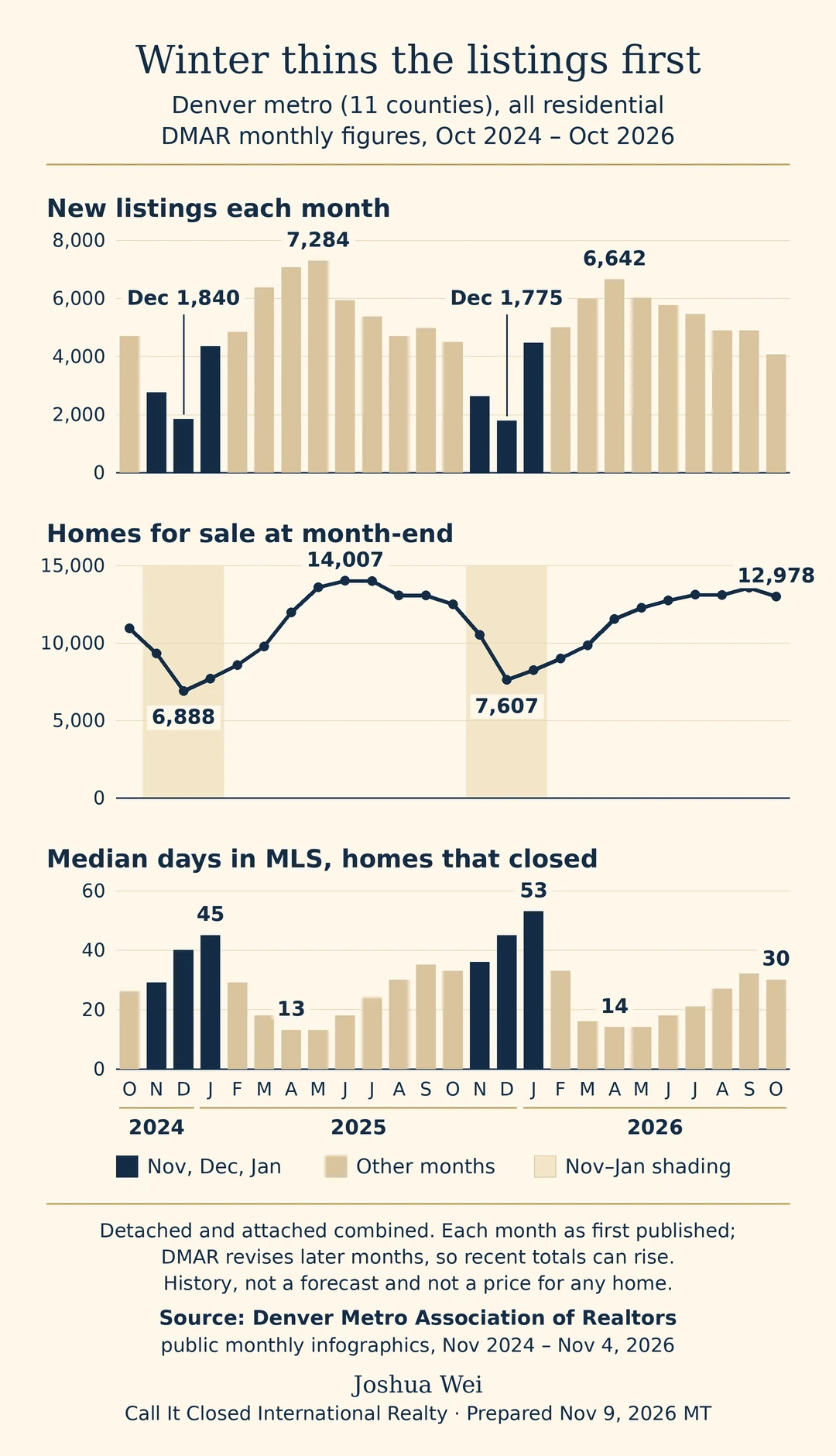
Three charts of Denver metro residential activity from October 2024 through October 2026. New listings and median days in MLS are bars, with November, December and January in navy and other months in tan. Homes for sale at month-end is a line. December new listings are labeled 1,840 and 1,775, against spring peaks of 7,284 and 6,642. Month-end inventory is labeled 6,888 and 7,607 in the two Decembers, with a May 2025 peak of 14,007 and 12,978 in October 2026. January median days in MLS are labeled 45 and 53, against 13 and 14 in spring.
The chart above uses DMAR's public monthly infographics for October 2024 through October 2026. Each one covers detached and attached homes together in DMAR's eleven-county area. The figures are as first published each month. Why that matters is explained under "What the numbers do not tell you," below.
What happens to the Denver market between November and February?
New listings fall first and fastest
The clearest seasonal pattern in the data is on the seller side. In November 2025, new listings fell 41.39 percent from October. DMAR's November 2025 summary (opens in a new tab) noted that this was nearly identical to the 41.54 percent drop between the same two months in 2024. December fell again. DMAR's infographics show 1,840 new listings in December 2024 (opens in a new tab) and 1,775 in December 2025 (opens in a new tab), each about a third below the November count.
For scale, the spring peaks were 7,284 new listings in May 2025 (opens in a new tab) and 6,642 in April 2026 (opens in a new tab). By my arithmetic on those published counts, December's new listings were about a quarter of the following spring's peak in both cycles: 1,840 against 7,284, and 1,775 against 6,642.
Homes for sale drop in December because sellers step back
Active listings, the homes for sale at month's end, follow the new listings down. The November 2025 summary reported a 15.92 percent decline from October, close to the 14.89 percent decline a year earlier. December falls harder. Active listings were 6,888 at the end of December 2024, down 26.02 percent from November, and 7,607 at the end of December 2025, down 27.59 percent. DMAR's December 2025 summary (opens in a new tab) attributed that drop "mostly to many sellers removing their homes from the market over the holidays," and said most of those listings were expected to return in the first quarter of 2026.
That is the mechanism behind the winter opportunity. The homes left on the market in December are fewer, and they include sellers who chose to stay listed through the holidays. A buyer touring in December is choosing from a shorter list than a buyer touring in May.
Buyers slow down too, but less
Buyers do not disappear in winter. Pending sales, the homes that went under contract during the month, fell to 2,459 in December 2024 and 2,226 in December 2025. In the following springs they reached 4,641 in March 2025 (opens in a new tab) and 4,612 in March 2026 (opens in a new tab). So December's contracts were roughly half of the spring high, while December's new listings were roughly a quarter.
One way to see the gap is to divide contracts by new listings for the same month. That ratio is my calculation, not a DMAR statistic. It was about 1.3 in December 2024 and December 2025, meaning more homes went under contract than came on new. In April 2025 and April 2026 it was between 0.6 and 0.7. A ratio above one does not mean every winter listing sells. Many of the homes going under contract in December had been listed for months. It means the flow of fresh competition slows more than the flow of buyers who are still writing contracts.
DMAR's committee chair put the same pattern in plain words in the September 2026 summary (opens in a new tab): "Active listings typically taper through the fourth quarter, and some sellers will pull their homes for the holidays. Buyers who remain in the market will face less competition than at any other time of year." That sentence was written to buyers. The same fact cuts the other way for a seller who stays listed: fewer competing homes.
Closings lag contracts by about a month
Closed sales describe contracts written earlier, usually the month before. That is why closings are lowest in January, not December. DMAR reported 2,259 closings in January 2025 (opens in a new tab) and 1,919 in January 2026 (opens in a new tab), which the January 2026 summary called one of the lowest monthly totals in data going back to 2008. December closings held up against November's as fall contracts closed before year-end. On first prints, December had 3,107 closings against November's 3,022 in 2024, and 3,101 against 2,734 in 2025. DMAR's own month-over-month arrows, which use revised November counts, show December down 0.89 percent in 2024 and up 9.23 percent in 2025.
If you list in December and accept an offer, a closing in January or February is a reasonable planning assumption. The exact date is a negotiated term in the contract, and it depends on the buyer's financing, the title work, and the holidays.
January brings the relisting wave
The quiet does not last long. New listings jumped to 4,339 in January 2025 and 4,455 in January 2026. The January 2026 summary reported new listings up 152.55 percent from December, "driven in part by homes withdrawn in November and December that returned to the market after the start of the year." Active listings rose 8.16 percent from December to January 2026, which DMAR called atypical for that time of year. They had also risen in January 2025, by 11.61 percent on that month's infographic.
This matters for the "wait for spring" plan. Waiting does not mean listing into an empty market in February. It means listing alongside the homes that were withdrawn for the holidays, plus the sellers who planned all along to start in the new year, and then the larger spring wave in March, April, and May.
Does a home sell for less in winter?
The median of what closes is lower in winter
On DMAR's combined residential median, the winter months have been the low points of the last two years. The median close price was $608,000 in June 2024 (opens in a new tab), $580,000 in December 2024, and $575,000 in January 2025. It was $610,200 in June 2025 (opens in a new tab), $575,000 in December 2025, and $569,500 in January 2026 (opens in a new tab). By my arithmetic, January's median was about 5 to 7 percent below the prior June's in both cycles. In 2026 it then rose to $616,000 in June (opens in a new tab) before easing to $595,000 in October (opens in a new tab).
DMAR's March 2024 summary (opens in a new tab) described the same arc: prices that "historically reach their peak in June and take a downward trajectory through December." Its April 2026 summary (opens in a new tab) added a caution: the predictable spring-driven seasonality of earlier years "has yet to fully return" since mortgage rate increases in late 2022 disrupted it, and April medians were nearly unchanged in 2024, 2025, and 2026, at $602,000, $604,000, and $605,000 by that summary's figures.
Why that is not the same as a winter discount
A lower winter median does not mean the same house sells for 5 to 7 percent less in January. The median is the middle price of the homes that happened to close that month. If the mix of homes that close in winter differs from the mix in June, by size, price range, property type, or location, the median moves even if no individual home's value changed. DMAR's public summaries do not break out the winter mix, so I cannot tell you how much of the seasonal dip is mix and how much is price. Treat the median as a description of winter closings, not as a price adjustment for your home.
Sale-to-list and time on market
Two other measures move in winter. The average close-price-to-list-price ratio was 97.94 percent in January 2026, against 98.23 percent in December 2025 and 98.50 percent in January 2025, according to the January 2026 summary. In April 2026 it was 99.44 percent. Those are small differences in a ratio, and they describe only homes that sold. DMAR's public summaries do not say whether the ratio uses the original or the final list price, so do not read it as a measure of how much sellers cut along the way.
Time on market moves more. The median days in MLS for homes that closed was 40 in December 2024, 45 in January 2025, 45 in December 2025, and 53 in January 2026. In April it was 13 in 2025 and 14 in 2026. Some of that winter figure is homes listed in the fall that sat before going under contract. It does not mean a home listed in December will take 53 days. It does mean a seller should plan cash flow and moving dates for a longer period than a spring listing would usually need.
How is this winter's starting point different?
More homes for sale than the last two Octobers
This winter starts with more supply. DMAR's October 2026 infographic (opens in a new tab) counted 12,978 active listings at month's end, against 12,495 in October 2025 and 10,940 in October 2024 as first published. Months of inventory, DMAR's estimate of how long current listings would last at the recent pace of sales, was 4.72, against 3.73 and 3.18 in those Octobers. New listings were lower, at 4,066, against 4,483 and 4,691.
Fewer sales, and more give in the terms
Buyers are also fewer. October 2026 had 2,748 closings, down 23.54 percent from a year earlier and the fewest October closings since 2010, according to DMAR's October 2026 summary (opens in a new tab). September's 2,849 closings were the fewest for any September in DMAR's records back to 2008. Sixty-five percent of October's sales included a seller concession, with an average amount of $12,557. My note on October prices and concessions explains what that figure does and does not measure.
Higher rates than a year ago
Mortgage rates are higher than they were heading into last winter. Freddie Mac's weekly survey of the average 30-year fixed rate, as published on FRED (opens in a new tab), was 7.11 percent for the week ending November 12, 2026, against 6.24 percent for the week ending November 13, 2025. It reached 7.40 percent in two October weeks. DMAR tied October's drop in closings to September's rate increase. I do not know where rates will be in March, and neither does anyone else with certainty. A plan to wait for spring is partly a bet on rates and buyer demand that no monthly report can settle.
What this adds up to is not a forecast. It means the seasonal pattern starts this year from a market with more listings, fewer buyers, and more negotiation than the last two Novembers. If November and December follow the last two years, the field will thin. It may still be wider than it was a year ago.
Do detached homes and condos face the same winter?
No. Property type changes the answer more than the calendar does. DMAR reported more than seven months of supply for attached homes, condos and townhomes, in October 2026, and a median of 48 days in MLS for attached homes that closed, against 26 days for detached homes. The September 2026 summary put attached months of inventory at 7.21.
County figures tell the same story. The Colorado Association of Realtors' September 2026 update for Denver County (opens in a new tab) shows 3.6 months of supply for single-family homes and 7.9 months for townhouses and condos. Its Arapahoe County update (opens in a new tab) for the same month shows 3.1 and 5.8. Both sheets say they were current as of October 5, 2026, and both note the medians do not account for seller concessions. Those are September county figures, not October metro figures, and Aurora spans more than one county.
For a condo or townhome seller, the seasonal thinning helps less when supply is long all year. The question is less "winter or spring" and more "how does my unit, my association's finances, and my price compare with the other units a buyer can see right now." For a detached home in a price range with short supply, winter may matter more, because a few competing listings can make the difference.
Should I list now or wait until spring?
When listing this winter can make sense
- You have a deadline: a job start, a purchase you have already made, a lease ending, or a move you cannot postpone.
- You are carrying costs that waiting would extend: a second mortgage payment, a vacant home's utilities and insurance, association dues, or property taxes.
- Few homes like yours, in your property type and price range, are listed nearby today.
- Your home shows well without its yard: good interior light, a workable layout, recent mechanical updates, and an exterior you can keep clear and safe.
- You are ready to price against today's competition and recent closed sales, not against last spring's.
When waiting can make sense
- Waiting costs you little, and you would not accept a winter-realistic price anyway.
- The home's main appeal is outdoor: a landscaped yard, gardens, a patio, or views best shown in green months.
- The home needs repairs or updates that an inspector would flag, and you can finish them before listing.
- Several homes like yours are already listed nearby, and you would rather not join a long line in December.
The middle path, with a caution
Some sellers use November and December to prepare, then list in January or February. That can work. The caution is the data above: January has brought a relisting wave in each of the last two years, with new listings more than doubling from December. A late-winter listing still meets buyers before the spring peak, but it is not the empty field of mid-December.
What waiting costs
Waiting has costs you can measure and costs you cannot. The measurable ones are the monthly carrying costs: mortgage interest, taxes, insurance, utilities, association dues, and upkeep on a home you may not be living in. Add them up for the months between now and a realistic spring closing. The costs you cannot measure are the spring price, the spring rate, and the spring competition. No one can promise that the spring market will pay back those carrying costs. Make the decision with the numbers you know and a range for the ones you do not.
How should I price against winter competition?
Price against the short list, not the metro
The metro counts above are the backdrop. A buyer compares your home with the handful of similar homes they can tour this week. Before you set a price, look at the active listings in your property type, size range, and area: how long each has been listed, and whether its price has changed. Then look at recent closed sales of similar homes, adjusted for condition and features. The real estate services page describes how I build that comparison.
Expect buyers to read days on market
Winter buyers can see how long a listing has been active. DMAR's December 2024 summary (opens in a new tab) reported a median of 78 days in MLS for active listings at the end of that year, against 40 days for homes that sold in December. In the November 2024 summary (opens in a new tab), the committee chair said about half of the homes sold that November had at least one price reduction before going under contract, and about 60 percent of sellers provided concessions. A listing that starts high in November and cuts in January carries that history into the relisting wave.
Decide your terms in advance
With concessions on 65 percent of October 2026 sales, expect to be asked. Decide before you list what you would contribute toward a buyer's costs or a rate buydown, and how that compares with a price reduction or a completed repair. They do not cost you the same, and they do not help every buyer the same way. The buyer's loan program sets limits on what a seller may contribute. Fannie Mae Selling Guide topic B3-4.1-02, Interested Party Contributions (05/07/2025) (opens in a new tab), retrieved November 10, 2026, states: "Fannie Mae does not permit IPCs to be used to make the borrower's down payment, meet financial reserve requirements, or meet minimum borrower contribution requirements." The same topic sets maximum financing concessions that depend on occupancy and loan-to-value for loans Fannie Mae purchases; other programs have their own rules. Ask a licensed lender what limit applies to the buyer's loan. Compare offers by your estimated net proceeds, not by the price line alone.
What should I prepare differently for a winter listing?
Outside: snow, ice, and light
Snow and ice are a showing problem and a safety problem. The City and County of Denver's snow removal page (opens in a new tab), accessed November 10, 2026, states: "Denver requires that property owners clear snow and ice from their sidewalks, including adjacent ADA ramps and bus stops, so that EVERYONE has safe access throughout the city!" On timing, the same page says: "Residences need to clear their sidewalks by the next day." On enforcement, it says: "Inspectors leave a time-stamped notice at properties with un-shoveled sidewalks. After receiving a notice, businesses have four hours and residences have 24 hours before the inspector’s re-check and a potential $150 fine." Aurora and other cities, and many associations, set their own rules, so check yours. Plan who clears the walks, steps, and driveway before showings, especially if the home is vacant. Shaded, north-facing walks can stay icy after the rest has melted.
Short days mean many showings happen near or after dark. Working porch and entry lights, readable house numbers, and bright interior lighting help a buyer see the home rather than the gloom.
Inside: heat, light, and photos
Keep the home at a comfortable temperature for showings. A cold house raises questions about the furnace before anyone asks. Have the heating system serviced and keep the receipt for buyers who ask. Open blinds for daytime showings and replace dim bulbs. If you have good photos of the yard from warmer months, ask your broker whether and how to use them, labeled with the season, so a buyer is not misled about what they will see in person.
Keep holiday decorations simple. A buyer is trying to picture the rooms, not the décor.
Protect the systems between contract and closing
A winter failure can change a deal. Colorado's standard residential contract for use on and after January 1, 2026 — the Colorado Real Estate Commission's Contract to Buy and Sell Real Estate (Residential), or CBS1, published by the Division of Real Estate (opens in a new tab) — states, in the walk-through provisions: "Except as otherwise provided in this Contract, the Property and Inclusions will be delivered in the condition existing as of the date of this Contract, ordinary wear and tear excepted." Section 18.2 of that form provides: "Should any Inclusion or service (including utilities and communication services), system, component or fixture of the Property (collectively Service) (e.g., heating or plumbing), fail or be damaged between the date of this Contract and Closing or possession, whichever is earlier, then Seller is liable for the repair or replacement of such Inclusion or Service with a unit of similar size, age and quality, or an equivalent credit, but only to the extent that the maintenance or replacement of such Inclusion or Service is not the responsibility of the Association, if any, less any insurance proceeds received by Buyer covering such repair or replacement." The same section continues: "If the failed or damaged Inclusion or Service is not repaired or replaced on or before Closing or possession, whichever is earlier, Buyer has the Right to Terminate under section 24.1., on or before Closing Date, or, at the option of Buyer, Buyer is entitled to a credit at Closing for the repair or replacement of such Inclusion or Service." Section 18.4 states: "Buyer, upon reasonable notice, has the right to walk through the Property prior to Closing to verify that the physical condition of the Property and Inclusions complies with this Contract." Those sentences are quoted from CBS1, retrieved November 10, 2026. Read your own contract with your broker, and talk with a Colorado real estate attorney about legal questions. This is not legal advice about your transaction.
In practice, that means keeping the heat on, protecting exposed pipes, shutting off and draining exterior irrigation before hard freezes, and checking a vacant home regularly. Ask a licensed insurance agent how vacancy affects your coverage before you move out.
Have the records ready
Winter buyers tend to ask about the systems that matter in winter: furnace age and service, water heater, roof, gutters, and any history of ice dams or water in the basement. Have the records and your seller's property disclosure ready before you list. If you have a radon test or a mitigation system, keep the results and paperwork together. My radon note explains how buyers tend to use those records. If drainage or snowmelt has been an issue on the lot, the flood and drainage checklist shows the questions a careful buyer will bring. If the home is in a metro district, expect buyers to ask about it; the Aurora property tax and metro district note shows what they will be checking.
What about the holidays and the closing date?
A December contract usually means a closing that crosses the holidays. Holiday closures can tighten schedules for lenders, title companies, appraisers, and inspectors. Build some room into the dates, and plan your own move around them.
Whether the closing date has tax consequences for you is a question for a tax advisor before you sign, not after. I am not giving tax advice. If you need the proceeds from this sale to buy the next home, ask a licensed lender early about how the timing works.
What do the numbers not tell you?
They are first prints, and they get revised
The monthly figures in this note and the chart are as DMAR first published them. Later reports revise earlier months as late transactions are recorded. For example, October 2026's 2,748 closings were reported as 23.54 percent below October 2025, which implies about 3,590 closings for October 2025. DMAR's first print for October 2025 was 3,354. My own comparisons in this note use first prints against first prints. The percentage changes quoted from DMAR, month-over-month and year-over-year, are DMAR's and use its revised figures for the earlier month.
They cover eleven counties and all residential types together
The chart uses DMAR's combined residential figures for Adams, Arapahoe, Boulder, Broomfield, Clear Creek, Denver, Douglas, Elbert, Gilpin, Jefferson, and Park counties, as listed on DMAR's reports page (opens in a new tab). Detached homes and condos are mixed together. Your street, your price range, and your property type can behave differently.
They are history, not a forecast
Two winters are not a law. The pattern held in the 2024–25 and 2025–26 winters. This year begins from more inventory and higher rates. DMAR's November 2026 figures are not expected until sometime in December. Nothing here predicts this winter's prices, sales, or rates.
They do not price a house
A metro median is not your home's value. That comes from closed sales of similar homes nearby, adjusted for size, condition, and features, and from the listings competing with it today. For the longer view of Denver prices against rents, incomes, and payments, the Denver metro market page has the measures, and the methodology page explains how they are built. The Aurora market page has city and county readings.
Frequently asked questions
Is it a bad idea to sell a house in winter in Denver?
Not necessarily. In the last two winters, new listings fell much more than contracts did, so a winter listing faced less competition. The trade-off is a smaller, slower buyer pool: homes that closed in January 2026 had a median of 53 days in the MLS. Whether winter is right for you depends on your timeline, carrying costs, property type, and local competition.
What is the best month to sell a house in Denver?
There is no single best month for every home. On DMAR's figures, buyer contracts and new listings both peak in spring, and median days in MLS are shortest in April and May. Winter has the fewest competing new listings. The better month for you is the one where your home compares best with what else is for sale and your own timing works.
Do houses sell in December in Denver?
Yes. DMAR reported 2,459 homes going under contract in December 2024 and 2,226 in December 2025, across the eleven-county metro. December was the low month for contracts in both winters, but those counts still exceeded December's new listings, 1,840 and 1,775.
Should I take my house off the market for the holidays?
Many Denver sellers do. DMAR attributed most of December 2025's 27.59 percent drop in active listings to sellers removing homes over the holidays. Staying listed means less competition in December. Withdrawing and relisting means joining the January wave, and buyers may be able to see the earlier listing history. Talk with your broker about how a withdrawal and relisting would appear to buyers and agents.
Do home prices drop in winter in Denver?
The median of homes that close in winter has been lower: $575,000 in January 2025 and $569,500 in January 2026, against $608,000 and $610,200 the prior Junes. That median reflects the mix of homes that closed, so it does not mean a given home is worth 5 to 7 percent less in January.
Is it better to list in January or wait until spring?
January and February listings meet buyers before the spring peak, but in the last two years new listings more than doubled from December to January as withdrawn homes returned. Spring brings more buyers and the most competition. The choice depends on your carrying costs and how ready your home is to show.
How long does it take to sell a house in Denver in winter?
Among homes that closed, the median days in MLS were 40 in December 2024, 45 in December 2025, 45 in January 2025, and 53 in January 2026, across the metro. Those medians include homes listed in the fall. They are not a promise for a home listed today, and they leave out homes that did not sell.
Sources and method
Monthly counts, medians, months of inventory, and median days in MLS for June 2024 through October 2026 (the chart covers October 2024 onward) are from DMAR's public monthly infographics, which cover residential properties, detached and attached combined, with month-over-month arrows. Each was read from the infographic published for that month, including the October 2024 (opens in a new tab) page through the October 2026 (opens in a new tab) page published November 4, 2026. Narrative statements, percentage changes, close-to-list ratios, and quotations are from DMAR's public monthly summaries linked in the text. DMAR states that its statistics are drawn from REcolorado. I did not access the MLS, and I did not use DMAR's member-only report downloads. The contracts-to-new-listings ratio and the June-to-January median comparison are my own arithmetic on DMAR's published figures.
County supply figures are from the Colorado Association of Realtors' September 2026 local market updates for Denver County (opens in a new tab) and Arapahoe County (opens in a new tab), current as of October 5, 2026. Mortgage rates are Freddie Mac's Primary Mortgage Market Survey 30-year fixed average, via FRED (opens in a new tab) series MORTGAGE30US, released November 12, 2026. Quoted contract language is from CBS1, the Colorado Real Estate Commission's Contract to Buy and Sell Real Estate (Residential), Adoption Date August 5, 2025, Mandatory Use Date January 1, 2026, retrieved November 10, 2026 from the official PDF on the Division of Real Estate contracts and forms page (opens in a new tab); the quotations in the winter-systems section are from the walk-through provisions and sections 18.2 and 18.4. Quoted sidewalk rules are from the City and County of Denver's snow removal page (opens in a new tab), accessed November 10, 2026. The quoted interested-party-contribution sentence is from Fannie Mae Selling Guide B3-4.1-02, Interested Party Contributions (05/07/2025) (opens in a new tab), retrieved November 10, 2026; those limits apply to loans sold to Fannie Mae, not to every loan.
This note is general education from a Colorado real estate broker with Call It Closed International Realty. It is not an appraisal, financing advice, tax advice, or legal advice. If you are deciding between this winter and next spring, I will walk through the competing listings, the recent closed sales, and your carrying costs with you before you set a date or a price.
Disclaimer
This article is general information only. It is not legal, tax, lending, insurance, appraisal, inspection, or financial advice, and it is not a substitute for advice about your situation. Joshua Wei is a Colorado real estate broker, not an attorney. Reading this article does not create a client relationship, an agency relationship, or an attorney-client relationship with Joshua Wei or with Call It Closed International Realty.
Laws, program rules, interest rates, insurance terms, tax figures, and other details change. Examples in this article are hypothetical illustrations unless a source is named for a specific, dated figure. Information in this article is believed accurate as of November 12, 2026 and is not guaranteed. No result is promised, and you should not rely on this article as the last word for your situation.
Before you act, confirm the point with the official source linked or cited in this article, and talk with a licensed professional who can apply the rule to your facts. That may be a licensed attorney, a tax professional, a lender, an insurance agent, a home inspector, or another licensed professional, depending on the question. Links to third-party websites and publications are provided for reference only. They are not an endorsement, and their content can change.
If you already have a brokerage relationship with another broker, this is not a solicitation.
Joshua Wei, Associate Broker, Call It Closed International Realty, Colorado license FA.100108558. Equal Housing Opportunity.