October 9, 2026 · Denver · Aurora · Buying · Investing
Buying a home you might rent out? Denver's rental license and Aurora's rental rules, explained
Planning to rent out a Denver or Aurora home for 30 days or more, now or after you move? What Denver's residential rental property license requires (inspection, fees, four-year term), where Aurora's rental licensing effort stands, and the state habitability baseline.
The short answer
In brief: If you buy a Denver home and later rent it out for 30 days or more at a time, the city requires a residential rental property license. Aurora works differently today: it runs its own rental inspection programs and has a rental registration task force. Check each city's official pages before counting on rental income.
If you buy a home in Denver and later rent it out for 30 days or more, the city requires a license. Denver's residential rental property page (opens in a new tab) says the license is "for anyone offering, providing, or operating a residential rental property in the City and County of Denver," and defines that property as "any building, structure, or accessory dwelling unit that is rented or offered for rent as a residence for 30 days or more at a time."
Aurora works differently today. Its Health and Housing Codes page (opens in a new tab) describes a "Multi-Family Systematic Housing Inspection Program" plus "Complaint-based inspections." Aurora has also formed a Rental Registration Task Force (opens in a new tab) that is "reviewing options for a rental registration and licensing program." Watch for changes.
This matters to buyers who plan to rent a basement or ADU, rent the house after a move, or buy a rental outright.
I am a licensed Colorado real estate broker with Call It Closed International Realty. I am not an attorney or tax advisor. I am not giving tax advice.
Disclaimer. This article is general information only. It is not legal, tax, lending, insurance, appraisal, inspection, or financial advice, and reading it does not create a client, agency, or attorney-client relationship. Laws, rates, programs, and figures change. Confirm the official source, and talk with a licensed attorney, tax professional, lender, insurance agent, or inspector before you act. Joshua Wei is a Colorado real estate broker, not an attorney. He is an Associate Broker with Call It Closed International Realty, license FA.100108558. Equal Housing Opportunity.
 Full size (opens in a new tab)
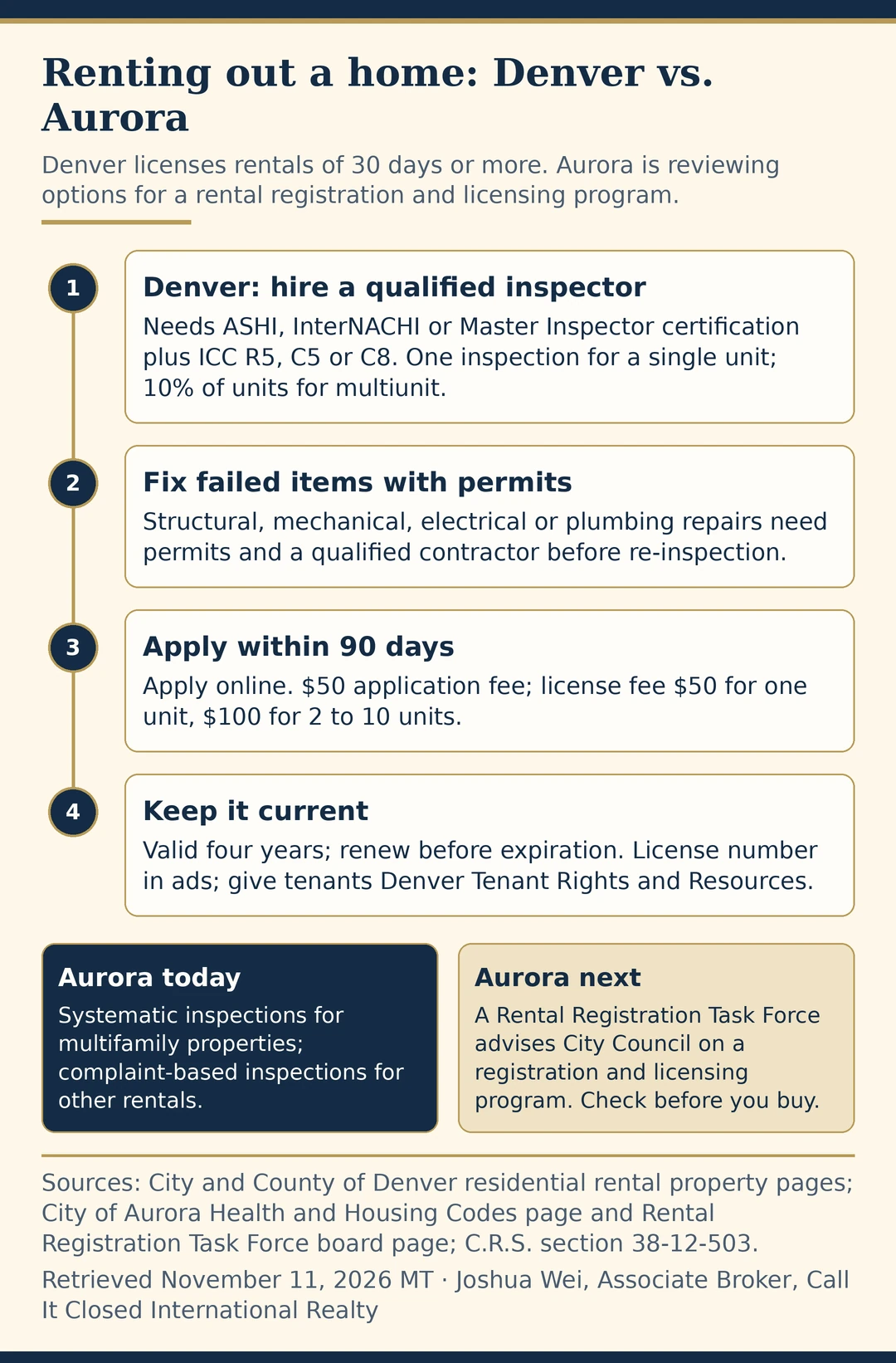
A vertical flow diagram, cream background with navy type and gold accents, titled Renting out a home: Denver vs. Aurora, with the subtitle Denver licenses rentals of 30 days or more, and Aurora is reviewing options for a rental registration and licensing program. Four numbered Denver steps: 1, hire a qualified inspector, who needs ASHI, InterNACHI or Master Inspector certification plus ICC R5, C5 or C8, with one inspection for a single unit and 10 percent of units for multiunit properties; 2, fix failed items with permits, since structural, mechanical, electrical or plumbing repairs need permits and a qualified contractor before re-inspection; 3, apply within 90 days, online, with a 50 dollar application fee and a license fee of 50 dollars for one unit or 100 dollars for 2 to 10 units; 4, keep it current, since the license is valid four years and must be renewed before expiration, the license number goes in ads, and tenants get Denver Tenant Rights and Resources. Two lower cards: Aurora today, systematic inspections for multifamily properties and complaint-based inspections for other rentals; and Aurora next, a Rental Registration Task Force advises City Council on a registration and licensing program, so check before you buy. Sources: City and County of Denver, City of Aurora, and C.R.S. section 38-12-503. Retrieved November 11, 2026 MT.
Sources: Denver Residential rental property (opens in a new tab); Aurora Health and Housing Codes (opens in a new tab)
Cream background, navy text, gold rules. Four numbered steps on a gold spine, two side-by-side cards, and a 28px source footer.
The diagram above walks through Denver's licensing steps and summarizes where Aurora's program stands. It summarizes each city's official pages.
Who needs a Denver rental license?
Denver's property owners and managers page (opens in a new tab) says: "A license is required for anyone offering, providing, or operating a residential rental property for 30 days or more. This includes any rental dwelling units on a single parcel."
Shorter stays fall under Denver's separate short-term rental license (opens in a new tab), which says "The property being rented must be your primary residence."
On how many licenses you need: "Each single-unit property will need an individual license." For multiunit properties, "a single license can be issued for multiple units, addresses, or structures. They must be all located on a single or contiguous parcels and under the same ownership."
What counts as "renting" in Denver?
Denver's Residential Rental Program Checklist Guidebook (opens in a new tab) (October 10, 2025) defines rent broadly: "Rent means receiving or offering money, services, or other remunerations in exchange for occupation of a residential rental property. Under this definition, any property owner who receives any type of benefit from a tenant, is considered renting."
It then draws a line that matters to a buyer with a roommate, a relative, or a basement tenant: "If the tenant does not pay rent and only pays for the utilities the tenant uses (i.e. the owner does not live on the property and does not receive any benefit), a license is not required. However, if the tenant pays rent, or helps with or covers any portion of the mortgage, property taxes or HOA fees for the property, that would be considered a benefit to the owner and would require a license for the property."
The guidebook also lists the property types covered: "all single-family homes, multi-plexes (duplexes, triplexes, etc.), townhouses, rowhouses, apartments, condominiums, accessory dwelling units, mobile homes and manufactured homes." It adds: "The RRP program does not apply to trailers or RVs as these are not considered structures and are covered by a separate program." The definition excludes "on-campus college housing, boarding homes, lodging facilities (hotels and motels) or short-term rentals that are rented for less than 30 days at a time."
What does the Denver inspection involve?
The license starts with a third-party inspection. Denver's new application page (opens in a new tab) says to "Complete a home inspection(s) with an RRP-qualified home inspector" and that "Applications must be submitted within 90 days of the initial inspection."
Denver's inspections page (opens in a new tab) says: "For single-unit properties, an inspection of the unit (if detached) or property (if attached) is required." For multiunit properties, "an inspection of 10% of the total units on the property, randomly selected by the inspector, is required."
Inspectors must hold two certifications. Per the page, a person must be "(a) Certified by the American Society of Home Inspectors (ASHI), the International Association of Certified Home Inspectors (InterNACHI) or the Master Inspector Certification Board, and (b) Certified as an R5, C5, or C8 Combination Building Inspector by the International Code Council (ICC)." The city adds: "Property owners/managers are responsible for confirming any inspector they hire is qualified."
On cost: "Because inspections and re-inspections are done by third-party inspectors, the cost is not set by the city."
If the home fails: "If repairs to structural, mechanical, electrical, or plumbing systems are required to ensure they are safe and in good working order, property owners must receive permits. A qualified contractor must make the repairs before having the rental unit re-inspected."
For multiunit properties, the page explains the math: "The number of inspections must be 10% of the total units, rounded to the nearest whole number. At least one must be inspected if there are fewer than 10 total units."
Newer homes may skip the inspection. The new construction exemption "applies only to applications submitted within four years after the date of issuance of the certificate of occupancy or temporary certificate of occupancy."
What is on Denver's inspection checklist?
The guidebook says the inspections cover "a subset of the most critical Residential Health (RH) Rules and Regulations," and adds: "While all properties are required to be compliant with all existing building, fire, and housing codes, the RRP inspections will only cover the items identified on the RRP Checklist." The checklist has nine sections: egress, water systems, electrical, fire safety, walls, roof and foundation, trash, pest control, required utilities, equipment and services, and safe and sanitary conditions.
A few items a buyer can look at during a showing or the purchase inspection:
- Smoke and CO detectors and an extinguisher. Item 4.1 quotes D.R.M.C. 27-195: a licensee "shall ensure that all dwelling units within a residential rental property contain a functioning smoke detector, carbon monoxide detector, and fire extinguisher." The guidebook says "Detectors must be less than 10 years old or the maximum life-expectancy of the device per the manufacturer, whichever is less," and smoke detectors belong "Inside each bedroom," "Outside each bedroom," and "On every occupiable level including the basement."
- Heat. Item 8.1 requires heating "capable of safely and adequately heating all habitable rooms, bathrooms and water closet compartments located therein to a temperature of at least seventy degrees Fahrenheit (70F) at a distance three (3) feet above floor level, when the temperature outside is minus five degrees Fahrenheit (-5F)." A space heater does not count: "Heating facility means a permanent, non-mobile source of heat, not including a space heater, oven or other appliance not designed for regularly heating entire rooms."
- Hot water. Item 2.2: "A minimum hot water temperature of 110 degrees Fahrenheit is considered compliant."
- Bathroom outlets. Item 3.3: "All bathrooms shall have at least one GFCI electrical outlet."
- Basement units. Item 5.3: "No basement or cellar space shall be let or used as a dwelling or rooming unit unless" "The floor and walls are impervious to leakage of underground and surface runoff water and are free from dampness."
- Foundations, decks, and porches. For item 5.4, the guidebook says the regulation "should be interpreted to include decks, porches and balconies," and a property is not compliant if the inspector sees a condition that warrants a structural engineer "until the structure or condition is reviewed by a structural engineer and, if necessary, remediated."
What happens if the inspection fails?
The guidebook sets the clock: "if more than 90 days pass between an initial inspection and an application for a license, the original inspection will be invalidated and a new, full inspection will be required." Owners "can submit an application for a license with their noncompliant inspection checklist within 90 days of that original inspection. They will then have one year from the date of their application to submit a passing inspection/reinspection form." After repairs, an owner "can hire an inspector for a partial reinspection that only covers the same units and checklist items that were previously noncompliant."
Repairs can trigger permits. The guidebook warns that "Any structural work or repairs to electrical, mechanical, roof, or plumbing systems will likely require a building permit obtained by a licensed contractor," and that "All foundation work requires a building permit." For owners who cannot meet an item, the inspections page (opens in a new tab) says "Variance petitions can be submitted to the Board of Public Health & Environment."
What does the Denver application ask for?
The new application page (opens in a new tab) lists three parts: "Licensed establishment: Property information. Entity registration: Ownership information. Residential rental license: Application information." The property part asks for details on "one to three on-site managers," who "must always have access to and control over the licensed establishment." The ownership part asks for the "True name of the entity or person that will hold the license" and, "For companies/corporations, details about any individual who owns 10% or more of the entity." Individuals or couples "will be asked to upload a copy of a valid state or federally issued ID."
The property owners and managers page (opens in a new tab) adds that owners need "a valid Denver address for the unit they are renting or having inspected" before hiring an inspector, which matters for a basement unit or ADU that has no separate address yet. The same page lists four categories of affordable or public housing whose "application and licensing fees" can be "waived."
What does a Denver license cost, and how long does it last?
Denver's new application page lists an "Application fee: $50." The license fee is "Based on the number of dwelling units," starting at "$50: Single dwelling unit" and "$100: 2 to 10 units."
On the term: "Residential rental property licenses are valid for four years. It is unlawful to operate with an expired license. A renewal application must be filed before the license expires."
Two ongoing duties also apply. "A residential rental property licensee must display the license number within advertisements." And the owner or operator "must give a copy of Denver Tenant Rights and Resources" to the tenant. The city says this "happens when the lease is signed and if rent demand is served."
What about Aurora?
Aurora's Health and Housing Codes page says: "Each multi-family property in Aurora is thoroughly inspected on a systematic basis." For other rentals, "Complaint-based inspections are initiated at the request of a resident, owner or manager, and usually address a specific issue."
For the systematic program, "An inspection report will be sent to the owner and/or manager and will specify a date and time for reinspection of at least 30 days to resolve all deficiencies. Reinspections will be conducted until all deficiencies have been corrected and administrative fees will apply."
The page lists what code enforcement officers look for. Examples include "Lack of heat (inability to maintain 70 degree temperature 3 feet above floor throughout unit)" and "Missing, inoperable, improperly installed or improperly located smoke detectors."
The page also lists "Imminent Hazards (24 hour response required)," including "Blocked exits including bars on windows," "Exposed wiring," "Inoperable smoke detectors," "No heat," "Gas leaks," and "Scalding Water." For basements, the list includes: "rooms used for sleeping must have a second means of egress."
Aurora's Rental Registration Task Force "serves in an advisory capacity to the Aurora City Council, reviewing options for a rental registration and licensing program." Its members include "Three tenant representatives" and "Two small rental-property owners with 1 to 7 units." The board page (opens in a new tab) says the task force has "13 members," that "A quorum is seven (7) members and final recommendations require at least seven (7) affirmative votes," and that meetings "will be open to the public." Recommendations go to City Council; the page does not describe an adopted program. If you buy an Aurora rental, check whether a registration or license requirement has been adopted.
What does Colorado law require of every landlord?
State law sets a baseline in both cities. Colorado Revised Statutes section 38-12-503(1) (opens in a new tab) says: "In every rental agreement, the landlord is deemed to warrant that the residential premises is fit for human habitation at the inception of the tenant's occupancy and that the landlord will maintain the residential premises as fit for human habitation throughout the entire period that the tenant lawfully occupies the residential premises or dwelling unit."
That statute sets repair timelines. Under C.R.S. 38-12-503(2)(b) (opens in a new tab), a landlord with notice of a qualifying condition breaches the warranty if the landlord "Has failed to commence remedial action" within "Twenty-four hours, where the condition materially interferes with the tenant's life, health, or safety; or" "Seventy-two hours, where the residential premises are uninhabitable as described in section 38-12-505 or otherwise." Section 38-12-503(3)(a) creates a rebuttable presumption that the landlord failed to act in time if the condition continues "Fourteen calendar days after the landlord received notice" for an uninhabitable condition, or "Seven calendar days" for one that "materially interferes with the tenant's life, health, or safety."
C.R.S. 38-12-505(1) (opens in a new tab) lists what makes a home "uninhabitable," including "mold that is associated with dampness" and a home that "substantially lacks" items such as "Functioning heating facilities," "Running water at all times and hot water," and "Locks on all exterior doors." Ask a Colorado attorney how these sections apply to a specific lease.
Other Colorado rules a new landlord should know
Several other state statutes apply in Denver and Aurora alike:
- Security deposit cap. C.R.S. 38-12-102.5(1) (opens in a new tab): "a landlord shall not require a tenant to submit a security deposit in an amount that exceeds the amount of two monthly rent payments under the rental agreement."
- Returning the deposit. C.R.S. 38-12-103(1)(a) (opens in a new tab): the landlord shall, "within thirty days after the termination of a lease or surrender of a premises, whichever occurs last, return to the tenant the full security deposit," "unless the lease agreement specifies a longer period of time, but not to exceed sixty days." The landlord "shall not retain the security deposit to cover normal wear and tear."
- Radon disclosure. C.R.S. 38-12-803(2)(a) (opens in a new tab): "Before signing a lease agreement for residential real property, the landlord shall disclose and provide in writing to the tenant" a radon warning statement and the landlord's known radon information, "in a document that the tenant signs to acknowledge receipt of the disclosure."
- Carbon monoxide alarms. C.R.S. 38-45-104(2) (opens in a new tab) applies the alarm rules to each rental "that has a change in tenant occupancy on or after July 1, 2009." Under 38-45-104(3)(a), the owner shall, "Prior to the commencement of a new tenant occupancy, replace any carbon monoxide alarm that was stolen, removed, found missing, or found not operational after the previous occupancy," and "Ensure that any batteries necessary to make the carbon monoxide alarm operational are provided to the tenant at the time the tenant takes residence in the dwelling unit."
A worked example (invented)
This example is invented to show how the Denver rules fit together; it is not a real property or client.
A buyer closes on a Denver house with a finished basement that has its own bathroom and kitchenette. The buyer moves upstairs and a friend moves into the basement, paying $900 a month toward the mortgage.
- License. The guidebook says a tenant who "helps with or covers any portion of the mortgage" is "considered a benefit to the owner" that "would require a license for the property."
- Address. The owners page says the unit needs "a valid Denver address" before an inspector is hired.
- Inspection. A single-unit property needs one inspection, by an inspector holding both certifications. Item 5.3 applies to the basement: the floor and walls must be "impervious to leakage" and "free from dampness."
- Detectors. A smoke detector inside the basement bedroom, outside it, and on each level, plus a CO detector and a fire extinguisher, per item 4.1.
- Timing. The buyer has to apply within 90 days of the inspection. If the inspection fails, the buyer can apply with the failed checklist inside that window and then has a year to submit a passing reinspection.
Is the basement a separate unit? Denver's ADU page says an accessory dwelling unit "has its own physically separate entrance, kitchen (partial or full), bath and sleeping area," and it lists basement apartments as one kind. It says an attached ADU, which can be a converted basement, "is considered a two-family dwelling (duplex) in the building code." If this basement works as its own apartment, ask the seller for the permits and ask Denver Community Planning and Development whether it is a permitted unit before you count on the income. A rental license is a separate step from those permits. If the friend simply rents a room as part of your household, the steps above are the licensing steps.
What should a buyer check before closing?
- Your plan. Denver's definition covers rentals "for 30 days or more at a time"; shorter stays fall under the short-term rental program. Ask the city about a specific plan.
- Inspection items. Denver's Residential Rental Program Checklist Guidebook (opens in a new tab) "explains which regulations the inspector will check for," per the inspections page. A purchase inspection may not cover the same checklist.
- Basement bedrooms and ADUs. Denver's definition of a residential rental property includes an "accessory dwelling unit that is rented or offered for rent as a residence for 30 days or more at a time." Ask the city whether a specific unit is permitted.
- Existing license. If you are buying a rental, ask the seller for license records. Denver's main page links a "New Ownership Notification Form." Ask the city what a new owner must file.
- HOA rules and costs. An association's declaration and rules can include leasing restrictions; the association can say what applies.
- Loan and insurance. How renting fits a loan's occupancy terms is a question for your lender; landlord coverage is a question for a licensed insurance agent.
Related: Aurora property tax and metro district checklist (opens in a new tab).
Frequently asked questions
Does renting my basement to a roommate need a Denver license?
Denver's definition covers any building, structure, or ADU "rented or offered for rent as a residence for 30 days or more at a time." Ask the city how that applies to your setup.
Who pays for the inspection?
The owner. The cost "is not set by the city" and varies by inspector.
How often do I renew?
Denver licenses "are valid for four years."
Does Aurora require a rental license?
Aurora's pages describe a multifamily inspection program, complaint-based inspections, and a task force "reviewing options for a rental registration and licensing program." Ask the city what is in effect for a specific property.
Is my home inspection the same as Denver's rental inspection?
Not automatically. The license needs the city's checklist, completed by an inspector who holds both required certifications. Your purchase inspection may not meet that standard.
Do I need a license if a family member rents from me?
Denver's guidebook does not carve out family members. It says that if a tenant "only pays for the utilities the tenant uses (i.e. the owner does not live on the property and does not receive any benefit), a license is not required," but if the tenant "pays rent, or helps with or covers any portion of the mortgage, property taxes or HOA fees," a license is required. Ask the city how that applies to your arrangement.
How long is a Denver rental inspection good for?
Applications "must be made within 90 days of a complete inspection to be considered valid," per the inspections page.
What is the maximum security deposit in Colorado?
C.R.S. 38-12-102.5(1) caps it at "two monthly rent payments under the rental agreement."
Related notes
- Thinking of Airbnb income? Denver and Aurora short-term rental rules for buyers, explained
- Buying a Denver or Aurora home with a tenant in it: leases, Colorado's for-cause eviction law, and move-in timing
- ADUs in Denver and Aurora: what Colorado's 2024 law, Denver's permit rules, and Aurora's pending update say
Sources and method
Official sources, retrieved November 11, 2026, America/Denver: City and County of Denver Residential rental property (opens in a new tab), New residential rental property application (opens in a new tab), Property owners and managers (opens in a new tab), and Inspections and inspector information (opens in a new tab) pages, and the Residential Rental Program Checklist Guidebook (opens in a new tab); City of Aurora Health and Housing Codes (opens in a new tab) and the city's board page for the Rental Registration Task Force (opens in a new tab); and Colorado Revised Statutes sections 38-12-503, 38-12-505, 38-12-102.5, 38-12-103, 38-12-803, and 38-45-104 (opens in a new tab) (2026 Colorado Revised Statutes, Title 38). Checklist items, application details, and statute sections added November 13, 2026. Quotations are verbatim. Fees are as published and may change.
This note is general education from a Colorado real estate broker with Call It Closed International Realty. If you are buying a Denver or Aurora home you might rent out, I can help you line up the questions for the city, your HOA, your lender, and your insurer.
Added November 19, 2026, after an expert review, and checked that day: City and County of Denver, ADU Permits (opens in a new tab).
Disclaimer
This article is general information only. It is not legal, tax, lending, insurance, appraisal, inspection, or financial advice, and it is not a substitute for advice about your situation. Joshua Wei is a Colorado real estate broker, not an attorney. Reading this article does not create a client relationship, an agency relationship, or an attorney-client relationship with Joshua Wei or with Call It Closed International Realty.
Laws, program rules, interest rates, insurance terms, tax figures, and other details change. Examples in this article are hypothetical illustrations unless a source is named for a specific, dated figure. Information in this article is believed accurate as of November 19, 2026 and is not guaranteed. No result is promised, and you should not rely on this article as the last word for your situation.
Before you act, confirm the point with the official source linked or cited in this article, and talk with a licensed professional who can apply the rule to your facts. That may be a licensed attorney, a tax professional, a lender, an insurance agent, a home inspector, or another licensed professional, depending on the question. Links to third-party websites and publications are provided for reference only. They are not an endorsement, and their content can change.
If you already have a brokerage relationship with another broker, this is not a solicitation.
Joshua Wei, Associate Broker, Call It Closed International Realty, Colorado license FA.100108558. Equal Housing Opportunity.