October 8, 2026 · Denver · Aurora · Buying · Investing
Thinking of Airbnb income? Denver and Aurora short-term rental rules for buyers, explained
Both Denver and Aurora limit short-term rentals to the host's primary residence. What each city's official pages say about licenses, primary residence, lodger's tax, HOAs, and Aurora's 180-day whole-home limit, before you buy a home counting on rental income.
The short answer
In brief: If you plan to cover part of a Denver or Aurora mortgage with Airbnb or VRBO income, check the city rules first. In both cities, a short-term rental generally has to be your own primary residence and needs a city license, and Aurora also has a 180-day whole-home limit. HOA rules, taxes and insurance are separate checks.
If you plan to buy a Denver or Aurora home and cover part of the mortgage with Airbnb or VRBO income, check the city rules first. In both cities, a short-term rental generally has to be your own primary residence.
- Denver. The city's short-term rentals page (opens in a new tab) says: "If you rent a property to guests for fewer than 29 nights at one time, a short-term rental license is required. The property being rented must be your primary residence."
- Aurora. The city's Short-Term Rentals FAQ (opens in a new tab) (dated October 10, 2025) says you can only operate a short-term rental if "The home is your primary residence (where you live most of the time)" and "The home isn't an investment property—homes you own but do not live in are not allowed to operate as STRs in most residential zones."
Both cities' pages tie residential short-term rentals to the host's primary residence. For a specific property or zone, ask the city's licensing office. Rentals of 30 days or more follow different rules.
I am a licensed Colorado real estate broker with Call It Closed International Realty. I am not an attorney or tax advisor. I am not giving tax advice.
Disclaimer. This article is general information only. It is not legal, tax, lending, insurance, appraisal, inspection, or financial advice, and reading it does not create a client, agency, or attorney-client relationship. Laws, rates, programs, and figures change. Confirm the official source, and talk with a licensed attorney, tax professional, lender, insurance agent, or inspector before you act. Joshua Wei is a Colorado real estate broker, not an attorney. He is an Associate Broker with Call It Closed International Realty, license FA.100108558. Equal Housing Opportunity.
 Full size (opens in a new tab)
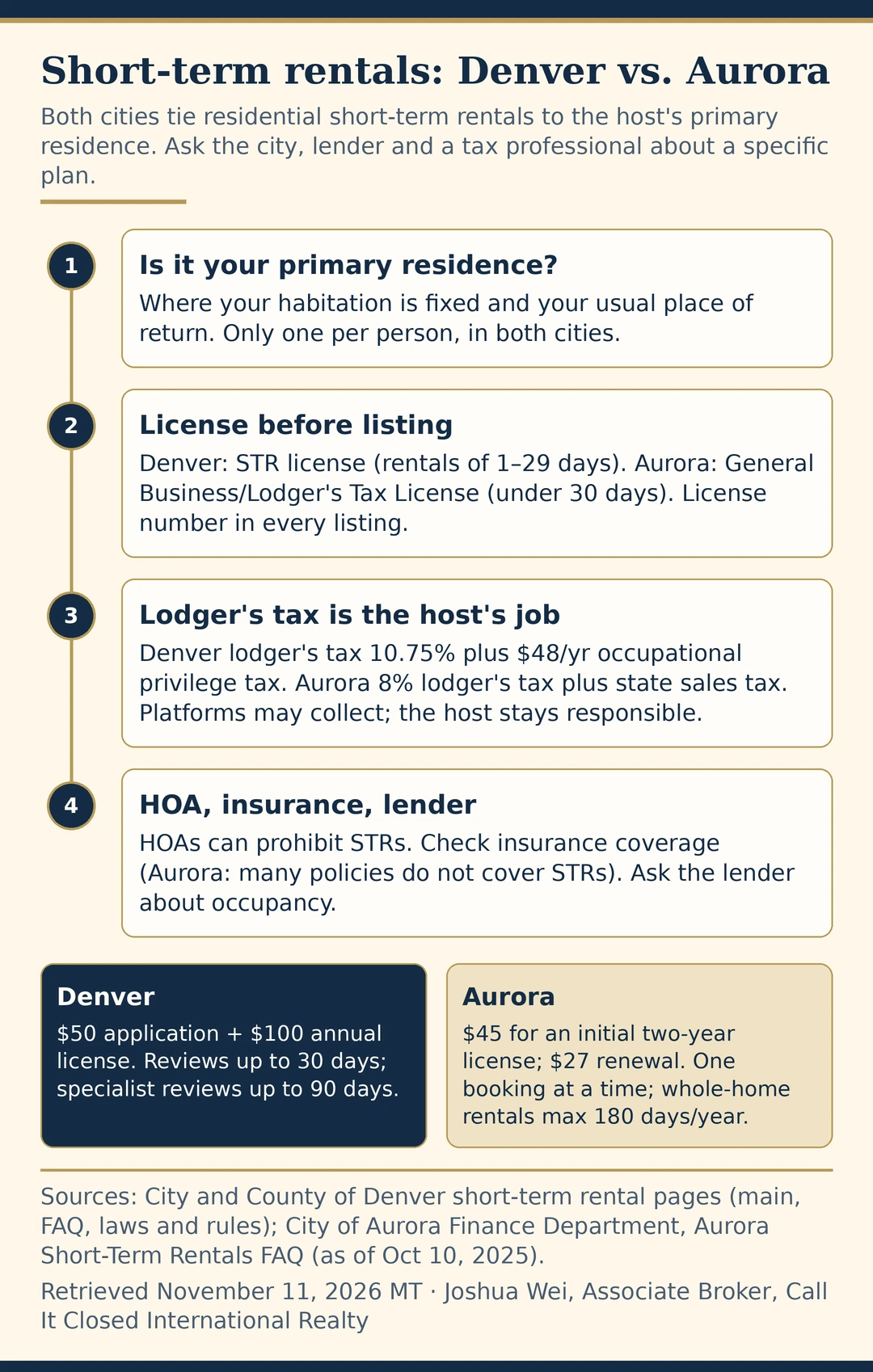
A vertical flow diagram, cream background with navy type and gold accents, titled Short-term rentals: Denver vs. Aurora, with the subtitle both cities tie residential short-term rentals to the host's primary residence, check before you count on rental income. Four numbered steps: 1, is it your primary residence, meaning where your habitation is fixed and your usual place of return, only one per person in both cities; 2, license before listing, with a Denver short-term rental license for rentals of 1 to 29 days and an Aurora General Business and Lodger's Tax License for under 30 days, and the license number in every listing; 3, lodger's tax is the host's job, with Denver lodger's tax of 10.75 percent plus a 48 dollar per year occupational privilege tax, and Aurora 8 percent lodger's tax plus state sales tax, where platforms may collect but the host stays responsible; 4, HOA, insurance, and lender, since HOAs can prohibit short-term rentals, insurance coverage should be checked because in Aurora's words many policies do not cover them, and the lender should be asked about occupancy. Two lower cards: Denver, a 50 dollar application plus a 100 dollar annual license, with reviews up to 30 days and specialist reviews up to 90 days; and Aurora, 45 dollars for an initial two-year license and 27 dollars to renew, one booking at a time, and whole-home rentals capped at 180 days per year. Sources: City and County of Denver and City of Aurora. Retrieved November 11, 2026 MT.
Sources: Denver Short-term rentals (opens in a new tab); Aurora Short-Term Rentals FAQ (PDF) (opens in a new tab)
Cream background, navy text, gold rules. Four numbered steps on a gold spine, two side-by-side city cards, and a 28px source footer.
The diagram above compares Denver's and Aurora's short-term rental rules side by side: primary residence, licensing, lodger's tax, and the limits that matter to a buyer. It summarizes each city's official pages.
What counts as a primary residence in Denver?
Denver says: "Primary residence means the place where a person's habitation is fixed for the term of the license and is the person's usual place of return. A person can have only one primary residence." It adds: "Note the common use of the term "usual," meaning "more often than not.""
The city lists factors it may weigh, including "Whether the address listed on an applicant's legal documents or tax assessment records is different than the address of the short-term rental" and "Whether the amount of time that the short-term rental has been, or will be, rented within the calendar year indicates the short-term rental is or is not the applicant's primary residence."
Its examples are blunt. "Primary residence does not include any qualifier such as "when I'm in Denver" or "when the home is not rented."" And: "Returning to a home for purpose of cleaning or "turn over" between STR stays would not qualify as returning for this purpose."
Denver's FAQ (opens in a new tab) also separates the city test from other residency claims: "Claiming primary residence with state or other governmental entities does not in itself meet the city definition." Its example is a tax filing: "claiming primary residence at a location for tax purposes would not necessarily make it a person's primary residence for purposes of obtaining a short-term rental license."
The FAQ walks through scenarios that matter to a buyer weighing a move:
- Family elsewhere. "It is the applicant's burden to prove their primary residence is separate from that of their spouse and family."
- Job relocation. "If a person is relocated away from the STR location for work or school, then the STR location would likely cease being the place where their habitation is fixed and would therefore no longer qualify as their primary residence."
- Work travel. "If a person travels for work, but still usually returns to the STR location, it would continue to qualify as their primary residence."
- Military deployment. Deployment is a factor the city "may consider," and "simply changing permanent residence paperwork to a location without the other conditions being met would not make it their primary residence."
On proof, Denver "requires documentation of primary residency" "upon application and renewal of a short-term rental license," and "The director also has the authority to request additional documentation that is pertinent to establishing primary residency." An inspection can be required, and the FAQ adds: "Refusal to allow inspection will result in denial of the application."
Renters can host too, with permission. Denver's FAQ (opens in a new tab) says: "Property owners and long-term renters can apply for a license at their primary residence."
Can I buy the home in an LLC or trust and still host in Denver?
Denver's zoning rules point the other way. The city's one-page handout of Denver Zoning Code short-term rental provisions (opens in a new tab) quotes section 11.8.10.1.B: a short-term rental "Shall be operated by the person or persons maintaining the dwelling unit use as their primary residence. For purposes of this provision, "person or persons" shall not include any corporation, partnership, firm, association, joint venture, or other similar legal entity." The Department's rules (opens in a new tab) define a "Licensee" as "any natural person holding a Short-Term Rental license."
How a particular trust or entity structure fits those words is a question for a Colorado attorney and the city's licensing office before you choose how to take title.
The same zoning section lists other limits a buyer should know about. A short-term rental:
- "Shall not include rentals where the length of stay per guest visit is 30 or more days."
- "Shall not be located in mobile homes, recreational vehicles, or travel trailers."
- "Shall not have any employees or regular assistants not residing in the primary or accessory dwelling unit located on the subject zone lot."
- "Shall not include simultaneous rental to more than one party under separate contracts."
- "Shall not be subject to a maximum number of guests per night."
The zoning definition in section 11.12.7.7 also excludes events: a short-term rental "does not include rental of a dwelling unit for meetings such as luncheons, banquets, parties, weddings, fund raisers, or other similar gatherings for direct or indirect compensation."
Duplexes, condos, and ADUs in Denver
The property type you buy changes what Denver allows. The city's ADU and short-term rental questions and answers (opens in a new tab) cover several buyer plans directly:
- Duplex, live in one side and host the other. The answer is "No." The city explains that "Duplexes contain two independent primary dwelling units," and "Even if a duplex is sold on one deed, one unit still cannot be used as a short-term rental by the person living in the other unit."
- Two neighboring condos. Asked whether a buyer can "buy two neighboring condo units and use one as my primary residence and one as a shortterm rental," the answer is "No. Two neighboring condo units are two independent primary dwelling units with neither one having a subordinate relationship to the other."
- Live in the main house, host the ADU. "Yes." Denver says this aligns with rules "that require the primary use of the zone lot to occur in the primary dwelling unit and the accessory use to occur in the ADU."
- Live in the ADU, host the main house. "No." The document says "you must maintain the primary dwelling unit as your primary residence to operate a short-term rental within either the primary dwelling unit or a permitted ADU."
- A tiny house on the driveway. "A tiny house or similar structure that is not built on a permanent foundation or connected to the water and sewer system cannot be considered as an ADU."
The same document gives one alternative for the main house when the owner moves into the ADU: "You may, however, use the primary dwelling unit as a long-term rental, which would be categorized as a primary residential use." Long-term rentals in Denver need their own license, covered in the related note on Denver's rental license below.
State law leaves room for these local rules. Colorado's 2024 ADU law, C.R.S. 29-35-403(2)(b) (opens in a new tab), bars a covered jurisdiction from requiring an ADU or the main home to be owner-occupied, "except that a subject jurisdiction may require a property owner to demonstrate that the property owner resides on the parcel when an application is submitted" "For a license or permit for a short-term rental on the parcel through a local law or program." Section 29-35-403(3)(g) also says the law does not prevent a local government from "Enacting or applying a local law concerning the short-term rental of an accessory dwelling unit or any other dwelling on the same lot as an accessory dwelling unit."
What if the home will not be my primary residence?
Denver's FAQ answers this directly: "If the property is not your primary residence, it is not eligible to be licensed as a short-term rental. To rent such a property on a short-term basis, you need to get a lodging facility license." It warns that "Lodging facilities are restricted to certain zone districts" and that "A change of building occupancy classification could be required and will likely have construction impacts, including but not limited to requirements for a fire sprinkler system, a fire alarm/detection system, exit signage, and accessibility upgrades."
Aurora's FAQ says investment properties "are not permitted as a home occupation," but "if the property is owner-occupied, you may qualify as a Bed and Breakfast," which "may require a conditional use permit, which must be approved by the Planning Commission." It adds: "A property that is not owner-occupied would be considered a Boardinghouse. Boardinghouses are only allowed in higher-density residential or mixed-use zones." The FAQ also says "The City of Aurora will be reviewing the possibility of allowing investment properties to operate as STRs in the future." The FAQ describes a review, not an adopted change, so ask Aurora's Planning and Development Services about the current status for a specific address.
What does a Denver license cost, and what taxes apply?
Denver's FAQ states: "An application fee of $50 and an annual license fee of $100 will be assessed for individual short-term rental license applications. Short-term rental licenses are for one year and must be renewed on time to avoid fines."
On taxes: "Short-term rental licensees must pay lodger's tax (10.75%), occupational privilege tax ($48 a year), and any other applicable taxes or fees."
On advertising, Denver's laws and rules page (opens in a new tab) says: "All advertisements must display the host's business license number."
Timing matters for a new owner. The main page says: "Initial reviews for short-term rental applications can take up to 30 days. Specialist reviews can take up to 90 days." It also says: "We do not provide pre-approval. In order for a license to be considered an application has to be submitted." For renewals, the FAQ says "Short-term rental licenses can be renewed up to 60 days before expiration," and lodger's "Tax accounts must be renewed every odd year."
Denver's Finance Department taxation handout (opens in a new tab) (revised March 2026) explains how the lodger's tax works with platforms. "When you use a licensed vendor platform who will remit the Lodger's Tax portion of your sales, then you may deduct those corresponding sales in your Other Deductions line on the Lodger's Tax Return." If a platform does not collect Denver's tax, "you are still required to collect and remit the Lodger's tax on those sales." The tax "is to be collected at the time of sale, regardless of when the lodging occurs." The $48 occupational privilege tax figure lines up with the handout's rule that owners "are subject to the Business OPT at a rate of $4.00 per month for each owner, partner or manager."
Filing frequency depends on the amount of tax. Per the handout, "Monthly filing is required if the average monthly tax liability for the previous six months exceeds $600.00," quarterly filing "is allowed if the monthly tax liability for the preceding six months averages $600.00 or less," and annual filing "is allowed if the monthly tax liability for the preceding six months averages $15.00 or less."
Denver's insurance, HOA notice, and local contact rules
Denver's short-term rental rules (opens in a new tab) add requirements that reach beyond the license application:
- Tell your insurer. Rule 3.1: "A Licensee shall inform his or her Insurance Company that the property covered by the Insurance Company will be used as a Short-Term Rental before any Short-Term Rental Transaction is processed."
- Liability coverage. Rule 3.2 requires liability insurance "in any case no amount of less than one million dollars ($1,000,000) in the aggregate," or, as an alternative, booking through "a Hosting Platform that provides equal or greater insurance coverage for each Short-Term Rental Use."
- Tell your HOA. Rule 3.3: if the property is in a homeowners association, the applicant "shall inform the Home Owners Association that the applicant intends to use the property as a Short-Term Rental prior to obtaining a Short-Term Rental license." The applicant signs an affidavit confirming this.
- Local contact. The FAQ says "The name and contact information of a general manager/local responsible party must also be provided as part of the license application. This person must be available to address issues when the licensee is out of town." Rule 6.1 requires changes to that contact to be reported "within 30 days of the change."
On enforcement, the FAQ says the director can "levy penalties, fines, suspension, or show-cause hearings that could lead to revocation of a license," and "Fines can be up to $999 per incident." Denver's laws page notes that Council Bill CB20-1229, effective February 1, 2021, prohibits "booking service providers from processing transactions for accommodations at properties not properly licensed as short-term rentals."
What are Aurora's rules?
Aurora's FAQ defines a short-term rental this way: "If you rent your home for less than 30 days, this is considered a short-term rental (STR)." It defines primary residence as "the place you usually return to and live during the time your STR license is active. You may only have one primary residence."
Key operating rules from the FAQ:
- "Obtain an Aurora General Business/Lodger's Tax License before you list or operate your STR."
- "After you receive your license, you must include the number in your online listings."
- "Only one booking at a time is allowed (you may rent multiple rooms or the whole house to one group, but not to different groups at the same time)"
- "You may only rent out your entire home for a maximum of 180 days per year. Exceeding this limit may indicate that the home is not your primary residence and would violate city rules."
On cost: "The initial application and two-year license fee is $45. The two-year license renewal fee is $27."
On taxes: "You must collect and pay 8% lodger's tax to the City of Aurora, and collect and pay state sales tax to the Colorado Department of Revenue." The FAQ notes that platforms "usually collect and pay these taxes for you. However, you are responsible for making sure the taxes are being collected and submitted correctly."
On proof of residence, Aurora says "City licensing and code inspectors have the authority to request documents that show the home is your primary residence," including a "Notarized Affidavit," a "Driver's license or State ID card," "Voter registration," "Tax documents," and "Utility bills." On enforcement, "The city will monitor the STR for licensing and tax collection compliance, respond to complaints through code enforcement, audit tax collection records, and/or issue municipal court summonses and fines for violations."
On safety, Aurora says an in-person inspection is not required, "However, the home must have properly working carbon monoxide detectors installed (required by Colorado state law)."
How does Colorado's state sales tax fit in?
Aurora's FAQ points hosts to the Colorado Department of Revenue for state sales tax. The Department's publication Sales & Use Tax Topics: Rooms & Accommodations (opens in a new tab) (revised April 2026) says "Colorado imposes sales tax on the entire amount charged for rooms and accommodations," and "a room cleaning charge is generally considered part of the charge for rooms and accommodations and is therefore subject to sales tax."
For platform bookings, the publication says "The marketplace facilitator is required to collect and remit the applicable state and state-administered sales taxes, as well as any applicable county lodging tax and local marketing district tax." It also says its guidance does not cover "any sales taxes administered by any home-rule city." Denver's and Aurora's lodger's taxes are the cities' own taxes, so each city's rules above control those. Which taxes a particular platform collects for your address is a question for the platform, the city, and a tax advisor.
Buying a tenant-occupied home to turn into a short-term rental
If the home you are buying has a long-term tenant, Colorado's for-cause eviction law applies. C.R.S. 38-12-1303(3)(a) (opens in a new tab) lists, as a no-fault ground, when a landlord plans to "convert it to a short-term rental property." The landlord may proceed "at the end of the term of the rental agreement" only if the landlord "Allows the tenant at least ninety days after receiving the written notice" to vacate and serves a written notice that includes "The date by which the tenant must vacate the residential premises" and "a material demonstration of the proposed date upon which the project will commence, such as a copy of a building permit or application for a permit or license to operate a short-term rental property, where applicable."
Section 38-12-1303(5)(b) adds that the notice "must include a statement of the legal and factual basis for the landlord's no-fault eviction of the tenant." In Denver and Aurora, that conversion also has to fit the cities' primary-residence rule, so the plan only works if you will live there. Timing and notice questions for a tenant-occupied purchase belong with a Colorado attorney. The related note on buying a Denver or Aurora home with a tenant in it covers the lease side.
Can an HOA ban short-term rentals?
Denver's FAQ says: "Homeowners associations (HOAs) can prohibit short-term rentals through their private covenants and rules." Aurora's FAQ tells hosts to check that "Your Homeowners Association (HOA) or landlord allows STRs (some may not—check before listing)."
If rental income matters to your purchase, read the HOA declaration and rules during your document review period, not after closing.
A worked example (invented)
This example is invented to show how the rules stack up; it is not a real property or client.
A buyer is choosing between two Denver listings. The first is a side-by-side duplex; the plan is to live in the north unit and host the south unit on a short-term platform. The second is a single-unit house with a permitted detached ADU over the garage.
- The duplex. Denver's ADU and short-term rental Q&A answers "No" to living in one duplex unit and hosting the other. The south unit could be a long-term rental under Denver's residential rental license instead, or the buyer could host rooms in the north unit while living there.
- The house with an ADU. Denver's Q&A answers "Yes" to living in the main house and hosting the ADU, as long as the main house stays the buyer's primary residence. If the buyer later moves into the ADU, the Q&A says the main house cannot become the short-term rental.
In either case, the buyer still has to check the HOA documents, tell the insurer before the first booking, carry or rely on the required liability coverage, register for lodger's tax, and wait for the license review, which "can take up to 30 days," with specialist reviews up to 90 days.
What should a buyer check?
- Primary residence. Both cities tie residential short-term rentals to the host's primary residence; ask the city about a specific plan.
- City rules for that address. Denver covers the City and County of Denver. Aurora's FAQ covers "most residential areas of Aurora."
- Property type. In Denver, a duplex unit or a second condo is not an accessory unit, per the city's Q&A; an ADU behind the house you live in can be.
- How you take title. Denver's zoning text says "person or persons" "shall not include any corporation, partnership, firm, association, joint venture, or other similar legal entity." Ask a Colorado attorney before buying in an entity.
- HOA documents. Denver's FAQ says HOAs "can prohibit short-term rentals through their private covenants and rules."
- Insurance. Aurora's FAQ warns: "Make sure your homeowner's insurance covers STRs. Many policies do not."
- Loan terms. How rental use fits a loan's occupancy terms is a question for your lender.
- Taxes. Both cities place lodger's tax responsibility on the host, as quoted in the FAQ below. Income tax questions are for a tax professional.
Related: Aurora property tax and metro district checklist (opens in a new tab).
Frequently asked questions
Can I buy a second home in Denver and Airbnb it?
Denver requires the rental to be your primary residence, and "A person can have only one primary residence."
Can I live in my Denver ADU and rent the main house short-term?
No, per Denver's Q&A: "If you are living in the ADU, you are not maintaining the primary dwelling unit as your primary residence because your primary residence is in the ADU."
Are there fines for hosting without a Denver license?
Denver's FAQ says "Fines can be up to $999 per incident," and the city's 2020 ordinance bars booking platforms from processing reservations for unlicensed properties.
Can I rent my basement or ADU short-term?
Aurora's FAQ says ADUs "can be used for short-term rentals, but only if the ADU is allowed under current zoning regulations." Denver's ADU permit page says short-term rentals of ADUs "require licenses."
What about 30-day-plus rentals?
Denver says that for rentals of "30-plus days at a time, a residential rental property license is required." Aurora treats a rental of more than 30 days with a written lease as long-term.
Do I need to be home while guests stay?
Aurora's FAQ says no, "as long as the property is your primary residence and you are away temporarily (e.g., on vacation)."
Does Airbnb handle the taxes?
Both cities place the responsibility on the host. Aurora says "you are responsible for making sure the taxes are being collected and submitted correctly."
Can I count projected Airbnb income to qualify for a loan?
That is a lender question. This article does not address loan qualification.
Related notes
- Buying a home you might rent out? Denver's rental license and Aurora's rental rules, explained
- ADUs in Denver and Aurora: what Colorado's 2024 law, Denver's permit rules, and Aurora's pending update say
- What a Colorado HOA can't prohibit: flags, signs, xeriscape, EV chargers, heat pumps, and more for Denver and Aurora owners
Sources and method
Official sources, retrieved November 11, 2026, America/Denver: City and County of Denver Short-term rentals (opens in a new tab), Short-term rental FAQ (opens in a new tab), laws, rules, and regulations (opens in a new tab), and ADU Permits (opens in a new tab) pages; City of Aurora Finance Department, Aurora Short-Term Rentals – FAQ (opens in a new tab) (as of October 10, 2025). Additional sources retrieved November 13, 2026: Denver Rules governing short-term rental licenses (opens in a new tab) (adopted January 25, 2019), Short-term rentals: Denver Zoning Code provisions (opens in a new tab) (revised May 28, 2019), ADUs and short-term rentals questions and answers (opens in a new tab), and Department of Finance Short Term Rental Taxation Information (opens in a new tab) (revised March 2026); Colorado Department of Revenue Sales & Use Tax Topics: Rooms & Accommodations (opens in a new tab) (revised April 2026); and Colorado Revised Statutes 2026 Title 38 (opens in a new tab) (C.R.S. 38-12-1303) and Title 29 (opens in a new tab) (C.R.S. 29-35-403), Office of Legislative Legal Services. Aurora's municipal code pages (Chapter 26) returned HTTP 403 to automated retrieval, so the city's FAQ is used instead. Quotations are verbatim. Fees and tax rates are as published by each city and may change.
This note is general education from a Colorado real estate broker with Call It Closed International Realty. If rental income is part of your plan for a Denver or Aurora home, I can help you check the city, HOA, and insurance rules before you commit.
Disclaimer
This article is general information only. It is not legal, tax, lending, insurance, appraisal, inspection, or financial advice, and it is not a substitute for advice about your situation. Joshua Wei is a Colorado real estate broker, not an attorney. Reading this article does not create a client relationship, an agency relationship, or an attorney-client relationship with Joshua Wei or with Call It Closed International Realty.
Laws, program rules, interest rates, insurance terms, tax figures, and other details change. Examples in this article are hypothetical illustrations unless a source is named for a specific, dated figure. Information in this article is believed accurate as of November 13, 2026 and is not guaranteed. No result is promised, and you should not rely on this article as the last word for your situation.
Before you act, confirm the point with the official source linked or cited in this article, and talk with a licensed professional who can apply the rule to your facts. That may be a licensed attorney, a tax professional, a lender, an insurance agent, a home inspector, or another licensed professional, depending on the question. Links to third-party websites and publications are provided for reference only. They are not an endorsement, and their content can change.
If you already have a brokerage relationship with another broker, this is not a solicitation.
Joshua Wei, Associate Broker, Call It Closed International Realty, Colorado license FA.100108558. Equal Housing Opportunity.