September 4, 2026 · Colorado · Buying · Title · Boundaries
Adverse possession in Colorado: the 18-year rule, the good-faith requirement, and the contract's survey sections
What Colorado's adverse possession statute, C.R.S. 38-41-101, actually requires. The 18-year period, clear and convincing evidence, the good-faith belief rule since 2008, compensation to the record owner, the bar against claims on public land, and how survey and title steps in a purchase can surface boundary problems.
The short answer
In brief: Colorado's main adverse possession statute, C.R.S. 38-41-101, says eighteen years' adverse possession of land is conclusive evidence of absolute ownership. Changes effective in 2008 require clear and convincing evidence of each element and, for title vesting on or after July 1, 2008, a reasonable good-faith belief of ownership. Survey and title steps in a purchase can surface boundary problems.
Colorado's main adverse possession statute is C.R.S. 38-41-101, in the 2026 Colorado Revised Statutes, Title 38 (opens in a new tab). It says "Eighteen years' adverse possession of any land shall be conclusive evidence of absolute ownership."
Changes that took effect in 2008 added requirements:
- The claimant must prove each element "by clear and convincing evidence."
- For title vesting on or after July 1, 2008, the claimant (or a predecessor) must have had "a good faith belief that the person in possession of the property of the owner of record was the actual owner of the property and the belief was reasonable under the particular circumstances."
The purchase contract's survey and title sections (sections 8.1.3 and 9) are where boundary questions come up in a sale. What a specific fence or structure means for a property line is a question for a professional land surveyor or a Colorado real estate attorney.
I am a licensed Colorado real estate broker with Call It Closed International Realty. I am not an attorney or a surveyor.
Disclaimer. This article is general information only. It is not legal, tax, lending, insurance, appraisal, inspection, or financial advice, and reading it does not create a client, agency, or attorney-client relationship. Laws, rates, programs, and figures change. Confirm the official source, and talk with a licensed attorney, tax professional, lender, insurance agent, or inspector before you act. Joshua Wei is a Colorado real estate broker, not an attorney. He is an Associate Broker with Call It Closed International Realty, license FA.100108558. Equal Housing Opportunity.
 Full size (opens in a new tab)
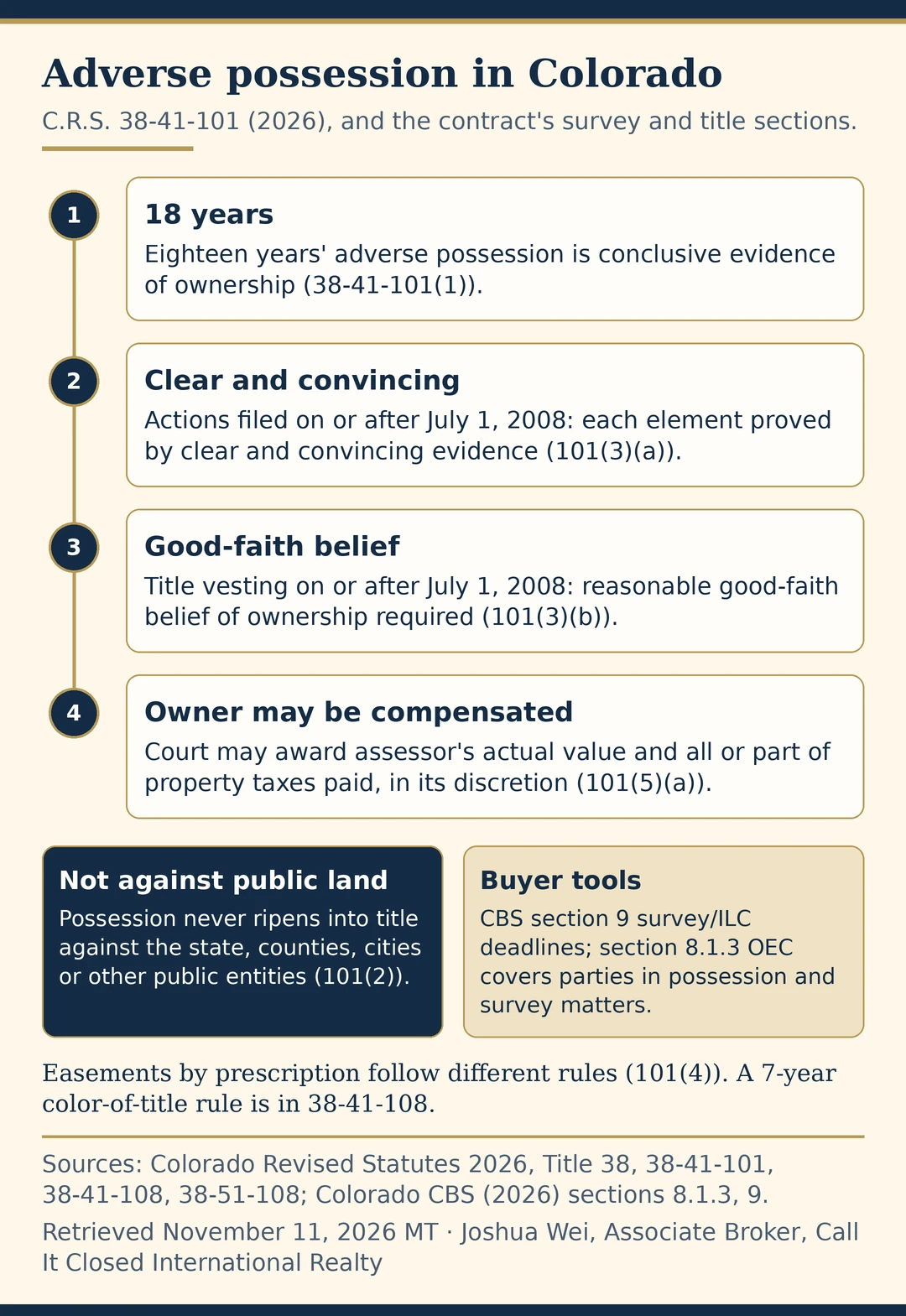
A vertical flow diagram, cream background with navy type and gold accents, titled Adverse possession in Colorado. Subtitle: C.R.S. 38-41-101 (2026), and the contract's survey and title sections. 4 numbered steps: 1, 18 years: Eighteen years' adverse possession is conclusive evidence of ownership (38-41-101(1)); 2, Clear and convincing: Actions filed on or after July 1, 2008: each element proved by clear and convincing evidence (101(3)(a)); 3, Good-faith belief: Title vesting on or after July 1, 2008: reasonable good-faith belief of ownership required (101(3)(b)); 4, Owner may be compensated: Court may award assessor's actual value and all or part of property taxes paid, in its discretion (101(5)(a)). Two cards: Not against public land: Possession never ripens into title against the state, counties, cities or other public entities (101(2)); and Buyer tools: CBS section 9 survey/ILC deadlines; section 8.1.3 OEC covers parties in possession and survey matters. A note says: Easements by prescription follow different rules (101(4)). A 7-year color-of-title rule is in 38-41-108. Sources: Colorado Revised Statutes 2026, Title 38, 38-41-101, 38-41-108, 38-51-108; Colorado CBS (2026) sections 8.1.3, 9. Retrieved November 11, 2026 MT. Joshua Wei, Associate Broker, Call It Closed International Realty.
Sources: C.R.S. 2026 Title 38 (opens in a new tab)
Cream background, navy text, gold rules. Numbered navy circles on a gold spine with white step cards, two branch cards (navy and tan), a note, and a source footer.
The figure above summarizes the statute's requirements and the contract sections that deal with surveys and title.
What the eighteen-year rule actually says
Section 38-41-101(1) is written as a deadline for lawsuits. It says "No person shall commence or maintain an action for the recovery of the title or possession or to enforce or establish any right or interest of or to real property or make an entry thereon unless commenced within eighteen years after the right to bring such action or make such entry has first accrued."
The adverse possession sentence follows: "Eighteen years' adverse possession of any land shall be conclusive evidence of absolute ownership." So the statute works two ways. It limits how long a record owner can wait to act, and it says what eighteen years of adverse possession proves.
What does a claimant have to prove?
Under 38-41-101(3)(b), for title vesting on or after July 1, 2008, the claimant must:
- present "evidence to satisfy all of the elements of a claim for adverse possession required under common law in Colorado"; and
- meet the good-faith belief requirement in the same subsection.
Under (3)(a), in civil actions filed on or after July 1, 2008, each element must be proved "by clear and convincing evidence." The common-law elements come from case law, which this article doesn't summarize; they are a question for a Colorado attorney.
Does the owner who loses land get paid?
Under 38-41-101(5)(a), if a claimant wins fee simple title, the court "may," after a separate evidentiary hearing and "if the court determines in its discretion that an award of compensation is fair and equitable under the circumstances," award the losing owner:
- damages "measured by the actual value of the property as determined by the county assessor as of the most recent valuation for property tax purposes"; and
- "An amount to reimburse the party losing title to the adverse possessor for all or a part of the property taxes and other assessments levied against and paid by" that party over the period the statute describes.
The tax reimbursement period runs "commencing eighteen years prior to the commencement of the adverse possession action and expiring on the date of the award or entry of final nonappealable judgment, whichever is later." The statute adds that "The amount of the award shall bear interest at the statutory rate from the dates on which the party losing title to the adverse possessor made payment of the reimbursable taxes and assessments."
If the lost strip hasn't been "separately taxed or assessed" from the rest of the owner's property, 5(a)(I) says "the court shall equitably apportion the actual value of the property to the portion of the owner's property lost by adverse possession," taking into account "the nature and character of the property lost and of the remainder."
A lower burden in two situations
Section 38-41-101(5)(b) sets a different standard for the compensation hearing and for one kind of defense. At a hearing under subsection (5), or where adverse possession "is claimed solely as a defense to an action for damages based upon a claim for trespass, forcible entry, forcible detainer, or similar affirmative claims," and not to win title, "the burden of proof shall be by a preponderance of the evidence."
A defendant raising adverse possession only as a defense "shall so state in a pleading filed by the defendant within ninety days after filing an answer," or within a longer period the court allows. How these rules apply in a dispute is a question for a Colorado attorney.
Can someone take city or county land this way?
Under 38-41-101(2), "No possession by any person, firm, or corporation, no matter how long continued, of any land, water, water right, easement, or other property whatsoever dedicated to or owned by the state of Colorado, or any county, city and county, city, irrigation district, public, municipal, or quasi-municipal corporation, or any department or agency thereof shall ever ripen into any title, interest, or right against the state of Colorado, or such county, city and county, city, public, municipal, or quasi-municipal corporation, irrigation district, or any department or agency thereof."
Do the 2008 rules apply to easements?
Subsection (4) says the stricter rules in (3) and (5) "shall not apply to the creation, establishment, proof, or judicial confirmation or delineation of easements by prescription, implication, prior use, estoppel, or otherwise." Easement questions are for a Colorado attorney.
The same subsection says (3) and (5) also don't apply "to claims or defenses for equitable relief under the common-law doctrine of relative hardships, or claims or defenses governed by any other statute of limitations specified in this article." Subsection (4) also says (3) and (5) "shall be limited to claims of adverse possession for the purpose of establishing fee simple title." A neighbor's claim to keep using a shared driveway or path, rather than to own it, is an easement question those subsections don't govern.
Is there a shorter period?
C.R.S. 38-41-108 covers a person in actual possession "under claim and color of title, made in good faith, who for seven successive years continues in such possession and also during said time pays all taxes legally assessed." How it applies to a particular situation is a question for a Colorado attorney.
The section says such a person "shall be held and adjudged to be the legal owner of said lands or tenements to the extent and according to the purport of his paper title." It also lets later owners count earlier time: "All persons holding under such possession by purchase, devise, or descent, before said seven years have expired, who continue such possession and continue to pay the taxes as provided in this section," get the benefit of the section. What counts as color of title in a given case is for a Colorado attorney.
What does the purchase contract provide?
The Commission's residential Contract to Buy and Sell Real Estate (opens in a new tab) addresses surveys and title:
- Section 9: deadlines for a "New ILC or New Survey" and for objecting to it.
- Section 8.1.3: if the title commitment includes Owner's Extended Coverage, it addresses standard exceptions including "(1) parties in possession, (2) unrecorded easements, (3) survey matters."
Which survey product fits a particular question is for a professional land surveyor or the title company.
Off-record matters and boundary discrepancies
Section 8.3 of the contract deals with problems that don't show up in the public record. The seller "must deliver to Buyer, on or before Off-Record Title Deadline, true copies of all existing surveys in Seller's possession pertaining to the Property and must disclose to Buyer all easements, liens (including, without limitation, governmental improvements approved, but not yet installed) or other title matters not shown by public records, of which Seller has actual knowledge."
The same section gives the buyer a right to look: "Buyer has the right to inspect the Property to investigate if any third party has any right in the Property not shown by public records (e.g., unrecorded easement, boundary line discrepancy or water rights)."
The buyer's objection or notice to terminate must be received by the Off-Record Title Objection Deadline. If it isn't, "Buyer accepts title subject to such Off-Record Matters and rights, if any, of third parties not shown by public records of which Buyer has actual knowledge." Our title commitment guide covers the record-title side.
Objection and resolution
Section 8.7 lets the buyer object or terminate over title matters, including off-record ones. If the parties haven't agreed in writing by the Title Resolution Deadline, "this Contract will terminate on the expiration of Title Resolution Deadline, unless Seller receives Buyer's written withdrawal of Buyer's Notice of Title Objection." The ILC and survey objection in section 9.3 follows a similar pattern with its own deadlines.
Extended coverage
The full list in section 8.1.3 says that if the commitment includes Owner's Extended Coverage, it "will commit to delete or insure over the standard exceptions which relate to: (1) parties in possession, (2) unrecorded easements, (3) survey matters, (4) unrecorded mechanics' liens, (5) gap period" and "(6) unpaid taxes, assessments and unredeemed tax sales prior to the year of Closing." The contract has checkboxes for who pays any added premium. What the title company requires to issue that coverage is a question for the title company.
ILC, improvement survey plat, or land survey plat?
Colorado's surveying statutes define the products. Under C.R.S. 38-51-102(8), an "Improvement location certificate" is "a representation of the boundaries of a parcel of land and the improvements thereon, prepared pursuant to section 38-51-108."
The certification an ILC must carry, under 38-51-108(2)(a)(II), says it "is not a land survey plat or improvement survey plat, and that it is not to be relied upon for the establishment of fence, building, or other future improvement lines." It also certifies "that there are no encroachments upon the described premises by improvements on any adjoining premises, except as indicated."
By contrast, 38-51-102(9) defines an "Improvement survey plat" as a land survey plat "resulting from a monumented land survey showing the location of all structures, visible utilities, fences, hedges, or walls situated on the described parcel and within five feet of all boundaries of such parcel, any conflicting boundary evidence or visible encroachments." Under 102(13), a "Monumented land survey" is one "in which monuments are either found or set" to mark the parcel's boundaries.
If you plan to build a fence, an addition or a garage near a line, that ILC language is the reason to ask a surveyor which product you need. Our fence rules guide covers Denver and Aurora permits and height limits.
What to look for, and what to ask
On a showing or during inspections, a few things are worth noting and raising with your broker:
- a fence, wall or hedge that doesn't run straight or seems to cut into one yard
- a shared driveway, or a neighbor's shed, garden or parking pad close to the line
- a path or gate neighbors seem to use
- a recent survey stake or marker that doesn't match the fence
Questions to ask in writing:
- Seller: Do you have any existing surveys? Are you aware of any unrecorded easement, boundary dispute or agreement with a neighbor? (These track section 8.3.)
- Title company: Does the commitment include Owner's Extended Coverage? What will you need to remove the survey and parties-in-possession exceptions?
- Surveyor: Will an ILC answer my question, or do I need an improvement survey plat? Will you set or find monuments?
- Attorney: If something on the line is off, what are my options before the deadline?
A hypothetical example
This example is invented, to show where the contract steps fall. It is not legal advice.
A buyer is under contract on a Denver bungalow. The New ILC arrives and shows the rear fence standing about two feet onto the neighbor's lot. The seller says the fence was there when he bought the house twelve years ago.
- The buyer notes the New ILC or New Survey Objection Deadline and the Off-Record Title Objection Deadline in the contract.
- Because the ILC says it is "not to be relied upon for the establishment of fence" lines, the buyer asks a surveyor about an improvement survey plat.
- The buyer asks a Colorado real estate attorney what the fence means for title. The buyer's broker sends a written objection before the deadline.
- If the parties can't agree in writing by the resolution deadline, the objection process in sections 8.7 or 9.3 sets out what happens next.
If you're the seller
Under section 8.3, a seller delivers "true copies of all existing surveys in Seller's possession" and discloses off-record title matters "of which Seller has actual knowledge." Gathering any old survey or ILC, and any written agreement with a neighbor, before listing can save time later. What you're required to disclose about a specific boundary issue is a question for your attorney. Our Seller's Property Disclosure guide covers the disclosure form.
Frequently asked questions
How long is adverse possession in Colorado?
Eighteen years under C.R.S. 38-41-101(1). There's a separate seven-year rule for possession under color of title with taxes paid (38-41-108).
Can my neighbor take my yard just by using it for 18 years?
For title vesting since July 1, 2008, the claimant must also prove a reasonable good-faith belief and meet the clear and convincing standard. Applying those rules to a specific yard is a question for a Colorado attorney.
Can someone adversely possess city land in Colorado?
Subsection (2) says "No possession by any person, firm, or corporation, no matter how long continued, of any land, water, water right, easement, or other property whatsoever dedicated to or owned by" the state, a county, a city, an irrigation district or another listed public body "shall ever ripen into any title, interest, or right" against it. Whether a specific parcel is publicly owned is a question for the title company or a Colorado attorney.
Do I have to pay if I win an adverse possession case?
Under 38-41-101(5)(a), the court "may" award the record owner compensation "if the court determines in its discretion that an award of compensation is fair and equitable under the circumstances." Whether that applies in a specific case is a question for a Colorado attorney.
Is a prescriptive easement the same thing?
Subsection (4) says the 2008 requirements "shall not apply" to easements by prescription and other easements it lists.
Does an ILC prove where my property line is?
Under C.R.S. 38-51-108, an ILC "shall not be designated as or construed as being a land survey plat or improvement survey plat." Which product answers a given question is for a professional land surveyor.
Does the seller have to give me old surveys?
CBS section 8.3 says the seller "must deliver to Buyer, on or before Off-Record Title Deadline, true copies of all existing surveys in Seller's possession pertaining to the Property."
What if I miss the off-record objection deadline?
Under section 8.3, the buyer "accepts title subject to such Off-Record Matters and rights, if any, of third parties not shown by public records of which Buyer has actual knowledge."
Does the 2008 law affect a dispute over a shared driveway?
Subsection (4) of 38-41-101 says the 2008 rules don't apply to easements by prescription, implication, prior use or estoppel. A driveway dispute is a question for a Colorado attorney.
Related notes
- ILC or survey? What Denver and Aurora buyers should know about Improvement Location Certificates
- Reading your title commitment: what Denver and Aurora buyers should check before the title objection deadline
- Special warranty, general warranty, or quitclaim? Colorado deed types for Denver and Aurora buyers, explained
- Fence rules and permits in Denver and Aurora
Sources and method
Official sources, retrieved November 11 and 13, 2026, America/Denver:
- Colorado Revised Statutes 2026, Title 38 (opens in a new tab): C.R.S. 38-41-101, 38-41-108, 38-51-102 and 38-51-108
- Colorado Real Estate Commission, Contract to Buy and Sell Real Estate (Residential), for use on and after January 1, 2026 (opens in a new tab): sections 8.1.3, 8.3, 8.7, 9
Quotations are verbatim from the statutes and the contract. The common-law elements and case law aren't summarized here. The example is hypothetical.
This note is general education from a Colorado real estate broker with Call It Closed International Realty. If a fence or driveway on a Denver or Aurora home doesn't look right, I'll help you raise it before your survey and title deadlines.
Disclaimer
This article is general information only. It is not legal, tax, lending, insurance, appraisal, inspection, or financial advice, and it is not a substitute for advice about your situation. Joshua Wei is a Colorado real estate broker, not an attorney. Reading this article does not create a client relationship, an agency relationship, or an attorney-client relationship with Joshua Wei or with Call It Closed International Realty.
Laws, program rules, interest rates, insurance terms, tax figures, and other details change. Examples in this article are hypothetical illustrations unless a source is named for a specific, dated figure. Information in this article is believed accurate as of November 13, 2026 and is not guaranteed. No result is promised, and you should not rely on this article as the last word for your situation.
Before you act, confirm the point with the official source linked or cited in this article, and talk with a licensed professional who can apply the rule to your facts. That may be a licensed attorney, a tax professional, a lender, an insurance agent, a home inspector, or another licensed professional, depending on the question. Links to third-party websites and publications are provided for reference only. They are not an endorsement, and their content can change.
If you already have a brokerage relationship with another broker, this is not a solicitation.
Joshua Wei, Associate Broker, Call It Closed International Realty, Colorado license FA.100108558. Equal Housing Opportunity.