September 29, 2026 · Denver · Aurora · Selling · Buying
Selling in Denver or Aurora? What Colorado's Seller's Property Disclosure asks, and what "actual knowledge" means
Colorado sellers fill out the Real Estate Commission's Seller's Property Disclosure (SPD19, mandatory January 1, 2026). What the form and the purchase contract say about current actual knowledge, adverse material facts, radon, insurance claims, short-term rentals, and updates after you sign.
The short answer
In brief: Colorado sellers using a Real Estate Commission contract complete the Seller's Property Disclosure, form SPD19, mandatory since January 1, 2026. The form says it should be completed by the seller, not the broker, and that the answers are correct to the seller's current actual knowledge as of the date signed. The contract also sets a deadline for delivering it.
When you sell a Denver or Aurora home with a Colorado Real Estate Commission contract, Section 10.1 of the contract calls for a long form called the Seller's Property Disclosure. The current residential version, SPD19, is posted on the Colorado Division of Real Estate's contracts and forms page (opens in a new tab). The form itself shows an adoption date of August 5, 2025, and a mandatory use date of January 1, 2026.
The form's own first instruction is: "THIS SELLER'S PROPERTY DISCLOSURE SHOULD BE COMPLETED BY SELLER, NOT BY BROKER." Its standard is narrow and specific. The form states that the seller's information "is correct to Seller's CURRENT ACTUAL KNOWLEDGE as of the date signed by Seller," and its advisory to buyers explains that "current actual knowledge" is "intended to limit Seller's disclosure only to facts actually known by the Seller and does not include 'constructive knowledge' or 'common knowledge' or what Seller 'should have known' about the Property."
That is not a license to be vague. The same form says: "If Seller has knowledge of an adverse material fact affecting the Property or occupants, it must be disclosed whether there is a specific item on this SPD or not." And it warns: "Seller's failure to disclose a known adverse material fact affecting the Property or occupant may result in legal liability."
This article walks through what the form asks, how the purchase contract ties into it, and the sections that tend to matter in Front Range homes. It is not legal advice about what you must disclose about a particular condition. That question belongs with a real estate attorney.
I am a licensed Colorado real estate broker with Call It Closed International Realty. I am not an attorney, an inspector, or a tax advisor. Under the form's own instruction, I should not fill out your disclosure for you.
Disclaimer. This article is general information only. It is not legal, tax, lending, insurance, appraisal, inspection, or financial advice, and reading it does not create a client, agency, or attorney-client relationship. Laws, rates, programs, and figures change. Confirm the official source, and talk with a licensed attorney, tax professional, lender, insurance agent, or inspector before you act. Joshua Wei is a Colorado real estate broker, not an attorney. He is an Associate Broker with Call It Closed International Realty, license FA.100108558. Equal Housing Opportunity.
 Full size (opens in a new tab)
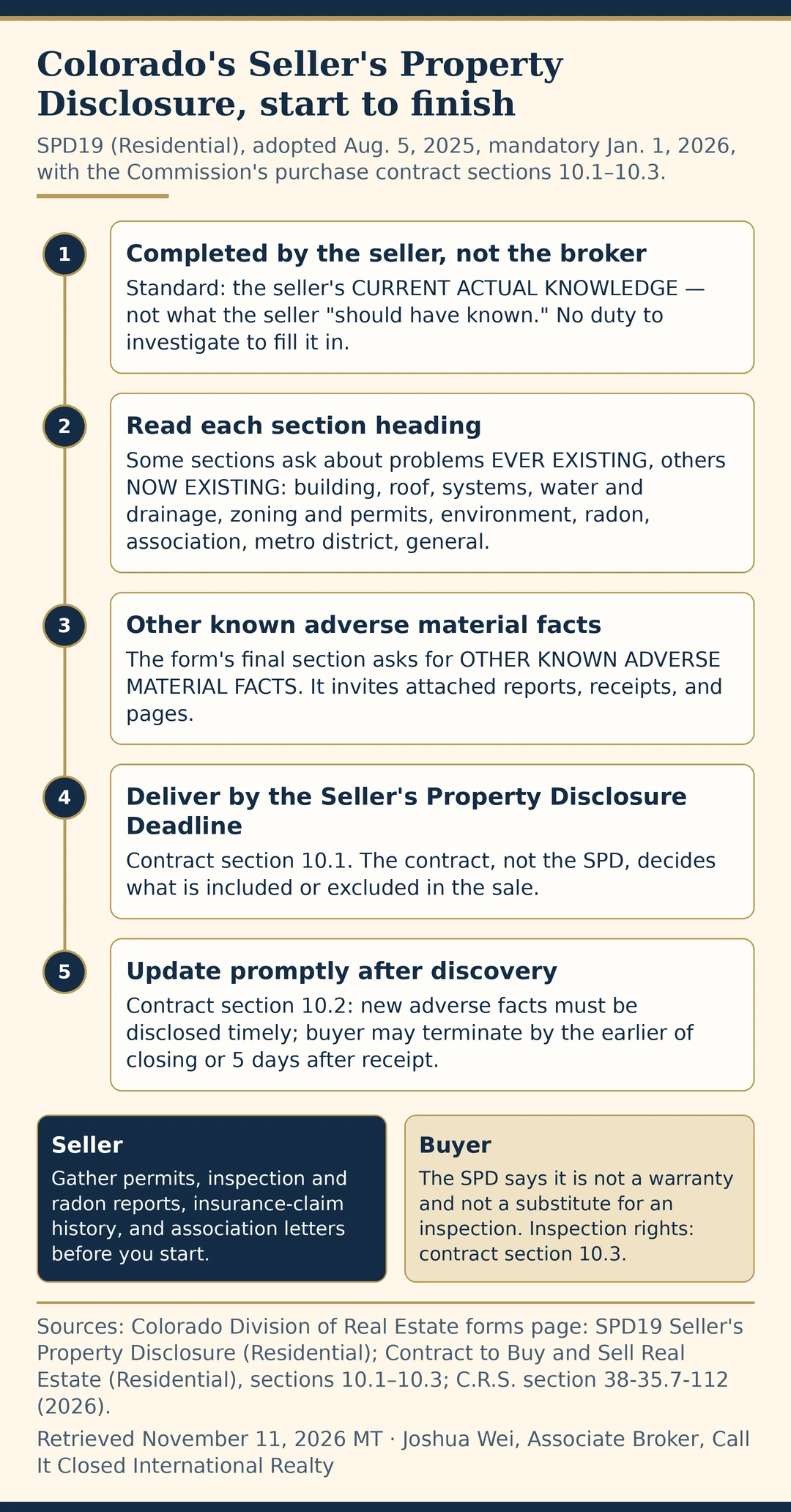
A vertical flow diagram, cream background with navy type and gold accents, titled Colorado's Seller's Property Disclosure, start to finish, covering SPD19 (Residential), adopted August 5, 2025 and mandatory January 1, 2026, with the Commission purchase contract sections 10.1 through 10.3. Five numbered steps: 1, completed by the seller, not the broker, to the seller's current actual knowledge, not what the seller should have known, with no duty to investigate to fill it in; 2, read each section heading, because some sections ask about problems ever existing and others now existing, across building, roof, systems, water and drainage, zoning and permits, environment, radon, association, metro district, and general sections; 3, the form's final section asks for other known adverse material facts, and invites attached reports, receipts, and pages; 4, deliver by the Seller's Property Disclosure Deadline under contract section 10.1, and the contract, not the SPD, decides what is included or excluded; 5, update promptly after discovery, since under section 10.2 new adverse facts must be disclosed timely and the buyer may terminate by the earlier of closing or 5 days after receipt. Two lower cards: for the seller, gather permits, inspection and radon reports, insurance-claim history, and association letters before starting; for the buyer, the SPD says it is not a warranty and not a substitute for an inspection; inspection rights are in contract section 10.3. Sources: Colorado Division of Real Estate forms page, SPD19, the residential purchase contract, and C.R.S. section 38-35.7-112. Retrieved November 11, 2026 MT.
Sources: Colorado Division of Real Estate, contracts and forms (SPD19; CBS1) (opens in a new tab); Official 2026 C.R.S. Title 38 (includes section 38-35.7-112) (opens in a new tab)
Cream background, navy text, gold rules. Five numbered steps on a gold spine, two side-by-side seller and buyer cards, and a 28px source footer.
The diagram above follows the SPD19 from start to finish: the knowledge standard, the sections of the form, the contract deadline, and the duty to update. It summarizes the official form; it is not a substitute for reading it.
How does the purchase contract connect to the disclosure?
The Commission's residential purchase contract, the Contract to Buy and Sell Real Estate (Residential), also posted on the DRE forms page (opens in a new tab), sets the timing. Section 10.1 states: "On or before Seller's Property Disclosure Deadline, Seller agrees to deliver to Buyer the most current version of the applicable Colorado Real Estate Commission's Seller's Property Disclosure form completed by Seller to Seller's actual knowledge and current as of the date of the Seller's Property Disclosure Deadline."
The deadline is a date the parties fill in, not a fixed number of days. Some listing brokers ask sellers to complete the form before the home goes on the market, so buyers can read it before they write offers. The SPD says: "Broker is authorized to deliver a copy of this SPD to prospective buyers."
Section 10.2 of the contract then adds a separate, ongoing duty: "Seller must disclose, in writing, to Buyer any adverse material facts actually known by Seller as of the date of this Contract. In the event Seller discovers an adverse material fact after the date of this Contract, Seller must timely disclose such adverse fact to Buyer." It also gives the buyer a specific remedy: "Buyer has the Right to Terminate based on the Seller's new disclosure on the earlier of Closing or five days after Buyer's receipt of the new disclosure."
The SPD repeats the update duty in its own words: "Any changes to the disclosures herein must be disclosed by Seller to Buyer promptly after discovery."
Whether a new condition must be disclosed is a question for a real estate attorney.
What does the form actually ask?
SPD19 is 14 pages. It is divided into "Improvements" and "General" parts, with lettered sections. Many sections ask whether you know of a problem "EVER EXISTING," and some ask only about conditions "NOW EXISTING." Reading the heading of each section matters.
Sections that bear on conditions in Denver and Aurora homes:
Building conditions. Section A asks about problems "EVER EXISTING," including "Structural problems with improvements," "Moisture and/or water, including but not limited to, leakage/seepage in the basement/crawlspace," "Damage due to hail, wind, fire, flood, or other casualty," and "Any settling, movement, cracking, heaving or breakage" of foundations, floors, walls, driveways, sidewalks, patios, and retaining walls.
Flooding and drainage. Section J asks about "Flooding," "Drainage," "Grading," "Water intrusion in the basement, crawl space, or other parts of Property," and "Repairs made to control water intrusion." It separately asks about "Drainage or retention ponds, dams, storm water detention basins, or other similar facilities."
Use, zoning, and legal issues. Section L includes "Any additions or non-aesthetic alterations made without a Building Permit," "Any part of the Property leased to others (written or oral)," and "Used for short-term rentals in the past year."
Environmental conditions. Section N includes "Sliding, settling, upheaval, movement or instability of earth, or expansive soils on the Property," "Within a governmentally designated floodplain or wetland area," "Smoking inside improvements," and "Animals kept in the residence."
Radon. Section O asks whether "Radon test(s)" were conducted, whether "Radon concentrations" were detected or mitigation performed, and whether a "Radon mitigation system" is installed, and asks the seller to provide records. That section reflects state law. Colorado Revised Statutes section 38-35.7-112 (opens in a new tab) (official 2026 Colorado Revised Statutes, Title 38) states: "A buyer of residential real property has the right to be informed of whether the property has been tested for elevated levels of radon."
Owners' associations and metro districts. Section P covers the owners' association, including "Special assessments or increases in regular assessments approved by owners' association but not yet implemented." Section Q asks whether the "Property is located within the boundaries of a Metropolitan District that was organized on or after January 1, 2000," and asks for the district's name and official website.
General disclosures. Section R asks about "Written reports of any building, site, roofing, soils, water, sewer, mold, or engineering investigations or studies of the Property," and "Any property insurance claim submitted (whether paid or not)." Section R also asks whether the "Property was previously used as a methamphetamine laboratory and not remediated to state standards."
Everything else. The form ends with "OTHER KNOWN ADVERSE MATERIAL FACTS," which it defines to "include any non-observable or observable physical conditions existing on the Property."
Which Colorado statutes sit behind the form?
Several SPD questions exist because a statute requires them. The sections below are from C.R.S. title 38, article 35.7 (opens in a new tab), "Disclosures Required in Connection with Conveyances of Residential Real Property."
Water source. C.R.S. 38-35.7-104(1)(a)(I) required the Commission, by rule, to have each listing contract, contract of sale or seller's disclosure state the source of potable water, including this language: "SOME WATER PROVIDERS RELY, TO VARYING DEGREES, ON NONRENEWABLE GROUNDWATER. YOU MAY WISH TO CONTACT YOUR PROVIDER TO DETERMINE THE LONG-TERM SUFFICIENCY OF THE PROVIDER'S WATER SUPPLIES." If the source is a well, section 38-35.7-104(1)(b) says "the seller shall also provide with such disclosure a copy of the current well permit if one is available." Subsection (2) puts the duty on the seller: "The obligation to provide the disclosure set forth in subsection (1) of this section shall be upon the seller."
Methamphetamine. C.R.S. 38-35.7-103(3)(a) states: "the seller shall disclose in writing to the buyer whether the seller knows that the property was previously used as a methamphetamine laboratory." A seller who knew and didn't disclose, under section 38-35.7-103(3)(b), "is liable to the buyer for" remediation costs, health-related injury costs, and "Reasonable attorney fees for collection of costs from the seller." Subsection (3)(c) gives the buyer "three years after the date on which the buyer closed the purchase" to sue. There is an exception in subsection (4) for a property that was remediated and received certificates of compliance. The SPD's Section R question, about a property "previously used as a methamphetamine laboratory and not remediated to state standards," tracks that exception.
Oil and gas. C.R.S. 38-35.7-108(1)(a) required a rule putting this language in each contract of sale or seller's disclosure: "THE SURFACE ESTATE OF THE PROPERTY MAY BE OWNED SEPARATELY FROM THE UNDERLYING MINERAL ESTATE, AND TRANSFER OF THE SURFACE ESTATE MAY NOT INCLUDE TRANSFER OF THE MINERAL ESTATE." Subsection (2) adds that the disclosure "does not create a duty to investigate or disclose that does not otherwise exist for the seller."
Metro district website. C.R.S. 38-35.7-111 says a seller of a home in "a metropolitan district organized on or after January 1, 2000," "shall provide the purchaser of the property with the official website established by the metropolitan district." It adds: "The information shall be provided on the Colorado real estate commission approved seller's property disclosure or other concurrent writing." That is the source of the Section Q question. A district shows up as a line on the property tax bill.
Radon. Section O tracks section 38-35.7-112, quoted above.
What does the listing broker have to disclose?
The broker has a separate statutory duty. Under C.R.S. 12-10-404(3)(a) (opens in a new tab), a broker acting as the seller's agent "shall, subject to the limitations of section 38-35.5-101, concerning psychologically impacted property, disclose to any prospective buyer or tenant all adverse material facts actually known by the broker." The statute continues: "The adverse material facts may include but shall not be limited to adverse material facts pertaining to the title and the physical condition of the property, any material defects in the property, and any environmental hazards affecting the property that are required by law to be disclosed."
Section 12-10-404(3)(b) sets the limit: the seller's agent "owes no duty to conduct an independent inspection of the property for the benefit of the buyer or tenant and owes no duty to independently verify the accuracy or completeness of any statement made by the seller or landlord or any independent inspector."
So if you tell your listing broker about a known roof leak and leave it off the form, the broker's own duty to disclose known adverse material facts still applies.
What about a death or crime in the home?
Colorado treats this differently. C.R.S. 38-35.5-101(1) (opens in a new tab) states: "Facts or suspicions regarding circumstances occurring on a parcel of property which could psychologically impact or stigmatize such property are not material facts subject to a disclosure requirement in a real estate transaction." Its examples include "That the property was the site of a homicide or other felony or of a suicide." Subsection (2) says "No cause of action shall arise against a real estate broker or salesperson for failing to disclose such circumstance." The statute says these are not material facts; how that applies to a specific seller's answers is a question for a real estate attorney.
Does the disclosure decide what stays with the house?
No. The form says so in Section I: "The Contract, not this SPD, determines whether an item is included or excluded in the sale. If there is an inconsistency between this SPD and the Contract, the Contract controls."
That matters for leased equipment. The form repeatedly asks whether items such as "Solar panels," a "Security system," a "Water softener," or "Fuel tanks" are owned or leased, and if leased, for "the name and contact information of entity leased from." Section I of the form says the contract controls. Questions about how a leased item is handled in a sale are for a real estate attorney or the leasing company.
What does the form tell buyers?
The SPD is written for both sides. It states: "Seller and Buyer understand that this SPD is not a warranty or guarantee of any kind by the Seller or by any Broker or Agent representing the Seller. Property inspection services may be purchased and are advisable. This SPD is not intended as a substitute for an inspection of the Property."
Its advisory to the buyer says that "Buyer should thoroughly inspect the Property and obtain expert assistance to accurately and fully evaluate the Property," and lists matters such as "the physical condition of the Property," "the presence of mold or other biological hazards," "the legal use of the Property, including zoning and legal access to the Property," and "the environmental and geological condition of the Property." It also states: "The Seller has no duty to investigate or inspect the Property or inclusions when this SPD is filled in and signed."
The contract matches that. Section 10.2 says that, except as otherwise provided, the buyer accepts the property in an "'As Is' condition, 'Where Is' and 'With All Faults.'" Section 10.3 gives the buyer inspection rights.
What does the form ask the seller to do?
What the form and contract say:
- Read each section heading. "EVER EXISTING" and "NOW EXISTING" ask different questions.
- Use the comments and attachments. The form says: "Your answers are NOT limited to only the space provided in this SPD. Attach additional pages, reports, receipts, or any other documents you believe necessary for the information you provide to be complete."
- Gather paperwork before you start. Permits, inspection reports, radon results, mitigation records, roof and hail claim records, sewer-line work, and association letters all map to specific questions.
- Questions about what to disclose. The form's standard is "CURRENT ACTUAL KNOWLEDGE." Whether a particular condition is an adverse material fact is a question for a real estate attorney.
- Updates. Contract section 10.2 says the seller "must timely disclose such adverse fact to Buyer."
Related: Radon testing guide (opens in a new tab).
Related: Aurora flood and drainage checklist (opens in a new tab).
A hypothetical
This example is invented. A Denver seller had a basement leak in 2019, hired a contractor to regrade the yard and install a sump pump, and has had no water since. Section J asks about "Water intrusion in the basement, crawl space, or other parts of Property" and "Repairs made to control water intrusion," and Section A asks about moisture problems "EVER EXISTING." The past leak and the repair fall within those questions as written. The seller attaches the contractor's invoice, which the form invites ("Attach additional pages, reports, receipts"). The buyer can then decide how to inspect it during the inspection period under Section 10.3.
Frequently asked questions
Can my listing broker fill out the SPD for me?
The form says it "SHOULD BE COMPLETED BY SELLER, NOT BY BROKER." A broker can explain how the form works and deliver it to buyers.
Do I have to disclose things I don't know about?
The form's standard is "CURRENT ACTUAL KNOWLEDGE," and it says the seller "has no duty to investigate or inspect the Property" to complete it. Its final section asks for "OTHER KNOWN ADVERSE MATERIAL FACTS." Whether a specific condition must be disclosed is a question for a real estate attorney.
What if I learn something new after we're under contract?
The contract's Section 10.2 says the seller "must timely disclose such adverse fact to Buyer," and gives the buyer a right to terminate "on the earlier of Closing or five days after Buyer's receipt of the new disclosure."
Is the SPD a warranty?
No. The form states it "is not a warranty or guarantee of any kind by the Seller or by any Broker or Agent representing the Seller."
Does the SPD cover the whole condo building?
The form says that in a common interest community, "this SPD is limited to the Property or unit itself, except as stated in Section P."
Does the SPD cover the house's water source?
Yes. C.R.S. 38-35.7-104 requires a disclosure of the "SOURCE OF POTABLE WATER," and a copy of the "current well permit if one is available" when the source is a well.
Does my listing broker have to tell buyers what I've told them?
Under C.R.S. 12-10-404(3)(a), a seller's agent must "disclose to any prospective buyer or tenant all adverse material facts actually known by the broker," subject to the stigmatized-property statute.
Which version should I use?
The contract calls for "the most current version of the applicable" Commission form. As of November 11, 2026, the DRE forms page lists SPD19, with a mandatory use date of January 1, 2026.
Related notes
- Why the listing's square footage may not match: Colorado's square footage disclosure for Denver and Aurora buyers
- Meth contamination and Colorado home sales: disclosure, testing, and the state list for Denver and Aurora buyers
- Buying a Denver or Aurora home? Make radon testing a plan, not a checkbox.
Sources and method
Official sources, retrieved November 11 and 13, 2026, America/Denver: Colorado Division of Real Estate contracts and forms page (opens in a new tab), including Seller's Property Disclosure (Residential), SPD19 (opens in a new tab), adopted August 5, 2025, mandatory January 1, 2026, and the Contract to Buy and Sell Real Estate (Residential) (opens in a new tab) for use on and after January 1, 2026, Sections 10.1, 10.2, and 10.3; and Colorado Revised Statutes section 38-35.7-112 (opens in a new tab), official 2026 Colorado Revised Statutes, Title 38, from the Office of Legislative Legal Services host; Colorado Revised Statutes sections 38-35.5-101, 38-35.7-103, 38-35.7-104, 38-35.7-108 and 38-35.7-111 from the same title; and Colorado Revised Statutes section 12-10-404 (opens in a new tab) from Title 12. The hypothetical is invented. Quotations are verbatim from those documents (capitalization as printed). No legal conclusion about any particular condition is offered.
This note is general education from a Colorado real estate broker with Call It Closed International Realty. If you are preparing to sell in Denver or Aurora, I can walk you through the forms and timeline, and I will tell you when a disclosure question belongs with an attorney.
Disclaimer
This article is general information only. It is not legal, tax, lending, insurance, appraisal, inspection, or financial advice, and it is not a substitute for advice about your situation. Joshua Wei is a Colorado real estate broker, not an attorney. Reading this article does not create a client relationship, an agency relationship, or an attorney-client relationship with Joshua Wei or with Call It Closed International Realty.
Laws, program rules, interest rates, insurance terms, tax figures, and other details change. Examples in this article are hypothetical illustrations unless a source is named for a specific, dated figure. Information in this article is believed accurate as of November 13, 2026 and is not guaranteed. No result is promised, and you should not rely on this article as the last word for your situation.
Before you act, confirm the point with the official source linked or cited in this article, and talk with a licensed professional who can apply the rule to your facts. That may be a licensed attorney, a tax professional, a lender, an insurance agent, a home inspector, or another licensed professional, depending on the question. Links to third-party websites and publications are provided for reference only. They are not an endorsement, and their content can change.
If you already have a brokerage relationship with another broker, this is not a solicitation.
Joshua Wei, Associate Broker, Call It Closed International Realty, Colorado license FA.100108558. Equal Housing Opportunity.