September 2, 2026 · Colorado · Title · Sellers · Homeownership
Paid off your Colorado mortgage? How the deed of trust release works, and how to check it was recorded
Denver's Public Trustee calls Colorado a deed of trust state, and a paid-off loan's lien comes off the record through a recorded release. Who requests the release, what it costs in Denver and Arapahoe County, and where the record can be checked.
The short answer
In brief: The Denver Public Trustee says true mortgages are rare in Colorado, which it calls a deed of trust state. When a home loan is paid off, the lien comes off the public record through a recorded release; Denver's page says recording the release signifies that the lien is satisfied. Owners can check county records to confirm the release was recorded.
The Denver Public Trustee's releases page (opens in a new tab) says true mortgages "are rare in Colorado," which it calls a "deed of trust" state.
When the loan is paid, the lien comes off the public record through a recorded release. Denver's page says: "Recording the release of the corresponding Deed of Trustee lien signifies that the lien is satisfied."
Under C.R.S. 38-39-102, in the 2026 Colorado Revised Statutes, Title 38 (opens in a new tab), the public trustee releases the deed of trust after receiving a written request from the holder of the debt (or its agent, attorney, or a title insurance company). The request comes with the canceled note or a permitted substitute, plus the fees.
I am a licensed Colorado real estate broker with Call It Closed International Realty. I am not an attorney.
Disclaimer. This article is general information only. It is not legal, tax, lending, insurance, appraisal, inspection, or financial advice, and reading it does not create a client, agency, or attorney-client relationship. Laws, rates, programs, and figures change. Confirm the official source, and talk with a licensed attorney, tax professional, lender, insurance agent, or inspector before you act. Joshua Wei is a Colorado real estate broker, not an attorney. He is an Associate Broker with Call It Closed International Realty, license FA.100108558. Equal Housing Opportunity.
 Full size (opens in a new tab)
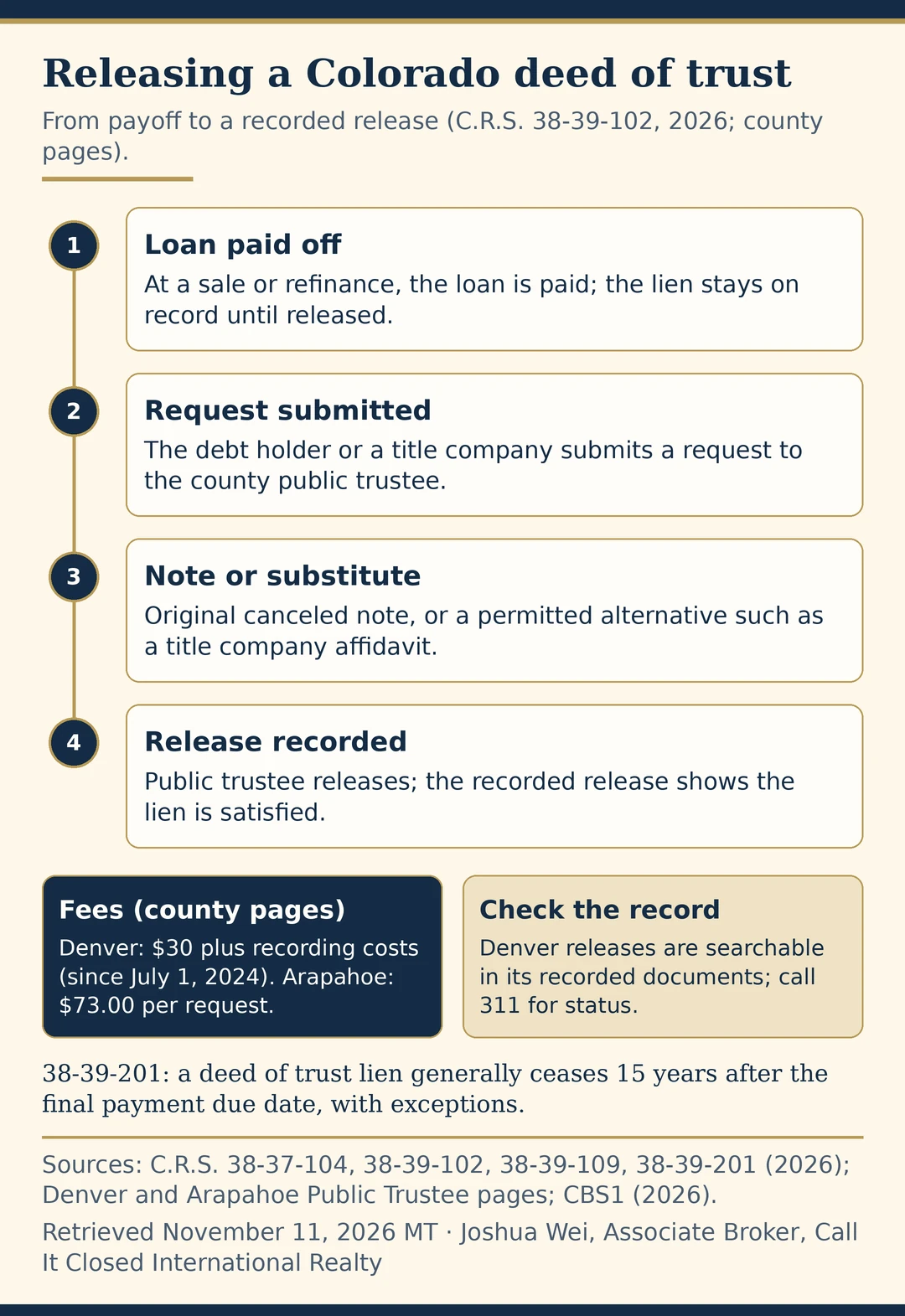
A vertical flow diagram, cream background with navy type and gold accents, titled Releasing a Colorado deed of trust. Subtitle: From payoff to a recorded release (C.R.S. 38-39-102, 2026; county pages). 4 numbered steps: 1, Loan paid off: At a sale or refinance, the loan is paid; the lien stays on record until released; 2, Request submitted: The debt holder or a title company submits a request to the county public trustee; 3, Note or substitute: Original canceled note, or a permitted alternative such as a title company affidavit; 4, Release recorded: Public trustee releases; the recorded release shows the lien is satisfied. Two cards: Fees (county pages): Denver: $30 plus recording costs (since July 1, 2024). Arapahoe: $73.00 per request; and Check the record: Denver releases are searchable in its recorded documents; call 311 for status. A note says: 38-39-201: a deed of trust lien generally ceases 15 years after the final payment due date, with exceptions. Sources: C.R.S. 38-37-104, 38-39-102, 38-39-109, 38-39-201 (2026); Denver and Arapahoe Public Trustee pages; CBS1 (2026). Retrieved November 11, 2026 MT. Joshua Wei, Associate Broker, Call It Closed International Realty.
Sources: C.R.S. 2026 Title 38 (opens in a new tab); Denver Public Trustee releases (opens in a new tab)
Cream background, navy text, gold rules. Numbered navy circles on a gold spine with white step cards, two branch cards (navy and tan), a note, and a source footer.
The figure above traces a release from payoff to the recorded document.
What the public trustee does
When a Colorado deed of trust names the county public trustee, that office handles the release. Denver's Public Trustee page (opens in a new tab) describes the office's "two primary responsibilities" as "to administer foreclosures according to law, selling homes at auction when necessary, and execute the release of deeds of trust to remove mortgage liens from a property."
So the same county office that would run a foreclosure is the one that signs your release. The release is a recorded document, separate from the payoff letter your servicer sends. The payoff letter shows the debt was paid; the recorded release is what takes the lien off the public record.
Who asks for the release?
Arapahoe County's Public Trustee release requirements (opens in a new tab) say: "The current holder of the debt or a title company must submit the Request for Release of Deed of Trust to the Public Trustee in the county where the property is located."
The statute lets a title insurance company licensed in Colorado request the release "without producing or exhibiting the original evidence of debt." When it does, the company gives the public trustee an affidavit that it "has caused the indebtedness secured by the deed of trust to be satisfied in full."
How long does the lender have?
A separate statute sets the lender's deadline. C.R.S. 38-35-124(1) says that when all debt secured by a lien on real property "has been satisfied, unless the debtor requests in writing that the lien not be released, the creditor or holder of the indebtedness shall, within ninety days after the satisfaction of the indebtedness and receipt from the debtor of the reasonable costs of procuring and recording the release documents," record the release documents. For a deed of trust to a public trustee, the holder instead files "with the public trustee the documents required for a release as prescribed by section 38-39-102."
Two more duties come with it. Under 38-35-124(3), "Upon satisfaction of the indebtedness, the creditor or holder shall return to the person satisfying the indebtedness all papers and personal property of the debtor" held in connection with the debt.
A creditor or holder who doesn't comply "is liable to the owner of the real property encumbered by such indebtedness and to any other person liable on such indebtedness for all actual economic loss incurred enforcing the rights provided under this section, including reasonable attorney fees and costs."
Note the condition in subsection (1): the 90 days run after satisfaction "and receipt from the debtor of the reasonable costs of procuring and recording the release documents." If you are unsure whether those costs were included in your payoff, ask the servicer.
Home equity lines of credit
A paid-down HELOC is different. Under 38-35-124(4)(a), where the debtor can still draw on a line of credit even though the balance is zero, "any lien on real property securing that line of credit continues, and no lien release under this section is required, until the line of credit expires and all indebtedness, whether absolute or contingent, has been satisfied." The exception is when, before the line expires, all debt is paid and "the debtor relinquishes in writing all right to make any further draw upon the line of credit."
Section 124(4)(b) says the debtor relinquishes that right "by either requesting in writing that the line of credit be closed by the creditor or by written notification by the debtor or debtor's designee that the real property is being conveyed upon payment of all indebtedness." A zero balance alone does not take the lien off the record.
What the public trustee needs
The statute lists what the public trustee needs before releasing. Under 38-39-102(1)(a), the release follows:
- a written request from the holder of the debt, its agent or attorney, or a qualifying title insurance company, "which request shall be duly executed and acknowledged"
- "Production of the original canceled evidence of debt such as a note or bond," unless a subsection (3) alternative applies
- the public trustee's release fee "and the fee for recording the release"
- a current address for the original grantor, assuming party or current owner, or a statement that the holder has no record of a different one
- "Production of a legible copy of the original recorded deed of trust"
Under 102(1)(b), once the public trustee signs the release, the public trustee "shall cause, as soon as practicable, the release to be recorded in the records of the county clerk and recorder."
Denver's releases page lists the documents it needs: a "Release of Deed of Trust form, signed and notarized"; the deed of trust, "original or copy"; and the "Promissory Note, the original document only, marked 'paid' or 'cancelled'." It adds: "Certified mail is recommended for documents submitted by U.S. mail."
Arapahoe County's page says "The Public Trustee inspects all submitted documents for accuracy and completeness." A request "may be rejected for failing to provide correct information," and if so, "all documents and payment will be returned to the sender for correction and re-submittal." Once approved, the county says its office "will sign the release form and submit it to the Arapahoe County Clerk and Recorder for recording."
When the original note isn't available
Subsection (3) of 38-39-102 gives several ways to release without producing the original note:
- Qualified holder (3)(a). A "qualified holder" of the original evidence of debt may request the release "without producing or exhibiting the original evidence of debt," and is deemed to agree to indemnify the public trustee.
- Surety bond (3)(b). A holder may instead deliver "a corporate surety bond in an amount equal to one and one-half times the original principal amount recited in the deed of trust."
- Title company (3)(c). A title insurance company licensed in Colorado may request the release with an officer's affidavit, described below.
- Holder e-filing (3)(d). A holder using this path "must electronically file the request for release of deed of trust via the county's electronic recording system."
Arapahoe's page describes the same choices as options for a qualified holder, a holder "submitting an original Lost Instrument surety bond in place of the original Promissory Note," and other listed cases.
Partial releases and the wrong county
A release can cover part of the property. Under 38-39-102(2), if the purpose of the deed of trust "has been fully or partially satisfied," the public trustee releases it "as to all or portions of the property" on a request that certifies that.
The county matters too. Under 102(8.5), if a deed of trust was recorded in the wrong county, it "must be recorded in the correct county before the public trustee may release the deed of trust." Arapahoe's page says the request goes to the public trustee "in the county where the property is located, even if the Deed of Trust names a Public Trustee from a different county."
Under 102(8), "If the written request to release the lien of any deed of trust is a fraudulent request, the release by the public trustee based upon such request shall be void."
What does it cost?
| County | Release fee, per the county page | |---|---| | Denver | "Effective July 1, 2024, Release of Deed of Trust fees increased to $30 plus recording costs." (Denver Public Trustee (opens in a new tab)) | | Arapahoe | "Each Request for Release of Deed of Trust must include a payment of $73.00 in the form of cash or check only to the Arapahoe County Public Trustee." |
Arapahoe's page adds two practical notes: "MONEY ORDERS ARE NOT ACCEPTED," and "Refunds for release over-payments will only be issued if the amount of the refund is more than $50.00." It also asks filers to "enclose a large postage-paid, addressed envelope in which to return original documents." Under C.R.S. 38-39-102(4), "A public trustee shall have no duty to retain the original canceled evidence of debt or deed of trust upon a release granted pursuant to this section."
C.R.S. 38-37-104(1)(a) sets the public trustee's fee "For executing a release of a deed of trust, the sum of thirty dollars." Denver's page lists recording costs in addition to the release fee.
How do I check that it was recorded?
Denver says: "All completed releases are recorded and become public documents searchable in Denver's recorded document database." Its public trustee page lists 311 for recording-status questions.
Denver's page also notes that releases can be filed electronically: "For information on electronic filing of releases of deeds of trust with the Public Trustee, please contact either Simplifile or Corporation Service Company (formerly Ingeo)." Those are the e-recording services the county names. They aren't a consumer lookup.
Under C.R.S. 38-39-109, the county clerk and recorder generally returns the original release to the owner at the address given to the public trustee. That doesn't apply if the release is recorded electronically.
If the mailed release comes back, 38-39-109(2) says "the county clerk and recorder shall maintain the original release pursuant to the policy of the office of the clerk and recorder." Under 109(3), an owner "seeking a copy of a release of a deed of trust after recording shall be subject to appropriate copy fees."
A checklist after payoff
- Keep the payoff statement and proof of the final payment.
- Ask the servicer, in writing, whether it or a title company is requesting the release, and when.
- Keep any canceled note or papers returned to you. Under 38-35-124(3), the holder returns the debtor's papers on satisfaction.
- If you had a HELOC, confirm in writing that the line is closed. Under 124(4), a zero balance alone may leave the lien in place.
- After the 90-day window in 38-35-124(1), search your county's recorded documents for the release. In Denver, that's the recorded document database the releases page names.
- If you can't find it, contact the servicer first, then the public trustee in your county. A Colorado real estate attorney can advise on a lender that won't act.
A hypothetical timeline
This example is invented, to show how the rules interact. It is not a prediction of how long any county or lender will take.
- An Aurora owner in Arapahoe County makes the last payment on a 30-year loan on March 15. The payoff included the release costs the servicer quoted.
- Under 38-35-124(1), the servicer's 90 days run from satisfaction and receipt of those costs. The owner notes mid-June as the date to check.
- The servicer files the request with the Arapahoe County Public Trustee. Arapahoe checks it, signs it and sends it to the clerk and recorder for recording.
- In late June, the owner searches the county's recorded documents and finds the release. If it had been missing, the owner would contact the servicer first.
What does the purchase contract say about liens?
The Colorado Real Estate Commission's Contract to Buy and Sell Real Estate (Residential), 2026 (opens in a new tab), says the seller delivers title "free and clear of all taxes (except personal property and general real estate taxes for the year of Closing), liens and" encumbrances, except as the contract provides.
Whether an old deed of trust still shows on the record is a question for the title company handling the sale.
Payoffs at a sale
When a seller's loan is paid off at closing, the closing company works from a written payoff statement. Under C.R.S. 38-35-124.5(1), a person "providing closing and settlement services for a real estate transaction and to whom a payoff statement is addressed shall be entitled to reasonably rely on the amounts that are set forth in such payoff statement for the time frame set forth therein." Once the stated amount is paid, the creditor "shall be required to comply with the release provisions of section 38-35-124."
For sellers, that means an old deed of trust that never got released can slow a closing. It's better to know before listing. For buyers, open deeds of trust can appear as requirements in the title commitment. Our title commitment guide explains how to read them.
What if the release never happened?
C.R.S. 38-39-201(1) says a deed of trust lien generally "shall cease to be a lien fifteen years after the date on which the final payment or performance of the obligation secured thereby is due as shown by such mortgage or deed of trust recorded" with the county. That clock starts on the final due date written in the recorded deed of trust, not on the day you actually paid the loan off. For a 30-year loan, that can be about 45 years after the loan was made. The statute also has exceptions. Do not wait for this rule to clear an unreleased lien. Ask the title company, the former lender, or a Colorado real estate attorney to get a release recorded. A specific unreleased lien is a question for the title company, the former lender or a Colorado real estate attorney.
Frequently asked questions
Is Colorado a deed of trust state?
Denver's Public Trustee page says true mortgages "are rare in Colorado," which it calls a "deed of trust" state.
Do I have to file the release myself?
Arapahoe County's page says "The current holder of the debt or a title company must submit the Request for Release of Deed of Trust."
How much is a release in Denver?
$30 plus recording costs, per Denver's page (effective July 1, 2024).
How much in Arapahoe County?
$73.00 per request, per the county page.
What if the original note is lost?
The statute and the Arapahoe page describe alternatives, including title company requests and lost-instrument bonds. The lender or title company can say which applies.
What about a true mortgage?
Denver says its release goes through the Clerk and Recorder, and suggests a licensed real estate attorney for the wording.
How long does my lender have to request the release?
C.R.S. 38-35-124(1) says the holder acts "within ninety days after the satisfaction of the indebtedness and receipt from the debtor of the reasonable costs of procuring and recording the release documents."
I paid my HELOC down to zero. Is the lien gone?
Not necessarily. Under C.R.S. 38-35-124(4)(a), the lien continues while you can still draw, unless the debt is paid and you relinquish in writing the right to make further draws.
Can a release be partial?
Yes. C.R.S. 38-39-102(2) lets the public trustee release "all or portions of the property" when the request certifies the purpose has been fully or partially satisfied.
Does the release come back to me in the mail?
Generally yes, at the address given to the public trustee, under C.R.S. 38-39-109(1). Not when the release is electronically recorded.
Related notes
- Reading your title commitment: what Denver and Aurora buyers should check before the title objection deadline
- Recent renovation? Mechanics' liens when you buy or sell a Colorado home
- Why you can't bring a personal check to closing: Colorado's good funds law for Denver and Aurora buyers and sellers
- Assumable mortgages in Colorado
Sources and method
Official sources, retrieved November 11 and 13, 2026, America/Denver:
- Colorado Revised Statutes 2026, Title 38 (opens in a new tab): 38-35-124, 38-35-124.5, 38-37-104, 38-39-102, 38-39-109, 38-39-201
- Denver Public Trustee, Releases (opens in a new tab) and Public Trustee main page (opens in a new tab)
- Arapahoe County Public Trustee, Release Requirements (opens in a new tab)
- Colorado Real Estate Commission CBS1 (2026) (opens in a new tab): title delivery language
Quotations are verbatim. Fees can change, so check the county page before you rely on them. The timeline example is hypothetical. Court annotations printed with the statutes aren't relied on here.
This note is general education from a Colorado real estate broker with Call It Closed International Realty. If you're selling, I'll help you spot old liens early so closing isn't delayed.
Disclaimer
This article is general information only. It is not legal, tax, lending, insurance, appraisal, inspection, or financial advice, and it is not a substitute for advice about your situation. Joshua Wei is a Colorado real estate broker, not an attorney. Reading this article does not create a client relationship, an agency relationship, or an attorney-client relationship with Joshua Wei or with Call It Closed International Realty.
Laws, program rules, interest rates, insurance terms, tax figures, and other details change. Examples in this article are hypothetical illustrations unless a source is named for a specific, dated figure. Information in this article is believed accurate as of November 19, 2026 and is not guaranteed. No result is promised, and you should not rely on this article as the last word for your situation.
Before you act, confirm the point with the official source linked or cited in this article, and talk with a licensed professional who can apply the rule to your facts. That may be a licensed attorney, a tax professional, a lender, an insurance agent, a home inspector, or another licensed professional, depending on the question. Links to third-party websites and publications are provided for reference only. They are not an endorsement, and their content can change.
If you already have a brokerage relationship with another broker, this is not a solicitation.
Joshua Wei, Associate Broker, Call It Closed International Realty, Colorado license FA.100108558. Equal Housing Opportunity.