September 5, 2026 · Colorado · HOA · Condos · Buying · Selling
HOA liens and foreclosure in Colorado: payment plans, the six-month rule, and owner protections
Colorado's Common Interest Ownership Act gives HOAs a lien for unpaid assessments but limits foreclosure. The 18-month payment plan, the six-month threshold, the recorded board vote, the extra protections for owner-occupants, lien priority, and how the purchase contract handles unpaid assessments.
The short answer
In brief: A Colorado HOA has a lien for unpaid assessments, but state law limits when it can foreclose. Under C.R.S. 38-33.3-316(11), an association may foreclose only if the unpaid balance equals or exceeds six months of common expense assessments under its adopted budget and the executive board has formally resolved, by a recorded vote, to authorize legal action against that unit.
A Colorado HOA has a lien for unpaid assessments, but the law limits when it can foreclose. Under C.R.S. 38-33.3-316(11) in the 2026 Colorado Revised Statutes, Title 38 (opens in a new tab), an association may foreclose only if:
- the unpaid balance "equals or exceeds six months of common expense assessments based on a periodic budget adopted by the association," and
- "The executive board has formally resolved, by a recorded vote, to authorize the filing of a legal action against the specific unit on an individual basis."
Before going to court, the association has to try to set up a payment plan. Fines and fees can be part of a lien, but they "are not subject to a foreclosure action."
I am a licensed Colorado real estate broker with Call It Closed International Realty. I am not an attorney.
Disclaimer. This article is general information only. It is not legal, tax, lending, insurance, appraisal, inspection, or financial advice, and reading it does not create a client, agency, or attorney-client relationship. Laws, rates, programs, and figures change. Confirm the official source, and talk with a licensed attorney, tax professional, lender, insurance agent, or inspector before you act. Joshua Wei is a Colorado real estate broker, not an attorney. He is an Associate Broker with Call It Closed International Realty, license FA.100108558. Equal Housing Opportunity.
 Full size (opens in a new tab)
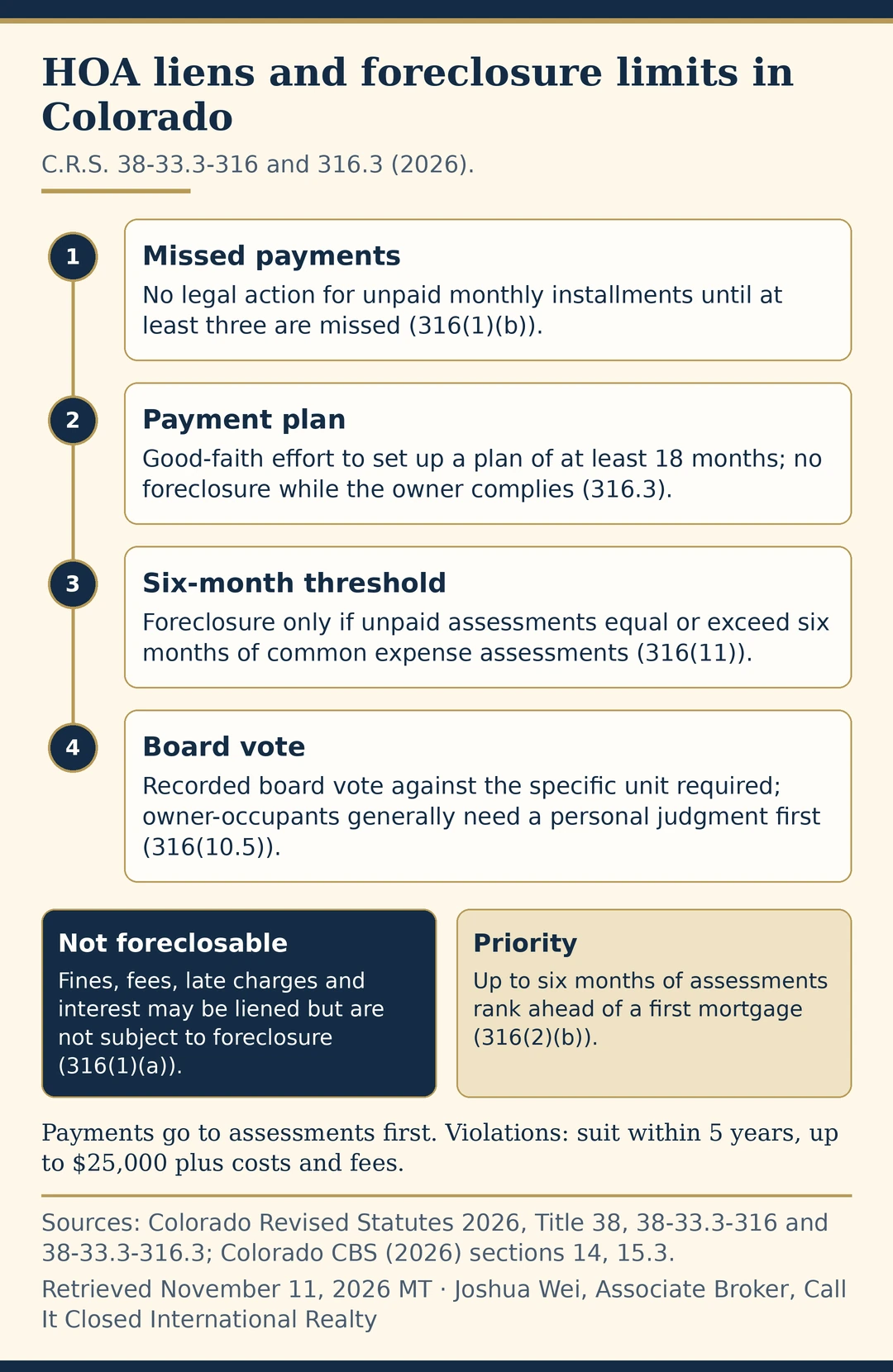
A vertical flow diagram, cream background with navy type and gold accents, titled HOA liens and foreclosure limits in Colorado. Subtitle: C.R.S. 38-33.3-316 and 316.3 (2026). 4 numbered steps: 1, Missed payments: No legal action for unpaid monthly installments until at least three are missed (316(1)(b)); 2, Payment plan: Good-faith effort to set up a plan of at least 18 months; no foreclosure while the owner complies (316.3); 3, Six-month threshold: Foreclosure only if unpaid assessments equal or exceed six months of common expense assessments (316(11)); 4, Board vote: Recorded board vote against the specific unit required; owner-occupants generally need a personal judgment first (316(10.5)). Two cards: Not foreclosable: Fines, fees, late charges and interest may be liened but are not subject to foreclosure (316(1)(a)); and Priority: Up to six months of assessments rank ahead of a first mortgage (316(2)(b)). A note says: Payments go to assessments first. Violations: suit within 5 years, up to $25,000 plus costs and fees. Sources: Colorado Revised Statutes 2026, Title 38, 38-33.3-316 and 38-33.3-316.3; Colorado CBS (2026) sections 14, 15.3. Retrieved November 11, 2026 MT. Joshua Wei, Associate Broker, Call It Closed International Realty.
Sources: C.R.S. 2026 Title 38 (opens in a new tab)
Cream background, navy text, gold rules. Numbered navy circles on a gold spine with white step cards, two branch cards (navy and tan), a note, and a source footer.
The figure above shows the statute's steps in order, from a missed payment to a possible foreclosure.
What can the HOA lien cover?
Under C.R.S. 38-33.3-316(1)(a), an association organized as a corporation or LLC "has a statutory lien on a unit for any assessment levied against that unit or fines imposed against its unit owner." Fees, late charges, capped attorney fees, fines and interest "may be subject to a statutory lien but are not subject to a foreclosure action."
Under subsection (1)(b), the association "may not pursue legal action for unpaid monthly installments until the unit owner has failed to pay at least three monthly installments."
The same subsection says each installment "may be subject to a statutory lien if the unit owner fails to pay the installment within fifteen days after the installment becomes due." So a lien can attach before the association is allowed to sue.
How the lien comes into being, and when it expires
The HOA doesn't have to record anything new to have its lien. Under 38-33.3-316(4), "Recording of the declaration constitutes record notice and perfection of the lien. No further recordation of any claim of lien for assessments is required."
The lien doesn't last forever. Under 316(5), "A lien for unpaid assessments is extinguished unless proceedings to enforce the lien are instituted within six years after the full amount of assessments become due." Subsection (6) adds that the section doesn't prohibit suits to recover the money, or "an association from taking a deed in lieu of foreclosure."
The statute's definition of "assessment" in 316(14) covers common expense payments under the adopted budget and payments for limited common elements, and "includes fees specific to delinquent payments and reasonable collection costs for collecting delinquent payments."
Attorney fees
Under 316(7)(a)(I), "The association is entitled to costs and reasonable attorney fees that the association incurs in any action or suit for a judgment or decree brought by the association under this section." Subsection (7)(b) says it can't recover fees incurred before it complied with the notice requirements of 38-33.3-209.5(1.7)(a), where those notices are required.
What's the payment plan rule?
C.R.S. 38-33.3-316.3(1)(b) requires the association to "Make a good-faith effort to coordinate with the unit owner to set up a payment plan." Under subsection (2), the plan "must permit the unit owner to pay off the deficiency in equal installments over a period of at least eighteen months."
Subsection (3.5) says the association "shall not foreclose a lien created under section 38-33.3-316 if the unit owner is in compliance with the terms of a payment plan."
The statute lists exceptions, including one for a non-occupant owner who got the unit through a foreclosure. How they apply to a specific unit is a question for a Colorado HOA attorney.
Another exception in 316.3(1)(b)(II) says the association "is not obligated to negotiate a payment plan with a unit owner who has previously entered into a payment plan under this section." And the plan has to be kept. Under 316.3(2), "A unit owner's failure to remit payment of three or more agreed-upon installments," or "to remain current with regular assessments as they come due during the eighteen-month period, constitutes a failure to comply with the terms of the unit owner's payment plan."
The association must also have a written collections policy. Section 316.3(1)(a) requires it to "Adopt and comply with a collections policy that meets the requirements of section 38-33.3-209.5 (5)." An owner who falls behind can ask for a copy.
When an owner makes a payment, subsection (4) requires the association to apply it to assessments first, then to fines, fees and other charges.
Are there extra protections for owner-occupants?
Subsection 316(10.5) addresses units an individual occupies as a principal residence. Before foreclosing on one, it requires the association to have obtained a personal judgment in a civil action first. The statute lists exceptions for an owner's death or incapacity, failed service, or bankruptcy.
Subsection (10.6) says the personal-judgment rule "Applies exclusively to a unit owned by an individual who occupies the unit as the unit owner's principal residence, unless the unit is used for workforce housing." It does not apply to units owned by an entity, or to units the owner doesn't live in, except workforce housing.
Subsections (10.3) and (10.7) also require notices at least thirty days before a foreclosure action, including information about credit counseling and mediation.
The notices before a foreclosure
The 2024 and 2025 amendments added several notice steps. At least thirty days before filing to foreclose, the association must give:
- Credit counseling notice (10.3). Written and electronic notice that "The unit owner has the right to participate in credit counseling at the unit owner's expense," with information available through the state HOA Information and Resource Center.
- Mediation notice (10.7)(a). Notice "that the unit owner has the right to engage in mediation prior to litigation." The owner "must respond within thirty days after the date of the notice." If the owner doesn't take the steps in (10.7)(b) within those thirty days, the association isn't barred from filing.
- Lienholder notice (10.7)(d). Notice "to all lienholders identified on the unit owner property records of the pending legal action for foreclosure," including the amount owed.
- Notice of intent to foreclose (10.8). Sent "by certified mail, return receipt requested, and by at least two of the following means": a phone call, a text, an email, or regular mail if the owner hasn't provided a phone or email.
The notice of intent must tell the owner that if the court forecloses, "the court will order the sale of the unit at auction to pay the delinquent assessments due to the association," and that "the unit owner could lose some or all of the unit owner's equity in the unit." If the owner asked for notices in another language, the notice "must be sent in the preferred language."
After filing, 316(11.2) requires the association, within five business days, to notify all lienholders of "The right to cure the nonpayment pursuant to section 38-38-104" and "The right of the unit owner to file a motion to stay the sale of the property at auction pursuant to section 38-38-109.5."
The board vote
The recorded-vote rule in 316(11)(a)(II) has teeth. The statute says "The board may not delegate its duty to act under this subparagraph (II) to any attorney, insurer, manager, or other person, and any legal action filed without evidence of the recorded vote authorizing the action must be dismissed." Fees and costs from an action dismissed for that reason can't be assessed against the owner.
Who can't buy at the foreclosure sale
Under 316(12)(a), board members, employees of the association's management company or law firm, their immediate family members, and the management company itself "shall not purchase the foreclosed unit." The ban reaches anyone in those roles "at any time during the five-year period immediately preceding the sale." Under 316(13), a buyer at an HOA foreclosure "acquires the unit subject to any covenants or limitations on the use or sale of the unit to which the previous unit owner was subject."
How does the HOA lien rank against a mortgage?
Under subsection 316(2)(a), the HOA lien is generally "prior to all other liens and encumbrances on a unit," with exceptions. The exceptions include a first security interest recorded before the assessment became delinquent, and real estate taxes.
Under subsection (2)(b), the HOA lien is also ahead of that first mortgage "to the extent of" common expense assessments that "would have become due ... during the six months immediately preceding" an enforcement action.
How these priority rules affect a specific loan or closing is a question for the title company or a Colorado real estate attorney.
A worked example of the six-month figure, with invented numbers: if an association's adopted budget sets assessments at $300 a month for a unit, six months of common expense assessments would be $1,800. That number matters twice. It is the threshold in 316(11) for an association foreclosure, and it describes the portion of the lien that 316(2)(b) places ahead of an earlier first mortgage. The real figure depends on the association's budget.
The statement of unpaid assessments
This part of the statute matters at a sale, because it tells the parties what's owed. Under 38-33.3-316(8), on a written request "delivered personally or by certified mail, first-class postage prepaid, return receipt, to the association's registered agent," the association "shall furnish" to the owner, the owner's designee or a lender "a written statement setting forth the amount of unpaid assessments currently levied against such owner's unit."
The statement "shall be furnished within fourteen calendar days after receipt of the request and is binding on the association, the executive board, and every unit owner." If no statement is furnished, "the association shall have no right to assert a lien upon the unit for unpaid assessments which were due as of the date of the request."
What does the purchase contract say?
The Commission's residential Contract to Buy and Sell Real Estate (opens in a new tab) has the seller request the association's status letter before closing (section 15.3), and it handles liens in section 14. Under section 14, "any amounts owed on any liens or encumbrances against the Property ... will be paid before Closing by Seller, at Closing from the proceeds of this transaction, or from any other source."
Section 15.3 says that "At least fourteen days prior to Closing Date, Seller agrees to promptly request that the Closing Company or the Association deliver to Buyer a current Status Letter, if applicable." Under section 15.3.1, "Any fee incident to the issuance of Association's Status Letter must be paid by Seller." The contract has checkboxes for who pays the record change fee, reserves or working capital, and other fees listed in the letter.
Section 16.2 handles the regular dues at closing: "All Association Assessments accrued before Closing must be paid by Seller and all Association Assessments accrued after Closing must be paid by Buyer." The same section has a separate checkbox for who pays a special assessment levied before the Closing Date.
Earlier in the deal, section 7.3.5 lists the association's financial documents the seller provides, including "the Association's operating budget for the current fiscal year" and a list of fees the manager or association will charge in connection with the closing. Our condo and HOA due diligence guide covers those documents.
Checklists for buyers, sellers and owners
Buyers in an HOA community:
- Read the budget in section 7.3.5 to see the regular assessment and what six months would be.
- When the status letter arrives, check for any delinquency, any special assessment, and fees due at closing.
- Ask the title company whether any recorded HOA lien or pending action appears in the commitment.
Sellers behind on dues:
- Ask the association, in writing, for the amount owed and a copy of its collections policy.
- Expect any unpaid amounts to be paid at or before closing under section 14.
- If a foreclosure notice has arrived, speak with a Colorado attorney promptly. The mediation window in (10.7) runs thirty days from the notice.
Owners who fall behind and plan to stay:
- Ask for the payment plan 316.3 describes, and keep current with new assessments during it.
- Remember the order in 316.3(4): payments go to assessments first.
- Keep copies of every notice and how it was delivered.
Related: Aurora property tax and metro district buyer checklist (opens in a new tab).
Frequently asked questions
Can my HOA foreclose over fines?
Under C.R.S. 38-33.3-316(1)(a), fines and fees may be part of a lien but "are not subject to a foreclosure action."
How far behind do I have to be before my HOA can foreclose?
The balance must equal or exceed six months of common expense assessments, and the board must authorize the action by a recorded vote (38-33.3-316(11)).
Does my HOA have to offer a payment plan?
C.R.S. 38-33.3-316.3 requires a "good-faith effort" to set up a plan of at least eighteen months, with exceptions.
Which comes first if I pay part of what I owe?
Assessments first, then fines, fees and other charges (38-33.3-316.3(4)).
What if the HOA breaks these rules?
Under 38-33.3-316.3(5), an owner may sue within five years, and the court may award "up to twenty-five thousand dollars, plus costs and reasonable attorney fees, if the unit owner proves the violation by a preponderance of the evidence."
Who pays unpaid dues when a home sells?
CBS section 14 says amounts owed on liens "will be paid before Closing by Seller, at Closing from the proceeds of this transaction, or from any other source."
Does the HOA have to record a lien against my unit?
No. C.R.S. 38-33.3-316(4) says recording the declaration "constitutes record notice and perfection of the lien. No further recordation of any claim of lien for assessments is required."
How quickly must the HOA tell me what's owed?
Within fourteen calendar days of a proper written request, under 38-33.3-316(8). The statement is binding on the association.
Does an HOA lien ever expire?
Under 38-33.3-316(5), it is extinguished unless enforcement proceedings begin "within six years after the full amount of assessments become due."
Can a board member buy my unit at an HOA foreclosure sale?
No. C.R.S. 38-33.3-316(12) bars board members, the management company, its employees, the association's law firm employees and their immediate families.
Related notes
- Who oversees Colorado HOAs? What the state HOA Center can and can't do for Denver and Aurora owners and buyers
- Buying a Denver or Aurora condo: read the building before you price the unit
- A metro district is not an HOA: how Denver and Aurora buyers can tell them apart
Sources and method
Official sources, retrieved November 11 and 13, 2026, America/Denver:
- Colorado Revised Statutes 2026, Title 38 (opens in a new tab): C.R.S. 38-33.3-316 (including (4), (5), (7), (8), (10.3) to (10.8), (11.2), (12) to (14)) and 38-33.3-316.3
- Colorado Real Estate Commission, Contract to Buy and Sell Real Estate (Residential), for use on and after January 1, 2026 (opens in a new tab): sections 7.3.5, 14, 15.3, 16.2
Quotations are verbatim. Some rules apply only to associations organized as corporations or LLCs, or only to owner-occupied units. Have an attorney apply them to your situation. The dollar example is hypothetical. Court annotations printed with the statutes aren't relied on here.
This note is general education from a Colorado real estate broker with Call It Closed International Realty. If you're buying or selling in a Denver or Aurora HOA community, I'll help you get the status letter early and read it against the contract.
Disclaimer
This article is general information only. It is not legal, tax, lending, insurance, appraisal, inspection, or financial advice, and it is not a substitute for advice about your situation. Joshua Wei is a Colorado real estate broker, not an attorney. Reading this article does not create a client relationship, an agency relationship, or an attorney-client relationship with Joshua Wei or with Call It Closed International Realty.
Laws, program rules, interest rates, insurance terms, tax figures, and other details change. Examples in this article are hypothetical illustrations unless a source is named for a specific, dated figure. Information in this article is believed accurate as of November 13, 2026 and is not guaranteed. No result is promised, and you should not rely on this article as the last word for your situation.
Before you act, confirm the point with the official source linked or cited in this article, and talk with a licensed professional who can apply the rule to your facts. That may be a licensed attorney, a tax professional, a lender, an insurance agent, a home inspector, or another licensed professional, depending on the question. Links to third-party websites and publications are provided for reference only. They are not an endorsement, and their content can change.
If you already have a brokerage relationship with another broker, this is not a solicitation.
Joshua Wei, Associate Broker, Call It Closed International Realty, Colorado license FA.100108558. Equal Housing Opportunity.