October 15, 2026 · Denver · Aurora · Buying
Who owns what's under the house? Mineral rights and oil and gas disclosures for Denver and Aurora buyers
In Colorado, the surface and the minerals under a home can be owned separately. What the state-required oil and gas disclosure says, how CBS1 handles a Mineral Rights Examination Deadline, where to look up nearby wells, and what the state's setback rule says.
The short answer
In brief: In Colorado, the surface of a property can be owned separately from the minerals beneath it, and section 8.8.1 of the state's residential contract warns that transferring the surface may not include the mineral estate or water rights. Denver and Aurora buyers can check county records, state and Aurora oil and gas maps, and the contract's Mineral Rights Examination Deadline.
Colorado's standard residential contract addresses mineral rights in capital letters.
Section 8.8.1 of the Colorado Real Estate Commission's residential contract (CBS1, 2026 form (opens in a new tab)), from the Division of Real Estate's contracts and forms page (opens in a new tab), states: "THE SURFACE ESTATE OF THE PROPERTY MAY BE OWNED SEPARATELY FROM THE UNDERLYING MINERAL ESTATE AND TRANSFER OF THE SURFACE ESTATE MAY NOT NECESSARILY INCLUDE TRANSFER OF THE MINERAL ESTATE OR WATER RIGHTS."
That disclosure exists because state law requires it. Colorado Revised Statutes section 38-35.7-108 (opens in a new tab) directed the Real Estate Commission to require it in residential contracts or seller disclosures.
I am a licensed Colorado real estate broker with Call It Closed International Realty. I am not an attorney or landman. This is not legal advice.
Disclaimer. This article is general information only. It is not legal, tax, lending, insurance, appraisal, inspection, or financial advice, and reading it does not create a client, agency, or attorney-client relationship. Laws, rates, programs, and figures change. Confirm the official source, and talk with a licensed attorney, tax professional, lender, insurance agent, or inspector before you act. Joshua Wei is a Colorado real estate broker, not an attorney. He is an Associate Broker with Call It Closed International Realty, license FA.100108558. Equal Housing Opportunity.
 Full size (opens in a new tab)
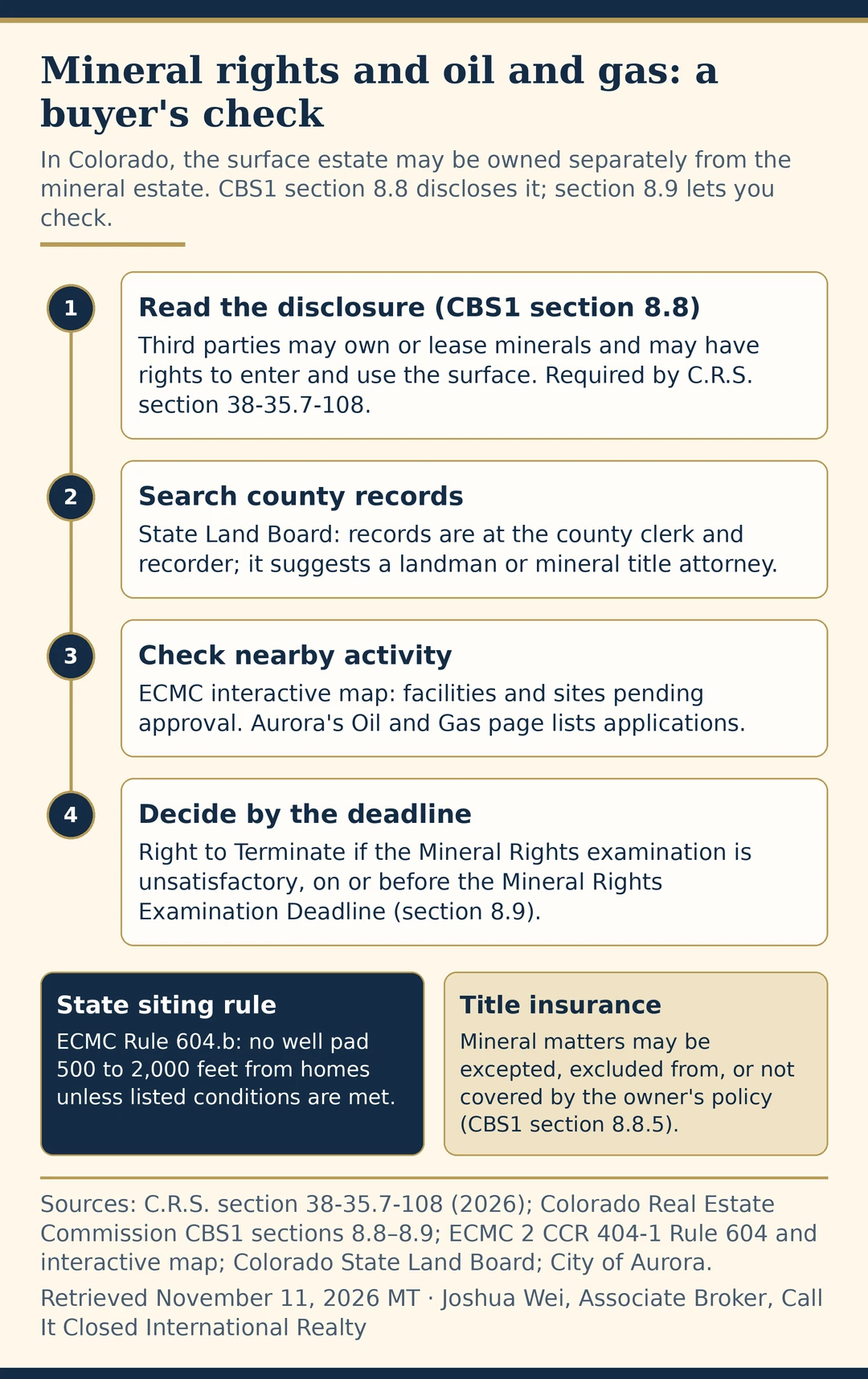
A vertical flow diagram, cream background with navy type and gold accents, titled Mineral rights and oil and gas: a buyer's check, with the subtitle in Colorado the surface estate may be owned separately from the mineral estate, CBS1 section 8.8 discloses it and section 8.9 lets you check. Four numbered steps: 1, read the disclosure in CBS1 section 8.8, that third parties may own or lease minerals and may have rights to enter and use the surface, as required by C.R.S. section 38-35.7-108; 2, search county records, where the State Land Board says records are at the county clerk and recorder and suggests a landman or mineral title attorney; 3, check nearby activity on the ECMC interactive map, which shows facilities and sites pending approval, and Aurora's Oil and Gas page, which lists applications; 4, decide by the deadline, with a Right to Terminate if the mineral rights examination is unsatisfactory on or before the Mineral Rights Examination Deadline under section 8.9. Two lower cards: state siting rule, ECMC Rule 604.b allows no well pad 500 to 2,000 feet from homes unless listed conditions are met; and title insurance, mineral matters may be excepted, excluded from, or not covered by the owner's policy under CBS1 section 8.8.5. Sources: Colorado Revised Statutes, Colorado Real Estate Commission contract, ECMC, Colorado State Land Board, and City of Aurora. Retrieved November 11, 2026 MT.
Sources: ECMC interactive map (opens in a new tab); State Land Board severed estate (opens in a new tab)
Cream background, navy text, gold rules. Four numbered steps on a gold spine, two side-by-side cards, and a 28px source footer.
The diagram above shows the surface and mineral estates, the contract steps, and where to look up activity. It summarizes the statute, the contract, and state agency pages.
What does the disclosure say?
Section 8.8 opens with a general title advisory: "The Title Documents affect the title, ownership and use of the Property and should be reviewed carefully." It continues that "other matters not reflected in the Title Documents may affect the title, ownership and use of the Property," listing among them "water on or under the Property and various laws and governmental regulations concerning land use, development and environmental matters."
CBS1 section 8.8 then has four capital-letter paragraphs. Beyond the surface and mineral estates, they say:
- Access. "THIRD PARTIES MAY OWN OR LEASE INTERESTS IN OIL, GAS, OTHER MINERALS, GEOTHERMAL ENERGY OR WATER ON OR UNDER THE SURFACE OF THE PROPERTY, WHICH INTERESTS MAY GIVE THEM RIGHTS TO ENTER AND USE THE SURFACE OF THE PROPERTY TO ACCESS THE MINERAL ESTATE, OIL, GAS OR WATER."
- Surface use agreements. Access "MAY BE GOVERNED BY A SURFACE USE AGREEMENT, A MEMORANDUM OR OTHER NOTICE OF WHICH MAY BE RECORDED WITH THE COUNTY CLERK AND RECORDER."
- Activity. It "MAY INCLUDE, BUT IS NOT LIMITED TO, SURVEYING, DRILLING, WELL COMPLETION OPERATIONS, STORAGE, OIL AND GAS, OR PRODUCTION FACILITIES, PRODUCING WELLS, REWORKING OF CURRENT WELLS AND GAS GATHERING AND PROCESSING FACILITIES."
- More information. "BUYER IS ENCOURAGED TO SEEK ADDITIONAL INFORMATION REGARDING OIL AND GAS ACTIVITY ON OR ADJACENT TO THE PROPERTY, INCLUDING DRILLING PERMIT APPLICATIONS."
The contract's last capital-letter sentence reads: "THIS INFORMATION MAY BE AVAILABLE FROM THE COLORADO OIL AND GAS CONSERVATION COMMISSION." The statute now names the "ENERGY AND CARBON MANAGEMENT COMMISSION," the agency's current name.
The statute's wording and the contract's wording
Section 38-35.7-108(1)(a) told the Commission to require "the following or substantially similar information." The two texts are close but not identical:
| Point | Statute, section 38-35.7-108(1)(a) | CBS1 section 8.8.1 | |---|---|---| | Transfer | "TRANSFER OF THE SURFACE ESTATE MAY NOT INCLUDE TRANSFER OF THE MINERAL ESTATE." | "TRANSFER OF THE SURFACE ESTATE MAY NOT NECESSARILY INCLUDE TRANSFER OF THE MINERAL ESTATE OR WATER RIGHTS." | | Third parties | "THIRD PARTIES MAY OWN OR LEASE INTERESTS IN OIL, GAS, OR OTHER MINERALS" | "THIRD PARTIES MAY OWN OR LEASE INTERESTS IN OIL, GAS, OTHER MINERALS, GEOTHERMAL ENERGY OR WATER" | | Agency | "ENERGY AND CARBON MANAGEMENT COMMISSION" | "COLORADO OIL AND GAS CONSERVATION COMMISSION" |
For contracts outside the Commission's jurisdiction, section 38-35.7-108(1)(b) says each one "must contain a disclosure statement in bold-faced type that is clearly legible in substantially the same form."
The statute also limits what the disclosure does. Section 38-35.7-108(2) says it "does not create a duty to investigate or disclose that does not otherwise exist for the seller, a person licensed under article 10 of title 12, or a title insurance agent or company licensed under article 2 of title 10."
How does the contract let a buyer check?
CBS1 section 8.9: "Buyer has a Right to Terminate if examination of the Mineral Rights is unsatisfactory to Buyer on or before the Mineral Rights Examination Deadline."
The Mineral Rights Examination Deadline is its own line in the contract's dates and deadlines table, listed with the "Water Rights Examination Deadline" under inspection and due diligence.
Section 19 of CBS1 says each broker "has recommended" that the parties "consult with their own attorney if Water Rights, Mineral Rights or Leased Items are included or excluded in the sale."
Section 8.8.5 adds a title point: "Matters set forth in this Section and others, may be excepted, excluded from, or not covered by the owner's title insurance policy."
How do I find out who owns the minerals?
The Colorado State Land Board's severed estate page (opens in a new tab) answers this for buyers: "Records related to the property in question are kept in the county clerk and recorder's office where the property is located." It adds: "if you are unfamiliar with searching property title, hiring a landman or a mineral title attorney may be your best option to assist in determining ownership of mineral rights."
The same answer notes a limit on county help: "The Staff at the Clerk and Recorder's Office can assist with how to look up records but does not interpret documents that are recorded."
The State Land Board also warns that a lease may not show up: "There is no requirement for a mineral owner or a lessee of a mineral owner to notify the surface owner if a lease is executed." It adds: "Sometimes, either the mineral owner or the lessee will record the lease in the County Clerk and Recorder's office in order to put the public on notice - but there is no requirement for that to happen." And: "Surface owners typically aren't entitled to notice until actual development is anticipated."
On the legal relationship, the State Land Board page says: "In Colorado the mineral owner is considered dominant and has a legal right to reasonably access their minerals." Where the State Land Board itself owns the minerals, it says "Surface owners can also pay a fee and obtain a twenty year No Surface Occupancy (NSO) Agreement with the State Land Board which prevents the State Land Board from using the surface estate to extract minerals." That option is described for State Land Board minerals only.
Who counts as a "Surface Owner" under ECMC's rules?
ECMC's rules define it: "SURFACE OWNER shall mean any person owning all or part of the surface of land upon which Operations are conducted, as shown by the tax records of the county in which the tract of land is situated, or any person with such rights under a recorded contract to purchase."
They also define a "SURFACE USE AGREEMENT" as "any agreement in the nature of a contract or other form of document binding on the Operator, including any lease, damage agreement, waiver, local government approval or permit, or other form of agreement, which governs the Operator's activities on the surface." That is the kind of agreement CBS1 section 8.8.2 says may be recorded.
How can I see nearby oil and gas activity?
- State map. The Energy and Carbon Management Commission (ECMC) says its interactive map (opens in a new tab) "includes data directly related to operations, such as the location of oil and gas facilities and sites pending approval."
- Aurora. The City of Aurora's Oil and Gas Drilling page (opens in a new tab) links an "Oil and Gas Operations Map" and lists permitting applications. As retrieved November 13, 2026, its "Permitting (Active) Applications" list included pipeline and pad-site projects, a "Future Applications" list, and an announcement titled "Aurora Mineral Leasing Application." Under "Comments or Concerns on Oil and Gas Facilities," it links a "City of Aurora Complaint Form," a "CDPHE Complaint Form," and an "ECMC Complaint Form."
The State Land Board page also suggests: "A good way to see what is going on nearby would be to check the ECMC's map server to see where wells are being drilled."
The State Land Board notes that timing is uncertain: "Sometimes, even when property is leased - or even permitted for a well - development will never occur."
How close can a well pad be to a home?
ECMC's rules, 2 CCR 404-1, Rule 604 (opens in a new tab) (as of October 30, 2025), set siting limits. Rule 604.b says: "No Working Pad Surface will be located more than 500 feet and less than 2,000 feet from 1 or more Residential Building Units or High Occupancy Building Units unless one or more of the following conditions are satisfied."
The listed conditions include informed consent from nearby owners and tenants and an approved Comprehensive Area Plan. Rule 604.a(4) also says: "No Working Pad Surface will be located less than 500 feet from 1 or more Residential Building Units not subject to a Surface Use Agreement or waiver, that includes informed consent from all Building Unit owner(s) and tenant(s) explicitly agreeing to the proposed Oil and Gas Location siting."
The full list of Rule 604.b conditions has four items. Beyond informed consent and a Comprehensive Area Plan, the other two are: "(3) Any Wells, Tanks, separation equipment, or compressors proposed on the Oil and Gas Location will be located more than 2,000 feet from all Residential Building Units or High Occupancy Building Units; or (4) The Commission finds, after a hearing pursuant to Rule 510, that the proposed Oil and Gas Location and conditions of approval will provide substantially equivalent protections for public health, safety, welfare, the environment, and wildlife resources."
The rules define the homes covered: "RESIDENTIAL BUILDING UNIT means a building or structure designed for use as a place of residency by a person, a family, or families." It "includes manufactured, mobile, and modular homes," and "Each individual residence within a building will be counted as one Residential Building Unit."
Rule 604.a sets other distances. A well "will be located not less than 200 feet from buildings, public roads, above ground utility lines, or railroads" when drilled, and "not less than 150 feet from a surface property line" when the location assessment is filed, subject to exceptions with a waiver. Rule 604.a(3) says: "No Working Pad Surface will be located 2,000 feet or less from a School Facility or Child Care Center."
Two official descriptions of the distance
The State Land Board's severed estate page says: "The COGCC rules specify how close development can get to a building unit, and typically that is no closer than 2,000 feet. Owners can sign waivers to allow development closer to the home, but an operator cannot require a waiver by an owner." That page still uses the agency's former name.
ECMC's own Rule 604.b, quoted above, sets the 2,000-foot line with listed conditions under which a Working Pad Surface may be between 500 and 2,000 feet from homes, and Rule 604.a(4) sets a 500-foot line. The two pages describe the distance differently. For a specific site, the rule text and ECMC's staff are the place to confirm.
How these rules apply to a specific address is a question for ECMC or a Colorado attorney. ECMC's interactive map and Aurora's Oil and Gas Operations Map show facilities and permitting applications.
An invented example
This example is invented; it is not a real property.
A buyer is under contract on a new-build home in east Aurora. The title commitment lists a recorded mineral reservation from decades ago and a recorded memorandum of a surface use agreement.
- Under CBS1 section 8.9, the buyer has until the Mineral Rights Examination Deadline to decide whether the examination is satisfactory.
- The buyer checks ECMC's interactive map and Aurora's Oil and Gas Operations Map for nearby facilities and pending sites.
- The buyer asks a mineral title attorney what the reservation and the memorandum mean for this lot.
- The buyer asks the title company which items appear as exceptions, since section 8.8.5 says these matters may not be covered.
Buyer checklist
- Read CBS1 section 8.8 and note your Mineral Rights Examination Deadline.
- Review the title commitment for mineral reservations, leases, and surface use agreements.
- Search ECMC's interactive map and, in Aurora, the city's Oil and Gas Operations Map.
- Ask a landman or mineral title attorney if the records are unclear.
- Ask the title company what the owner's policy excludes.
For more on reading the commitment, see Reading your title commitment.
Related: Aurora property tax and metro district checklist (opens in a new tab).
Frequently asked questions
Are mineral rights severed under Denver homes?
The sources here give no count. The State Land Board points to county clerk and recorder records and to "a landman or a mineral title attorney."
Can a mineral owner drill in my backyard?
The contract says third-party interests "MAY GIVE THEM RIGHTS TO ENTER AND USE THE SURFACE." State siting rules also apply. Ask an attorney about a specific property.
Will my title insurance cover mineral issues?
CBS1 section 8.8.5 says these matters "may be excepted, excluded from, or not covered by the owner's title insurance policy." Ask the title company.
Will I be notified if minerals under my home are leased?
The State Land Board says there is no requirement to notify the surface owner when a lease is signed.
What deadline should I watch?
The Mineral Rights Examination Deadline in your contract's dates and deadlines table.
Does a buyer under contract count as a surface owner?
ECMC's definition includes "any person with such rights under a recorded contract to purchase." Whether that fits your contract is a question for a Colorado attorney.
Can I stop a mineral owner from using the surface?
The State Land Board says the mineral owner "is considered dominant and has a legal right to reasonably access their minerals." It describes a "No Surface Occupancy (NSO) Agreement" only for State Land Board minerals. Ask an attorney about other mineral owners.
Does the seller have to tell me about a mineral lease?
CBS1 section 10.2 says: "Seller must disclose, in writing, to Buyer any adverse material facts actually known by Seller as of the date of this Contract." Section 38-35.7-108(2) says the oil and gas disclosure itself "does not create a duty to investigate or disclose that does not otherwise exist for the seller." Whether a particular lease is an adverse material fact is a question for a Colorado real estate attorney; the title commitment and county records are where recorded leases appear.
Who do I call about an existing well or facility?
Aurora's page lists city, CDPHE, and ECMC complaint forms.
Related notes
- Reading your title commitment: what Denver and Aurora buyers should check before the title objection deadline
- Buying a home with solar panels in Denver or Aurora? Owned, financed, leased, or a power purchase agreement, explained
- ILC or survey? What Denver and Aurora buyers should know about Improvement Location Certificates
Sources and method
Official sources, retrieved November 11, 2026, America/Denver: Colorado Revised Statutes section 38-35.7-108 (opens in a new tab) (2026 Colorado Revised Statutes, Title 38); the Colorado Real Estate Commission's Contract to Buy and Sell Real Estate (Residential) (CBS1), sections 8.8 and 8.9, from the Division of Real Estate contracts and forms page (opens in a new tab); the Energy and Carbon Management Commission's rules, 2 CCR 404-1 (opens in a new tab) (Rule 604, as of October 30, 2025) and interactive map page (opens in a new tab); the Colorado State Land Board's severed estate page (opens in a new tab); and the City of Aurora's Oil and Gas Drilling page (opens in a new tab). Added November 13, 2026: CBS1 2026 PDF (opens in a new tab) sections 8.8, 8.9, and 19; Colorado Revised Statutes section 38-35.7-108(1) (Title 38 (opens in a new tab)); ECMC rules (opens in a new tab) (100 Series definitions; Rule 604.a and 604.b); the State Land Board severed estate page (opens in a new tab); and the Aurora Oil and Gas Drilling page (opens in a new tab) as retrieved November 13, 2026. Quotations are verbatim. Contract text appears in capital letters as printed.
This note is general education from a Colorado real estate broker with Call It Closed International Realty. If you are looking at homes in east Aurora or anywhere near oil and gas activity, I can help you set the Mineral Rights Examination Deadline and line up the right questions for a title company or attorney.
Disclaimer
This article is general information only. It is not legal, tax, lending, insurance, appraisal, inspection, or financial advice, and it is not a substitute for advice about your situation. Joshua Wei is a Colorado real estate broker, not an attorney. Reading this article does not create a client relationship, an agency relationship, or an attorney-client relationship with Joshua Wei or with Call It Closed International Realty.
Laws, program rules, interest rates, insurance terms, tax figures, and other details change. Examples in this article are hypothetical illustrations unless a source is named for a specific, dated figure. Information in this article is believed accurate as of November 13, 2026 and is not guaranteed. No result is promised, and you should not rely on this article as the last word for your situation.
Before you act, confirm the point with the official source linked or cited in this article, and talk with a licensed professional who can apply the rule to your facts. That may be a licensed attorney, a tax professional, a lender, an insurance agent, a home inspector, or another licensed professional, depending on the question. Links to third-party websites and publications are provided for reference only. They are not an endorsement, and their content can change.
If you already have a brokerage relationship with another broker, this is not a solicitation.
Joshua Wei, Associate Broker, Call It Closed International Realty, Colorado license FA.100108558. Equal Housing Opportunity.