October 14, 2026 · Denver · Aurora · Buying · Selling
Why the listing's square footage may not match: Colorado's square footage disclosure for Denver and Aurora buyers
In Colorado, the square footage in a listing comes with a required disclosure of its source. What Commission Rule 6.11 and the Square Footage Disclosure form say, why the number is "for the purpose of marketing ONLY," and how buyers can verify it before contract deadlines.
The short answer
In brief: The square footage in a Denver or Aurora listing is a marketing number, and Colorado requires the listing broker to disclose where it came from. Real Estate Commission Rule 6.11 says a broker who advertises a home's square footage must disclose the source of the living-area measurement on the Commission's form. Buyers can verify it before relying on it.
The square footage in a Denver or Aurora listing is a marketing number, and Colorado requires the listing broker to tell you where it came from.
The Colorado Real Estate Commission's Rules Regarding Real Estate Brokers (opens in a new tab), Rule 6.11, say: "When a Broker Advertises the square footage of a residential property, the Broker must disclose the source of the square footage of the floor space of the living area of the residence to Consumers on the Commission-Approved Form."
That form, the Square Footage Disclosure (Residential) (opens in a new tab), says: "Measurement may not be exact and is for the purpose of marketing ONLY. Measurement is not for loan, valuation or other purposes. If exact square footage is a concern, the property should be independently measured."
I am a licensed Colorado real estate broker with Call It Closed International Realty. I am not an appraiser or attorney.
Disclaimer. This article is general information only. It is not legal, tax, lending, insurance, appraisal, inspection, or financial advice, and reading it does not create a client, agency, or attorney-client relationship. Laws, rates, programs, and figures change. Confirm the official source, and talk with a licensed attorney, tax professional, lender, insurance agent, or inspector before you act. Joshua Wei is a Colorado real estate broker, not an attorney. He is an Associate Broker with Call It Closed International Realty, license FA.100108558. Equal Housing Opportunity.
 Full size (opens in a new tab)
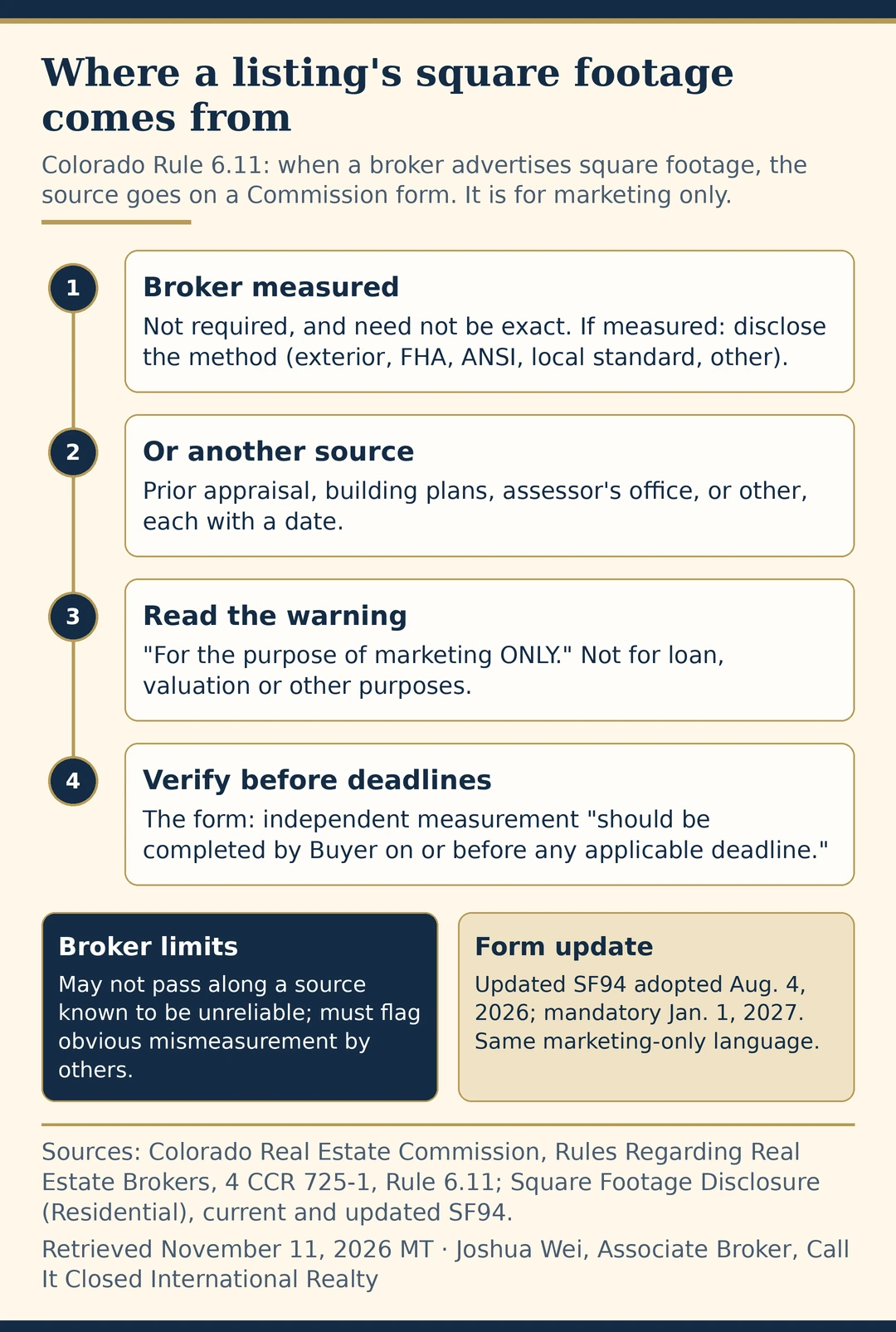
A vertical flow diagram, cream background with navy type and gold accents, titled Where a listing's square footage comes from, with the subtitle Colorado Rule 6.11 requires that when a broker advertises square footage, the source goes on a Commission form, and it is for marketing only. Four numbered steps: 1, broker measured, which is not required and need not be exact, but if measured the method must be disclosed, such as exterior, FHA, ANSI, local standard, or other; 2, or another source, such as a prior appraisal, building plans, the assessor's office, or other, each with a date; 3, read the warning, for the purpose of marketing only, and not for loan, valuation or other purposes; 4, verify before deadlines, where the form says independent measurement should be completed by the buyer on or before any applicable deadline. Two lower cards: broker limits, a broker may not pass along a source known to be unreliable and must flag obvious mismeasurement by others; and form update, an updated SF94 was adopted August 4, 2026, is mandatory January 1, 2027, and keeps the same marketing-only language. Sources: Colorado Real Estate Commission rules and forms. Retrieved November 11, 2026 MT.
Sources: 4 CCR 725-1 (opens in a new tab); Square Footage Disclosure (opens in a new tab)
Cream background, navy text, gold rules. Four numbered steps on a gold spine, two side-by-side cards, and a 28px source footer.
The diagram above shows the two ways a listing's square footage can be sourced on the Colorado form, and what a buyer can do with it. It summarizes Rule 6.11 and the Commission form.
Does the listing broker have to measure?
No. Rule 6.11(A) says: "A Broker is not required to measure the square footage of a property. If the Broker takes an actual measurement, it does not have to be exact; however, the Broker's objective must be to measure accurately and calculate competently in a manner that is not misleading."
If the broker does measure, the rule lists three things the broker must do:
- "Disclose to the Consumer the standard, methodology, or manner in which the measurement was taken;"
- "Advise that the measurement is for purposes of marketing and is not a measurement for loan, valuation, or any other purpose; and"
- "Advise that if exact square footage is a concern, then the property should be independently measured."
The standard the rule sets for a broker who measures is effort and honesty, not precision: the measurement "does not have to be exact," but the broker's objective "must be to measure accurately and calculate competently in a manner that is not misleading."
The form gives these measurement choices: "Exterior measurement," "FHA," "ANSI," "Local standard," and "Other." Note which box is checked, because the method is part of the number.
The form's first section starts with a yes-or-no choice: "Listing Licensee Has Has Not measured the square footage of the residence according to the following standard, methodology or manner." Next to the method, it has spaces for the "Date Measured" and the "Square Footage." If "Has Not" is checked, look to section 2 for the source.
What if the number came from somewhere else?
Section 2 of the form covers "Other Source of Measurement." Its listed sources are "Prior appraisal," "Building plans," "Assessor's office," and "Other," each with a date.
Rule 6.11(B) applies "If a Consumer is provided information from a source other than the Broker's own measurement for square footage." It names the kinds of source it means: "(whether an actual measurement, building plans, prior appraisals, assessor's office, etc.)." Such a source "must include the date of issuance, if any, and must be disclosed to the Consumers in writing by the Broker in a timely manner." The rule adds: "Such disclosure must be on the Commission-Approved Form."
On the form, the broker checks whether the listing licensee "Is" or "Is Not" "providing information on square footage of the residence from another source(s) as indicated below." It adds: "A Broker may not provide information to a person from a source known to be unreliable and is responsible for indicating obvious mismeasurement by others."
The form asks for the date of an outside source. Ask the listing broker which source and date were used.
How do Rules 6.10 and 6.11 fit together?
Two Commission rules speak to outside numbers, and they read differently.
Rule 6.10(C) says: "Brokerage Firms and Brokers are responsible for ensuring that all Advertising is accurate and complies with copyright laws and other applicable laws and regulations." It continues: "This includes, but is not limited to, the accuracy of information entered into Multiple Listing Services regarding property data, sales information, and the identification of Brokers who participated in the listing and sale of the property." Then it adds: "The Broker does not have a duty to investigate the information provided to the broker by the seller or obtained from a third-party source (e.g. assessor records, building plans)."
Rule 6.11(B), quoted above, says a broker "is responsible for indicating obvious mismeasurement by others" and "may not provide information to a person from a source known to be unreliable."
Both texts are quoted here as written. How the Commission applies them together to a particular listing is a question for the Division of Real Estate (opens in a new tab) or a Colorado real estate attorney.
What happens if a listing number is misleading?
The Commission's licensing statute covers misleading advertising. Under Colorado Revised Statutes section 12-10-217(1) (opens in a new tab), the Commission, after a hearing, "may impose an administrative fine not to exceed two thousand five hundred dollars for each separate offense, censure a licensee, place a licensee on probation and set the terms of probation, or temporarily suspend a license or revoke a license" if the licensee is guilty of, among other acts, "(a) Knowingly making any misrepresentation or knowingly making use of any false or misleading advertising."
The same subsection says the Commission "upon its own motion, may, and, upon the complaint in writing of any person, shall, investigate the activities of any licensee." Whether a buyer has any claim of their own is a question for a Colorado real estate attorney.
How can a buyer check the number?
The form tells both sides: "Buyer and Seller are advised to verify this information. Any independent measurement or investigation should be completed by Buyer on or before any applicable deadline in the contract."
Points the form itself raises:
- Method and date. The form records the measurement method or the outside source and its date.
- Assessor records. The assessor's office is one listed source; the county assessor can explain its own records.
- Independent measurement. The form says it "should be completed by Buyer on or before any applicable deadline in the contract."
- Appraisal. The form says the listing measurement "is not for loan, valuation or other purposes."
- Inspection rights. CBS1 section 10.3 (2026 form (opens in a new tab)) says: "Buyer, acting in good faith, has the right to have inspections (by one or more third parties, personally or both) of the Property, Leased Items, and Inclusions (Inspection), at Buyer's expense." Which contract deadline fits an independent measurement in your deal is a question for your broker.
How do appraisals measure?
Lender guides set their own measurement rules for appraisals, separate from the listing form. The form's method boxes include "ANSI" and "FHA"; the guides below describe what appraisers on those loans must do, which can add detail on what is counted where.
Fannie Mae loans
Fannie Mae's Selling Guide B4-1.3-05, Improvements Section of the Appraisal Report (opens in a new tab), says: "Appraisers must follow the American National Standard Institute (ANSI) Square Footage-Method for Calculating : ANSI ® Z765-2021" "when measuring, calculating and reporting the above- and below-grade square footage(s)." It adds: "This includes finished and unfinished area(s) of the subject for attached and detached single-family dwellings, including manufactured homes."
For condos, it says: "When measuring apartment unit in a condo or co-op project building, the appraiser must use interior perimeter measurements."
On basements and walk-outs, it says: "Fannie Mae considers a level to be below-grade if any portion of it is below-grade, regardless of the quality of its finish or the window area of any room. Therefore, a walk-out partially below-grade area with finished rooms would not be included in the above-grade square footage or room count."
The guide also says: "Rooms that are not included in the above-grade room count may add substantially to the value of a property, particularly when the quality of the finish is high." So a finished basement is reported on its own line, not dropped.
Two more Fannie Mae rules bear on comparisons. The guide says: "The appraiser must be consistent when reporting the finished above-grade square footage, below-grade square footage, and room count." And for odd spaces: "The square footage of any nonstandard finished area(s) (NSFA) such as finished area(s) with direct interior access from within the dwelling not conforming to the ANSI ceiling height requirements or accessed through unfinished area(s) (e.g. an unfinished hallway, a room, a staircase, etc.) must be calculated and reported separately in accordance with the ANSI standard."
FHA loans
HUD's Handbook 4000.1 (PDF (opens in a new tab); the PDF carries a "Last Revised: 08/14/2019" footer and points readers to the online version for section effective dates) defines the term: "Gross Living Area (GLA) refers to the total area of finished, above-grade residential space calculated by measuring the outside perimeter of the Structure. It includes only finished, habitable, above-grade living space."
The handbook says the appraiser must "ensure that finished basements and unfinished attic areas are not included in the total GLA." It also says: "The Appraiser must not include the living area of the ADU in the calculation of the Gross Living Area (GLA) of the primary dwelling."
For additions and garage conversions, the handbook says they count in GLA "provided that the addition or conversion space: • is accessible from the interior of the main dwelling in a functional manner; • has a permanent and sufficient heat source; and • was built in keeping with the design, appeal, and quality of construction of the main dwelling."
The handbook also tells the appraiser to "use the same measurement techniques for the subject and comparable sales, and report the building dimensions in a consistent manner." On split levels, it says: "When any part of a finished level is below grade, the Appraiser must report all of that level as below-grade finished area, and report that space on a different line in the appraisal report, unless the market considers it to be Partially Below-Grade Habitable Space."
Ask your lender which guide applies to your loan and how the appraiser will report the home.
What the form does not do
- It does not define living area. The form records a method or source; the rules quoted here do not say which rooms count.
- It does not require a measurement. Rule 6.11(A) says: "A Broker is not required to measure the square footage of a property."
- It is tied to advertising. Rule 6.11 starts: "When a Broker Advertises the square footage of a residential property." If a listing gives no square footage, ask the listing broker whether a disclosure was prepared.
- It is not an appraisal. In the form's words, the measurement "is not for loan, valuation or other purposes."
An invented example
This example is invented; it is not a real listing.
A Denver ranch is advertised at 2,400 square feet. The Square Footage Disclosure shows "Has Not" measured and lists "Assessor's office" with a date. A buyer compares it with another home at the same price and works out price per square foot from the listing number.
- The buyer asks what the 2,400 includes. The assessor record lists 1,300 above grade and 1,100 in a finished basement.
- The buyer's lender uses Fannie Mae guidelines. Under B4-1.3-05, the appraiser reports above-grade and below-grade space separately under ANSI Z765-2021.
- If price per square foot drives the offer, the buyer can have the home measured before the deadline the form mentions.
The numbers above are invented for illustration.
Buyer checklist
- Get the Square Footage Disclosure for each home you are comparing.
- Note "Has" or "Has Not" measured, the method box, and the date.
- For an outside source, note which one and its date.
- Ask what the figure includes: above-grade, basement, finished, unfinished.
- Ask your lender which appraisal guide applies.
- If size matters, arrange an independent measurement before the applicable contract deadline.
Is the form changing?
A new version has been adopted. The updated SF94 form (opens in a new tab) lists "Adoption Date: August 4, 2026" and "Mandatory Use Date: January 1, 2027." Its disclosure language matches the current form's "for the purpose of marketing ONLY" wording. The fields are the same: the "Has" or "Has Not" measured choice, the five method boxes, and the four listed outside sources. The 2027 header adds that the form "has been approved and promulgated by the Commission for use by real estate brokers as required by C.R.S. section 12-10-403(4)."
Related: Aurora property tax and metro district checklist (opens in a new tab).
Frequently asked questions
Is the listing square footage guaranteed?
No. The form says the measurement "may not be exact and is for the purpose of marketing ONLY."
Does my appraisal use the listing number?
The form says the listing measurement "is not for loan, valuation or other purposes." Ask your lender or appraiser how the appraisal measures.
Why does the assessor's number differ from the listing?
The form lists the assessor's office as one possible source, with a date. Methods and dates can differ. Ask the listing broker which source and date were used.
Who should measure if I'm concerned?
The form says "the property should be independently measured." It does not name who; ask a qualified measurement professional or appraiser about their method.
When should I measure?
"On or before any applicable deadline in the contract," per the form.
Does a basement count as living area?
The form shows the method, not a definition. Ask the person who measured which standard they used and what it includes. For loans, Fannie Mae treats a level as below-grade "if any portion of it is below-grade," and HUD's handbook says finished basements are "not included in the total GLA."
Does a converted garage count?
For FHA appraisals, HUD's handbook counts a garage conversion in GLA only if it meets the listed criteria, including "a permanent and sufficient heat source." For the listing number, ask the listing broker what the figure includes.
Do the buyer and seller sign the form?
The form has lines for the broker and for each seller and buyer under the statement: "The undersigned acknowledge receipt of this disclosure."
Who do I contact about a misleading listing?
Under Colorado Revised Statutes section 12-10-217(1), the Commission "upon the complaint in writing of any person, shall, investigate the activities of any licensee." The Division of Real Estate handles the Commission's process.
Related notes
- Selling in Denver or Aurora? What Colorado's Seller's Property Disclosure asks, and what "actual knowledge" means
- Checking permit history before you buy in Denver or Aurora: where to look and what unpermitted work can mean
- Colorado purchase contract deadlines, in plain English
Sources and method
Official sources, retrieved November 11, 2026, America/Denver: Colorado Real Estate Commission, Rules Regarding Real Estate Brokers, 4 CCR 725-1 (opens in a new tab), Rule 6.11; Square Footage Disclosure (Residential) (opens in a new tab) (current form) and the updated SF94 (opens in a new tab) (adopted August 4, 2026; mandatory January 1, 2027), from the Division of Real Estate contracts and forms page (opens in a new tab). Added November 13, 2026: Rule 6.10(C) of 4 CCR 725-1; Colorado Revised Statutes section 12-10-217 (opens in a new tab) (2026 Colorado Revised Statutes, Title 12); CBS1 2026 PDF (opens in a new tab) section 10.3; Fannie Mae Selling Guide B4-1.3-05 (opens in a new tab); and HUD Handbook 4000.1 (PDF (opens in a new tab)), Gross Living Area. Quotations are verbatim.
This note is general education from a Colorado real estate broker with Call It Closed International Realty. If you are comparing homes in Denver or Aurora by price per square foot, I can help you check where each listing's number came from.
Disclaimer
This article is general information only. It is not legal, tax, lending, insurance, appraisal, inspection, or financial advice, and it is not a substitute for advice about your situation. Joshua Wei is a Colorado real estate broker, not an attorney. Reading this article does not create a client relationship, an agency relationship, or an attorney-client relationship with Joshua Wei or with Call It Closed International Realty.
Laws, program rules, interest rates, insurance terms, tax figures, and other details change. Examples in this article are hypothetical illustrations unless a source is named for a specific, dated figure. Information in this article is believed accurate as of November 13, 2026 and is not guaranteed. No result is promised, and you should not rely on this article as the last word for your situation.
Before you act, confirm the point with the official source linked or cited in this article, and talk with a licensed professional who can apply the rule to your facts. That may be a licensed attorney, a tax professional, a lender, an insurance agent, a home inspector, or another licensed professional, depending on the question. Links to third-party websites and publications are provided for reference only. They are not an endorsement, and their content can change.
If you already have a brokerage relationship with another broker, this is not a solicitation.
Joshua Wei, Associate Broker, Call It Closed International Realty, Colorado license FA.100108558. Equal Housing Opportunity.