October 16, 2026 · Denver · Aurora · Buying · Selling · Home Safety
Meth contamination and Colorado home sales: disclosure, testing, and the state list for Denver and Aurora buyers
Colorado gives homebuyers a legal right to test for methamphetamine contamination and requires sellers to disclose what they know. What Colorado Revised Statutes section 38-35.7-103 and CBS1 section 10.12 say, how CDPHE's meth-affected property list works, and what buyers can check.
The short answer
In brief: Colorado law gives every residential buyer the right to test a property to determine whether it was ever used as a methamphetamine laboratory. Under Colorado Revised Statutes section 38-35.7-103, the seller must disclose in writing whether the seller knows of such prior use, with an exception for properties cleaned up and certified under state rules. CDPHE also keeps a state list.
Colorado law gives every residential buyer a testing right. Colorado Revised Statutes section 38-35.7-103(1) (opens in a new tab) says: "A buyer of residential real property has the right to test the property for the purpose of determining whether the property has ever been used as a methamphetamine laboratory."
Sellers must also speak up. Under section 38-35.7-103(3)(a), "the seller shall disclose in writing to the buyer whether the seller knows that the property was previously used as a methamphetamine laboratory," subject to an exception for properties cleaned up and certified under state rules.
The state health department keeps a public list of meth-affected homes discovered after August 7, 2023.
I am a licensed Colorado real estate broker with Call It Closed International Realty. I am not an attorney, an industrial hygienist, or a home inspector. This is not legal advice.
Disclaimer. This article is general information only. It is not legal, tax, lending, insurance, appraisal, inspection, or financial advice, and reading it does not create a client, agency, or attorney-client relationship. Laws, rates, programs, and figures change. Confirm the official source, and talk with a licensed attorney, tax professional, lender, insurance agent, or inspector before you act. Joshua Wei is a Colorado real estate broker, not an attorney. He is an Associate Broker with Call It Closed International Realty, license FA.100108558. Equal Housing Opportunity.
 Full size (opens in a new tab)
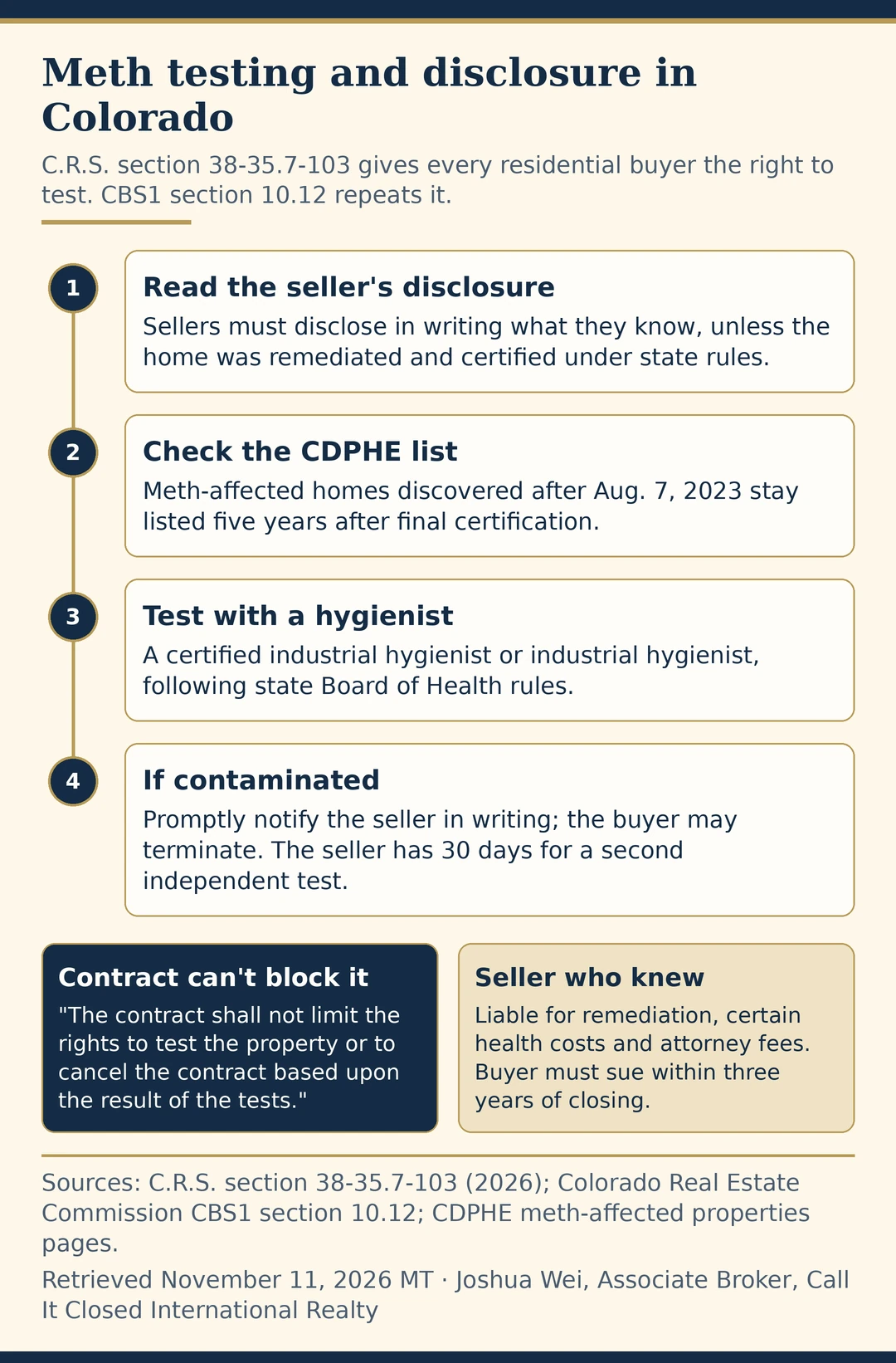
A vertical flow diagram, cream background with navy type and gold accents, titled Meth testing and disclosure in Colorado, with the subtitle C.R.S. section 38-35.7-103 gives every residential buyer the right to test, and CBS1 section 10.12 repeats it. Four numbered steps: 1, read the seller's disclosure, since sellers must disclose in writing what they know unless the home was remediated and certified under state rules; 2, check the CDPHE list, where meth-affected homes discovered after August 7, 2023 stay listed five years after final certification; 3, test with a hygienist, a certified industrial hygienist or industrial hygienist following state Board of Health rules; 4, if contaminated, promptly notify the seller in writing, the buyer may terminate, and the seller has 30 days for a second independent test. Two lower cards: contract can't block it, quoting the contract shall not limit the rights to test the property or to cancel the contract based upon the result of the tests; and seller who knew, who is liable for remediation, certain health costs and attorney fees, with the buyer required to sue within three years of closing. Sources: Colorado Revised Statutes, Colorado Real Estate Commission contract, and CDPHE. Retrieved November 11, 2026 MT.
Sources: CDPHE meth-affected list (opens in a new tab); C.R.S. Title 38 (2026) (opens in a new tab)
Cream background, navy text, gold rules. Four numbered steps on a gold spine, two side-by-side cards, and a 28px source footer.
The diagram above shows the testing path in Colorado law and the contract, and where to check the state list. It summarizes the statute, CBS1, and CDPHE pages.
Why does it matter for a home?
The Colorado Department of Public Health and Environment (CDPHE) cleanup page (opens in a new tab) says: "Methamphetamine (meth) labs may leave contamination on hard surfaces like walls, countertops, sinks or heating and air conditioning ducts, and may also be absorbed into soft surfaces like furniture, drapes and carpeting. Contamination may also occur when meth is smoked in a property."
It adds: "Even in small amounts, meth lab contaminants may pose health risks to people exposed to them."
The same page describes the legal frame: "Statutes and regulations require that properties contaminated by meth labs or meth use be cleaned up in accordance with standards established by the state Board of Health, or the property owner may elect to demolish the property instead." It also says: "Meth contaminated properties that don't meet the regulatory requirements are deemed a public health nuisance."
What counts as an "illegal drug laboratory"?
The cleanup law, Colorado Revised Statutes section 25-18.5-101(8) (opens in a new tab), defines it as "the areas where controlled substances, as defined by section 18-18-102, C.R.S., have been manufactured, processed, cooked, disposed of, used, or stored and all proximate areas that are likely to be contaminated as a result of the manufacturing, processing, cooking, disposal, use, or storage." That definition reaches use and storage, not only manufacturing.
What does the purchase contract say?
Section 10.12 of the Colorado Real Estate Commission's residential contract (CBS1, 2026 form (opens in a new tab)), from the Division of Real Estate's contracts and forms page (opens in a new tab), says: "If Seller knows that methamphetamine was ever manufactured, processed, cooked, disposed of, used or stored at the Property, Seller is required to disclose such fact."
The contract's list ("manufactured, processed, cooked, disposed of, used or stored") is worded more broadly than the statute's "used as a methamphetamine laboratory." Read your contract's version. The contract's verbs track the cleanup law's definition of an "illegal drug laboratory" in section 25-18.5-101(8), quoted above.
Section 10.12 has its own cleanup exception: "No disclosure is required if the Property was remediated in accordance with state standards and other requirements are fulfilled pursuant to section 25-18.5-102, C.R.S." It ends: "Buyer must promptly give written notice to Seller of the results of the test."
The Seller's Property Disclosure
The Commission's Seller's Property Disclosure (Residential) (opens in a new tab) (2026 form) asks about the same topic. One line reads: "Property was previously used as a methamphetamine laboratory and not remediated to state standards." The SPD's wording is tied to remediation status; CBS1 section 10.12's wording is tied to what the seller knows about manufacturing, use, or storage.
It also confirms the buyer's testing right: "Buyer further acknowledges that Buyer has the right to engage a certified hygienist or industrial hygienist to test whether the Property has ever been used as a methamphetamine laboratory."
Who can test, and what happens after a positive result?
Under section 38-35.7-103(2)(a), tests "shall be performed by a certified industrial hygienist or industrial hygienist" and follow state Board of Health rules. The full phrase says the tests must follow "the procedures and standards established by rules of the state board of health promulgated pursuant to section 25-18.5-102, C.R.S."
Two definitions in section 25-18.5-101 help a buyer pick who to call:
- Certified industrial hygienist. "an individual who is certified by the American board of industrial hygiene or its successor."
- Consultant. "a certified industrial hygienist or industrial hygienist who is not an employee, agent, representative, partner, joint venture participant, or shareholder of the contractor or of a parent or subsidiary company of the contractor, and who has been certified under section 25-18.5-106."
A "Contractor," by contrast, is a person "Hired to decontaminate an illegal drug laboratory" and "Certified by the department under section 25-18.5-106." Under these definitions, the consultant is kept separate from the contractor's business.
If the results show contamination that has not been remediated to state standards, "the buyer shall promptly give written notice to the seller of the results of the test, and the buyer may terminate the contract." The statute adds: "The contract shall not limit the rights to test the property or to cancel the contract based upon the result of the tests."
CBS1 section 10.12 matches this. The buyer "has the Right to Terminate under section 24.1., upon Seller's receipt of Buyer's written Notice to Terminate, notwithstanding any other provision of this Contract," based on such results.
The seller can retest. Under section 38-35.7-103(2)(b): "The seller shall have thirty days after receipt of the notice to conduct a second independent test." If that test also shows unremediated use, "the second independent hygienist shall so notify the seller."
Section 38-35.7-103(2)(c) says what happens if the seller does not retest: "If the seller receives a notice under this subsection (2) and does not elect to have the property retested under this subsection (2), then an illegal drug laboratory used to manufacture methamphetamine has been discovered."
The same paragraph sets the conditions for a buyer who wants to close anyway. Nothing in the section "prohibits a buyer from purchasing the property and assuming liability under section 25-18.5-103, C.R.S., if, on the date of closing, the buyer provides notice to the department of public health and environment and" the "governing body of the purchase and assumption of liability and if the remediation required by section 25-18.5-103, C.R.S., is completed within ninety days after the date of closing."
What does the owner of a contaminated home have to do?
Colorado Revised Statutes section 25-18.5-103(1)(a) (opens in a new tab) says that once a property owner has received notice, "the owner of any contaminated property shall meet the clean-up standards for property established by the board in section 25-18.5-102; except that a property owner may, subject to paragraph (b) of this subsection (1), elect instead to demolish the contaminated property."
Once the owner has "received certificates of compliance from a contractor and a consultant," section 25-18.5-103(2)(a) says the owner "Shall furnish copies of the certificates of compliance to the governing body and the department" and "Is immune from a suit brought by a current or future owner, renter, occupant, or neighbor of the property for health-based civil actions that allege injury or loss arising from the illegal drug laboratory." Paragraph (2)(b) carves out people convicted of manufacturing methamphetamine; how it applies is a question for an attorney.
Who is the "governing body"? Section 25-18.5-101(7) says it is "the agency or office designated by the city council or board of county commissioners where the property in question is located," and if none is designated, "the county, district, or municipal public health agency, building department, and law enforcement agency with jurisdiction over the property in question." CDPHE's cleanup page says: "Contact your local health department, building department or law enforcement agency to find out if the cleanup will be handled locally." It also says: "Copies of reports that have been filed with the division may be obtained through our record center."
Local governments have a role too. Under section 25-18.5-105(1), "Governing bodies may declare an illegal drug laboratory that has not met the clean-up standards set by the board in section 25-18.5-102 a public health nuisance." Under section 25-18.5-107(1), a person who violates the Board of Health's rules "is subject to an administrative penalty not to exceed fifteen thousand dollars per day per violation until the violation is corrected."
When doesn't a seller have to disclose?
Section 38-35.7-103(4) says that if the seller "remediates the property in accordance with the standards established pursuant to section 25-18.5-102, and receives certificates of compliance," then "The seller is not required to disclose that the property was used as an illegal methamphetamine drug laboratory to a buyer."
For sellers who knew and didn't disclose, section 38-35.7-103(3)(b) makes them "liable to the buyer" for remediation costs, certain health-related costs, and "Reasonable attorney fees for collection of costs from the seller." Under (3)(c), the buyer "shall commence an action under this subsection (3) within three years after the date on which the buyer closed the purchase."
How do I check the state list?
CDPHE's meth-affected residential properties listing (opens in a new tab) says: "Methamphetamine-affected residential real property, discovered after August 7, 2023, must be included on a public list in accordance with state statute (section 25-18.5-106, C.R.S.)."
The page adds: "Properties must remain on the list for five years after the final certificate of compliance is issued, unless the property is demolished." Covered properties include "Condominiums," "Townhomes," and "Rental property, including apartments."
A home not on the list is not proof of anything. The list covers discoveries after August 7, 2023, reported by law enforcement or a certified consultant.
Two official descriptions of the list's scope
The statute and the CDPHE page describe the list's start in different terms. Colorado Revised Statutes section 25-18.5-106(2) (opens in a new tab) says: "On and after January 1, 2024, the department shall create and make available to the public an online database of any residential real property, as defined in section 38-35.7-103 (5), that has been used as an illegal drug laboratory involving methamphetamine." It adds that "Each residential real property on the database must contain a field that is made available to the public and that records whether the property has a certificate of compliance."
The CDPHE page says the list covers property "discovered after August 7, 2023," and "will include residential real property deemed methamphetamine-affected through reporting by law enforcement or a consultant certified under section 25-18.5-106, C.R.S." Both are quoted here as written; CDPHE can explain what the list does and does not include.
The CDPHE page also lists grounds to ask for removal, including "The property has been demolished," "The property is not residential real property," and "The last certification of compliance is more than five years old."
Where do the sources point a buyer?
- The seller's disclosure under section 38-35.7-103(3)(a), and CBS1 section 10.12.
- The CDPHE list, described above.
- Testing. The statute calls for a "certified industrial hygienist or industrial hygienist." Questions about testing go to one; questions about rights go to a Colorado real estate attorney.
- Unclear disclosures. Questions go to the seller through the contract process, and legal questions to an attorney.
An invented example
This example is invented; it is not a real property.
A buyer is under contract on an Aurora townhome. The seller's disclosure is silent on meth, and the home is not on the CDPHE list. The buyer hires an industrial hygienist anyway, and the results show contamination above state standards.
- The buyer "shall promptly give written notice to the seller of the results of the test" and may terminate under CBS1 section 10.12 and section 24.1.
- The seller has thirty days to run a second independent test under section 38-35.7-103(2)(b).
- If the buyer wants to keep the home, section 38-35.7-103(2)(c) sets the notice and ninety-day remediation conditions for assuming liability.
Each step's timing in a real deal is a question for a Colorado real estate attorney.
Buyer checklist
- Read CBS1 section 10.12 and the Seller's Property Disclosure meth line.
- Search the CDPHE meth-affected properties list, and note whether a listed property shows a certificate of compliance.
- Decide whether to test, and hire a certified industrial hygienist or industrial hygienist.
- If results are positive, send written notice promptly and talk to an attorney about termination or assuming liability.
- For a cleaned-up home, ask for copies of the certificates of compliance.
If you plan to rent the home out, see Denver and Aurora rental licenses for buyers.
Related: Radon testing when buying in Denver or Aurora (opens in a new tab).
Frequently asked questions
Can a seller refuse to let me test?
The statute says "The contract shall not limit the rights to test the property." Ask an attorney if a seller resists.
Does a regular home inspection test for meth?
The statute calls for testing by a "certified industrial hygienist or industrial hygienist." Ask your inspector what their inspection includes.
What if the home was cleaned up years ago?
If it was remediated and certified under state rules, section 38-35.7-103(4) says the seller "is not required to disclose" it. The CDPHE list keeps properties for "five years after the final certificate of compliance is issued, unless the property is demolished."
Can I still buy a contaminated home?
The statute allows a buyer to purchase and assume liability under conditions, including that remediation "is completed within ninety days after the date of closing." Whether that fits a specific purchase is a question for a Colorado real estate attorney.
Does this apply to condos and townhomes?
Yes. Section 38-35.7-103(5) includes a "condominium" and "townhome."
Does this apply to a rental I buy?
Section 38-35.7-103(5) includes "rental property, including an apartment; and short-term residence such as a motel or hotel." The CDPHE list's covered properties include "Rental property, including apartments."
Is a seller who cleaned up the home protected from lawsuits?
Under section 25-18.5-103(2)(a), an owner with certificates of compliance from a contractor and a consultant "Is immune from a suit brought by a current or future owner, renter, occupant, or neighbor of the property for health-based civil actions that allege injury or loss arising from the illegal drug laboratory," with exceptions in (2)(b).
Can the same company clean and test?
The statute's definition of "Consultant" excludes anyone who is "an employee, agent, representative, partner, joint venture participant, or shareholder of the contractor."
Who do I report a suspected lab to?
CDPHE says: "To report a known or suspected meth lab, contact your local law enforcement agency or drug task force."
Related notes
- Selling in Denver or Aurora? What Colorado's Seller's Property Disclosure asks, and what "actual knowledge" means
- Buying an older Denver or Aurora home to remodel? Colorado's asbestos inspection rules come first
- Buying an older Denver or Aurora home? Lead paint disclosures and lead water service lines, explained
Sources and method
Official sources, retrieved November 11, 2026, America/Denver: Colorado Revised Statutes section 38-35.7-103 (opens in a new tab) (2026 Colorado Revised Statutes, Title 38); the Colorado Real Estate Commission's Contract to Buy and Sell Real Estate (Residential) (CBS1), section 10.12, from the Division of Real Estate contracts and forms page (opens in a new tab); and CDPHE's meth-affected residential properties listing (opens in a new tab) and meth-affected properties environmental cleanup (opens in a new tab) pages. Added November 13, 2026: Colorado Revised Statutes sections 25-18.5-101, -102, -103, -105, -106, and -107 (Title 25 (opens in a new tab)); CBS1 2026 PDF (opens in a new tab) section 10.12; and the Seller's Property Disclosure (Residential), 2026 PDF (opens in a new tab). Quotations are verbatim. No testing costs are estimated.
This note is general education from a Colorado real estate broker with Call It Closed International Realty. If you are buying in Denver or Aurora and want to understand your testing options before deadlines, I can help you plan the inspection period.
Disclaimer
This article is general information only. It is not legal, tax, lending, insurance, appraisal, inspection, or financial advice, and it is not a substitute for advice about your situation. Joshua Wei is a Colorado real estate broker, not an attorney. Reading this article does not create a client relationship, an agency relationship, or an attorney-client relationship with Joshua Wei or with Call It Closed International Realty.
Laws, program rules, interest rates, insurance terms, tax figures, and other details change. Examples in this article are hypothetical illustrations unless a source is named for a specific, dated figure. Information in this article is believed accurate as of November 13, 2026 and is not guaranteed. No result is promised, and you should not rely on this article as the last word for your situation.
Before you act, confirm the point with the official source linked or cited in this article, and talk with a licensed professional who can apply the rule to your facts. That may be a licensed attorney, a tax professional, a lender, an insurance agent, a home inspector, or another licensed professional, depending on the question. Links to third-party websites and publications are provided for reference only. They are not an endorsement, and their content can change.
If you already have a brokerage relationship with another broker, this is not a solicitation.
Joshua Wei, Associate Broker, Call It Closed International Realty, Colorado license FA.100108558. Equal Housing Opportunity.