September 18, 2026 · Denver · Aurora · Pets · Relocation · Buyers
Moving to Denver or Aurora with a dog or cat: licenses, pit bull rules, and pet limits
Moving with a pet? What Denver and Aurora require for pet licenses, how Denver's Breed-Restricted Permit works, Aurora's 2025 repeal of its breed ban, and Denver's limit on dogs and cats per home.
The short answer
In brief: Denver and Aurora both require pet licenses, and their pit bull rules differ. Denver requires dogs and cats 6 months and older to be licensed within 30 days of being in the city, and pit bull-type dogs are legal only with a Breed-Restricted Permit. Aurora requires licensing through its shelter and, since January 2025, allows those breeds within city limits.
Both cities require pet licenses, and the rules for pit bull-type dogs differ.
- Denver: "Pet licenses are required by law in Denver." Denver's Pet Licensing page (opens in a new tab) says the city code "requires all dogs and cats 6 months of age and older to be licensed with the City of Denver within 30 days of being in the city."
- Denver pit bulls: "Pitties (American pit bull terriers, American Staffordshire terriers, and Staffordshire bull terriers) are legal in Denver only when they have received a Breed-Restricted Permit."
- Aurora: the city "requires that all cats and dogs, over 6 months of age, be current on their rabies vaccines and licensed through the Aurora Animal Shelter." And "Effective January 2025, residents are allowed to own American Pit Bull Terriers, American Staffordshire Terriers and Staffordshire Bull Terriers within city limits."
I am a licensed Colorado real estate broker with Call It Closed International Realty. I am not an attorney.
Disclaimer. This article is general information only. It is not legal, tax, lending, insurance, appraisal, inspection, or financial advice, and reading it does not create a client, agency, or attorney-client relationship. Laws, rates, programs, and figures change. Confirm the official source, and talk with a licensed attorney, tax professional, lender, insurance agent, or inspector before you act. Joshua Wei is a Colorado real estate broker, not an attorney. He is an Associate Broker with Call It Closed International Realty, license FA.100108558. Equal Housing Opportunity.
 Full size (opens in a new tab)
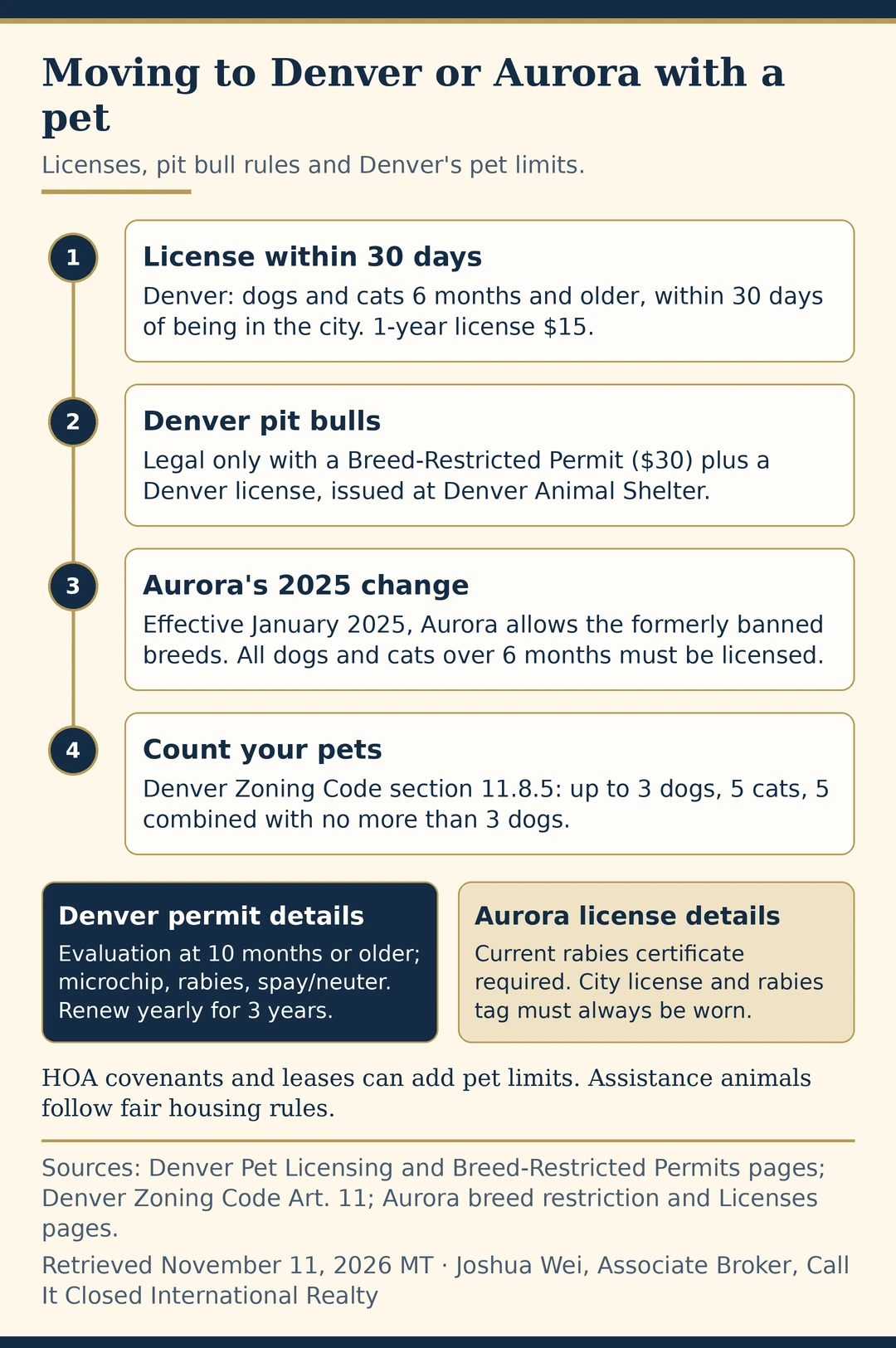
A vertical flow diagram, cream background with navy type and gold accents, titled Moving to Denver or Aurora with a pet. Subtitle: Licenses, pit bull rules and Denver's pet limits. 4 numbered steps: 1, License within 30 days: Denver: dogs and cats 6 months and older, within 30 days of being in the city. 1-year license $15; 2, Denver pit bulls: Legal only with a Breed-Restricted Permit ($30) plus a Denver license, issued at Denver Animal Shelter; 3, Aurora's 2025 change: Effective January 2025, Aurora allows the formerly banned breeds. All dogs and cats over 6 months must be licensed; 4, Count your pets: Denver Zoning Code section 11.8.5: up to 3 dogs, 5 cats, 5 combined with no more than 3 dogs. Two cards: Denver permit details: Evaluation at 10 months or older; microchip, rabies, spay/neuter. Renew yearly for 3 years; and Aurora license details: Current rabies certificate required. City license and rabies tag must always be worn. A note says: HOA covenants and leases can add pet limits. Assistance animals follow fair housing rules. Sources: Denver Pet Licensing and Breed-Restricted Permits pages; Denver Zoning Code Art. 11; Aurora breed restriction and Licenses pages. Retrieved November 11, 2026 MT. Joshua Wei, Associate Broker, Call It Closed International Realty.
Sources: Denver pet licensing (opens in a new tab); Aurora licenses (opens in a new tab)
Cream background, navy text, gold rules. Numbered navy circles on a gold spine with white step cards, two branch cards (navy and tan), a note, and a source footer.
The figure above compares the two cities' license and breed rules.
How does Denver's Breed-Restricted Permit work?
Denver's Breed-Restricted Permits page (opens in a new tab) says:
- "Only dogs 10 months of age or older must be evaluated."
- If the evaluation finds "a majority of your pup's physical characteristics are consistent with the restricted breeds," the dog needs "a permit and a Denver pet license."
- "General Cost: $0 for evaluation, $30 for Breed-Restricted Permit, $15 for pet license."
- Permitted dogs "must also be microchipped, vaccinated against rabies, and spayed/neutered." Denver also allows proof of a "DAP intact permit."
How the evaluation works: the page says to visit "the Denver Animal Shelter between 1 p.m. – 3 p.m., 7 days per week," and "No appointment necessary." During it, "three certified breed evaluators will look at the dog's physical characteristics and compare them to the American Kennel Club and United Kennel Club breed standards." The page adds, "There is no evaluation of behavior or temperament during the assessment," and "All three evaluators must determine that the dog displays predominant pit bull characteristics in order for the dog to be classified as a pit bull breed." If you disagree, "you may file a written petition for a hearing concerning such classification no later than 7 days after the assessment."
The same page lists the evaluation as "$0" in one place and says "Breed assessments cost $25" in another, and the permit list refers to "the $25 assessment fee." Ask the shelter which applies before you go.
The application also requires "Names and addresses of two people who may be contacted in the event of an emergency involving the pit bull," "An accurate description of the pit bull and recent photograph," and "Proof that the animal has had a registered microchip implanted." The page says those two contacts must be "people who can take care of the dog or be able to control the dog when you're not available."
Denver also caps the number: "The maximum number of pit bulls that any owner or keeper may have living in their home is two."
The permit isn't forever. "Renew your Breed-Restricted Permit every year for 3 years. After 3 years, if your pup has had no violations of Denver's animal protection ordinances, your pet will no longer need a permit to be legal in the city."
Violations reset the clock. The page lists examples, including "Off-leash charge," "Lapsed permit charge," "Bite charge," and "Excessive barking charge," and says "Each violation results in a resetting of the three-year time period, or other consequences."
The licensing page adds: "Pit bulls cannot be licensed through PetData," and "A pit bull license can only be issued at Denver Animal Shelter."
Moving to Denver with a pit bull-type dog
Timing matters for buyers moving in. Denver's FAQ says "You cannot bring a restricted-breed dog into Denver until you have a Breed-Restricted Permit issued by DAP." You can't buy one in advance online: "DAP needs to complete an in-person evaluation of the dog to determine its breed." But "If you get your dog evaluated by DAP prior to moving, you are welcome to purchase the permit at the same time and then update it when you move to a Denver address." The rule reaches visits too: a permit "is required for the dog to be within Denver City and County limits at any time," including at day care.
If an unpermitted dog is found, the page says "You will receive a warning and a mandatory request to bring the animal(s) in for an assessment," followed by "a follow-up verification within 10 days." After that, "you may be subject to a court appearance or a fine, or DAP may remove the animal(s) from the home."
What do Denver licenses cost?
Denver lists a "One-Year License" at $15, a "Three-Year License" at $40, and a "Lifetime License" at $150. It notes "Lifetime licenses do not apply to other jurisdictions outside of Denver." Seniors 65 and older get "One free three-year license per senior citizen," and service dogs get a "Free three-year license."
Other details from the licensing page:
- Online licensing adds "a convenience fee of $1.95" per transaction.
- "Denver ordinance requires your pet to be spayed or neutered after 6 months of age."
- "Denver pet licenses are non-transferable." The lifetime license "cannot be transferred to another owner or pet."
- For a service dog license, "include a note stating that the dog is a service animal and the task the animal is trained to perform." The page says "An animal that provides emotional support, crime prevention and comfort or companionship is not considered a service animal."
- "If you have moved outside the City and County of Denver, you are not required to license your pet with us."
What changed in Aurora?
Aurora's breed restriction page (opens in a new tab) says the change "follows the Aurora City Council's approval of an ordinance reflecting the will of voters in the November 2024 election, in which 56% supported repealing the previous ban on these breeds."
Owners of those breeds "are required to license their dogs with the city, just as is mandatory for all Aurora dog and cat owners." Aurora's Licenses page (opens in a new tab) lists a 1-year spayed or neutered license at $15 and a 3-year at $41, with higher fees for animals that aren't spayed or neutered. "Per city ordinance, both the city license and rabies tag must always be worn."
Aurora's fees for animals that aren't spayed or neutered are "$53" for one year and "$156" for three years, and "No license discount available for animals that are not spayed or neutered." Spayed or neutered pets get a "50% discount for residents 65 or older (proof of age is required)." The page says online purchases "can take up to 20 business days to process and receive," and "Expired rabies certificates will not be accepted."
The ordinance is Aurora City Code section 14-41 (opens in a new tab). Any owner of a dog or cat "kept as a household pet or working within the city shall obtain a city license from the city or its designated agents for each animal over the age of six months." It adds that "No license shall be issued until the applicant for the license provides proof of current vaccination for rabies," and "The absence of a city license tag attached to the collar or harness of the animal shall be prima facie evidence that such animal is not properly licensed."
After the repeal, section 14-75 (opens in a new tab) says owners of those three breeds "shall adhere to all requirements in this chapter, as amended from time to time." The city's page also notes "a new dangerous-dog ordinance, which gives judges greater latitude in deciding whether a dog of any breed poses a community risk based on their behavior and actions."
One caution: Aurora's landlord code enforcement page (opens in a new tab) still says those breeds "are restricted breeds and may not be kept within Aurora city limits." That conflicts with the January 2025 change and section 14-75. Rely on the code and the city's announcement, and confirm with Aurora Animal Services if a landlord or HOA points to the older page.
How many pets can I keep in Denver?
The Denver Zoning Code (opens in a new tab), section 11.8.5, allows household animals without a zoning permit within these limits:
- Dogs: "3 maximum"
- Cats: "5 maximum"
- Combination: "No more than 5 dogs and cats combined provided there are no more than 3 dogs as part of the total."
Denver's table also covers other animals: rabbits "2 maximum," pigeons or doves "25 maximum," and horses "No more than 1 horse for each 1/2 acre of zone lot area." For more, "The Zoning Administrator may allow the accessory keeping of animals of a type or number other than permitted," after a Zoning Permit with Informational Notice review. The animal must be kept "solely as a pet; a hobby; for educational, research, rehabilitation or propagation purposes; or for the production of food products for personal consumption by the resident."
A dog run has its own rules under section 11.8.6. Outdoor kennels and exercise runs "shall not exceed 200 square feet in area," must be "not less than 20 feet from any habitable building on an adjacent zone lot," and must be "in the rear one-half of the zone lot" and "visually screened from adjacent residential property by a solid fence or wall."
How many pets can I keep in Aurora?
Aurora's Animal Restrictions page (opens in a new tab) says "The city of Aurora's pet limit is for the entire household." The limits are "Dogs - 4," "Cats - 5," "Ferrets - 3," and "Rabbits - 2." Section 14-71 (opens in a new tab) makes it unlawful "to keep or harbor more than four dogs on any premises, except puppies whelped by dam at the residence," and "Only one litter of offspring may be kept on the premises until the age of four months."
The page also says "Livestock is not permitted unless allowed by zoning provisions of the City Code," and "Hens and ducks are allowed; however, a permit is required prior to having hens and ducks your property." Our backyard chickens guide covers that.
What about HOAs and rentals?
City rules are the floor, not the whole picture. An HOA's covenants or a landlord's lease can add pet limits. Read them before you write an offer or sign a lease. Assistance animals follow different rules under Colorado fair housing law.
Homeowner's insurance and dog breeds
Colorado limits how insurers can use breed. Under C.R.S. 10-4-110.8(16)(a) (opens in a new tab), an insurer "shall not refuse to issue, cancel, refuse to renew, or increase a premium or rate for a homeowner's insurance policy, a dwelling fire insurance policy, a commercial policy for multifamily units, or a policy to cover the contents of a structure used for a residence and occupied by an owner or renter based on the breed or mixture of breeds of a dog." The statute still allows action "on the basis that a particular dog kept at the dwelling, multifamily unit, or structure used as a residence is known to be dangerous or has been declared to be dangerous." And under (16)(c), "An insurer may not ask or otherwise inquire about the specific breed or mixture of breeds of a dog that is kept at the dwelling except to ask if the dog is known to be dangerous or has been declared to be dangerous."
Two hypotheticals
These are invented, to show how the rules apply.
Moving from Aurora to Denver with two dogs. A family with a Staffordshire bull terrier and a lab mix buys a house in Denver. Their Aurora license doesn't carry over. Before moving day, they take the terrier to Denver Animal Shelter for a breed evaluation and buy the permit there, then update it to the new address. Both dogs need Denver licenses within 30 days, and the terrier's license must come from the shelter, not PetData.
Four dogs and a move to Denver. An Aurora owner with four dogs, within Aurora's limit of four, buys a house in Denver. Denver's zoning code allows "3 maximum" dogs without a zoning permit. The owner would need to ask the Zoning Administrator to approve the fourth dog under section 11.8.5.1(B) before moving in, which requires a Zoning Permit with Informational Notice review.
Before you buy, if you have pets
- Count your dogs and cats against the city's limits.
- If you have a pit bull-type dog and are moving to Denver, schedule the evaluation before you move.
- Read HOA covenants and rules for pet limits, leash rules, and breed or size rules.
- If you're renting out the home, check the lease's pet terms against city law.
- Plan any dog run under Denver's section 11.8.6 placement rules.
Frequently asked questions
Are pit bulls legal in Denver?
Yes, with a Breed-Restricted Permit and a Denver pet license.
Can I visit Denver with my pit bull?
Not without a permit. Denver says a permit "is required for the dog to be within Denver City and County limits at any time."
How many dogs can I have in Aurora?
Four, under section 14-71, plus one litter of puppies until four months old.
What if I disagree with Denver's breed evaluation?
You may file a written petition for a hearing "no later than 7 days after the assessment."
Can a permitted pit bull use Denver dog parks?
Yes. Denver says that once the dog has a Breed-Restricted Permit and a city license, it "is allowed in any off-leash dog park in the City and County of Denver."
Can my insurer ask about my dog's breed?
Only whether the dog is known to be dangerous or has been declared dangerous, under C.R.S. 10-4-110.8(16)(c).
Are pit bulls legal in Aurora?
Yes. Aurora's ban was repealed effective January 2025.
How soon do I need a Denver pet license after moving?
Within 30 days of being in the city, for dogs and cats 6 months and older.
How many dogs can I have in Denver?
Three, within a combined limit of five dogs and cats.
Does a Denver lifetime license work in Aurora?
No. Denver says lifetime licenses don't apply outside Denver.
Do I need a rabies certificate to license in Aurora?
Yes. Aurora says "a Current Rabies Certificate is Required."
Related notes
- Buying a Denver or Aurora condo: read the building before you price the unit
- Buying a home you might rent out? Denver's rental license and Aurora's rental rules, explained
- What a Colorado HOA can't prohibit: flags, signs, xeriscape, EV chargers, heat pumps, and more for Denver and Aurora owners
Sources and method
Official sources, retrieved November 11 and 13, 2026, America/Denver:
- Denver, Pet Licensing (opens in a new tab)
- Denver, Breed-Restricted Permits (opens in a new tab)
- Denver Zoning Code, Article 11 (republished February 25, 2025) (opens in a new tab): sections 11.8.5 and 11.8.6
- Aurora, City Council Removes Dog-Breed Restrictions (opens in a new tab)
- Aurora, Licenses (opens in a new tab)
- Aurora, Animal Restrictions (opens in a new tab)
- Aurora, Code Enforcement for landlords (opens in a new tab)
- Aurora City Code section 14-41 (opens in a new tab), section 14-71 (opens in a new tab), and section 14-75 (opens in a new tab). The Aurora code site blocks automated requests, so these were read through a web fetch on November 13, 2026.
- C.R.S. title 10 (2026) (opens in a new tab): section 10-4-110.8(16)
Fees can change. Other metro cities have their own rules. Denver's Sec. 8-67 text wasn't separately reviewed; it's described as Denver's page states it. The hypotheticals are invented.
This note is general education from a Colorado real estate broker with Call It Closed International Realty. For pet questions, contact Denver Animal Protection or Aurora Animal Services. I'm glad to help you check HOA pet rules during a home search.
Disclaimer
This article is general information only. It is not legal, tax, lending, insurance, appraisal, inspection, or financial advice, and it is not a substitute for advice about your situation. Joshua Wei is a Colorado real estate broker, not an attorney. Reading this article does not create a client relationship, an agency relationship, or an attorney-client relationship with Joshua Wei or with Call It Closed International Realty.
Laws, program rules, interest rates, insurance terms, tax figures, and other details change. Examples in this article are hypothetical illustrations unless a source is named for a specific, dated figure. Information in this article is believed accurate as of November 13, 2026 and is not guaranteed. No result is promised, and you should not rely on this article as the last word for your situation.
Before you act, confirm the point with the official source linked or cited in this article, and talk with a licensed professional who can apply the rule to your facts. That may be a licensed attorney, a tax professional, a lender, an insurance agent, a home inspector, or another licensed professional, depending on the question. Links to third-party websites and publications are provided for reference only. They are not an endorsement, and their content can change.
If you already have a brokerage relationship with another broker, this is not a solicitation.
Joshua Wei, Associate Broker, Call It Closed International Realty, Colorado license FA.100108558. Equal Housing Opportunity.