September 19, 2026 · Denver · Aurora · Chickens · Homeowners · HOA · Buyers
Backyard chickens in Denver and Aurora: the permit, the limits, and what changes when you buy the house
What Denver's Food-Producing Animal permit and Aurora's chicken and duck permit allow, the space and coop rules, why the permit doesn't come with the house, and how HOA covenants fit in.
The short answer
In brief: Both Denver and Aurora allow backyard hens with a city permit, and neither allows roosters. Denver's Food-Producing Animals permit is available at the Denver Animal Shelter for a one-time fee of $25 per property and covers up to 8 hens or ducks combined, among other limits. Aurora has its own permit. This guide covers what changes when you buy.
Both Denver and Aurora allow backyard hens with a city permit, and neither allows roosters.
- Denver: a Food-Producing Animals (FPA) permit "can be obtained at the Denver Animal Shelter, for a one-time fee of $25 per property." It covers "Up to 8 hens (no roosters), OR up to 8 ducks (no drakes), or any combination of hens and ducks, not to exceed 8," plus up to two pygmy or dwarf goats.
- Aurora: "A city permit is required and must be obtained before having the animals on your property." The one-time fee is $40, and "Permits are granted to single-family residents."
If you're buying a house that already has a coop, the permit doesn't transfer to you. Denver's application says "This permit is not transferrable to other persons nor to other addresses."
I am a licensed Colorado real estate broker with Call It Closed International Realty. I am not an attorney.
Disclaimer. This article is general information only. It is not legal, tax, lending, insurance, appraisal, inspection, or financial advice, and reading it does not create a client, agency, or attorney-client relationship. Laws, rates, programs, and figures change. Confirm the official source, and talk with a licensed attorney, tax professional, lender, insurance agent, or inspector before you act. Joshua Wei is a Colorado real estate broker, not an attorney. He is an Associate Broker with Call It Closed International Realty, license FA.100108558. Equal Housing Opportunity.
 Full size (opens in a new tab)
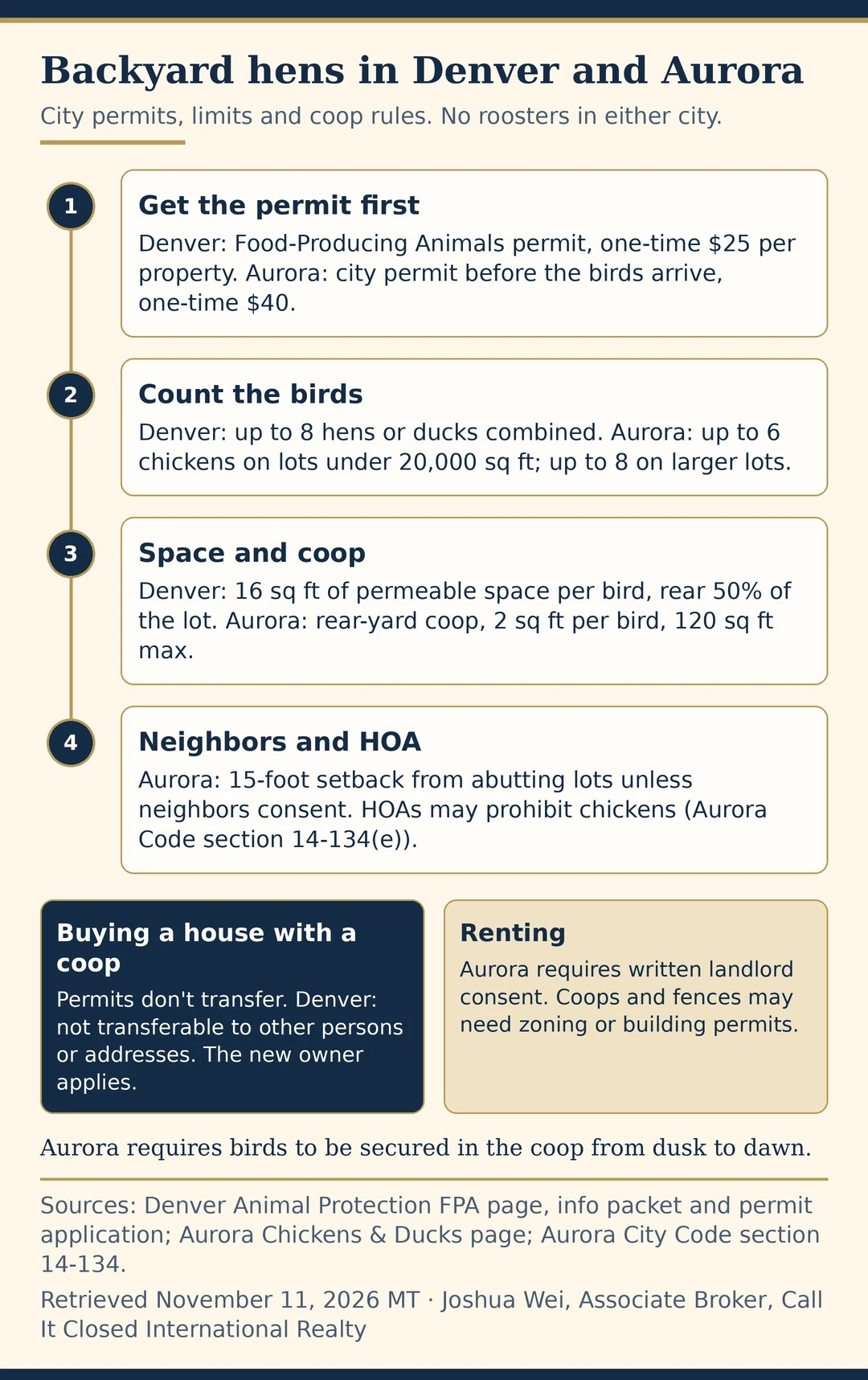
A vertical flow diagram, cream background with navy type and gold accents, titled Backyard hens in Denver and Aurora. Subtitle: City permits, limits and coop rules. No roosters in either city. 4 numbered steps: 1, Get the permit first: Denver: Food-Producing Animals permit, one-time $25 per property. Aurora: city permit before the birds arrive, one-time $40; 2, Count the birds: Denver: up to 8 hens or ducks combined. Aurora: up to 6 chickens on lots under 20,000 sq ft; up to 8 on larger lots; 3, Space and coop: Denver: 16 sq ft of permeable space per bird, rear 50% of the lot. Aurora: rear-yard coop, 2 sq ft per bird, 120 sq ft max; 4, Neighbors and HOA: Aurora: 15-foot setback from abutting lots unless neighbors consent. HOAs may prohibit chickens (Aurora Code section 14-134(e)). Two cards: Buying a house with a coop: Permits don't transfer. Denver: not transferable to other persons or addresses. The new owner applies; and Renting: Aurora requires written landlord consent. Coops and fences may need zoning or building permits. A note says: Aurora requires birds to be secured in the coop from dusk to dawn. Sources: Denver Animal Protection FPA page, info packet and permit application; Aurora Chickens & Ducks page; Aurora City Code section 14-134. Retrieved November 11, 2026 MT. Joshua Wei, Associate Broker, Call It Closed International Realty.
Sources: Denver animal ordinances (opens in a new tab); Aurora City Code section 14-134 (opens in a new tab)
Cream background, navy text, gold rules. Numbered navy circles on a gold spine with white step cards, two branch cards (navy and tan), a note, and a source footer.
The figure above compares the two cities' permits, bird limits, and space rules.
What does Denver require?
Denver Animal Protection's Food-Producing Animals information packet (opens in a new tab) says:
- "The ordinance requires that FPA owners have at least 16 square feet of permeable space per bird."
- "The fowls' permeable space (as well as the shelter) must be on the rear 50% of your zone lot."
- "Permeable space" means "ground or grass (i.e. not concrete)."
What the Denver Zoning Code adds
The zoning rules are in Denver Zoning Code section 11.8.5 (opens in a new tab), Keeping of Household Animals. For chickens and ducks, the table says:
- "No more than 8 chickens and ducks combined per zone lot."
- "No structure used to house the animals may be closer than 15 feet to: (1) a structure on an abutting zone lot containing a dwelling unit, and (2) a dwelling unit not the residence of the animal keeper(s) and located in a primary structure on the same zone lot."
- "On any residential zone lot, the animals shall be maintained in the rear 50% of the Zone Lot Depth."
- "Slaughtering of the animals as part of keeping such animals is prohibited."
The 8-bird limit is per zone lot, not per household, so a duplex on one lot shares it. The 15-foot rule is measured to the neighbor's house, not the property line. The city's information packet says "Slaughtering is allowed in Denver as well as many rural areas surrounding Denver," which reads differently from the zoning text. Rely on the code and ask Denver Animal Protection if it matters to you.
Can you keep more? Section 11.8.5.1(B) says "The Zoning Administrator may allow the accessory keeping of animals of a type or number other than permitted," after a Zoning Permit with Informational Notice review. The animals must be kept "solely as a pet; a hobby; for educational, research, rehabilitation or propagation purposes; or for the production of food products for personal consumption by the resident," and "The Zoning Administrator may not approve the keeping of animals otherwise prohibited by federal, state, or other city law."
For goats, the table allows "No more than 2 Dwarf Goats, except any number of their offspring younger than 6 months," with the same 15-foot and rear-50-percent rules.
The permit application (opens in a new tab) asks you to confirm "Adequate* shelter will be provided (predator-proof and protected from elements)" and that "Fencing will be provided to contain animals and prevent escape."
The coop itself may need city approval. The application says "zoning and/or building permits may be required for those structures." The packet also notes that "construction of fences 4' or higher require a zoning permit in Denver." On coops, it says "construction of a structure requires a zoning permit and in Denver, except for portable structures not larger than a typical dog house." For questions it lists "Denver Zoning by email at zoningreview@denvergov.org or phone 720-865-2984."
Care guidance in Denver's packet
The packet is practical. It's guidance, not code, but it shows what the city expects:
- "Plan on four square feet of coop space per bird. For Bantam sized chickens (less than two pounds) two square feet per bird is adequate."
- If the floor is dirt, "bury chicken wire or hardware cloth at least 12 inches around the perimeter of the enclosure, to prevent predators from digging in."
- "Fences that are 3'11" tall are typically adequate to keep fowl contained."
- "Be a good neighbor and do not make a common fence with your neighbor one side of your fowl/goat fencing."
- Birds "often need supplemental heating at night when the temperature drops below about 20°F."
It also covers time. "Fowl need regular daily care," and for vacations, "fowl typically should not be brought to another fowl owner's backyard to be cared for, since mixing flocks can create behavior problems." The packet suggests a predator-proof run of "at least 16 square feet per bird" attached to the coop for owners who can't let birds out each morning.
It also sets expectations about eggs: "Chickens only produce eggs consistently for 2-3 years; ducks for about 5 years. Fowl can live to be 8-10 years old." It warns that even with female chicks, "there is still a small chance that you could end up with a rooster." On disposal, "Dead animal pick-up can be requested by calling 311," and "Fowl can be buried on your property if they are buried at least 24" down."
On the application, the goat line is "Up to 2 pygmy goats (pygmy goat shall mean African Pygmy Goats or Nigerian Dwarf Goats (no unneutered males)," and each goat needs "130 square feet" of permeable land.
What does Aurora require?
Aurora City Code section 14-134 (opens in a new tab) sets the numbers by lot size:
- On single-family lots "less than 20,000 square feet in size, up to six chickens," or two ducks with no more than four chickens.
- On lots "of 20,000 or more square feet in size, up to eight chickens," with set combinations of ducks and chickens.
- "No single-family residential property duck owner shall have less than two ducks."
The coop must be "Located in the rear yard that is fenced by an opaque fence," be "At least two square feet per chicken hen and duck in size," and be "Not in excess of 120 square feet in floor space." It must sit next to an outdoor enclosure "not less than 16 square feet in size."
Setbacks matter on smaller lots. Neither the coop nor the enclosure may be "less than 15 feet from any property line of any abutting properties" unless the neighbors give written consent. The birds "must be secured in the bird coop from dusk to dawn."
That consent has a lasting effect. Under section 14-134(a)(9), once the neighbors agree, "the agreed-upon location shall then be deemed acceptable notwithstanding any subsequent change in ownership of such abutting property or properties." A buyer next door inherits the earlier consent.
Other Aurora conditions
The rest of section 14-134(a) adds:
- "During daylight hours, the chicken hens and ducks must have access to the bird coop and the outdoor enclosure."
- The birds must be kept "to prevent them from coming into contact with wild ducks or geese or their excrement, and to prevent them from running at large."
- Coops and enclosures "shall be kept in a neat and sanitary condition at all times."
- The coop must be "Properly ventilated, and designed to be easily accessed, cleaned, and maintained."
- "During the months of April through October, ducks shall have access to a suitable single container with a minimum of 30 gallons of fresh potable water."
- No hen or duck may be killed by or at the owner's direction except under a health official's order, "for the purpose of euthanasia when surrendered to a licensed veterinarian, or as otherwise permitted by law."
The opaque rear-yard fence must conform "to the fence requirements in chapter 146." Our fence rules guide covers those.
Roosters
Aurora bans roosters twice. Section 14-134(a)(2) says "The keeping of roosters is prohibited; only chicken hens or ducks are permitted." Section 14-134(f) adds: "It shall be unlawful for a person to keep or allow to be kept a rooster or roosters on any lot of single-family residential property anywhere in the city," with penalties under section 1-13. Since even female-only chick orders can produce a rooster, as Denver's packet warns, plan for what you'd do with one.
Permits, revocation and disease
The city's page says to "Email your permit application, drawing and written consent from neighbors or landlords (if required) to the permit office." It adds: "A permit can be revoked for conviction in municipal court of violating city ordinances (i.e., animal violations, fence regulations, etc.)." Under section 14-134(b), "Any failure to maintain premises in compliance with the requirements of this section, or the conditions of the permit, shall be grounds for revocation of the permit."
Section 14-134(d) gives the city power "to confiscate, quarantine, or euthanize any chickens or ducks for the purpose of controlling the outbreak of contagious or infectious disease within the city." It also preserves the state's authority under "the Colorado Livestock Health Act, C.R.S. section 35-50-101 et seq."
Aurora's Animal Restrictions page (opens in a new tab) separates hens and ducks from livestock. It says "Livestock is not permitted unless allowed by zoning provisions of the City Code," and lists "roosters, pigeons, geese or other poultry" among livestock.
Can my HOA say no?
In Aurora, yes. The city's chickens and ducks page (opens in a new tab) says "Homeowners Associations (HOAs) have the authority to prohibit chickens or ducks within their bylaws." City Code section 14-134(e) says the city rule doesn't permit chickens or ducks where "otherwise prohibited by covenants, conditions, and restrictions imposed by a homeowners' association."
Read the HOA's covenants and rules before you buy if hens are in your plans. Some Aurora homes are also in a metro district, which has its own documents. My Aurora buyer checklist (opens in a new tab) covers how I pull a parcel's district information.
What if I rent?
Aurora says "If renting you must acquire written consent from your landlord." The code requires written consent from the property owner as a condition of the permit.
Two hypotheticals
These are invented, to show how the numbers work.
An Aurora buyer on a 7,500-square-foot lot. The buyer wants three ducks and three hens. On a lot under 20,000 square feet, section 14-134(a)(3)(a) allows "up to six chickens; or a minimum of two ducks but no more than two ducks with no more than four chickens." Three ducks isn't an option on this lot. Two ducks and up to four hens is. The coop needs at least two square feet per bird, so 12 square feet for six birds, and it must be 15 feet from abutting property lines unless the neighbors sign.
A Denver duplex. Two households share one zone lot, and each wants six hens. Denver's limit is "No more than 8 chickens and ducks combined per zone lot," so together they can keep eight. The coop must be at least 15 feet from the other unit if that unit isn't the keeper's residence.
What should buyers and sellers do with an existing flock?
Whether the birds stay or go is a deal point. If the buyer wants to keep hens, the buyer needs a permit in the buyer's own name. In Denver, the permit isn't transferable to other people or addresses. In Aurora, the code says the "chicken or duck owner must obtain and maintain a permit."
In Aurora, check whether the seller got neighbor consent for a coop closer than 15 feet. If so, ask for a copy, since the consent runs with the location.
A coop, run or fence can also be a structure question. If the setup looks permanent, ask whether permits were needed and pulled, and put any agreement about leaving the coop in writing.
A buyer's checklist for backyard birds
- Read the HOA covenants and rules for any ban on chickens or ducks.
- Measure the backyard: Denver needs 16 square feet of permeable ground per bird on the rear half of the lot. Aurora needs a fenced rear yard and a 16-square-foot enclosure.
- Measure from the coop location to neighbors' houses (Denver) or property lines (Aurora).
- In Aurora, confirm the lot size, since 20,000 square feet changes the limits.
- Check whether the existing coop needed a zoning permit.
- Plan to apply for your own permit after closing.
Frequently asked questions
How many chickens can I have in Denver?
Up to eight hens or ducks combined, with an FPA permit.
How many chickens can I have in Aurora?
Up to six on lots under 20,000 square feet and up to eight on larger lots, with fewer chickens if you keep ducks.
Are roosters allowed?
No. Denver's permit says "no roosters," and Aurora's code prohibits them on single-family lots.
What does the permit cost?
Denver lists a one-time $25 fee per property. Aurora lists a one-time $40 fee.
Does the permit come with the house?
No. Denver's permit isn't transferable, and Aurora requires the owner of the birds to hold the permit.
Can I keep more than eight birds in Denver?
Only with the Zoning Administrator's approval through a Zoning Permit with Informational Notice under section 11.8.5.1(B).
Do I need a permit for the coop itself?
In Denver, the packet says a structure needs a zoning permit "except for portable structures not larger than a typical dog house." In Aurora, the coop can't exceed 120 square feet and must sit in a rear yard with an opaque fence.
What if my neighbor's coop is close to my property line in Aurora?
If the earlier owner of your house signed written consent, the location stays "acceptable notwithstanding any subsequent change in ownership." Ask the seller whether they signed one.
Can I keep ducks without a pond?
In Aurora, ducks need "a suitable single container with a minimum of 30 gallons of fresh potable water" from April through October. Denver's packet says "providing bathing water is not required when keeping ducks."
Can I keep just one duck in Aurora?
No. The code says "No single-family residential property duck owner shall have less than two ducks."
Can an HOA ban chickens in Aurora?
Yes. The city says HOAs may prohibit them.
Related notes
- What a Colorado HOA can't prohibit: flags, signs, xeriscape, EV chargers, heat pumps, and more for Denver and Aurora owners
- Checking permit history before you buy in Denver or Aurora: where to look and what unpermitted work can mean
- ADUs in Denver and Aurora: what Colorado's 2024 law, Denver's permit rules, and Aurora's pending update say
Sources and method
Official sources, retrieved November 11 and 13, 2026, America/Denver:
- Denver Animal Protection, Animal Ordinances and Legislation (opens in a new tab)
- Denver, Food-Producing Animals information packet (opens in a new tab)
- Denver, Food-Producing Animal permit application (opens in a new tab)
- Aurora, Chickens & Ducks (opens in a new tab)
- Aurora City Code section 14-134 (opens in a new tab). The Aurora code site blocks automated requests, so it was read through a web fetch on November 13, 2026.
- Aurora, Animal Restrictions (opens in a new tab)
- Denver Zoning Code, Article 11 (republished February 25, 2025) (opens in a new tab): section 11.8.5
Goats are covered only briefly, and beekeeping isn't covered. Denver's Chapter 8 ordinance text wasn't separately reviewed. The hypotheticals are invented. Other Front Range cities have their own rules.
This note is general education from a Colorado real estate broker with Call It Closed International Realty. Ask the city permit office about your specific lot. I'm happy to help you check covenants before you write an offer.
Disclaimer
This article is general information only. It is not legal, tax, lending, insurance, appraisal, inspection, or financial advice, and it is not a substitute for advice about your situation. Joshua Wei is a Colorado real estate broker, not an attorney. Reading this article does not create a client relationship, an agency relationship, or an attorney-client relationship with Joshua Wei or with Call It Closed International Realty.
Laws, program rules, interest rates, insurance terms, tax figures, and other details change. Examples in this article are hypothetical illustrations unless a source is named for a specific, dated figure. Information in this article is believed accurate as of November 13, 2026 and is not guaranteed. No result is promised, and you should not rely on this article as the last word for your situation.
Before you act, confirm the point with the official source linked or cited in this article, and talk with a licensed professional who can apply the rule to your facts. That may be a licensed attorney, a tax professional, a lender, an insurance agent, a home inspector, or another licensed professional, depending on the question. Links to third-party websites and publications are provided for reference only. They are not an endorsement, and their content can change.
If you already have a brokerage relationship with another broker, this is not a solicitation.
Joshua Wei, Associate Broker, Call It Closed International Realty, Colorado license FA.100108558. Equal Housing Opportunity.