September 16, 2026 · Denver · Aurora · Water · Irrigation · Homeowners · Buyers
Sprinkler backflow testing in Denver and Aurora: the annual test new homeowners miss
If a Denver or Aurora home has an irrigation system, its backflow assembly likely needs an annual test by a certified tester. What Denver Water and Aurora Water require, who's responsible, the penalties for missing it, and what buyers should ask before closing.
The short answer
In brief: If a Denver or Aurora house has an in-ground sprinkler system, find out when its backflow assembly was last tested. Denver Water says the water customer must have the assembly tested upon installation and annually thereafter by a certified backflow prevention assembly tester, and its irrigation testing season runs from May to September. Aurora Water has its own program.
If the house has an in-ground sprinkler system, find out when its backflow assembly was last tested.
- Denver Water: "the water customer must have the assembly tested upon installation and annually thereafter by a certified backflow prevention assembly tester." Its backflow program page (opens in a new tab) says "The irrigation backflow testing season is from May to September."
- Aurora Water: "Operational tests by a Certified Backflow Technician must be conducted on any required backflow prevention assembly upon installation and at least annually thereafter." Results "must be submitted online at the backflow site before the annual test due date," according to Aurora's backflow prevention page (opens in a new tab).
Missing the test can cost money. Aurora's code adds a $1,000 civil penalty after 30 days, and Denver Water charges $250 if service is suspended.
I am a licensed Colorado real estate broker with Call It Closed International Realty. I am not an attorney.
Disclaimer. This article is general information only. It is not legal, tax, lending, insurance, appraisal, inspection, or financial advice, and reading it does not create a client, agency, or attorney-client relationship. Laws, rates, programs, and figures change. Confirm the official source, and talk with a licensed attorney, tax professional, lender, insurance agent, or inspector before you act. Joshua Wei is a Colorado real estate broker, not an attorney. He is an Associate Broker with Call It Closed International Realty, license FA.100108558. Equal Housing Opportunity.
 Full size (opens in a new tab)
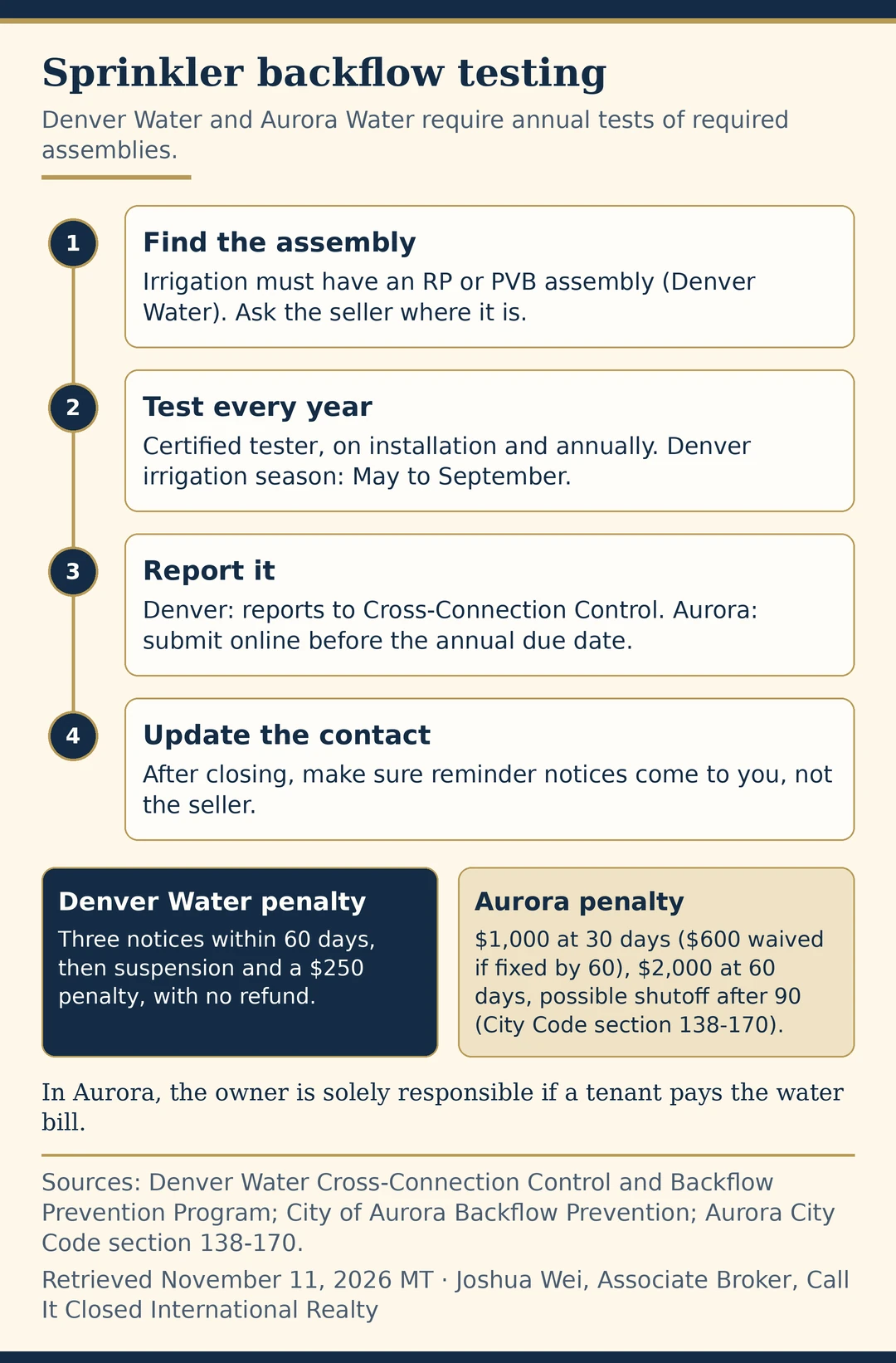
A vertical flow diagram, cream background with navy type and gold accents, titled Sprinkler backflow testing. Subtitle: Denver Water and Aurora Water require annual tests of required assemblies. 4 numbered steps: 1, Find the assembly: Irrigation must have an RP or PVB assembly (Denver Water). Ask the seller where it is; 2, Test every year: Certified tester, on installation and annually. Denver irrigation season: May to September; 3, Report it: Denver: reports to Cross-Connection Control. Aurora: submit online before the annual due date; 4, Update the contact: After closing, make sure reminder notices come to you, not the seller. Two cards: Denver Water penalty: Three notices within 60 days, then suspension and a $250 penalty, with no refund; and Aurora penalty: $1,000 at 30 days ($600 waived if fixed by 60), $2,000 at 60 days, possible shutoff after 90 (City Code section 138-170). A note says: In Aurora, the owner is solely responsible if a tenant pays the water bill. Sources: Denver Water Cross-Connection Control and Backflow Prevention Program; City of Aurora Backflow Prevention; Aurora City Code section 138-170. Retrieved November 11, 2026 MT. Joshua Wei, Associate Broker, Call It Closed International Realty.
Sources: Denver Water backflow (opens in a new tab); Aurora City Code section 138-170 (opens in a new tab)
Cream background, navy text, gold rules. Numbered navy circles on a gold spine with white step cards, two branch cards (navy and tan), a note, and a source footer.
The figure above compares the two utilities' testing rules and penalties.
What is backflow, and why test it?
Denver Water defines backflow as the "unwanted flow of water or other liquids, mixtures, gasses or substances into the drinking water supply." A backflow prevention assembly "is a mechanical valve arrangement designed to prevent the reversal of the flow of water once it has passed through the valve."
It adds: "Like any mechanical device, a backflow prevention assembly requires maintenance and annual testing."
Denver Water describes two ways backflow happens:
- Backsiphonage "occurs when there is a negative pressure in the water distribution system, which draws the water from a private water system into the public water system. This can occur at any time, such as during a water main break or during a large firefighting effort."
- Backpressure "occurs when the pressure in a private water system exceeds the pressure in the public water distribution lines that can cause normal flow to reverse."
Denver Water defines cross-connections as "actual or potential connections between the public water supply and any other system that could accidentally introduce a contaminant back into the public water supply." A sprinkler line runs from the house supply out to heads in the yard, so it's one of those connections. The assembly keeps water from flowing back through it. Denver Water says that "According to the Environmental Protection Agency, cross-connections can be a serious public health hazard if they do not have adequate backflow prevention assemblies installed."
Where the rule comes from
Denver Water says "The Colorado Department of Public Health and Environment regulates drinking water quality and standards. The Colorado Primary Drinking Water Regulations ( Regulation 11 ) outline Denver Water's requirements for cross-connection control and backflow prevention." It cites "CDPHE Regulation 11.39(3)(c)(i)" for annual testing. Aurora's program is set by city ordinance, section 138-170, which gives the Aurora Water general manager "the authority to adopt standards for water, wastewater and storm drainage infrastructure relating to backflow prevention and cross-connection control programs."
What does Denver Water require?
Denver Water says "All commercial, industrial, domestic, irrigation and fire line services are required to have an approved backflow prevention assembly installed." For single-family homes, "Requirements for multi- and single-family residences are assessed based on site hazards."
For sprinklers:
- "Irrigation systems must be protected with either a reduced pressure principle assembly (RP) or a pressure vacuum breaker (PVB) depending on installation requirements."
- Irrigation assemblies "must be tested by a certified backflow assembly tester as the water is turned on."
- "Denver Water will send out a testing reminder notice 30 days before the annual test is due."
- "There are no exemptions or grandfathering in of backflow prevention assembly requirements."
Who can test? Denver Water says that after HB25-1077, "Plumbing licensure is not required to inspect, test and repair backflow assemblies," and domestic and irrigation assemblies can be handled by "a certified tester that holds either an ABPA or ASSE certification."
Which device is on the house?
Denver Water lists the assembly types and where each may go:
- Pressure vacuum breaker (PVB). "PVBs are for use on irrigation systems. They have specific installation requirements and are limited in their use." A PVB "Must be installed a minimum of 12 inches above the highest point of use and 12 inches away from a wall" and "Cannot be subjected to continuous backpressure."
- Reduced pressure principle assembly (RP). An RP "can also be used on irrigation systems where a pressure vacuum breaker (PVB) cannot be used." It must be installed at least "12 inches off the floor and 12 inches away from a wall," and "Adequate drainage is required, as there is a potential for discharge from the unit. Protect from freezing."
- Double check valve assembly (DC). "They are not allowed for irrigation systems."
- Atmospheric vacuum breaker (AVB). "Denver Water does not allow AVBs for any type of containment or irrigation uses."
Assemblies "must be approved by the University of Southern California's Foundation for Cross-Connection Control and Hydraulic Research, otherwise known as being USC-approved." Denver Water adds: "You must also confirm the assembly is approved in the orientation for which it is being installed (horizontal, vertical, etc.)."
For a buyer, this list helps with the walk-through. If the sprinkler system has an AVB or a double check valve, that's a question to raise with the seller and your inspector. The PVB's 12-inch rule is measured from "the highest point of use," so on a sloped lot the device's height relative to the uphill heads matters.
Wells and ponds
Denver Water also says "All customers with an auxiliary water supply, such as a well or a pond, are also required to install and maintain backflow prevention assemblies." A house with a private irrigation well and a Denver Water tap is in that group.
Where to send the report
"All testing must be reported to Denver Water's Cross-Connection Control office. All test reports must be sent to crossconnectioncontrol@denverwater.org."
What happens if a Denver home misses the test?
Denver Water says it "sends out three notices to both the service address and the backflow contact on record prior to a disconnection of service within a 60-day time frame." After that, "The $250 penalty is assessed after three mailed notification letters have not been responded to and the service goes into suspension status. There is no refund to this penalty." Denver Water says it requires compliance "within 60 days," and "The Cross Connection Control team will need to be notified if it will take longer." To avoid the penalty, "Cross Connection Control needs to be notified of any delays in testing or installation before suspension of service occurs." The penalty took effect "May 1, 2025."
Denver Water also surveys service lines. It says "The survey of the water service line is required per State Regulation 11.39 to determine if a backflow is necessary to protect the main drinking water supply from hazards on the property." If the utility can't get access, the customer may receive a "Suspension of Service and Public Health Hazard Notice."
What does Aurora require?
Aurora City Code section 138-170 (opens in a new tab) puts the duty on the "responsible party," defined as "the person billed for water service provided by the city, or the owner of the property served by city water if the owner is different than the person billed." If they differ, "the owner shall be solely responsible."
The code sets out the duty in section 138-170(d)(1). The responsible party "shall have operational tests conducted on any required backflow prevention assembly or inspect any required backflow prevention method prior to receiving a certificate of occupancy and at least annually thereafter." Proof must reach Aurora Water "no later than the annual due date." Tests are "at the expense of the responsible party and must be performed by a certified cross-connection control technician," meaning someone with a tester certification from "American Society of Sanitary Engineering (ASSE) or the American Backflow Prevention Association (ABPA)."
Other duties in section 138-170(d):
- A failed or defective assembly "shall be repaired or replaced at the expense of the responsible party."
- Records of tests, repairs or replacements must be kept, and "a copy of all such records shall be sent to Aurora Water within five working days of performance of such work."
- The city "may require operational tests at more frequent intervals."
Containment and isolation
Aurora's code uses two terms a test report may mention. "Containment" is "the control of cross-connections within a property owner's plumbing system by the installation of approved backflow prevention assemblies or methods on the property owner's service line after the meter and before any branches." "Isolation" means controlling cross-connections "at or near the point of potential contamination or pollution." A sprinkler assembly on the irrigation branch is an isolation device. The code also separates a testable "Backflow prevention assembly," which "is an in-line field-tested assembly," from a "Backflow prevention method," which includes a "nontestable device." Section 138-170(d)(1) requires testing the first and inspecting the second.
Section 138-170(c)(2) adds: "The installation or maintenance of any unprotected cross connection which may endanger the water supply of the city is prohibited." Any such connection "shall be immediately protected by a city-approved backflow assembly or method or eliminated."
Due dates
The "annual due date" is "the annual date as established by the city when required tests must be completed and proof received by Aurora Water." If it falls on a non-business day, "the due date for that year will be the next regular business day."
The notices go to more than one place. Under section 138-170(f)(1)(a), "a notice of reminder will be mailed to the party billed for water service," and if the owner is different, "a notice of reminder will also be mailed to the listed owner, at the address on file with the applicable county tax assessor's office."
The penalties climb:
- After 30 days past the annual due date, "a $1,000 charge will be added to the water bill for the property as a civil penalty." If proof comes within 60 days of the due date, "$600.00 of this charge will be waived."
- After 60 days, a second notice and "a $2,000 charge."
- After 90 days, "Water service may be terminated seven days after notice."
When the responsible party isn't the person billed, the code says "a bill reflecting the $1,000 civil penalty will be mailed to the responsible party." Penalties "may be appealed to the general manager pursuant to the appeal procedure set forth in section 138-226."
A failed test has its own clock. Under section 138-170(f)(2)(a), "Service will be discontinued within 60 days of notification of a failed test or notification of an inadequate backflow prevention method and shall not be restored until such conditions or defects are corrected."
The city may also inspect. Under section 138-170(e), "Refusing entry to the city representative shall be sufficient cause for Aurora Water to discontinue water service to the property."
Two hypotheticals
These are invented, to show how the timelines work.
An Aurora closing in the middle of the testing year. A buyer closes on an Aurora house in July. The seller never sent in this year's test, and the annual due date was June 1. By the time the buyer moves in, more than 30 days have passed, and the property may already carry a $1,000 civil penalty on the water account. Under section 138-170(f)(1)(b), $600 is waived if proof arrives within 60 days of the due date. A buyer who asked about the test during the inspection period could have asked the seller to test and send proof before closing.
A Denver rental with a tenant on the account. An investor buys a Denver house with a tenant who has the water account. The reminders go to the service address and the backflow contact on record. If the old owner is still listed as the backflow contact, the new owner may not see the notices. Updating the contact through Denver Water Customer Care after closing avoids that.
What should buyers ask?
Questions for the seller during the inspection period:
- Is there an irrigation system, and where is the backflow assembly?
- When was it last tested, and is there a test report?
- Who is the backflow contact on the water account?
- What type of assembly is it (PVB or RP), and is it the type the utility allows for irrigation?
- Has the assembly ever failed a test, and was it repaired or replaced?
- In Aurora, what is the annual due date for this property?
After closing, update the contact information with the utility so the reminder comes to you. In a landlord setup in Aurora, the owner carries the duty even if the tenant pays the water bill.
Water service details belong on the same checklist as drainage. My flood map and drainage checklist (opens in a new tab) covers the rest of the water questions I ask.
Frequently asked questions
Do I need to test my sprinkler backflow every year?
Denver Water and Aurora Water both require annual testing of required assemblies.
When does Denver Water expect irrigation tests?
Its testing season is May to September, as the water is turned on.
Who can do the test?
A certified tester. Denver Water accepts ABPA or ASSE certification for domestic and irrigation assemblies.
Who's responsible in Aurora if a tenant pays the water bill?
The owner. Aurora's code says the owner "shall be solely responsible" when the owner and billed person differ.
What's the penalty in Aurora?
$1,000 after 30 days, $2,000 after 60 days, and possible shutoff after 90 days.
Can a plumber or a certified tester do it?
Denver Water says that after HB25-1077, plumbing licensure isn't required to test and repair domestic and irrigation assemblies; a tester with ABPA or ASSE certification can. Aurora's code requires a certified cross-connection control technician with ASSE or ABPA certification.
What if my assembly fails the test in Aurora?
It must be repaired or replaced at the responsible party's expense, and service can be discontinued within 60 days of notice of a failed test if it isn't fixed.
Will Denver Water remind me?
Yes. It says it "will send out a testing reminder notice 30 days before the annual test is due," and it sends three notices before a disconnection. If you didn't get a letter, Denver Water says to "call Customer Care at 303-893-2444 to provide the backflow contact mailing address."
What's the penalty in Denver?
$250 once service goes into suspension after three notices, with no refund.
Related notes
- Buying a home in Aurora? The new turf ban, Stage 1 watering rules, lawn permits, and grass-replacement rebates
- Sewer scopes and roof inspections in Denver and Aurora: what they catch that a general inspection can miss
- Checking permit history before you buy in Denver or Aurora: where to look and what unpermitted work can mean
Sources and method
Official sources, retrieved November 11 and 13, 2026, America/Denver:
- Denver Water, Cross-Connection Control and Backflow Prevention Program (opens in a new tab)
- City of Aurora, Backflow Prevention (opens in a new tab)
- Aurora City Code section 138-170 (opens in a new tab). The Aurora code site blocks automated requests, so it was read through a web fetch on November 13, 2026.
Other water providers in the metro area set their own rules. Fees and penalties can change. CDPHE Regulation 11 and HB25-1077 are described as Denver Water states them; their text wasn't separately reviewed. The hypotheticals are invented, and the June 1 date in one is made up for the example.
This note is general education from a Colorado real estate broker with Call It Closed International Realty. For your system's requirements, call your water provider's cross-connection office. I'm glad to help you build these questions into a purchase.
Disclaimer
This article is general information only. It is not legal, tax, lending, insurance, appraisal, inspection, or financial advice, and it is not a substitute for advice about your situation. Joshua Wei is a Colorado real estate broker, not an attorney. Reading this article does not create a client relationship, an agency relationship, or an attorney-client relationship with Joshua Wei or with Call It Closed International Realty.
Laws, program rules, interest rates, insurance terms, tax figures, and other details change. Examples in this article are hypothetical illustrations unless a source is named for a specific, dated figure. Information in this article is believed accurate as of November 13, 2026 and is not guaranteed. No result is promised, and you should not rely on this article as the last word for your situation.
Before you act, confirm the point with the official source linked or cited in this article, and talk with a licensed professional who can apply the rule to your facts. That may be a licensed attorney, a tax professional, a lender, an insurance agent, a home inspector, or another licensed professional, depending on the question. Links to third-party websites and publications are provided for reference only. They are not an endorsement, and their content can change.
If you already have a brokerage relationship with another broker, this is not a solicitation.
Joshua Wei, Associate Broker, Call It Closed International Realty, Colorado license FA.100108558. Equal Housing Opportunity.