September 12, 2026 · Denver · Zoning · Homeownership · Home Business · Work From Home
Running a business from your Denver home: when you need a home occupation permit
Working from home, tutoring, selling online, or running a home salon in Denver? What the city's home business page and Denver Zoning Code Division 11.9 say about when a zoning permit is needed, the 300-square-foot cap, employees, signs, and what happens when you sell.
The short answer
In brief: Denver's home business page says that if you intend to do business from your home and use your home address as a business address, you must obtain a zoning permit for a home occupation. The rules are in Denver Zoning Code Division 11.9, and home occupations are intended to be secondary to the home's primary use as a dwelling.
Denver's home business page (opens in a new tab) says "if you intend on doing business from your home and using your home address as a business address, you must obtain a zoning permit for a home occupation."
The rules are in Denver Zoning Code (DZC) Division 11.9 (opens in a new tab). Home occupations are "intended to be secondary to the home's primary use as a dwelling, and therefore may be limited in size, employees, signage, and hours of operation."
I am a licensed Colorado real estate broker with Call It Closed International Realty. I am not an attorney.
Disclaimer. This article is general information only. It is not legal, tax, lending, insurance, appraisal, inspection, or financial advice, and reading it does not create a client, agency, or attorney-client relationship. Laws, rates, programs, and figures change. Confirm the official source, and talk with a licensed attorney, tax professional, lender, insurance agent, or inspector before you act. Joshua Wei is a Colorado real estate broker, not an attorney. He is an Associate Broker with Call It Closed International Realty, license FA.100108558. Equal Housing Opportunity.
 Full size (opens in a new tab)
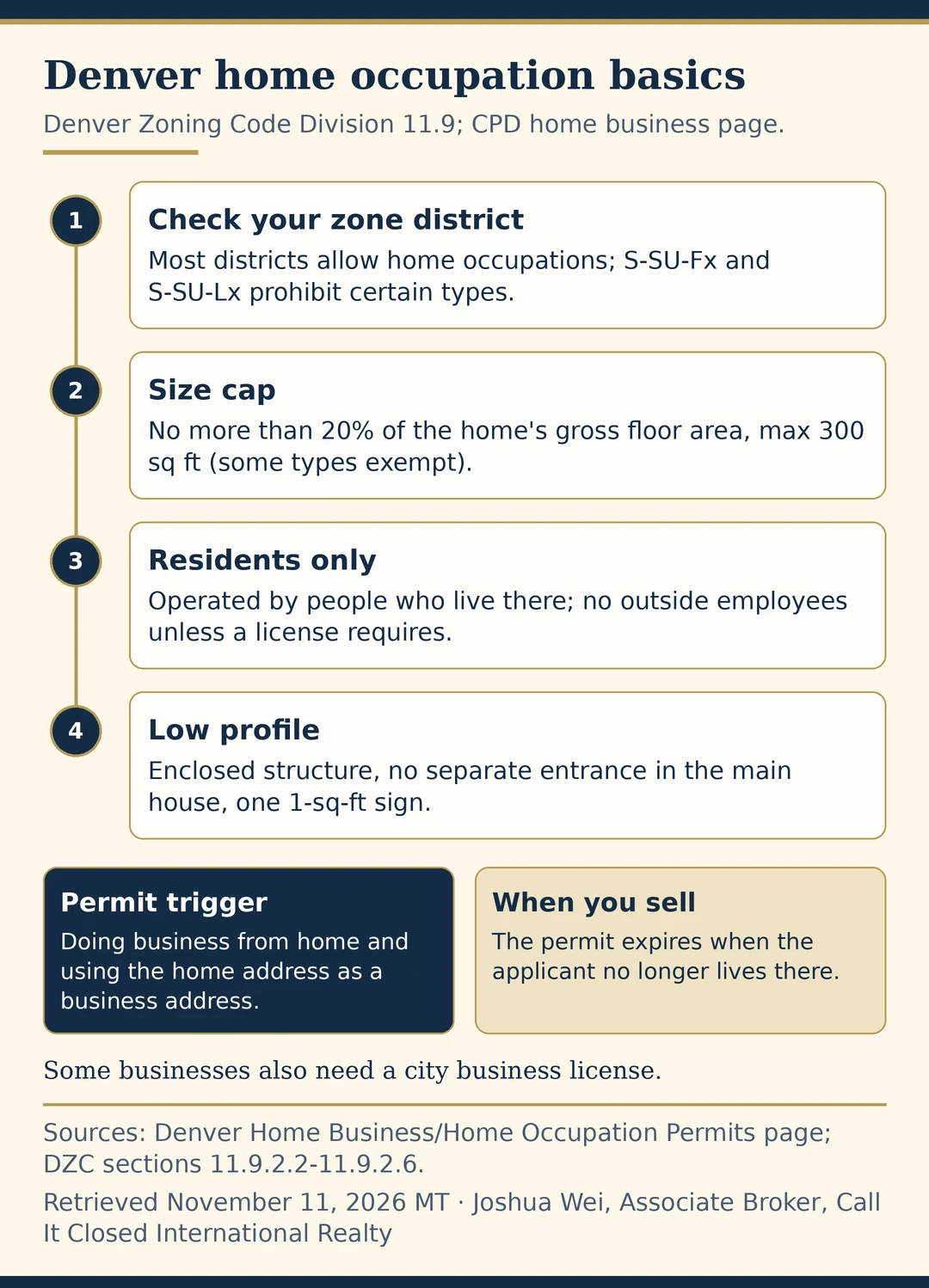
A vertical flow diagram, cream background with navy type and gold accents, titled Denver home occupation basics. Subtitle: Denver Zoning Code Division 11.9; CPD home business page. 4 numbered steps: 1, Check your zone district: Most districts allow home occupations; S-SU-Fx and S-SU-Lx prohibit certain types; 2, Size cap: No more than 20% of the home's gross floor area, max 300 sq ft (some types exempt); 3, Residents only: Operated by people who live there; no outside employees unless a license requires; 4, Low profile: Enclosed structure, no separate entrance in the main house, one 1-sq-ft sign. Two cards: Permit trigger: Doing business from home and using the home address as a business address; and When you sell: The permit expires when the applicant no longer lives there. A note says: Some businesses also need a city business license. Sources: Denver Home Business/Home Occupation Permits page; DZC sections 11.9.2.2-11.9.2.6. Retrieved November 11, 2026 MT. Joshua Wei, Associate Broker, Call It Closed International Realty.
Sources: Denver Home Business Permits (opens in a new tab); DZC Article 11 (opens in a new tab)
Cream background, navy text, gold rules. Numbered navy circles on a gold spine with white step cards, two branch cards (navy and tan), a note, and a source footer.
The figure above summarizes the general limits that apply to every Denver home occupation.
Are home businesses allowed in every zone district?
Mostly. The city says "Most home occupations are allowed in all zone districts, except S-SU-Fx and S-SU-Lx, which are zone districts that prohibit certain types of home occupations."
Check your district on the zoning map. The city also notes your home may be under the 2010 Denver Zoning Code or "the 1956 Former Chapter 59 zoning code," which has its own list.
How to check your own district
The city's page walks through it. After you find the zone district, "make note of the first letter of the zone district. This indicates your neighborhood context." That letter points to one of Articles 3 through 9 of the code. The page says to "check the article's 'District Specific Standards' located at the end of the article" and find the table entry for "Accessory to Primary Residential Uses Use Classification," then look at Division 11.9 "for a final check."
Former Chapter 59 properties work differently. The page says "'Food preparation' is not allowed as a home occupation in Former Chapter 59 zone districts," and "Online Retail Sales is not allowed in areas governed by the Former Chapter 59 zoning code." If a zone district has waivers or conditions, the page says to "contact the Zoning Team for more guidance."
Why the city allows them
The intent statement in section 11.9.1.1 lists the city's goals: "reducing the number of home-to-work vehicle trips with related improvements in air quality; facilitating small business ventures that contribute to the city's overall economic health; and accommodating demand for certain business services convenient to where prospective clients or customers live." The standards are "generally intended to minimize the impact such uses may have on the character and enjoyment of the surrounding residential neighborhood."
Under section 11.9.2.1, a home occupation operated according to the rules "shall be considered, in combination with the primary dwelling unit use, a residential use for all purposes of this Code." The house stays a house for zoning purposes.
How big can the business be?
DZC section 11.9.2.5 says home occupations "shall not in the aggregate utilize more than 20 percent of the gross floor area of the dwelling unit primary use, but in no case shall exceed 300 square feet."
That cap "shall not apply to Adult Care Home, Child Care Home, Small or Large, Craft Work, or Artist Studio."
Who can work there?
Under section 11.9.2.3(A), "Only the person or persons maintaining the dwelling unit as their primary place of residence shall operate the Home Occupation." For that rule, "'person' shall not include any corporation, partnership, firm, association, joint venture, or other similar legal entity." The operator is the resident, even if the business itself is an LLC.
Section 11.9.2.6(A) says it "shall not have any employees or regular assistants not residing in the primary or accessory dwelling unit," unless a required state or city license calls for it.
Can I have a sign or a separate entrance?
Inside the main house, section 11.9.2.4(A) says the business "shall not have a separate external entrance serving the Home Occupation."
The only sign allowed is "One non-animated, non-illuminated flat wall or window sign having an area of not more than 1 square foot" per street frontage.
All home occupations "shall operate in a Completely Enclosed Structure," with exceptions for child care play areas and produce sales.
Equipment and tools
Section 11.9.2.6(B) says "The use of hand tools is permitted without limitation." Under (C), mechanical equipment "is limited to the use of electric motors for power, with a total limitation of not greater than 3 horsepower." A woodworker with a table saw and a dust collector would want to add up the motors.
What types of businesses are listed?
The city lists types such as offices, online retail sales, artist studios, craft work, small child care homes, and small service businesses like a "Beauty Shop or Salon" or "Tutoring."
Some come with extra limits. For limited retail services, "All services provided shall be by appointment only." Tutoring is limited to "no more than 6 students simultaneously."
Unlisted occupations may be allowed "at the city's discretion" after a Zoning Permit with Informational Notice (ZPIN) review.
The city's page says unlisted uses "cannot include the following: adult businesses; animal sales; commercial parking, warehousing or storage; industrial manufacturing; retail or wholesale sales; or vehicle or equipment sales, rentals, and services." Section 11.9.5 starts from the other direction: "Generally, an accessory home occupation use not listed as specifically permitted in this Division 11.9 is prohibited."
The type-by-type limits
Division 11.9.4 adds limits for specific types. Section 11.9.2 says that if a general limit conflicts with a specific one, "the more specific use limitation shall apply to the Home Occupation." Several of the specific limits matter for buyers and owners:
- Office, non-medical, non-dental (section 11.9.4.7). "No goods, wares or merchandise shall be commercially created, displayed, exchanged, stored or sold." Services "shall be by appointment only. Walk-in appointments are prohibited." The city's page gives examples: "offices for architects, designers, accountants, lawyers and similar."
- Online retail sales (section 11.9.4.8). "On-premise Retail or Wholesale sales direct to consumers are prohibited." The city's page says online sales "cannot include transferring goods directly to a buyer at the residential premises." Any required business license must be obtained and "sales taxes must be paid as required by law."
- Limited retail services and repair (section 11.9.4.6). By appointment only, with "Walk-in appointments are prohibited," and "In-person Retail or Wholesale sales direct to consumers are prohibited." The city's example: "a home salon cutting hair for a fee is allowed but hair products and accessories cannot be sold there."
- Animal care services (section 11.9.4.1). Grooming, care or boarding is allowed if the total animals in the home stay within the household-animal limits. Hours run "6:00 a.m. until 8 p.m. only," and "Overnight boarding of animals, not including those kept by residents of the primary Dwelling unit, is prohibited."
- Artist studio (section 11.9.4.2). "Art Galleries are not permitted." The studio is "to create individual works of art and display them for viewing purposes only."
- Fresh produce and cottage foods sales (section 11.9.4.5). "Sales are permitted only from 8:00 a.m. until dusk daily," the permittee "must have grown, cultivated, and/or prepared all items for sale," and "Wholesale activities are prohibited."
- Food preparation. The city's page describes it as "Preparation and assembly of food items that do not fit into the Fresh Produce and Cottage Food Sales category." It says "Direct sales and consumption must occur off-premises," and that this type "will also require a business license and may require building, fire, or health reviews if there is a commercial-grade kitchen or you are installing a second kitchen."
- Adult care home. The city's page says it "Provides less than 24-hour care of four or fewer clients who are over 16 years of age." It's one of the types exempt from the 300-square-foot cap.
Pets aren't a home business
The city's page draws a line for pet owners: "A permit is not necessary for keeping household pets as long as you do not exceed 2 rabbits, 25 pigeons, 2 domestic honey bee hives, or 5 dogs and cats combined with no more than 3 dogs as part of the combined total." Animal care as a business is the separate category above, and it's capped by those same household limits. Our pet license guide covers licensing.
Child care homes
The city's page describes a small child care home as a "Licensed facility providing less than 24-hour care and education to no more than six children, plus two additional children who attend either before- or after-school hours." It says "City and state licensing requirements will also apply."
A large child care home has more conditions in section 11.9.3. "The applicant shall be the owner or the applicant has written permission of the owner of the subject property," and the home must be "the applicant's primary place of residence." Each permit requires that the home "provide full-time supervision of the children in the home during hours of operation." If it would sit next to another large child care home, the applicant must run "an ongoing traffic management program" so drop-off and pick-up don't "create traffic or parking problems in the neighborhood."
Cottage foods and the 2027 change
Denver's page says "Cottage foods are defined by the State of Colorado Cottage Food Act and include foods such as tea, honey, jams, jellies, and dried produce." The state law is C.R.S. 25-4-1614 (opens in a new tab). Its purposes include "Providing Colorado citizens with unimpeded access to healthy food from known sources."
The statute is changing. The version in effect until January 1, 2027 limits producers to foods that "are nonpotentially hazardous and do not require refrigeration." The version effective January 1, 2027 adds that a producer "may use their home kitchen to produce and sell packaged foods that require time and temperature control for safety, including tamales, burritos, and tortas," limited to "one type of food product that requires time and temperature control for safety, with the ability to offer up to five variations." Both versions cap whole eggs: a person "may not sell more than two hundred fifty dozen whole eggs per month." How the city's home occupation rules apply to the new categories is a question for Denver's zoning team and the health department.
What happens when I sell or move?
The permit doesn't transfer. Section 11.9.2.3(B) says it "shall automatically expire at such time as the applicant no longer resides at the subject property."
A buyer who wants to run a business from the home applies for a new permit. The city's page puts it this way: "The permit for an approved home occupation expires when the resident operator who is specified on the permit no longer operates the home occupation at that property." If the home is in an HOA, check the covenants too. Colorado Revised Statutes section 38-33.3-106.5(1)(l) (opens in a new tab) addresses "The operation of a home-based business at a unit by the unit owner or a resident of the unit with the unit owner's permission," subject to conditions. HOA rules are a separate question from city zoning.
That HOA statute protects a home business only on stated terms. Under 38-33.3-106.5(1)(l)(II), the business "must comply with, and an association may adopt and enforce, any reasonable and applicable rules and regulations governing architectural control, parking, landscaping, noise, nuisance, or other matters concerning the operation of a home-based business." Under (III), it must follow local noise and nuisance ordinances. And (IV) defines "home-based business" as "a business for which the main office is located at, or the business operations primarily occur at, a unit."
Two hypotheticals
These are invented, to show how the limits apply.
A therapist's office in a basement. A licensed counselor buys a 2,000-square-foot Denver house and wants a 350-square-foot basement office. The size rule caps home occupations at 20 percent of the dwelling's gross floor area "but in no case shall exceed 300 square feet," so the office would have to shrink to 300 square feet. If the house's only basement access is a separate outside door used for clients, section 11.9.2.4(A) bars "a separate external entrance serving the Home Occupation" inside the main house. Clients come by appointment. Whether a counseling practice fits "Office, Non-Medical, Non-Dental" or another category is for the zoning team.
A woodshop in a detached garage. A furniture maker wants to work in a detached garage. Section 11.9.2.2(B) allows a detached accessory structure. Craft Work is exempt from the 300-square-foot cap, and the city lists "woodwork" in that category, but "Mass production or retail sales from the home are prohibited." The 3-horsepower limit on electric motors still applies.
Before you buy, if you plan to work from home
- Look up the zone district and whether it's under the 2010 code or Former Chapter 59.
- Measure the space you'd use against the 20 percent and 300-square-foot limits.
- Check whether the house would need a separate client entrance, which the code bars inside the main house.
- Ask whether a business license is also required.
- If there's an HOA, read its rules on parking, signs and noise.
- Count employees: under section 11.9.2.6(A), anyone who doesn't live in the home can't work there unless a required license calls for it.
Frequently asked questions
Do I need a permit to work remotely for my employer?
The city's trigger is doing business from home and using the home address as a business address. Ask the zoning team if you're unsure whether that fits your situation.
Can my home business sell products to people who visit?
Generally no. Section 11.9.2.6(D) says that apart from produce and cottage food sales or online retail, "no Home Occupation may include on-premise Retail or Wholesale Sales."
Can I use power tools?
"The use of hand tools is permitted without limitation." Mechanical equipment is limited to electric motors totaling "not greater than 3 horsepower."
Do I also need a business license?
Maybe. The city says "Some businesses will also require a business license."
Can I run the business from a detached garage or studio?
Section 11.9.2.2(B) says home occupations "may operate in the primary dwelling unit structure, or in a detached accessory structure, allowed under this Code."
Can I have clients come to my home office in Denver?
For a non-medical office, services "shall be by appointment only. Walk-in appointments are prohibited," under section 11.9.4.7.
Can I pick up online orders at my house?
No. The city's page says online sales "cannot include transferring goods directly to a buyer at the residential premises."
Does my home business permit transfer when I sell?
No. Section 11.9.2.3(B) says it expires when the applicant no longer lives there.
Can a large child care home operate in a house?
Yes, with a ZPIN review. The city describes it as care for "7-12 children."
Related notes
- ADUs in Denver and Aurora: what Colorado's 2024 law, Denver's permit rules, and Aurora's pending update say
- Thinking of Airbnb income? Denver and Aurora short-term rental rules for buyers, explained
- Checking permit history before you buy in Denver or Aurora: where to look and what unpermitted work can mean
Sources and method
Official sources, retrieved November 11 and 13, 2026, America/Denver:
- Denver, Home Business/Home Occupation Permits (opens in a new tab)
- Denver Zoning Code, Article 11 (republished February 25, 2025) (opens in a new tab): Division 11.9, sections 11.9.1 to 11.9.5
- C.R.S. title 38 (2026) (opens in a new tab): section 38-33.3-106.5(1)(l)
- C.R.S. title 25 (2026) (opens in a new tab): section 25-4-1614 (both the current and the January 1, 2027 versions)
Former Chapter 59 home occupation rules and Aurora's rules weren't reviewed. State child care licensing rules weren't reviewed. The hypotheticals are invented.
This note is general education from a Colorado real estate broker with Call It Closed International Realty. For a specific business, contact Denver's zoning team.
Disclaimer
This article is general information only. It is not legal, tax, lending, insurance, appraisal, inspection, or financial advice, and it is not a substitute for advice about your situation. Joshua Wei is a Colorado real estate broker, not an attorney. Reading this article does not create a client relationship, an agency relationship, or an attorney-client relationship with Joshua Wei or with Call It Closed International Realty.
Laws, program rules, interest rates, insurance terms, tax figures, and other details change. Examples in this article are hypothetical illustrations unless a source is named for a specific, dated figure. Information in this article is believed accurate as of November 13, 2026 and is not guaranteed. No result is promised, and you should not rely on this article as the last word for your situation.
Before you act, confirm the point with the official source linked or cited in this article, and talk with a licensed professional who can apply the rule to your facts. That may be a licensed attorney, a tax professional, a lender, an insurance agent, a home inspector, or another licensed professional, depending on the question. Links to third-party websites and publications are provided for reference only. They are not an endorsement, and their content can change.
If you already have a brokerage relationship with another broker, this is not a solicitation.
Joshua Wei, Associate Broker, Call It Closed International Realty, Colorado license FA.100108558. Equal Housing Opportunity.