November 27, 2026 · Closing · Home Buying · Home Selling · Holidays · Taxes · Denver · Aurora · Colorado
Closing on a Colorado home in December or January: holidays, business days and the year-end tax questions to ask
What federal rules, the IRS and the Colorado purchase contract say about closing a home sale near the end of the year, including which December and January days do not count as business days, how property taxes are split, and which tax rules depend on the year of sale.
The short answer
In brief: No single rule says December or January is the better month to close. What changes near the end of the year is the calendar. Federal holidays shorten the count of days for the Closing Disclosure, and the closing date decides which tax year the sale belongs to. The answers to the tax questions come from the IRS publications quoted below and from your own tax advisor.
Many people search for "is it better to close on a house in december or january." This article does not answer that question for you, because the answer depends on your own taxes, loan and moving plans. It collects what the official rules say, so you know which questions to ask your lender, your title company and a tax professional.
Three sets of rules matter most:
- The federal Truth in Lending rules, called Regulation Z, which control when you must receive your Closing Disclosure.
- The Colorado Real Estate Commission's residential purchase contract, which sets the Closing Date and how property taxes are divided.
- IRS Publication 530 and Publication 523, which explain how property taxes, mortgage points and the date of sale are treated.
I am a licensed Colorado real estate broker with Call It Closed International Realty. I am not an attorney.
Disclaimer. This article is general information only. It is not legal, tax, lending, insurance, appraisal, inspection, or financial advice, and reading it does not create a client, agency, or attorney-client relationship. Laws, rates, programs, and figures change. Confirm the official source, and talk with a licensed attorney, tax professional, lender, insurance agent, or inspector before you act. Joshua Wei is a Colorado real estate broker, not an attorney. He is an Associate Broker with Call It Closed International Realty, license FA.100108558. Equal Housing Opportunity.
 Full size (opens in a new tab)
Sources: 12 CFR 1026.2 (opens in a new tab); OPM federal holidays (opens in a new tab); IRS Publication 523 (opens in a new tab)
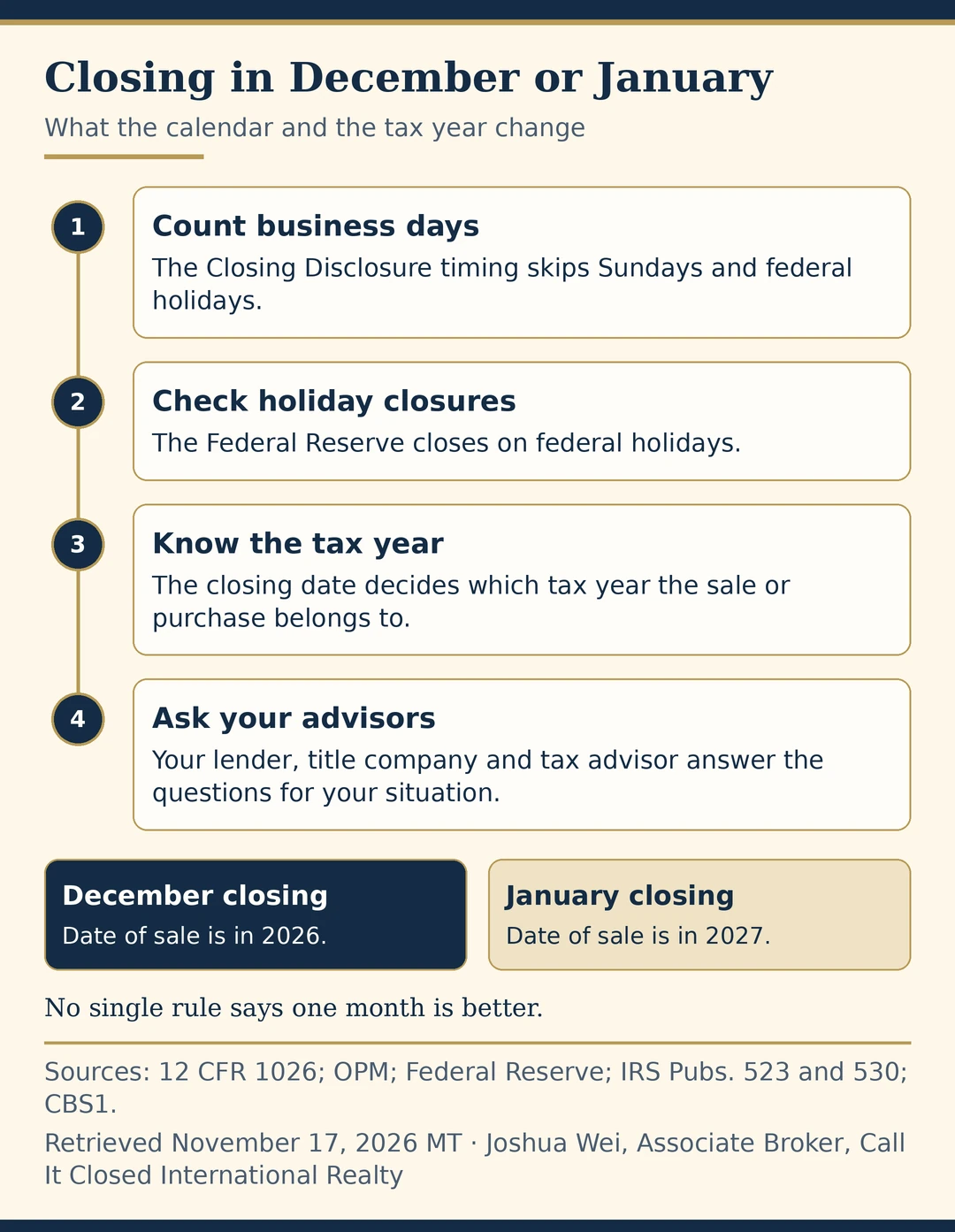
Cream background, navy text, gold rules. Numbered navy circles on a gold spine with white step cards, two branch cards (navy and tan), a note, and a source footer.
The diagram above summarizes the calendar points covered below. It does not say which month is better for you.
Why the end of the year changes the calendar
Two federal holidays fall inside a closing window that runs through late December and early January for a contract signed in November or December. In 2026, Christmas Day falls on Friday, December 25. In 2027, New Year's Day falls on Friday, January 1. The U.S. Office of Personnel Management's federal holiday schedule (opens in a new tab) lists "Friday, December 25 Christmas Day" for 2026 and "Friday, January 01 New Year's Day" for 2027. Thanksgiving Day was Thursday, November 26, 2026.
Banks that move money for closings also follow a holiday calendar. The Federal Reserve's holiday schedule page (opens in a new tab) lists Christmas Day as December 25. It also says: "For holidays falling on Saturday, Federal Reserve Banks and Branches will be open the preceding Friday." Neither 2026 Christmas Day nor 2027 New Year's Day falls on a weekend, so that note does not move either date.
Colorado state law has its own list of legal holidays. Section 24-11-101 of the Colorado Revised Statutes (opens in a new tab) names "the twenty-fifth day of December, commonly called Christmas day" and "The first day of January, commonly called New Year's day" among them.
What counts as a business day for the Closing Disclosure
Regulation Z uses two different meanings of "business day." The general meaning, in 12 CFR 1026.2(a)(6) (opens in a new tab), is "a day on which the creditor's offices are open to the public for carrying on substantially all of its business functions."
For the Closing Disclosure timing rule and several others, the same paragraph uses a second, more specific meaning. For those rules, "the term means all calendar days except Sundays and the legal public holidays specified in 5 U.S.C. 6103(a), such as New Year's Day, the Birthday of Martin Luther King, Jr., Washington's Birthday, Memorial Day, Independence Day, Labor Day, Columbus Day, Veterans Day, Thanksgiving Day, and Christmas Day."
Under that specific meaning, Saturdays count as business days. Sundays and the listed federal holidays do not.
The days that do not count in late December 2026 and early January 2027
Applying the list above to the calendar, these days are not counted as business days for the Closing Disclosure timing rule:
| Date | Day of the week | Why it does not count | |---|---|---| | December 20, 2026 | Sunday | Sundays are excluded | | December 25, 2026 | Friday | Christmas Day is a listed holiday | | December 27, 2026 | Sunday | Sundays are excluded | | January 1, 2027 | Friday | New Year's Day is a listed holiday | | January 3, 2027 | Sunday | Sundays are excluded |
Your lender, not this table, decides the actual delivery date. The table only shows which days the federal definition leaves out.
When the Closing Disclosure must arrive
The rule itself is in 12 CFR 1026.19(f)(1)(ii)(A) (opens in a new tab). It says "the creditor shall ensure that the consumer receives the disclosures required under paragraph (f)(1)(i) of this section no later than three business days before consummation."
The rule also covers mail and email. Under paragraph (f)(1)(iii): "If any disclosures required under paragraph (f)(1)(i) of this section are not provided to the consumer in person, the consumer is considered to have received the disclosures three business days after they are delivered or placed in the mail."
The Consumer Financial Protection Bureau explains the purpose on its Closing Disclosure page (opens in a new tab): "The lender is required to give you the Closing Disclosure at least three business days before you close on the mortgage loan. This three-day window allows you time to compare your final terms and costs to those estimated in the Loan Estimate that you previously received from the lender."
Changes that start a new three-day wait
Regulation Z lists three changes that require a corrected Closing Disclosure and a new waiting period. Under paragraph (f)(2)(ii), they are:
- "The annual percentage rate disclosed under section 1026.38(o)(4) becomes inaccurate, as defined in section 1026.22."
- "The loan product is changed, causing the information disclosed under section 1026.38(a)(5)(iii) to become inaccurate."
- "A prepayment penalty is added, causing the statement regarding a prepayment penalty required under section 1026.38(b) to become inaccurate."
Other changes are handled differently. Under paragraph (f)(2)(i), the creditor "shall provide corrected disclosures reflecting any changed terms to the consumer so that the consumer receives the corrected disclosures at or before consummation."
The emergency waiver
The rule allows a waiver only in a narrow case. Under paragraph (f)(1)(iv), a consumer who "determines that the extension of credit is needed to meet a bona fide personal financial emergency" may modify or waive the waiting period. The rule says "the consumer shall give the creditor a dated written statement that describes the emergency, specifically modifies or waives the waiting period, and bears the signature of all consumers who are primarily liable on the legal obligation."
What the Colorado contract says about the Closing Date
The Colorado Real Estate Commission's Contract to Buy and Sell Real Estate (Residential) (opens in a new tab), the form known as CBS1, sets the Closing Date in its deadline table. Section 12.3 of the form says: "Closing will be on the date specified as the Closing Date or by mutual agreement at an earlier date."
What happens when a deadline lands on a holiday
The contract does not automatically move a deadline that falls on a weekend or holiday. Section 3.3.3 says: "If any deadline falls on a Saturday, Sunday or federal or Colorado state holiday (Holiday), such deadline Will Will Not be extended to the next day that is not a Saturday, Sunday or Holiday. Should neither box be checked, the deadline will not be extended."
The words "Will Will Not" are two check boxes on the printed form. Which box is checked in your contract decides the answer. If neither is checked, the form says the deadline is not extended.
How the contract counts a day
Section 3.3.1 says a day "means the entire day ending at 11:59 p.m., United States Mountain Time (Standard or Daylight Savings, as applicable)."
Section 3.3.2 explains counting: "In computing a period of days (e.g., three days after MEC), when the ending date is not specified, the first day is excluded and the last day is included." The form defines MEC as "mutual execution of this Contract," which means the date both parties have signed.
Moving the Closing Date
The contract does not change itself because of a holiday or a late Closing Disclosure. Any change to the Closing Date is made in writing by the parties. Questions about whether to sign an amendment, and what it should say, belong with a Colorado real estate attorney.
How property taxes are split at closing
Section 16.1.1 of the contract says these items "will be prorated to the Closing Date, except as otherwise provided": "Personal property taxes, if any, special taxing district assessments, if any, and general real estate taxes for the year of Closing."
The form then offers check boxes for the basis of that calculation. The printed choices include "Taxes for the Calendar Year Immediately Preceding Closing" and "Most Recent Mill Levy and Most Recent Assessed or Actual Valuation per the county assessor." Section 16.1.4 says: "Unless otherwise specified in Additional Provisions, these prorations are final."
The proration is a contract term between buyer and seller. Your title company calculates it on the settlement statement.
Two Colorado facts make the choice of basis matter near the new year. First, Colorado property taxes are paid a year behind. The Colorado Division of Property Taxation's property tax overview (opens in a new tab) says tax bills "reflecting the taxes due for the preceding year, are mailed as soon after January 1 as possible." So the taxes for the year of closing usually have not been billed yet, and the seller's share is usually handled as a credit from the seller to the buyer on the settlement statement.
Second, the same page says: "Real property is revalued every odd-numbered year." A closing in January 2027 prorates 2027 taxes, and those taxes will be based on new 2027 values. A basis built on an earlier year's taxes or values may not match the bill that later arrives. Because section 16.1.4 makes the prorations final unless the Additional Provisions say otherwise, ask your title company, and a Colorado real estate attorney if needed, whether your contract should use a different basis or call for a later adjustment.
What IRS Publication 530 says about property taxes in the year of a sale
IRS Publication 530, Tax Information for Homeowners (opens in a new tab), addresses taxes paid at closing. It says: "Real estate taxes are generally divided so that you and the seller each pay taxes for the part of the property tax year you owned the home."
It then sets the federal rule: "For federal income tax purposes, the seller is treated as paying the property taxes up to but not including the date of sale. You (the buyer) are treated as paying the taxes beginning with the date of sale. This applies regardless of the lien dates under local law."
It continues: "You and the seller each are considered to have paid your own share of the taxes, even if one or the other paid the entire amount. You each can deduct your own share, if you itemize deductions, for the year the property is sold."
Publication 530 also covers a buyer who pays part of the seller's share: "If you pay any part of the seller's share of the real estate taxes (the taxes up to the date of sale) and the seller didn't reimburse you, add those taxes to your basis in the home. You can't deduct them as taxes paid." Basis is the figure the IRS uses as your cost in the home.
The 2025 change to the state and local tax limit
The current edition of Publication 530 lists this under "What's New": "The overall limit on the deduction for state and local income, sales, and property taxes has increased to $40,000 ($20,000 if married filing separately)." It adds that the limit "is reduced if your modified adjusted gross income is more than $500,000 ($250,000 if married filing separately) but will not be reduced below $10,000 ($5,000 if married filing separately)."
The edition fetched for this article is the 2025 edition. Ask a tax professional which figures apply to a 2026 or 2027 return.
What Publication 530 says about mortgage points and prepaid interest
Buyers who pay points at closing often ask whether the closing year matters. Publication 530 states a general rule and an exception.
The general rule: "You can't deduct the full amount of points in the year paid. They are prepaid interest, so you must generally deduct them over the life (term) of the mortgage."
The exception: "You can deduct the full amount of points in the year paid if you meet all the following tests." The first tests listed are "Your loan is secured by your main home," "Paying points is an established business practice in the area where the loan was made," and "The points paid weren't more than the points generally charged in that area." The full list is longer, and it is in the publication.
On interest paid ahead: "If you pay interest in advance for a period that goes beyond the end of the tax year, you must spread this interest over the tax years to which it applies."
On points a seller pays for the buyer: "The buyer treats seller-paid points as if the buyer had paid them."
What Publication 523 says about the date of sale
For sellers, the date of sale decides which tax year the sale belongs to. IRS Publication 523, Selling Your Home (opens in a new tab), says: "If you received Form 1099-S, Proceeds From Real Estate Transactions, the date of sale appears in box 1. If you didn't receive Form 1099-S, the date of sale is either the date the title transferred or the date the economic burdens and benefits of ownership shifted to the buyer, whichever date is earlier. In most cases, these dates are the same."
The IRS Instructions for Form 1099-S (opens in a new tab) describe box 1 this way: "Enter the closing date. On a Closing Disclosure, the closing date is the Closing Disclosure date."
The date of sale also matters for the home sale exclusion, which lets many sellers leave some or all of their gain out of income. Publication 523 says: "If you owned the home for at least 24 months (2 years) out of the last 5 years leading up to the date of sale (date of the closing), you meet the ownership requirement." It has a similar residence requirement of "a total of 24 months (730 days) of residence during the 5-year period." If you are close to the two-year mark, a closing a few weeks earlier or later could change whether you meet these tests. Check the dates with a tax professional before you agree to a Closing Date.
Publication 523 also covers the other parts of the exclusion and how to report a sale. Those questions depend on your history with the home, and they belong with a tax professional.
Questions to ask, and who answers them
This list does not tell you what to choose. It sorts common year-end questions by the professional whose job it is to answer them.
Your lender:
- On what date do you plan to send the Closing Disclosure, and how will you send it?
- Which days are you counting as business days around December 25 and January 1?
- Is my interest rate locked through the Closing Date, and what happens if closing moves?
Your title company or closing company:
- What hours are you open the week of Christmas and New Year's Day?
- What is the cut-off time for receiving wired funds on the closing day?
- Which basis for the property tax proration does our contract use, and how close is it likely to be to the actual tax bill for the year of closing?
A tax professional:
- Does a December or January closing change which year I report the sale or deduct property taxes?
- Could a December or January Closing Date change whether I meet the two-year ownership and residence tests for the home sale exclusion?
- Do my mortgage points meet the tests in Publication 530 for deducting them in the year paid?
- Which state and local tax limit applies to my return?
A Colorado real estate attorney:
- Does our contract extend a deadline that lands on a holiday?
- How should an amendment to change the Closing Date be written?
Frequently asked questions
Is it better to close on a house in December or January?
No official rule makes one month better. The answer depends on your loan, your taxes and your move. The IRS publications quoted above explain how property taxes, points and the date of sale are treated, and a tax professional can apply them to you.
Does Christmas Day count toward the three-day Closing Disclosure wait?
No. For the Closing Disclosure timing rule, Regulation Z excludes "Sundays and the legal public holidays specified in 5 U.S.C. 6103(a)," and the list includes Christmas Day.
Do Saturdays count as business days for the Closing Disclosure?
Yes. The specific definition used for this rule excludes only Sundays and the listed federal holidays, so Saturdays count.
If a contract deadline falls on New Year's Day, does it move?
It depends on the boxes checked in section 3.3.3 of the contract. If neither box is checked, the form says "the deadline will not be extended."
Who pays property taxes for the year I sell?
The contract prorates "general real estate taxes for the year of Closing" to the Closing Date, using the basis checked in section 16.1.1. For federal income tax purposes, Publication 530 says "the seller is treated as paying the property taxes up to but not including the date of sale."
What date does the IRS use as my date of sale?
Publication 523 says that if you received Form 1099-S, "the date of sale appears in box 1." The Form 1099-S instructions say that on a Closing Disclosure, "the closing date is the Closing Disclosure date."
Can I waive the three-day wait to close before the holiday?
Only in the narrow case the rule describes, which is "a bona fide personal financial emergency," with a dated written statement signed by every consumer primarily liable on the loan.
Related notes
- Colorado purchase contract deadlines, in plain English
- Closing costs in Denver and Aurora
- Colorado's good funds law and closing
- Real estate wire fraud at closing
- Selling a Denver home in winter or spring
Sources and method
Official sources, retrieved November 17, 2026, America/Denver:
- U.S. Office of Personnel Management, Federal Holidays (opens in a new tab), 2026 and 2027 schedules
- Federal Reserve Financial Services, Holiday Schedules (opens in a new tab)
- Colorado Revised Statutes 2026, Title 24 (opens in a new tab), section 24-11-101
- 12 CFR 1026.2 (eCFR) (opens in a new tab), paragraph (a)(6)
- 12 CFR 1026.19 (eCFR) (opens in a new tab), paragraphs (f)(1)(ii) to (f)(1)(iv) and (f)(2)(i) to (f)(2)(ii)
- Consumer Financial Protection Bureau, What is a Closing Disclosure? (opens in a new tab)
- Colorado Real Estate Commission, Contract to Buy and Sell Real Estate (Residential), for use on or after January 1, 2026 (opens in a new tab), sections 3.3.1 to 3.3.3, 12.3 and 16.1
- Colorado Division of Property Taxation, Understanding Property Taxes in Colorado (opens in a new tab)
- IRS Publication 530 (2025), Tax Information for Homeowners (opens in a new tab)
- IRS Publication 523, Selling Your Home (opens in a new tab)
- IRS Instructions for Form 1099-S (opens in a new tab), box 1
Search demand was checked with Google autocomplete on November 17, 2026. It suggested "should i close on a house in december or january" and "is it better to close on a house in december or january." Autocomplete shows that a phrase is suggested, not how often it is searched. No search volumes are stated.
The holiday table applies the federal definition to the calendar. It is not a delivery schedule. No interest rate, tax amount or closing cost is given.
Disclaimer
This article is general information only. It is not legal, tax, lending, insurance, appraisal, inspection, or financial advice, and it is not a substitute for advice about your situation. Joshua Wei is a Colorado real estate broker, not an attorney. Reading this article does not create a client relationship, an agency relationship, or an attorney-client relationship with Joshua Wei or with Call It Closed International Realty.
Laws, program rules, interest rates, insurance terms, tax figures, and other details change. Examples in this article are hypothetical illustrations unless a source is named for a specific, dated figure. Information in this article is believed accurate as of November 27, 2026 and is not guaranteed. No result is promised, and you should not rely on this article as the last word for your situation.
Before you act, confirm the point with the official source linked or cited in this article, and talk with a licensed professional who can apply the rule to your facts. That may be a licensed attorney, a tax professional, a lender, an insurance agent, a home inspector, or another licensed professional, depending on the question. Links to third-party websites and publications are provided for reference only. They are not an endorsement, and their content can change.
If you already have a brokerage relationship with another broker, this is not a solicitation.
Joshua Wei, Associate Broker, Call It Closed International Realty, Colorado license FA.100108558. Equal Housing Opportunity.