October 11, 2026 · Denver · Aurora · Selling · Buying · Home Safety
Selling or buying a Colorado home? Carbon monoxide alarm rules for Denver and Aurora, explained
Colorado law requires many home sellers to make sure working carbon monoxide alarms are installed near bedrooms. What Colorado Revised Statutes section 38-45-102 says, how the Commission's contracts mention it, what landlords must do, and the CDC's safety basics.
The short answer
In brief: Colorado law puts a carbon monoxide alarm duty on the seller of an existing single-family home with a fuel-fired heater or appliance, a fireplace or an attached garage. Under Colorado Revised Statutes section 38-45-102, the seller must assure an operational alarm is installed within fifteen feet of the entrance to each room lawfully used for sleeping, or as a building code specifies.
If you are selling a Denver or Aurora home that has a fuel-fired heater or appliance, a fireplace, or an attached garage, Colorado law puts a carbon monoxide (CO) alarm duty on you.
Colorado Revised Statutes section 38-45-102(1)(a) (opens in a new tab) says the seller of each existing single-family dwelling offered for sale or transfer on or after July 1, 2009, that has a fuel-fired heater or appliance, a fireplace, or an attached garage "shall assure that an operational carbon monoxide alarm is installed within fifteen feet of the entrance to each room lawfully used for sleeping purposes or in a location as specified in any building code adopted by the state or any local government entity."
Section 38-45-103(1)(a) sets the same duty for each unit in a multi-family building, which "includes a condominium or cooperative" under section 38-45-101(5).
I am a licensed Colorado real estate broker with Call It Closed International Realty. I am not an attorney or a home inspector. This is not legal advice.
Disclaimer. This article is general information only. It is not legal, tax, lending, insurance, appraisal, inspection, or financial advice, and reading it does not create a client, agency, or attorney-client relationship. Laws, rates, programs, and figures change. Confirm the official source, and talk with a licensed attorney, tax professional, lender, insurance agent, or inspector before you act. Joshua Wei is a Colorado real estate broker, not an attorney. He is an Associate Broker with Call It Closed International Realty, license FA.100108558. Equal Housing Opportunity.
 Full size (opens in a new tab)
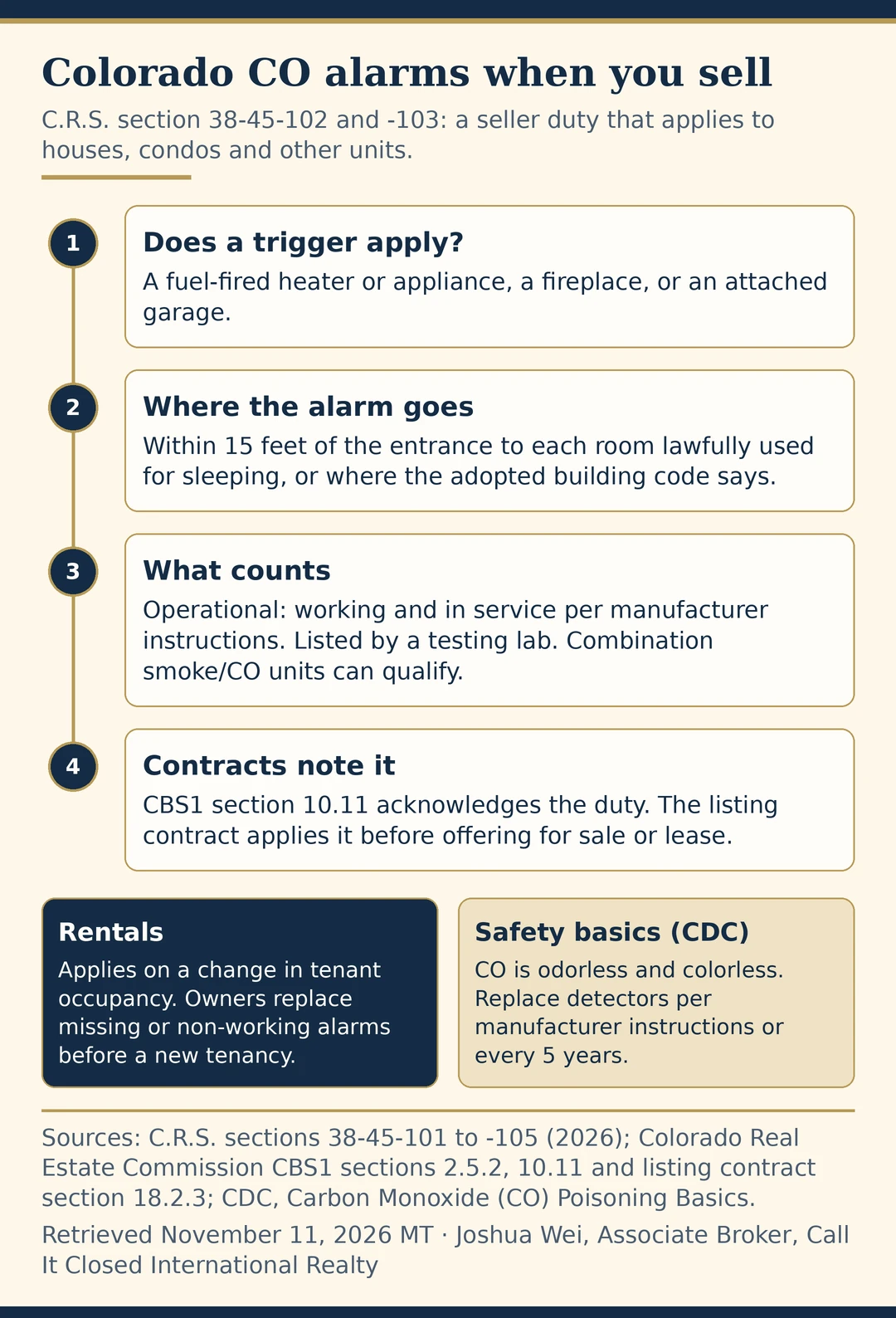
A vertical flow diagram, cream background with navy type and gold accents, titled Colorado CO alarms when you sell, with the subtitle C.R.S. sections 38-45-102 and 103 set a seller duty that applies to houses, condos and other units. Four numbered steps: 1, does a trigger apply, meaning a fuel-fired heater or appliance, a fireplace, or an attached garage; 2, where the alarm goes, within 15 feet of the entrance to each room lawfully used for sleeping, or where the adopted building code says; 3, what counts, an operational alarm working and in service per manufacturer instructions and listed by a testing lab, where combination smoke and CO units can qualify; 4, contracts note it, since CBS1 section 10.11 acknowledges the duty and the listing contract applies it before offering for sale or lease. Two lower cards: rentals, where the rule applies on a change in tenant occupancy and owners replace missing or non-working alarms before a new tenancy; and safety basics from the CDC, CO is odorless and colorless, and detectors should be replaced per manufacturer instructions or every 5 years. Sources: Colorado Revised Statutes, Colorado Real Estate Commission contracts, and the CDC. Retrieved November 11, 2026 MT.
Sources: C.R.S. Title 38 (2026) (opens in a new tab); CDC CO Poisoning Basics (opens in a new tab)
Cream background, navy text, gold rules. Four numbered steps on a gold spine, two side-by-side cards, and a 28px source footer.
The diagram above shows when Colorado's seller CO alarm duty applies and where the alarm has to be. It summarizes C.R.S. Title 38, Article 45.
Why does CO matter in a home?
The CDC's Carbon Monoxide Poisoning Basics (opens in a new tab) page says: "Carbon monoxide (CO) is an odorless, colorless gas that kills without warning. It claims the lives of hundreds of people every year and makes thousands more ill."
It adds: "Many household items including gas- and oil-burning furnaces, portable generators, and charcoal grills produce this poison gas." And: "People who are sleeping, drunk, or under the influence of other substances can die from CO poisoning before they have symptoms."
On symptoms, the same CDC page says: "The most common symptoms of CO poisoning are headache, dizziness, weakness, upset stomach, vomiting, chest pain, and confusion." On scale, it says: "Each year, more than 400 Americans die from unintentional CO poisoning not linked to fires, more than 100,000 visit an emergency department, and more than 14,000 are hospitalized."
The CDC also names who faces higher risk: "Infants, the elderly, and people with chronic heart disease, anemia, or breathing problems are more likely to get sick from CO."
Where does CO come from in a house?
The EPA's page on carbon monoxide's impact on indoor air quality (opens in a new tab) lists sources that include "unvented kerosene and gas space heaters," "leaking chimneys and furnaces," "back-drafting from furnaces, gas water heaters, wood stoves and fireplaces," "gas stoves," "generators and other gasoline powered equipment," and "automobile exhaust from attached garages."
Those sources line up with the statute's three triggers: fuel-fired appliances, fireplaces, and attached garages.
The EPA gives indoor reference levels: "Average levels in homes without gas stoves vary from 0.5 to 5 parts per million (ppm). Levels near properly adjusted gas stoves are often 5 to 15 ppm and those near poorly adjusted stoves may be 30 ppm or higher." Its prevention list includes "Keep gas appliances properly adjusted," "Open flues when fireplaces are in use," and "Have a trained professional inspect, clean and tune-up central heating system (furnaces, flues and chimneys) annually."
When does the seller's duty apply?
Under section 38-45-102(1)(a), three triggers matter. The home has:
- a fuel-fired heater or appliance,
- a fireplace, or
- an attached garage.
The statute defines "Fuel" as "coal, kerosene, oil, fuel gases, or other petroleum products or hydrocarbon products such as wood that emit carbon monoxide as a by-product of combustion."
The duty is tied to the sale itself. It covers each existing single-family dwelling "offered for sale or transfer on or after July 1, 2009." The statute does not set a separate inspection or certificate step for the seller; the verb it uses is "assure."
Where must the alarm go, and what counts?
The alarm has to be "within fifteen feet of the entrance to each room lawfully used for sleeping purposes or in a location as specified in any building code adopted by the state or any local government entity."
Under section 38-45-101(6), "Operational" means "working and in service in accordance with manufacturer instructions." The definition of a carbon monoxide alarm in section 38-45-101(1) requires a device that "Produces a distinct, audible alarm" and is listed by "a nationally recognized, independent product-safety testing and certification laboratory."
The device also has to meet a power rule. Section 38-45-101(1)(c) says the alarm "Is battery powered, plugs into a dwelling's electrical outlet and has a battery backup, is wired into a dwelling's electrical system and has a battery backup, or is connected to an electrical system via an electrical panel."
"Installed" has its own definition in section 38-45-101(4). The alarm must be installed in one of three ways:
- "(a) Wired directly into the dwelling's electrical system;"
- "(b) Directly plugged into an electrical outlet without a switch other than a circuit breaker; or"
- "(c) If the alarm is battery-powered, attached to the wall or ceiling of the dwelling unit in accordance with the national fire protection association's standard 720, or any successor standard, for the operation and installation of carbon monoxide detection and warning equipment in dwelling units."
So under that definition, a battery alarm sitting loose on a shelf is not "installed"; a battery unit has to be attached to the wall or ceiling under NFPA 720. A plug-in unit cannot be on a switched outlet.
Combination smoke and CO alarms can qualify. Section 38-45-101(1)(d) allows a combined device if it "produces an alarm, or an alarm and voice signal, in a manner that clearly differentiates between the two hazards."
The statute also bars disabling alarms. Section 38-45-102(3) says: "No person shall remove batteries from, or in any way render inoperable, a carbon monoxide alarm, except as part of a process to inspect, maintain, repair, or replace the alarm or replace the batteries in the alarm." Sections 38-45-103(3) and 38-45-104(6) repeat that rule for multi-family and rental dwellings.
Local codes can go further. Colorado Revised Statutes section 38-45-105 (opens in a new tab) says nothing in the article limits a local government "from adopting or enforcing any requirements for the installation and maintenance of carbon monoxide alarms that are more stringent than the requirements set forth in this article."
How do Colorado contracts mention it?
The statute directed the Commission to put the rule into its forms. Section 38-45-102(1)(b) says the real estate commission "shall by rule require each listing contract for residential real property that is subject to the commission's jurisdiction pursuant to article 10 of title 12 to disclose the requirements specified in subsection (1)(a) of this section."
The Colorado Real Estate Commission's residential purchase contract (CBS1, 2026 form (opens in a new tab)), from the Division of Real Estate's contracts and forms page (opens in a new tab), says in section 10.11: "the parties acknowledge that Colorado law requires that Seller assure the Property has an operational carbon monoxide alarm installed within fifteen feet of the entrance to each Bedroom or in a location as required by the applicable building code."
The full note opens with the triggers: "If the improvements on the Property have a fuel-fired heater or appliance, a fireplace, or an attached garage and include one or more rooms lawfully used for sleeping purposes (Bedroom), the parties acknowledge that Colorado law requires that Seller assure the Property has an operational carbon monoxide alarm installed within fifteen feet of the entrance to each Bedroom or in a location as required by the applicable building code." It is worded as the parties' acknowledgment of the law, not as a separate promise with its own deadline.
The Commission's exclusive right-to-sell listing contract (opens in a new tab) (2026 V2 form) has a similar note. Section 18.2.3 says: "Seller understands that Colorado law requires that Seller assure the Property has an operational carbon monoxide alarm installed within fifteen feet of the entrance to each Bedroom or in a location as required by the applicable building code, prior to offering the Property for sale or lease." That wording ties the duty to the time the home is offered, which comes before any buyer's contract. Separately, section 38-45-102(1)(b) directed the Commission to require this disclosure in listing contracts.
The listing contract's inclusions list in section 13.1.2 also names "carbon monoxide alarms, smoke/fire detectors, and all keys."
CBS1 section 2.5.2 also lists "carbon monoxide alarms, smoke/fire detectors and all keys" among the items included in the sale unless excluded.
What does the Seller's Property Disclosure ask?
The Commission's Seller's Property Disclosure (Residential) (opens in a new tab) (2026 form) has two places for CO alarms. In its list of systems and features, one line reads "Carbon monoxide alarm(s) Battery Hardwire," next to "Smoke/fire detector(s) Battery Hardwire."
In the electrical and telecommunications section, the form tells the seller to mark "Yes" next to an item "If you know of any problems NOW EXISTING with the following," and that list includes "Carbon monoxide alarm."
For fireplaces and stoves, the form asks for the "Date fireplace/wood stove, chimney/flue last cleaned." A buyer can compare that answer with the CDC's advice to "Have your chimney checked or cleaned every year."
Who is liable if an alarm fails?
Section 38-45-106(1) limits claims against owners and installers who follow the rules. It says no person shall have a claim for relief against a property owner, an authorized agent, a person in possession, or an installer "for any damages resulting from the operation, maintenance, or effectiveness of a carbon monoxide alarm if the property owner, authorized agent, person in possession of real property, or installer installs a carbon monoxide alarm in accordance with the manufacturer's published instructions and the provisions of this article."
Section 38-45-106(2) covers brokers. A purchaser "shall have no claim for relief against any person licensed pursuant to article 10 of title 12" for such damages if the licensee complies with the Commission rules. It adds: "Nothing in this subsection (2) shall affect any remedy that a purchaser may otherwise have against a seller."
How those limits apply to a specific claim is a question for a Colorado attorney.
What about remodels and rentals?
Remodels can trigger the rule too. Section 38-45-102(2) applies when "interior alterations, repairs, fuel-fired appliance replacements, or additions, any of which require a building permit," occur, or "where one or more rooms lawfully used for sleeping purposes are added."
For rentals, Colorado Revised Statutes section 38-45-104(2) (opens in a new tab) applies the same requirements to an existing rental "that has a change in tenant occupancy on or after July 1, 2009." Under section 38-45-104(3)(a), the owner must, among other things, "Prior to the commencement of a new tenant occupancy, replace any carbon monoxide alarm that was stolen, removed, found missing, or found not operational after the previous occupancy." The owner must also "Ensure that any batteries necessary to make the carbon monoxide alarm operational are provided to the tenant at the time the tenant takes residence in the dwelling unit." Outside those listed duties, section 38-45-104(3)(b) says the owner "is not responsible for the maintenance, repair, or replacement of a carbon monoxide alarm or the care and replacement of batteries for such an alarm."
Tenants have duties too, including to "Keep, test, and maintain all carbon monoxide alarms in good repair." Under section 38-45-104(4)(c) and (d), the tenant must notify the owner in writing "if any carbon monoxide alarm is stolen, removed, found missing, or found not operational during the tenant's occupancy," and "of any deficiency in any carbon monoxide alarm that the tenant cannot correct."
Larger rental buildings have one alternative. Section 38-45-104(5) says that "so long as there is a centralized alarm system or other mechanism for a responsible person to hear the alarm at all times in a multi-family dwelling used for rental purposes," the building "may have an operational carbon monoxide alarm installed within twenty-five feet of any fuel-fired heater or appliance, fireplace, or garage or in a location as specified in any building code adopted by the state or any local government entity."
Denver's rental license inspection
If you plan to rent a Denver home, the city's rental license adds its own check. Item 4.1 of Denver's Residential Rental Program Checklist Guidebook (opens in a new tab) (October 10, 2025) says: "A residential rental property licensee shall ensure that all dwelling units within a residential rental property contain a functioning smoke detector, carbon monoxide detector, and fire extinguisher."
The guidebook adds: "All units must have at least one carbon monoxide detector, regardless of whether it is required by the fire code." It also says: "Detectors must be less than 10 years old or the maximum life-expectancy of the device per the manufacturer, whichever is less." Where no fire code sets placement, a detector "may be installed anywhere in any room where the detector is capable of detecting carbon monoxide levels (e.g. not inside a cabinet or closet)." And: "Testing of carbon monoxide levels is not required."
Related: Denver and Aurora rental licenses for buyers.
An invented example
This example is invented to show how the pieces fit; it is not a real property.
A seller lists a 1960s Aurora ranch with a gas furnace, a gas water heater, a wood-burning fireplace, and an attached two-car garage. It has three bedrooms on the main level and a basement bedroom added under a permit last year.
- Triggers. The gas appliances, fireplace, and attached garage each meet section 38-45-102(1)(a).
- Placement. An alarm is needed within fifteen feet of the entrance to each room lawfully used for sleeping, or where the adopted building code says. One hallway unit may or may not be within fifteen feet of all three main-level doors; the basement bedroom needs its own coverage.
- The remodel. Because a sleeping room was added under a permit, section 38-45-102(2) also applied at the time of that work.
- The forms. The seller's listing contract carries the section 18.2.3 note. On the Seller's Property Disclosure, the seller marks whether the alarms are battery or hardwired, and checks "Yes" if they know of a problem now existing.
- At closing. Under CBS1 section 2.5.2, the alarms stay with the house unless excluded.
How the city's adopted code treats placement in that house is a question for the local building department.
What should buyers and sellers do?
- Sellers. The statute's placement rule and its definition of "Operational" appear earlier in this article. How it applies to a specific home is a question for a Colorado real estate attorney or the local building department.
- Buyers. Whether a purchase inspection notes CO alarm locations is a question for your home inspector.
- Seller checklist. Count rooms lawfully used for sleeping, measure fifteen feet from each entrance, check the power and mounting options in section 38-45-101(1)(c) and (4), and fill in the CO alarm lines on the Seller's Property Disclosure.
- Buyer checklist. Read CBS1 section 10.11, look at the Seller's Property Disclosure's CO alarm and chimney-cleaning lines, and confirm at the final walk-through that the alarms included under section 2.5.2 are still there.
- Everyone. The CDC says: "Replace your CO detector following the manufacturer's instructions or every 5 years." It also recommends: "Have your heating system, water heater, and any other gas, oil, or coal burning appliances serviced by a qualified technician every year."
Related: Radon testing when buying in Denver or Aurora (opens in a new tab).
Frequently asked questions
My home is all-electric with no fireplace and a detached garage. Does the seller rule apply?
The statute's triggers are a fuel-fired heater or appliance, a fireplace, or an attached garage. If none applies, ask an attorney or your local building department whether any other requirement applies.
Does a gas stove count?
The statute refers to a "fuel-fired heater or appliance" and defines "Fuel" to include "fuel gases." Ask your building department or an attorney about a specific appliance.
Can I use a combination smoke and CO alarm?
Section 38-45-101(1)(d) addresses combination units, including that the device "clearly differentiates between the two hazards." Ask your building department about a specific device.
Who pays for the alarms?
The statute puts the duty on the seller to "assure" an operational alarm is installed. Who pays in a specific deal is set by the parties' contract; ask your broker, or a Colorado real estate attorney about the legal duty.
Does the rule apply to a condo?
Yes, if the unit meets the triggers. Section 38-45-103(1)(a) puts the same duty on "the seller of every dwelling unit of an existing multi-family dwelling," and section 38-45-101(5) says a multi-family dwelling "includes a condominium or cooperative."
Can the seller take the alarms when they move?
CBS1 section 2.5.2 lists "carbon monoxide alarms, smoke/fire detectors and all keys" as included in the sale unless excluded. And section 38-45-102(3) bars removing batteries or rendering an alarm inoperable except to inspect, maintain, repair, or replace it.
Does this cover smoke alarms?
Article 45 is about carbon monoxide alarms. Ask your local building or fire department about smoke alarm rules.
How often should I replace a CO alarm?
The CDC says to replace it "following the manufacturer's instructions or every 5 years."
Related notes
- Meth contamination and Colorado home sales: disclosure, testing, and the state list for Denver and Aurora buyers
- Selling in Denver or Aurora? What Colorado's Seller's Property Disclosure asks, and what "actual knowledge" means
- What if the furnace dies or a pipe bursts before closing? Colorado's contract rules for damage and the final walk-through
Sources and method
Official sources, retrieved November 11, 2026, America/Denver: Colorado Revised Statutes sections 38-45-101 through 38-45-105 (opens in a new tab) (2026 Colorado Revised Statutes, Title 38); the Colorado Real Estate Commission's Contract to Buy and Sell Real Estate (Residential) (CBS1), sections 2.5.2 and 10.11, and Exclusive Right-to-Sell Listing Contract, section 18.2.3, from the Division of Real Estate contracts and forms page (opens in a new tab); and the CDC's Carbon Monoxide (CO) Poisoning Basics (opens in a new tab) (updated October 26, 2026). Added November 13, 2026: Colorado Revised Statutes section 38-45-106 (Title 38 (opens in a new tab)); CBS1 2026 PDF (opens in a new tab) sections 2.5.2 and 10.11; Exclusive Right-to-Sell Listing Contract V2, 2026 PDF (opens in a new tab) sections 13.1.2 and 18.2.3; Seller's Property Disclosure (Residential), 2026 PDF (opens in a new tab); the EPA's Carbon Monoxide's Impact on Indoor Air Quality (opens in a new tab); and Denver's Residential Rental Program Checklist Guidebook (opens in a new tab) (October 10, 2025), item 4.1. Quotations are verbatim.
This note is general education from a Colorado real estate broker with Call It Closed International Realty. If you are getting a Denver or Aurora home ready to sell, I can help you build a pre-listing checklist that includes CO alarms.
Disclaimer
This article is general information only. It is not legal, tax, lending, insurance, appraisal, inspection, or financial advice, and it is not a substitute for advice about your situation. Joshua Wei is a Colorado real estate broker, not an attorney. Reading this article does not create a client relationship, an agency relationship, or an attorney-client relationship with Joshua Wei or with Call It Closed International Realty.
Laws, program rules, interest rates, insurance terms, tax figures, and other details change. Examples in this article are hypothetical illustrations unless a source is named for a specific, dated figure. Information in this article is believed accurate as of November 13, 2026 and is not guaranteed. No result is promised, and you should not rely on this article as the last word for your situation.
Before you act, confirm the point with the official source linked or cited in this article, and talk with a licensed professional who can apply the rule to your facts. That may be a licensed attorney, a tax professional, a lender, an insurance agent, a home inspector, or another licensed professional, depending on the question. Links to third-party websites and publications are provided for reference only. They are not an endorsement, and their content can change.
If you already have a brokerage relationship with another broker, this is not a solicitation.
Joshua Wei, Associate Broker, Call It Closed International Realty, Colorado license FA.100108558. Equal Housing Opportunity.