September 10, 2026 · Colorado · Denver · Zoning · Roommates · Investors · Renting
Can roommates share a house in Denver? Colorado's occupancy law and Denver's household definition
Colorado's HOME Act (C.R.S. 29-20-111) stops cities from limiting how many people live together based on family relationship. What the law says, what limits cities can still use, and how the Denver Zoning Code defines a household.
The short answer
In brief: Colorado law, Colorado Revised Statutes section 29-20-111(3), says a local government shall not limit the number of people who may live together in a single dwelling based on familial relationship. The statute keeps local occupancy limits based only on health and safety standards or affordable housing program guidelines. The Denver Zoning Code's household definition reflects that rule.
Colorado Revised Statutes section 29-20-111(3) (opens in a new tab) says "A local government shall not limit the number of people who may live together in a single dwelling based on familial relationship."
The statute keeps local occupancy limits that are based only on health and safety standards or affordable housing program guidelines.
In Denver, the Denver Zoning Code (opens in a new tab) defines a household as "any number of persons, plus any permitted domestic service workers," who share a dwelling unit and household activities.
I am a licensed Colorado real estate broker with Call It Closed International Realty. I am not an attorney.
Disclaimer. This article is general information only. It is not legal, tax, lending, insurance, appraisal, inspection, or financial advice, and reading it does not create a client, agency, or attorney-client relationship. Laws, rates, programs, and figures change. Confirm the official source, and talk with a licensed attorney, tax professional, lender, insurance agent, or inspector before you act. Joshua Wei is a Colorado real estate broker, not an attorney. He is an Associate Broker with Call It Closed International Realty, license FA.100108558. Equal Housing Opportunity.
 Full size (opens in a new tab)
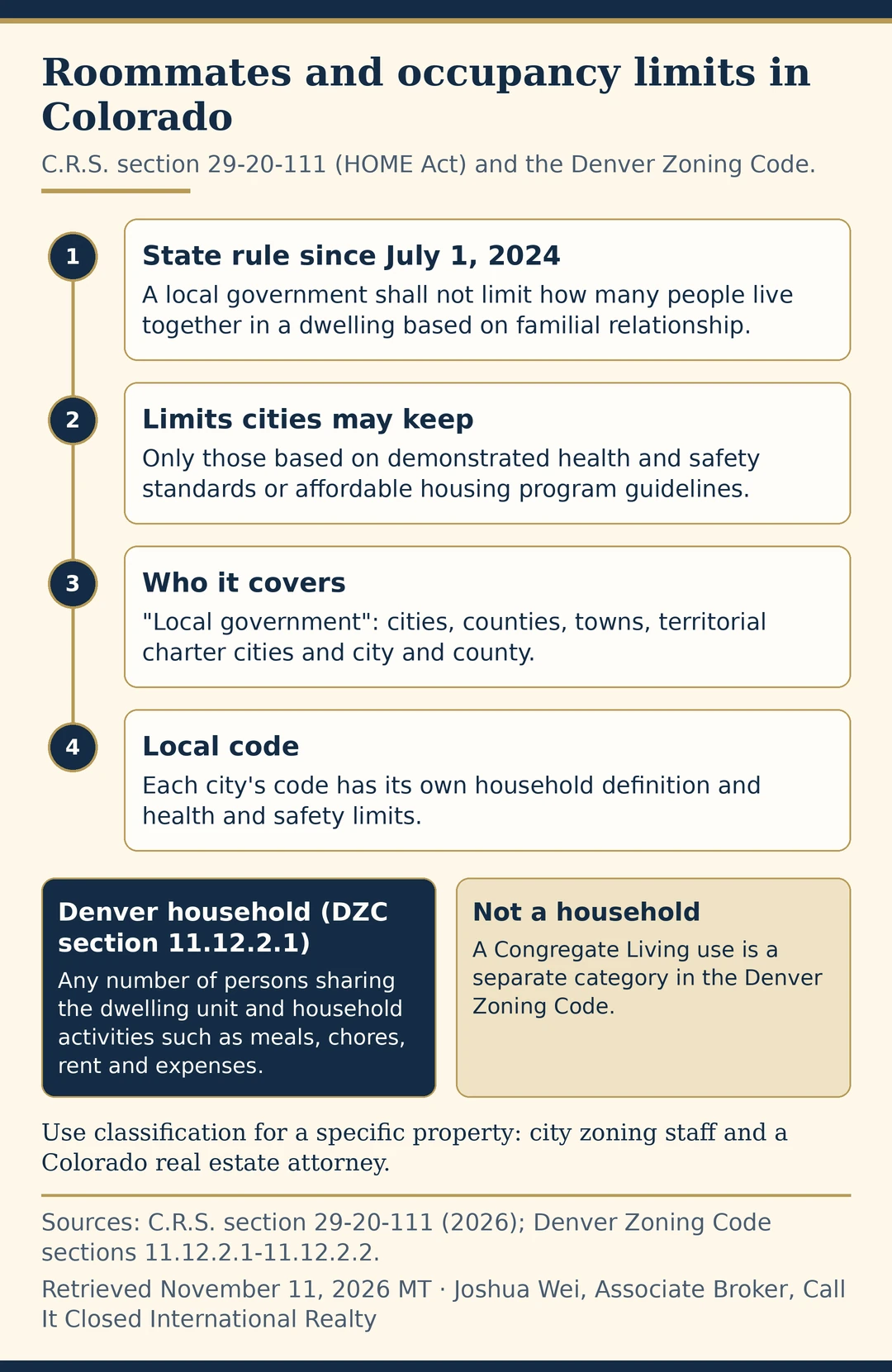
A vertical flow diagram, cream background with navy type and gold accents, titled Roommates and occupancy limits in Colorado. Subtitle: Colorado Revised Statutes section 29-20-111 (HOME Act) and the Denver Zoning Code. 4 numbered steps: 1, State rule since July 1, 2024: A local government shall not limit how many people live together in a dwelling based on familial relationship; 2, Limits cities may keep: Only those based on demonstrated health and safety standards or affordable housing program guidelines; 3, Who it covers: "Local government": cities, counties, towns, territorial charter cities and city and county; 4, Local code: Each city's code has its own household definition and health and safety limits. Two cards: Denver household (DZC section 11.12.2.1): Any number of persons sharing the dwelling unit and household activities such as meals, chores, rent and expenses; and Not a household: A Congregate Living use is a separate category in the Denver Zoning Code. A note says: Use classification for a specific property: city zoning staff and a Colorado real estate attorney. Sources: Colorado Revised Statutes section 29-20-111 (2026); Denver Zoning Code sections 11.12.2.1-11.12.2.2. Retrieved November 11, 2026 MT. Joshua Wei, Associate Broker, Call It Closed International Realty.
Sources: C.R.S. title 29 (2026) (opens in a new tab); Denver Zoning Code Article 11 (opens in a new tab)
Cream background, navy text, gold rules. Numbered navy circles on a gold spine with white step cards, two branch cards (navy and tan), a note, and a source footer.
The figure above summarizes the state statute and Denver's household definition.
What does the HOME Act say?
The law's short title is the "HOME (Harmonizing Occupancy Measures Equitably) Act." The General Assembly declared that "occupancy limits and the increased availability of housing are matters of mixed statewide and local concern."
Local governments keep authority to set occupancy limits based only on:
- "Demonstrated health and safety standards, such as international building code standards, fire code regulations, or Colorado department of public health and environment wastewater and water quality standards; or"
- "Local, state, federal, or political subdivision affordable housing program guidelines."
The source note says the section was added by HB 24-1007, "effective July 1" in 2024.
What the rule changes, and what it leaves alone
The statute targets one kind of rule: a cap tied to whether the people living together are related. A city can't say, for example, that no more than a set number of unrelated adults may share a house when a related family of the same size could. That's the meaning of "based on familial relationship."
The statute doesn't remove every limit. Subsection (3) says local governments "retain the authority to implement residential occupancy limits based only on" the two listed grounds. Building, fire and wastewater standards are the examples it gives for health and safety. So a limit tied to a home's size, bedrooms, exits or septic capacity can still apply, if it's a "demonstrated" health and safety standard. Whether a particular local rule meets that test is a legal question.
The second ground covers affordable housing programs. A home bought or rented through a program with its own household-size rules may still have to follow them, because the statute keeps limits based on "Local, state, federal, or political subdivision affordable housing program guidelines."
Who does it apply to?
The statute defines "local government" as "a home rule or statutory city, home rule or statutory county, town, territorial charter city, or city and county."
How association documents or a lease interact with the statute is a question for a Colorado real estate attorney.
The definition lists governments only. It doesn't mention homeowners' associations, landlords or lenders. Private occupancy rules are a separate question, and federal fair housing law is one of the things that shapes them, as the section on HUD's policy below explains.
How does Denver define a household?
Denver Zoning Code section 11.12.2.1 defines Household Living as "residential occupancy of a 'dwelling unit' by a single 'household.'" Tenancy is "arranged on a month-to-month or longer basis."
A household shares "household activities and responsibilities, such as meals, chores, rent, and expenses." The code adds that the household's adults are chosen by its members, "rather than by a landlord, property manager, or other third party." It also says "All members of the household jointly occupy the entire premises of the dwelling unit."
A household "excludes any use that meets the definition of a Congregate Living use." Congregate Living is a separate use category for people "who do not live in a Household" under that definition.
The full household definition in section 11.12.2.1.B.2 (opens in a new tab) reads: "A 'household' is any number of persons, plus any permitted domestic service workers, who all occupy a Dwelling Unit who share household activities and responsibilities, such as meals, chores, rent, and expenses." It also says "Members are not required to seek services or care of any type as a condition of residency."
The code defines a Dwelling Unit as "One or more Rooms constituting a unit for permanent occupancy, having but one kitchen together with facilities for sleeping, bathing." Household Living use types include "Dwelling, Single Unit," "Dwelling, Two Unit," and "Dwelling, Multi-Unit."
Live-in help
The household definition counts "any permitted domestic service workers" along with the household's members. Section 11.8.3 says "housing of one or more domestic employee(s) is permitted as accessory to all primary residential household living uses," where the zone district permits it with limitations. A live-in nanny or caregiver doesn't by itself change a household into a different use.
Household or Congregate Living?
The line between the two matters most for owners who rent out rooms. Under section 11.12.2.2 (opens in a new tab), Congregate Living "includes groups of Persons who each have separate contracts or agreements with property owners, or who do not jointly occupy the entirety of a dwelling unit." The code lists examples:
- "Rent-by-the-room configurations, such as rooming and boarding houses or student housing"
- dormitories for students of an education use, including fraternity and sorority houses "officially recognized by a college/university, or seminary"
- "Permanent tiny home villages"
The same section says "Residents of a Congregate Living use may share sleeping units, and may have shared cooking, bathroom and common areas, or some combination of personal and shared facilities." It adds that "A Congregate Living use may occur within a self-contained Dwelling Unit."
Read side by side, the two definitions turn on how the home is shared. A group that chooses its own members, shares the whole unit and splits rent and chores fits the household language. Separate agreements with the owner, or residents who don't jointly occupy the whole unit, are listed under Congregate Living. Whether a specific arrangement is one or the other is for Denver's zoning staff. Which zone districts allow Congregate Living, and with what limits, isn't covered here.
Residential Care is a third category
Under section 11.12.2.3 (opens in a new tab), Residential Care is a structure "where guests receive treatment, supervision, emergency shelter, personal care, protective oversight, or other similar care or services, from staff on-site as a condition of the guests' residency." Examples include shelters, recovery residences where participation in a program "is required," assisted living facilities and nursing homes.
The code sorts Residential Care by size. Type 1 is "up to 10 guests year-round, or up to 100 guests for a maximum of 130 days per calendar year." Type 2 is "11 to 40 guests," Type 3 is "41 to 100 guests," and Type 4 is "101 or more guests." The code counts "guests" broadly: "a 'guest' is a person who stays overnight, regardless of total length of stay." Staff who "regularly return to another place of primary residence" aren't guests. The definition "excludes care provided by domestic employees or care workers in a private home that meets this Code's definition of Household Living or Congregate Living."
The one-kitchen rule
People who share a house sometimes want a second kitchen. Denver's Household Living limitations in section 11.2.7.1 say "more than one Full Kitchen is prohibited in any Dwelling Unit containing a Household Living use," with exceptions.
The exceptions include a separate zoning permit "for a second Full Kitchen according to Section 11.8.9," a kitchen that's part of "an allowed Accessory Dwelling Unit use," and an outdoor kitchen in an area "permanently open to the outdoors on at least two sides." The section also says "Any Household Living use may include both one Full Kitchen and one or more Partial Kitchens."
If a buyer is looking at a house with two kitchens, it's worth asking whether the second was permitted. Our ADU rules guide covers accessory units.
Renting rooms or a whole house in Denver
Denver's residential rental property page (opens in a new tab) says the city's license is required for "anyone offering, providing, or operating a residential rental property in the City and County of Denver." It defines a residential rental property as "any building, structure, or accessory dwelling unit that is rented or offered for rent as a residence for 30 days or more at a time." The page says the program "is part of Denver's drive to achieve minimum residential rental housing standards." Our rental license guide covers the steps.
What HUD says about private occupancy policies
Federal fair housing law applies to landlords and condo associations, not just cities. HUD's 1998 statement of policy on occupancy standards (opens in a new tab) explains how HUD reviews occupancy rules for discrimination "on the basis of familial status (the presence of children in a family)."
The policy says "the Department believes that an occupancy policy of two persons in a bedroom, as a general rule, is reasonable under the Fair Housing Act." It adds right away that "the reasonableness of any occupancy policy is rebuttable." HUD "will consider the size and number of bedrooms and other special circumstances."
HUD's own examples include one aimed at condo buyers. Two associations each reject a family of two adults and three children under a two-people-per-bedroom rule. In one building the unit has two bedrooms "plus a den or study"; in the other it doesn't. The policy says "Depending on the other facts, a charge might be warranted in the first situation, but not in the second."
The factors HUD lists include the size of the bedrooms and unit, the age of children, the unit's configuration, and "the capacity of the septic, sewer, or other building systems." On local rules, the policy says that if a housing provider's policy reflects "State or local governmental occupancy requirements," HUD "would consider the governmental requirements as a special circumstance tending to indicate that the housing provider's occupancy policies are reasonable." It also says "An occupancy policy which limits the number of children per unit is less likely to be reasonable than one which limits the number of people per unit."
Colorado has its own fair housing law. C.R.S. 24-34-502(1)(a)(I) (opens in a new tab) makes it an unfair housing practice to refuse to sell or rent housing, or to discriminate "in the terms, conditions, or privileges pertaining to any housing," because of a list of protected traits that includes "familial status" and "marital status." Under 24-34-501(1.6), "Familial status" means "one or more individuals, who have not attained eighteen years of age, being domiciled with a parent or another person having legal custody." It also "shall apply to any person who is pregnant or is in the process of securing legal custody." How the state law applies to an occupancy rule is a question for a fair housing attorney or the Colorado Civil Rights Division.
The HOME Act and HUD's policy work on different questions. The HOME Act stops local governments from capping occupancy by family relationship. HUD's policy is about whether a private occupancy rule discriminates against families with children. A landlord or association writing an occupancy rule should talk with a fair housing attorney.
Three hypotheticals
These are invented, to show which rule each situation raises.
Four friends buy together. Four unrelated co-buyers purchase a Denver house, share the whole home and split the mortgage, utilities and chores. That arrangement matches the household definition's language about members who "share household activities and responsibilities." How they take title is a separate question. Our joint tenancy guide explains the options.
An owner rents out rooms. An owner lives in a four-bedroom house and signs a separate lease with each of three tenants, each renting one room. The code lists "groups of Persons who each have separate contracts or agreements with property owners" under Congregate Living. The owner would want to ask Denver's zoning staff how the arrangement is classified, and check the rental license rules, before signing leases.
A family of six rents a three-bedroom home. The HOME Act doesn't apply to the landlord's own policy, but HUD's statement does. Under HUD's policy, two persons per bedroom is a general rule that is rebuttable on the facts.
Questions to ask before you buy
- Is the house zoned for the use you plan: one household, rented rooms, or something else? Denver's zoning staff can answer that.
- Does the home have more than one full kitchen, and was the second permitted?
- If you'll rent it, what does Denver's residential rental license require?
- If it's in an HOA, do the governing documents have occupancy or leasing rules? Ask an attorney how they apply.
- Is the home part of an affordable housing program with its own household-size rules?
Who classifies a specific use?
How a particular arrangement, such as co-buyers or rented rooms, fits Denver's definitions is a question for Denver zoning staff and a Colorado real estate attorney. Denver's rental licensing office handles rental license questions.
Frequently asked questions
Can a Colorado city cap unrelated roommates?
Colorado Revised Statutes section 29-20-111(3) says "A local government shall not limit the number of people who may live together in a single dwelling based on familial relationship."
When did this start?
HB 24-1007 added the section effective July 1, 2024.
Does it apply to HOAs?
The statute defines "local government" as "a home rule or statutory city, home rule or statutory county, town, territorial charter city, or city and county." Association documents are a question for a Colorado real estate attorney.
How many people can live in a Denver house?
Denver's zoning definition of household says "any number of persons" who share the dwelling and household activities. Health and safety codes can still apply.
Can a landlord choose my roommates and still call it a household?
Denver's definition says the household's adults are chosen by its members, "rather than by a landlord, property manager, or other third party."
Is renting rooms on separate leases the same as a household in Denver?
Not under the zoning code's wording. Denver's Congregate Living definition "includes groups of Persons who each have separate contracts or agreements with property owners." Denver's zoning staff classify a specific arrangement.
Can a Denver house have two kitchens?
Section 11.2.7.1 prohibits more than one Full Kitchen in a Household Living dwelling unit, with exceptions that include a separate permit under section 11.8.9 and an allowed ADU.
Does the HOME Act stop a landlord's two-per-bedroom rule?
The HOME Act applies to local governments. A private landlord's policy is reviewed under federal fair housing law. HUD's 1998 policy calls two persons per bedroom reasonable "as a general rule," and says that's rebuttable.
What about Aurora and other cities?
The statute applies to each "local government" as it defines the term. Each city's zoning staff can explain its own household definition.
Related notes
- Buying a home you might rent out? Denver's rental license and Aurora's rental rules, explained
- Thinking of Airbnb income? Denver and Aurora short-term rental rules for buyers, explained
- Buying a Denver or Aurora home with a tenant in it: leases, Colorado's for-cause eviction law, and move-in timing
Sources and method
Official sources, retrieved November 11 and 13, 2026, America/Denver:
- C.R.S. title 29 (2026) (opens in a new tab): section 29-20-111
- Denver Zoning Code, Article 11 (opens in a new tab): sections 11.2.7.1, 11.12.2.1–11.12.2.3 (republished February 25, 2025)
- HUD, Fair Housing Enforcement: Occupancy Standards; Statement of Policy, 63 Fed. Reg. 70256 (Dec. 18, 1998) (opens in a new tab)
- C.R.S. title 24 (2026) (opens in a new tab): sections 24-34-501(1.6), 24-34-502(1)(a)(I)
- City and County of Denver, Residential rental property (opens in a new tab)
Aurora's code and Denver's building and housing codes weren't reviewed for numeric health and safety limits. Which Denver zone districts permit Congregate Living wasn't reviewed. The hypotheticals are invented.
This note is general education from a Colorado real estate broker with Call It Closed International Realty. For use classification or lease questions, talk with a Colorado real estate attorney and the city's zoning staff.
Disclaimer
This article is general information only. It is not legal, tax, lending, insurance, appraisal, inspection, or financial advice, and it is not a substitute for advice about your situation. Joshua Wei is a Colorado real estate broker, not an attorney. Reading this article does not create a client relationship, an agency relationship, or an attorney-client relationship with Joshua Wei or with Call It Closed International Realty.
Laws, program rules, interest rates, insurance terms, tax figures, and other details change. Examples in this article are hypothetical illustrations unless a source is named for a specific, dated figure. Information in this article is believed accurate as of November 13, 2026 and is not guaranteed. No result is promised, and you should not rely on this article as the last word for your situation.
Before you act, confirm the point with the official source linked or cited in this article, and talk with a licensed professional who can apply the rule to your facts. That may be a licensed attorney, a tax professional, a lender, an insurance agent, a home inspector, or another licensed professional, depending on the question. Links to third-party websites and publications are provided for reference only. They are not an endorsement, and their content can change.
If you already have a brokerage relationship with another broker, this is not a solicitation.
Joshua Wei, Associate Broker, Call It Closed International Realty, Colorado license FA.100108558. Equal Housing Opportunity.