September 3, 2026 · Colorado · Buying · Selling · Closing
Can't make it to closing? Using a power of attorney to buy or sell a Colorado home
When a buyer or seller can't sign in person, an agent under a power of attorney may be able to. What Colorado's Uniform Power of Attorney Act says about signing, notarization, real property authority, durability, termination and acceptance, and why you should start with your title company early.
The short answer
In brief: When an owner will be deployed, traveling, ill or unable to sign at closing, a power of attorney can come up. Under Colorado's Uniform Power of Attorney Act, C.R.S. 15-14-727(1), general authority over real property lets the agent sell, convey or mortgage it unless the document says otherwise. Ask an attorney and the title company whether a document works.
When an owner will be deployed, traveling, ill or otherwise unable to sign at closing, a power of attorney is one document that comes up. Colorado's Uniform Power of Attorney Act is at C.R.S. 15-14-701 and following, in the 2026 Colorado Revised Statutes, Title 15 (opens in a new tab).
Points from the Act that relate to real estate:
- Under 15-14-727(1), general authority over real property lets the agent "Sell; exchange; convey" and "Pledge or mortgage" real property, unless the document says otherwise.
- Under 15-14-705, a signature "is presumed to be genuine if the principal acknowledges the signature before a notary public."
- Under 15-14-710(1)(a), a power of attorney ends when "The principal dies."
Drafting or reviewing a power of attorney is a question for a Colorado attorney, and whether a title company will accept one is a question for that title company.
I am a licensed Colorado real estate broker with Call It Closed International Realty. I am not an attorney.
Disclaimer. This article is general information only. It is not legal, tax, lending, insurance, appraisal, inspection, or financial advice, and reading it does not create a client, agency, or attorney-client relationship. Laws, rates, programs, and figures change. Confirm the official source, and talk with a licensed attorney, tax professional, lender, insurance agent, or inspector before you act. Joshua Wei is a Colorado real estate broker, not an attorney. He is an Associate Broker with Call It Closed International Realty, license FA.100108558. Equal Housing Opportunity.
 Full size (opens in a new tab)
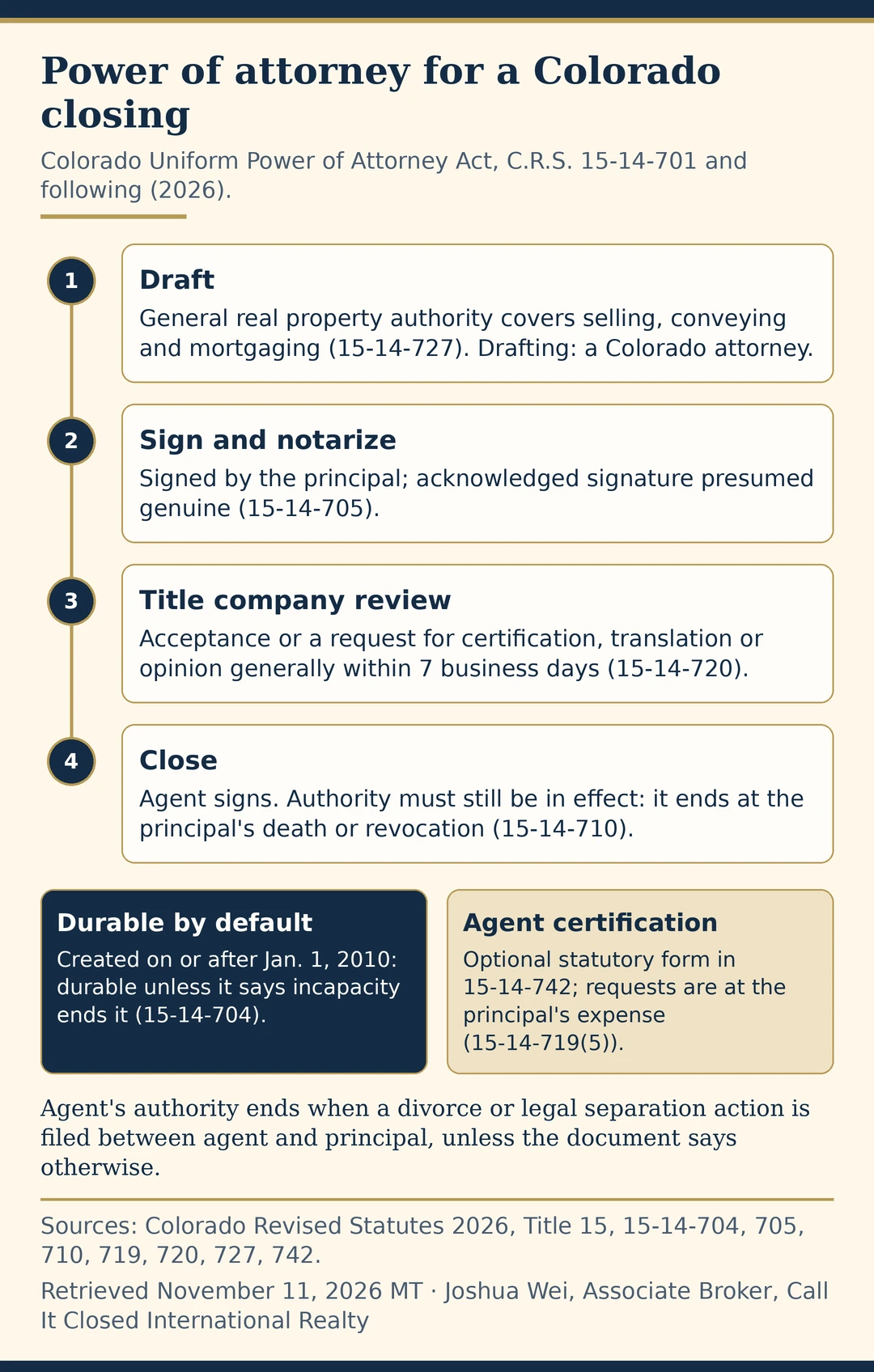
A vertical flow diagram, cream background with navy type and gold accents, titled Power of attorney for a Colorado closing. Subtitle: Colorado Uniform Power of Attorney Act, C.R.S. 15-14-701 and following (2026). 4 numbered steps: 1, Draft: General real property authority covers selling, conveying and mortgaging (15-14-727). Drafting: a Colorado attorney; 2, Sign and notarize: Signed by the principal; acknowledged signature presumed genuine (15-14-705); 3, Title company review: Acceptance or a request for certification, translation or opinion generally within 7 business days (15-14-720); 4, Close: Agent signs. Authority must still be in effect: it ends at the principal's death or revocation (15-14-710). Two cards: Durable by default: Created on or after Jan. 1, 2010: durable unless it says incapacity ends it (15-14-704); and Agent certification: Optional statutory form in 15-14-742; requests are at the principal's expense (15-14-719(5)). A note says: Agent's authority ends when a divorce or legal separation action is filed between agent and principal, unless the document says otherwise. Sources: Colorado Revised Statutes 2026, Title 15, 15-14-704, 705, 710, 719, 720, 727, 742. Retrieved November 11, 2026 MT. Joshua Wei, Associate Broker, Call It Closed International Realty.
Sources: C.R.S. 2026 Title 15 (opens in a new tab)
Cream background, navy text, gold rules. Numbered navy circles on a gold spine with white step cards, two branch cards (navy and tan), a note, and a source footer.
The figure above follows the Act's provisions in the order they come up: drafting, signing, acceptance and closing.
How must a power of attorney be signed?
C.R.S. 15-14-705 says it "must be signed by the principal or in the principal's conscious presence by another individual directed by the principal to sign the principal's name."
The Act's signing rule doesn't list notarization, but the official comment says: "As a practical matter, an acknowledged signature is required if the power of attorney will be recorded by the agent in conjunction with the execution of real estate documents on behalf of the principal." Whether a particular document needs acknowledgment is a question for the title company or a Colorado attorney.
Out-of-state, military and copied documents
Under 15-14-706(1), a power of attorney signed in Colorado on or after January 1, 2010 "is valid if its execution complies with section 15-14-705." Under 706(3), one signed elsewhere is valid in Colorado if its execution complied with the law of the jurisdiction that governs it under 15-14-707, or with "The requirements for a military power of attorney pursuant to 10 U.S.C. sec. 1044b, as amended."
Copies are addressed in 706(4): "a photocopy or electronically transmitted copy of an original power of attorney has the same effect as the original." The same subsection adds: "Nothing in this subsection (4) shall preclude a third party relying upon a power of attorney from requesting the original document."
The official comment to 706 gives a real estate example of when an original may matter: "An example of another law that might require presentation of the original power of attorney is the jurisdiction's recording act." If the agent will sign a deed or deed of trust, ask the title company early whether it needs the original, and where it should be sent.
When does it take effect?
Under 15-14-709(1), "A power of attorney is effective when executed unless the principal provides in the power of attorney that it becomes effective at a future date or upon the occurrence of a future event or contingency."
A document that springs into effect on a later event raises a practical question at closing: who confirms the event happened? Section 709(2) lets the principal name "one or more persons to determine in a writing or other record that the event or contingency has occurred." If the trigger is incapacity and no one was named, 709(3) looks to a written determination by "A physician or licensed psychologist," or by "An attorney-at-law, a judge, or an appropriate governmental official," depending on the kind of incapacity.
What can the agent do with real estate?
Unless the document limits it, general real property authority under 15-14-727(1) covers buying, selling, conveying, mortgaging, and releasing liens. Whether a general or narrower document fits a particular transaction is a question for a Colorado attorney.
The list in 727(1) is long. Besides selling and mortgaging, it covers the power to "Demand, buy, lease, receive" an interest in real property; to "Release, assign, satisfy, or enforce by litigation or otherwise a mortgage, deed of trust" or lien; and to "Change the form of title of an interest in or right incident to real property."
What general authority doesn't cover
Some acts need express wording. Under 15-14-724(1), an agent may do certain things "only if the power of attorney expressly grants the agent the authority." The list includes:
- "Make a gift"
- "Create or change rights of survivorship"
- "Create or change a beneficiary designation"
- "Delegate authority granted under the power of attorney"
That can matter in real estate. How a buyer takes title, for example as joint tenants with a right of survivorship, involves survivorship rights. Our joint tenancy vs. tenants in common guide explains the difference. If an agent will sign for a buyer, ask the attorney whether the document covers the vesting you intend.
Section 724(2) adds a limit for agents outside the family. Unless the document says otherwise, an agent "that is not an ancestor, spouse, or descendant of the principal" may not use the power "to create in the agent, or in an individual to whom the agent owes a legal obligation of support, an interest in the principal's property."
The statutory form
C.R.S. 15-14-741 sets out an optional "STATE OF COLORADO STATUTORY FORM POWER OF ATTORNEY." Its instructions say: "This power of attorney does not authorize the agent to make health care decisions for you." They also say: "This power of attorney becomes effective immediately unless you state otherwise in the special instructions."
The form lists subjects to initial, starting with "Real property." A separate section for specific authority, including "Create or change rights of survivorship," carries this caution: "Granting any of the following will give your agent the authority to take actions that could significantly reduce your property or change how your property is distributed at your death." The form also says: "If you have questions about the power of attorney or the authority you are granting to your agent, you should seek legal advice before signing this form."
What the agent owes the owner
An agent signing closing documents is a fiduciary. Under 15-14-714(1), an agent who has accepted appointment shall, notwithstanding the document, "Act in accordance with the principal's reasonable expectations to the extent actually known by the agent and, otherwise, in the principal's best interest," "Act in good faith," and "Act only within the scope of authority granted in the power of attorney."
Unless the document says otherwise, 714(2) adds duties to "Act loyally for the principal's benefit" and to "Keep a record of all receipts, disbursements, and transactions made on behalf of the principal." For a home sale, that record could include the settlement statement and where the proceeds went.
Is it still good if I become incapacitated?
Under 15-14-704(1), a power of attorney created on or after January 1, 2010 "is durable unless it expressly provides that it is terminated by the incapacity of the principal."
When does it end?
C.R.S. 15-14-710(1) lists when a power of attorney terminates. The list includes when the principal dies, when the principal revokes it, when it says it ends, and when "The express purpose of the power of attorney is accomplished."
Under 15-14-710(2)(c), unless the document says otherwise, an agent's authority also ends when a divorce, annulment or legal separation action is filed between the agent and the principal.
Three more rules in 15-14-710 matter at closing:
- Old documents don't go stale. Under 710(3), unless the document provides otherwise, an agent's authority "is exercisable until the authority terminates under subsection (2) of this section, notwithstanding a lapse of time since the execution of the power of attorney." A title company may still ask questions about an old document; the statute doesn't set an expiration.
- A new document doesn't cancel an old one by itself. Under 710(6), signing a new power of attorney "does not revoke a power of attorney previously executed by the principal unless the subsequent power of attorney provides that the previous power of attorney is revoked or that all other powers of attorney are revoked."
- Good-faith reliance. Under 710(4), termination "is not effective as to the agent or another person that, without actual knowledge of the termination, acts in good faith under the power of attorney." If an owner revokes a power of attorney while a sale is pending, telling the title company in writing is the practical step.
What happens to a pending sale after an owner's death is a question for a Colorado attorney.
Will the title company accept it?
C.R.S. 15-14-719(4) lets a person asked to accept an acknowledged power of attorney request:
- "An agent's certification under penalty of perjury of any factual matter concerning the principal, agent, or power of attorney"
- A translation, if any part is in another language
- An opinion of counsel, with a written reason
Under 15-14-720(1)(a), a person generally must accept, or make one of those requests, "no later than seven business days after presentation." Section 15-14-720(2) lists exceptions.
If the person asks for a certification, translation or opinion, 720(1)(b) says the person "shall accept the power of attorney no later than five business days after receipt" of it. Under 719(5), those items "must be provided at the principal's expense."
C.R.S. 15-14-742 provides an optional "AGENT'S CERTIFICATION" form. Title companies and lenders may have their own review steps; each can describe its timeline.
When a lender or title company can say no
The seven-day rule has exceptions in 720(2). Two are relevant for buyers. A person is not required to accept if "The agent seeks to establish a customer relationship under the power of attorney and the principal is not currently a customer," or if "The agent seeks services under the power of attorney that the person does not offer."
A new mortgage lender, for example, may not have an existing customer relationship with the principal. Another exception applies if the person "in good faith believes that the power is not valid or that the agent does not have the authority to perform the act requested." For a purchase with a loan, ask the lender early whether it will accept the document at all.
Section 720(3) sets the consequence of a refusal that violates the section: "A court order mandating acceptance of the power of attorney" and "Liability for reasonable attorney's fees and costs incurred in any action or proceeding that confirms the validity of the power of attorney or mandates acceptance of the power of attorney." That remedy takes a court case, and a closing date may not leave time for one. Asking early is the practical answer.
Planning a closing with an agent signing
What to ask, and when
- Your attorney: Does the document grant real property authority? Does it need specific authority for the vesting or any gift? Is it effective now, or does it spring on an event?
- The title company: Will it accept this document? Does it need the original, a certification under 15-14-742, or both? Will the document be recorded with the deed?
- The lender (buyers): Will the lender accept a power of attorney for this loan at all, and does it require its own review or form? Under 720(2), a lender may have grounds to decline.
- Everyone: Who is the agent's contact, and how will closing funds and wiring instructions be confirmed? Our wire fraud guide covers verification.
A hypothetical timeline
This example is invented, to show where the steps fall. It is not legal advice and not a prediction of any company's timeline.
- A Denver seller learns in February that she will be deployed during her May closing. She asks a Colorado attorney about a power of attorney naming her brother as agent, and signs an acknowledged document in March.
- Right after the contract is signed in April, the seller's broker asks the title company to review the document. The title company asks for an agent's certification, which the brother signs.
- Under 15-14-720(1)(b), the title company's acceptance would be due no later than five business days after it receives the certification, unless an exception in 720(2) applies.
- At closing, the brother signs as agent. The seller's net proceeds go to the account she designated in writing, and the brother keeps a record of the transaction under 714(2)(d).
Starting early is the point of the example. If the title company had asked for an opinion of counsel instead, more time would have been needed.
Frequently asked questions
Does a Colorado power of attorney have to be notarized?
C.R.S. 15-14-705 presumes an acknowledged signature "to be genuine," and the official comment says: "As a practical matter, an acknowledged signature is required if the power of attorney will be recorded by the agent in conjunction with the execution of real estate documents on behalf of the principal."
Can my agent sell my house with a general power of attorney?
Under 15-14-727(1), general real property authority includes the power to sell and convey, unless the document provides otherwise.
Does a power of attorney survive my death?
C.R.S. 15-14-710(1)(a) says it terminates when the principal dies.
How long does a title company have to accept it?
Generally seven business days to accept or request a certification, translation or opinion, under 15-14-720, subject to exceptions.
Can the title company require its own form?
C.R.S. 15-14-720(1)(c) says "A person may not require an additional or different form of power of attorney for authority granted in the power of attorney presented." Exceptions apply.
Who should draft it?
The Act doesn't say who drafts. Drafting questions are for a Colorado attorney.
Will a copy work, or do they need the original?
Under 15-14-706(4), a photocopy or electronic copy generally "has the same effect as the original," but a third party may still request the original. Ask the title company which it needs.
Is a military power of attorney valid in Colorado?
C.R.S. 15-14-706(3)(b) recognizes a power of attorney whose execution complied with "The requirements for a military power of attorney pursuant to 10 U.S.C. sec. 1044b, as amended."
Can my agent put the house in joint tenancy with someone?
Under 15-14-724(1)(c), creating or changing rights of survivorship requires an express grant in the document.
Does a lender have to accept my power of attorney for a new loan?
Not always. C.R.S. 15-14-720(2)(a.3) lists the case where "The agent seeks to establish a customer relationship under the power of attorney and the principal is not currently a customer."
Related notes
- Colorado beneficiary deeds: what a transfer-on-death deed does, and doesn't do, for a Denver or Aurora home
- Special warranty, general warranty, or quitclaim? Colorado deed types for Denver and Aurora buyers, explained
- Why you can't bring a personal check to closing: Colorado's good funds law for Denver and Aurora buyers and sellers
- Joint tenancy vs. tenants in common in Colorado
- Reading your title commitment
Sources and method
Official source, retrieved November 11 and 13, 2026, America/Denver:
- Colorado Revised Statutes 2026, Title 15 (opens in a new tab): C.R.S. 15-14-704, 705 (with official comment), 706 (with official comment), 709, 710, 714, 719, 720, 724, 727, 741, 742
Quotations are verbatim from the statute and official comment. The Commission's forms page doesn't list a power of attorney form. Lender and title company acceptance practices vary and aren't stated here. The timeline example is hypothetical.
This note is general education from a Colorado real estate broker with Call It Closed International Realty. If you can't be at your Denver or Aurora closing, I'll help coordinate the timing between your attorney, the title company and your lender.
Disclaimer
This article is general information only. It is not legal, tax, lending, insurance, appraisal, inspection, or financial advice, and it is not a substitute for advice about your situation. Joshua Wei is a Colorado real estate broker, not an attorney. Reading this article does not create a client relationship, an agency relationship, or an attorney-client relationship with Joshua Wei or with Call It Closed International Realty.
Laws, program rules, interest rates, insurance terms, tax figures, and other details change. Examples in this article are hypothetical illustrations unless a source is named for a specific, dated figure. Information in this article is believed accurate as of November 13, 2026 and is not guaranteed. No result is promised, and you should not rely on this article as the last word for your situation.
Before you act, confirm the point with the official source linked or cited in this article, and talk with a licensed professional who can apply the rule to your facts. That may be a licensed attorney, a tax professional, a lender, an insurance agent, a home inspector, or another licensed professional, depending on the question. Links to third-party websites and publications are provided for reference only. They are not an endorsement, and their content can change.
If you already have a brokerage relationship with another broker, this is not a solicitation.
Joshua Wei, Associate Broker, Call It Closed International Realty, Colorado license FA.100108558. Equal Housing Opportunity.