October 22, 2026 · Aurora · Denver · Buying · Selling · Inspections
Buying a home with a well or septic system near Denver or Aurora? Colorado contract steps and Arapahoe County's septic use permit
Some properties around Denver and Aurora have a private well or a septic system. What Colorado's contract, the Division of Water Resources, and Arapahoe County Public Health say buyers and sellers need to do.
The short answer
In brief: A home with a private well or septic system adds steps at sale. Colorado's residential contract, section 2.7.3, has the seller supply required well information, and a buyer of a small-capacity or domestic exempt well must complete a Change in Ownership form at or before closing. In Arapahoe County, the seller must obtain a septic use permit before the sale.
If a home has a private well or a septic system, there are extra steps at sale.
- Well. Colorado's standard residential contract (CBS1) section 2.7.3 says: "Seller agrees to supply required information to Buyer about the well." It also says a buyer of a "Small Capacity Well" or "Domestic Exempt Water Well" used for household purposes "must, prior to or at Closing, complete a Change in Ownership form for the well."
- Septic in Arapahoe County. Arapahoe County Public Health says: "The seller of the property is required to obtain a use permit prior to the sale of the property."
I am a licensed Colorado real estate broker with Call It Closed International Realty. I am not an attorney, inspector, or water-rights professional. This is not legal advice.
Disclaimer. This article is general information only. It is not legal, tax, lending, insurance, appraisal, inspection, or financial advice, and reading it does not create a client, agency, or attorney-client relationship. Laws, rates, programs, and figures change. Confirm the official source, and talk with a licensed attorney, tax professional, lender, insurance agent, or inspector before you act. Joshua Wei is a Colorado real estate broker, not an attorney. He is an Associate Broker with Call It Closed International Realty, license FA.100108558. Equal Housing Opportunity.
 Full size (opens in a new tab)
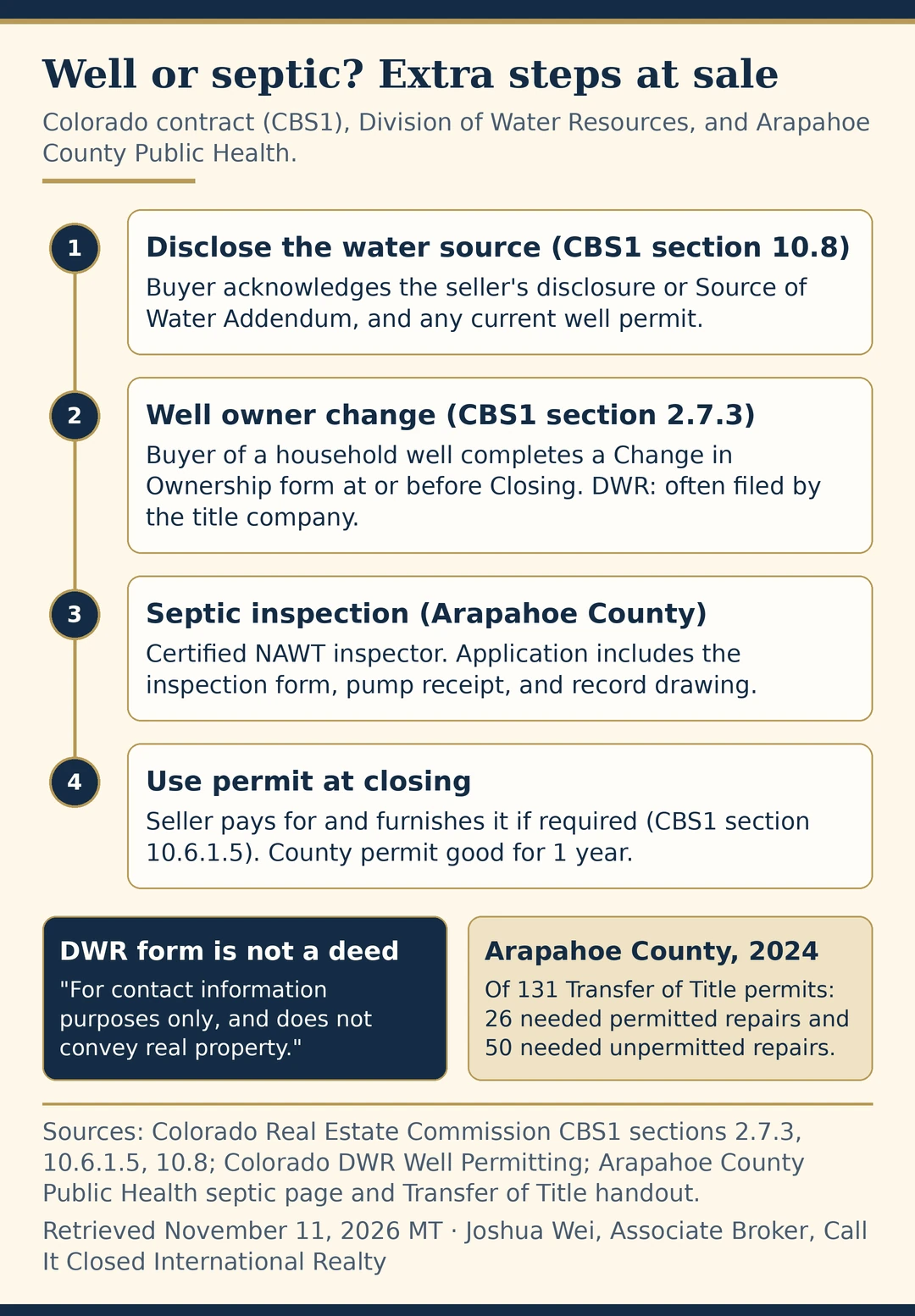
A vertical flow diagram, cream background with navy type and gold accents, titled Well or septic? Extra steps at sale, with the subtitle Colorado contract CBS1, Division of Water Resources, and Arapahoe County Public Health. Four numbered steps: 1, disclose the water source under CBS1 section 10.8, where the buyer acknowledges the seller's disclosure or Source of Water Addendum and any current well permit; 2, well owner change under CBS1 section 2.7.3, where the buyer of a household well completes a Change in Ownership form at or before Closing, and DWR says the title company often files it; 3, septic inspection in Arapahoe County by a certified NAWT inspector, with an application including the inspection form, pump receipt, and record drawing; 4, use permit at closing, which the seller pays for and furnishes if required under CBS1 section 10.6.1.5, and the county permit is good for 1 year. Two lower cards: DWR form is not a deed, quoting that it is for contact information purposes only and does not convey real property; and Arapahoe County 2024, where of 131 Transfer of Title permits 26 needed permitted repairs and 50 needed unpermitted repairs. Sources: Colorado Real Estate Commission, Colorado DWR, Arapahoe County Public Health. Retrieved November 11, 2026 MT.
Sources: DWR Well Permitting (opens in a new tab); Arapahoe County septic (opens in a new tab)
Cream background, navy text, gold rules. Four numbered steps on a gold spine, two side-by-side cards, and a 28px source footer.
The diagram above puts the well steps and the Arapahoe County septic steps side by side, based on the contract, the Division of Water Resources, and Arapahoe County Public Health.
What does the contract say about wells?
CBS1 is on the Division of Real Estate's contracts and forms page (opens in a new tab); quotations here are from the 2026 CBS1 PDF (opens in a new tab). Section 2.7.3 continues: "If an existing well has not been registered with the Colorado Division of Water Resources in the Department of Natural Resources (Division), Buyer must complete a registration of existing well form for the well and pay the cost of registration."
It adds: "If no person will be providing a closing service in connection with the transaction, Buyer must file the form with the Division within sixty days after Closing."
Section 10.8, "Source of Potable Water," has the buyer acknowledge whether they received the seller's disclosure "or Source of Water Addendum disclosing the source of potable water for the Property," and whether they received "a copy of the current well permit." It also carries this note: "SOME WATER PROVIDERS RELY, TO VARYING DEGREES, ON NONRENEWABLE GROUND WATER."
Other water lines in section 2.7
Section 2.7 has more than the well paragraph. It has blanks for deeded water rights (section 2.7.1), "Other Rights Relating to Water" (section 2.7.2), and water stock (section 2.7.4). Section 2.7.3 has a blank for "The Well Permit #." Under section 2.7.5, if the buyer is to receive rights to water under those sections, "Seller agrees to convey such rights to Buyer by executing the applicable legal instrument at Closing." Section 2.7.6 gives the buyer "a Right to Terminate if examination of the Water Rights is unsatisfactory to Buyer on or before the Water Rights Examination Deadline."
Section 19 records that each broker recommended the parties "consult with their own attorney if Water Rights, Mineral Rights or Leased Items are included or excluded in the sale."
What does the seller's disclosure ask about water and septic?
The 2026 Seller's Property Disclosure (opens in a new tab) (SPD) has a "SOURCE OF WATER & WATER SUPPLY" section. It asks for the "Type of water supply" (public, community, well, shared well, other, or none), whether "a copy of the Well Permit Is Is Not provided," the "Well Permit #," whether "Drilling Records Are Are Not provided," and whether there is a "Shared Well Agreement."
The water problems section lists "Well" and "Water has been tested for potability," with the instruction: "Indicate result of test in comments and provide the most recent records and reports pertaining to such testing."
For sewer, the SPD's septic lines ask for the system "Type," "Date of issuance of the latest Individual Use Permit," "Date of the latest inspection," "Date of the latest pumping," and whether the "System is under a maintenance agreement (pumped/inspected on a regular basis)." A seller's answers are limited to "Seller's CURRENT ACTUAL KNOWLEDGE," so they are a starting point for questions, not a substitute for an inspection.
Looking up a well permit
DWR says: "Information on all registered well permits can be found through our Well Permit Search Tool and our Map Viewer Tools." It describes what the file holds: "The well permit file will contain the allowable uses of the well, the original permit application, and any available well construction and pump installation records." A buyer can compare the allowable uses in the file with how the seller uses the well. Questions about what a permit allows go to DWR or a water-rights attorney.
Section 10.8's note to buyers continues past the line quoted above: "YOU MAY WISH TO CONTACT YOUR PROVIDER (OR INVESTIGATE THE DESCRIBED SOURCE) TO DETERMINE THE LONG-TERM SUFFICIENCY OF THE PROVIDER'S WATER SUPPLIES."
Who updates the well owner with the state?
The Division of Water Resources' well permitting page (opens in a new tab) says: "In many cases, the title company will file the Title Companies - Change of Owner Name/Contact Information form in connection with a real estate transaction."
If that doesn't happen: "if updates are needed after closing or if the title company did not submit the form, the well owner, their attorney, or agent may file the Change of Owner Name/Contact Information."
DWR also says the form "is for contact information purposes only, and does not convey real property." It adds: "A Change of Owner Name/Contact Information form can only be filed for a valid permit." If the seller cannot produce a permit number, ask about it early; section 2.7.3 covers a well that "has not been registered" with the Division.
What does Arapahoe County require for septic?
Arapahoe County Public Health's septic systems page (opens in a new tab) says: "A Use Permit is required for:" including "A sale or change of ownership of a property." It also says: "Use permit inspections must be conducted by a Certified NAWT Inspector."
Its Transfer of Title handout (opens in a new tab) says: "A septic inspection and use permit are required at the time of sale to confirm the system is working properly and isn't creating a public health risk."
The handout's steps:
- Hire a septic inspector through NAWT.org.
- After the inspection, submit a "Transfer of Title/Use" permit application. Include the inspector's form, "the pump receipt of the septic tank(s)," and "an up-to-date record drawing of the septic system."
- Submit the application with payment.
- The county "takes approximately 2 business days to process applications when: payment is received, all required information is submitted, and the application is complete."
- "Provide the transfer of title permit issued by Arapahoe County Public Health at closing."
The handout says the permit "is good for 1 year from the issue date." It continues: "If the home has not sold by then, the permit expires and the process must be repeated." It also warns: "Incomplete applications and lack of payment will delay the process."
What else triggers a use permit?
The county's septic page lists the triggers. Besides "A sale or change of ownership of a property," a use permit is required for "A change in use of the property (i.e., a residence to a business)," "Any addition of bedrooms," the addition of a separate "modular" home, and "Other reasons deemed necessary by the department."
The page lists the documents: "Application for a Septic Use Permit," "Use Permit Inspection Form," a "Use Permit Repair Verification Form (if applicable)," an "Agreement to Forgo Expansion (if applicable)," and an "Agreement to Repair a Septic (if applicable)." The county page also links to its "Online Septic Record Search."
Who can work on a septic system?
The county says: "All Onsite Wastewater Treatment System designers, soil evaluators, installers, inspectors, operation and maintenance providers, and pumpers will be required to obtain a license from Arapahoe County Public health and obtain certification from the National Association of Wastewater Technicians (NAWT) for the discipline they want to work in." Cleaner and installer licenses "expire Dec. 31 of each calendar year."
What the county says about owning a septic system
Arapahoe County Public Health's FAQ answers several owner questions:
- Pumping. "We require that septic tanks be inspected every four years and pumped when scum and sludge accumulate to greater than 25% of the effective volume of the tank." It adds: "All pumping and evaluation of septic tanks should be done by a licensed cleaner."
- The soil treatment area. "We recommend that an STA be left largely untouched by homeowners." The FAQ says "Irrigated landscaping is not recommended," and "Horses or other livestock should not be placed on an STA, because compaction of the soils may occur causing premature failure of your absorption area."
- New plumbing. For a bathroom in a garage or barn, the county says: "We generally allow connection to the existing septic system, provided the owner notifies Arapahoe County Public Health in advance, and we approve the connection." It adds: "Prior to final approval, the existing record drawing of the system must also be amended to show new buildings and plumbing."
- Finding the system. If county records are missing, "it may be necessary to contact a licensed installer or a certified Use Permit inspector or surveyor to locate your system."
What does Colorado law say about septic systems?
Septic systems are on-site wastewater treatment systems under Colorado law. In Colorado Revised Statutes section 25-10-102 (opens in a new tab), the general assembly declares it in the public interest "to establish minimum standards and rules for on-site wastewater treatment systems in the state," among other reasons "To preserve the environment and protect the public health and water quality."
Section 25-10-112 sets general prohibitions. A few of them can matter to a buyer:
- "Construction of new cesspools is prohibited."
- "A person shall not connect more than one dwelling, commercial, business, institutional, or industrial unit to the same on-site wastewater treatment system unless such multiple connection was specified in the application submitted and in the permit issued for the system."
- "No person shall construct or maintain any dwelling or other occupied structure that is not equipped with adequate facilities for the sanitary disposal of sewage."
If a property has an accessory dwelling or a second structure on the same system, ask the county what the permit allows. See ADU rules in Denver and Aurora.
How does the contract handle a septic use permit?
CBS1 section 10.6.1.5: "If required by the local health department or other applicable government entity, on or before the local health department's applicable deadline, Seller must pay for and furnish to Buyer a Septic Use Permit."
What do the county's numbers show?
The Arapahoe County handout reports that of 131 Transfer of Title permits processed in 2024, "26 needed permitted repairs" and "50 needed unpermitted repairs." For 2023, it reports "124 Transfer of Title/Use permits were processed in 2023," of which "17 needed permitted repairs" and "42 needed unpermitted repairs." The handout does not define the two repair categories; ask the county what they cover.
Arapahoe County Public Health also warns, about its system records, that "we may not have records of all septic systems due to age or permit status."
The county lists the inspection form, pump receipt and record drawing as part of the application; timing questions for a specific sale go to Arapahoe County Public Health.
An invented example
This example is invented; it is not a real property.
A buyer is under contract on a house on acreage in unincorporated Arapahoe County with a domestic well and a septic system.
- The SPD lists a well permit number and says drilling records are provided. The buyer's broker checks that section 2.7.3 has the Well Permit # filled in.
- The seller hires a NAWT-certified inspector, has the tank pumped, and submits the Transfer of Title/Use application with the inspection form, pump receipt, and record drawing.
- Under section 10.6.1.5, the seller furnishes the Septic Use Permit by the county's deadline.
- The buyer completes the Change in Ownership form for the well at or before closing, as section 2.7.3 requires, and asks the title company whether it will file DWR's change of owner form.
- The buyer arranges a water test with a lab, separate from the contract steps.
Who does what in a real sale depends on the contract and the county; check with each.
Checklist for a well or septic purchase
- Confirm the Well Permit # in CBS1 section 2.7.3 and the SPD.
- Ask whether the well is registered with the Division of Water Resources.
- Ask who will file the Change of Owner Name/Contact Information form.
- Calendar the Water Rights Examination Deadline in section 2.7.6.
- For Arapahoe County septic, confirm the use permit and its issue date.
- Read the inspector's form and ask about any repairs.
- Look up the system in the county's septic record search.
- Ask the seller for pumping and maintenance records listed in the SPD.
Related: Radon testing guide for Denver and Aurora (opens in a new tab).
Frequently asked questions
How common is septic in Arapahoe County?
Arapahoe County Public Health's handout says: "More than 6,000 properties are served by septic in Arapahoe County." Whether a particular home has a well or septic system should show up in the seller's disclosure and contract section 10.8.
Who pays for the septic use permit?
Section 10.6.1.5 says the seller "must pay for and furnish" it to the buyer, if it's required.
How long is an Arapahoe County use permit good for?
The handout says "1 year from the issue date."
Does the DWR owner form transfer the well?
No. DWR says it "is for contact information purposes only, and does not convey real property."
What if the house doesn't sell within a year of the permit?
The handout says that if the home has not sold within the year, "the permit expires and the process must be repeated."
Can I add a bedroom to a home on septic?
The county lists "Any addition of bedrooms" among the reasons a use permit is required. Ask Arapahoe County Public Health before you plan the work.
What inspection schedule does Arapahoe County set for septic tanks?
The county FAQ says: "We require that septic tanks be inspected every four years and pumped when scum and sludge accumulate to greater than 25% of the effective volume of the tank." Ask the seller for the dates of the latest inspection and pumping, which the SPD asks for.
Does a shared well need an agreement?
The SPD asks whether there is a "Shared Well Agreement." What such an agreement should say is a question for a Colorado real estate or water attorney.
What if the property is in Adams or Douglas County?
This article quotes Arapahoe County Public Health. Check the public health agency for the county where the property sits.
Should I test well water?
That's a question for a qualified water-testing lab or your inspector. This article doesn't cover water quality.
Related notes
- Sewer scopes and roof inspections in Denver and Aurora: what they catch that a general inspection can miss
- Colorado purchase contract deadlines, in plain English
- Swelling soils in Denver and Aurora: Colorado’s most common geologic hazard, and what a buyer can actually check
Sources and method
Official sources, retrieved November 11, 2026, America/Denver:
- Colorado Real Estate Commission CBS1 sections 2.7.3, 10.6.1.5, 10.8 (DRE contracts and forms (opens in a new tab))
- Added November 13, 2026: CBS1 2026 PDF (opens in a new tab) sections 2.7, 10.6.1.5, 10.8, and 19; the 2026 Seller's Property Disclosure (Residential) (opens in a new tab); Colorado Revised Statutes sections 25-10-102 and 25-10-112 (opens in a new tab) (2026 Colorado Revised Statutes, Title 25); and further passages of the Arapahoe County septic page and Transfer of Title handout
- Colorado Division of Water Resources, Well Permitting (opens in a new tab)
- Arapahoe County Public Health, Septic Systems (opens in a new tab) and Septic System Transfer of Title Process in Arapahoe County (opens in a new tab)
Quotations are verbatim.
This note is general education from a Colorado real estate broker with Call It Closed International Realty. If you're buying or selling a property with a well or septic system, I can help you build these steps into the timeline.
Disclaimer
This article is general information only. It is not legal, tax, lending, insurance, appraisal, inspection, or financial advice, and it is not a substitute for advice about your situation. Joshua Wei is a Colorado real estate broker, not an attorney. Reading this article does not create a client relationship, an agency relationship, or an attorney-client relationship with Joshua Wei or with Call It Closed International Realty.
Laws, program rules, interest rates, insurance terms, tax figures, and other details change. Examples in this article are hypothetical illustrations unless a source is named for a specific, dated figure. Information in this article is believed accurate as of November 13, 2026 and is not guaranteed. No result is promised, and you should not rely on this article as the last word for your situation.
Before you act, confirm the point with the official source linked or cited in this article, and talk with a licensed professional who can apply the rule to your facts. That may be a licensed attorney, a tax professional, a lender, an insurance agent, a home inspector, or another licensed professional, depending on the question. Links to third-party websites and publications are provided for reference only. They are not an endorsement, and their content can change.
If you already have a brokerage relationship with another broker, this is not a solicitation.
Joshua Wei, Associate Broker, Call It Closed International Realty, Colorado license FA.100108558. Equal Housing Opportunity.