November 25, 2026 · Denver · Aurora · Buying · Financing
When a conventional loan isn't the fit: alternative financing options for Denver and Aurora buyers
A 2026 guide for Denver and Aurora buyers and investors looking past a conventional payment — bank-statement and asset-depletion loans, DSCR financing, rate buydowns, CHFA assistance, condo-reserve changes, and HECM for Purchase — and the questions to take to a licensed lender.
The short answer
In brief: Alternative financing for Denver and Aurora buyers includes non-QM bank-statement and asset-depletion loans, DSCR loans for rentals, temporary buydowns and adjustable-rate mortgages, CHFA assistance paired with a CHFA first mortgage, and FHA's HECM for Purchase for buyers 62 and older. None is automatically cheaper or safer than a conventional loan. Confirm any financing path with a licensed lender.
A conventional loan is still the first tool to check, not the last. Many otherwise qualified Denver and Aurora buyers no longer fit neatly "in the box": self-employed borrowers whose tax returns show less income than their deposits, investors who have hit agency financed-property limits, older buyers who do not want a required monthly principal-and-interest payment, and condo buyers whose associations no longer meet conventional project standards.
Those situations have names. Non-qualified-mortgage, or non-QM, programs can underwrite from bank statements or from assets rather than from tax-return net income. Debt-service-coverage-ratio, or DSCR, loans underwrite an investment property on its rent. Temporary buydowns and modern adjustable-rate mortgages change the payment, not the documentation. Colorado Housing and Finance Authority programs can help with down payment and closing costs when they are paired with a CHFA first mortgage. Buyers 62 and older can ask about an FHA Home Equity Conversion Mortgage used to purchase a home. None of these is a loophole, and none is automatically cheaper or safer than a conventional loan.
I am a licensed Colorado real estate broker with Call It Closed International Realty, and I invest in rental property, including with creative-finance tools, on my own account. I write here as a broker, not as a loan originator, an attorney, or a tax advisor. This is general education, not a loan quote, legal advice, or tax advice. Confirm any financing path with a licensed lender. Take tax questions to a tax professional, and legal questions to an attorney.
Disclaimer. This article is general information only. It is not legal, tax, lending, insurance, appraisal, inspection, or financial advice, and reading it does not create a client, agency, or attorney-client relationship. Laws, rates, programs, and figures change. Confirm the official source, and talk with a licensed attorney, tax professional, lender, insurance agent, or inspector before you act. Joshua Wei is a Colorado real estate broker, not an attorney. He is an Associate Broker with Call It Closed International Realty, license FA.100108558. Equal Housing Opportunity.
 Full size (opens in a new tab)
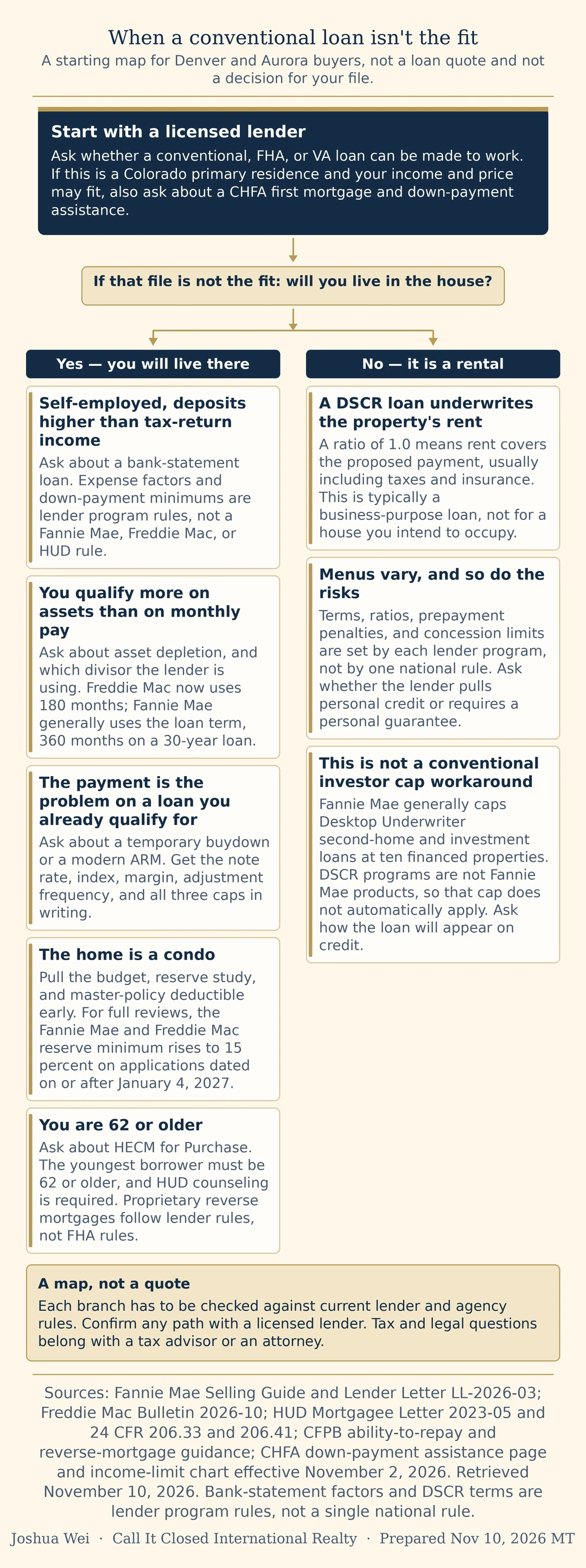
A navy, cream, and gold decision map for Denver and Aurora buyers titled "When a conventional loan isn't the fit." A navy box at the top says to start with a licensed lender and ask whether a conventional, FHA, or VA loan can be made to work, and, on a Colorado primary residence, about a CHFA first mortgage and down-payment assistance. An arrow leads to the question: if that file is not the fit, will you live in the house? The Yes column covers bank-statement loans for self-employed borrowers whose deposits exceed tax-return income; asset depletion, noting Freddie Mac's 180-month divisor versus Fannie Mae's loan term, 360 months on a 30-year loan; temporary buydowns or modern ARMs when the payment is the problem on a loan the buyer already qualifies for; pulling a condo's budget, reserve study, and deductible early, with the Fannie Mae and Freddie Mac full-review reserve minimum rising to 15 percent on applications dated on or after January 4, 2027; and HECM for Purchase, where the youngest borrower must be 62 or older and HUD counseling is required, noting that proprietary reverse mortgages follow lender rules, not FHA rules. The No column covers DSCR loans underwritten on the property's rent, notes that terms, ratios, prepayment penalties, and concession limits are set by each lender program, and notes Fannie Mae's usual ten-financed-property cap on Desktop Underwriter second-home and investment loans, which does not automatically apply to DSCR programs. A footer states that the diagram is a map, not a quote, and cites Fannie Mae, Freddie Mac, HUD, the CFPB, and CHFA, retrieved November 10, 2026.
Sources: Freddie Mac Bulletin 2026-10 (opens in a new tab); Fannie Mae Selling Guide B3-3.4-06 (opens in a new tab); Fannie Mae Lender Letter LL-2026-03 (opens in a new tab); CHFA down-payment assistance (opens in a new tab); 24 CFR 206.41 (opens in a new tab)
Text version of this figure
- When a conventional loan isn't the fit
- A starting map for Denver and Aurora buyers, not a loan quote and not a decision for your file.
- Start with a licensed lender
- Ask whether a conventional, FHA, or VA loan can be made to work. If this is a Colorado primary residence and your income and price may fit, also ask about a CHFA first mortgage and down-payment assistance.
- If that file is not the fit: will you live in the house?
- Yes — you will live there
- No — it is a rental
- Self-employed, deposits higher than tax-return income
- Ask about a bank-statement loan. Expense factors and down-payment minimums are lender program rules, not a Fannie Mae, Freddie Mac, or HUD rule.
- You qualify more on assets than on monthly pay
- Ask about asset depletion, and which divisor the lender is using. Freddie Mac now uses 180 months; Fannie Mae generally uses the loan term, 360 months on a 30-year loan.
- The payment is the problem on a loan you already qualify for
- Ask about a temporary buydown or a modern ARM. Get the note rate, index, margin, adjustment frequency, and all three caps in writing.
- The home is a condo
- Pull the budget, reserve study, and master-policy deductible early. For full reviews, the Fannie Mae and Freddie Mac reserve minimum rises to 15 percent on applications dated on or after January 4, 2027.
- You are 62 or older
- Ask about HECM for Purchase. The youngest borrower must be 62 or older, and HUD counseling is required. Proprietary reverse mortgages follow lender rules, not FHA rules.
- A DSCR loan underwrites the property's rent
- A ratio of 1.0 means rent covers the proposed payment, usually including taxes and insurance. This is typically a business-purpose loan, not for a house you intend to occupy.
- Menus vary, and so do the risks
- Terms, ratios, prepayment penalties, and concession limits are set by each lender program, not by one national rule. Ask whether the lender pulls personal credit or requires a personal guarantee.
- This is not a conventional investor cap workaround
- Fannie Mae generally caps Desktop Underwriter second-home and investment loans at ten financed properties. DSCR programs are not Fannie Mae products, so that cap does not automatically apply. Ask how the loan will appear on credit.
- A map, not a quote
- Each branch has to be checked against current lender and agency rules. Confirm any path with a licensed lender. Tax and legal questions belong with a tax advisor or an attorney.
- Sources: Fannie Mae Selling Guide and Lender Letter LL-2026-03; Freddie Mac Bulletin 2026-10; HUD Mortgagee Letter 2023-05 and 24 CFR 206.33 and 206.41; CFPB ability-to-repay and reverse-mortgage guidance; CHFA down-payment assistance page and income-limit chart effective November 2, 2026. Retrieved November 10, 2026. Bank-statement factors and DSCR terms are lender program rules, not a single national rule.
- Joshua Wei · Call It Closed International Realty · Prepared Nov 10, 2026 MT
Cream background, navy text, gold rules and arrows, 1080 by 2889 pixels. A navy rounded box at the top tells the reader to start with a licensed lender. A gold arrow leads to a cream question pill, 'If that file is not the fit: will you live in the house?' A fork then splits into two columns with navy headers: 'Yes — you will live there' on the left, with five white cards (bank-statement, asset depletion, buydown or ARM, condo reserves, HECM), and 'No — it is a rental' on the right, with three white cards (DSCR underwriting, lender program terms, and the Fannie Mae ten-property cap). A cream footer box labeled 'A map, not a quote' sits above a source line and the author credit.
The diagram above is a starting map, not a decision for your file. Each branch still has to be checked against current lender and agency rules.
Why are buyers looking past a conventional loan in 2026?
The payment is the obvious pressure. Freddie Mac's weekly average for the 30-year fixed rate, as published in its Primary Mortgage Market Survey (opens in a new tab), was 7.21 percent as of November 25, 2026. It had been 7.40 percent in the weeks ending October 8 and October 15, as published on FRED (opens in a new tab).
The other pressure is documentation and property type. In October 2026, the Denver Metro Association of Realtors reported in its monthly summary (opens in a new tab) that 65 percent of sales included a seller concession, with an average amount of $12,557, and that condos and townhomes had more than seven months of supply. DMAR's October infographic (opens in a new tab) shows a median close price of $595,000 for detached and attached homes together. My note on October prices and concessions explains what that average does and does not measure.
A recent continuing-education class on alternative financing made one distinction carefully: modern non-QM is not pre-2008 subprime. The Consumer Financial Protection Bureau's ability-to-repay rule is in Regulation Z, 12 CFR 1026.43 (opens in a new tab). Section 1026.43(a) applies that section to "any consumer credit transaction that is secured by a dwelling," with listed exceptions. Section 1026.43(c)(1) then provides: "A creditor shall not make a loan that is a covered transaction unless the creditor makes a reasonable and good faith determination at or before consummation that the consumer will have a reasonable ability to repay the loan according to its terms." A qualified mortgage is a defined way to satisfy that requirement, including through the safe harbor and presumption in section 1026.43(e)(1). It is not a license to skip underwriting on a consumer-purpose mortgage. Many DSCR loans are offered as business-purpose loans. 12 CFR 1026.3(a)(1) (opens in a new tab) states that "an extension of credit primarily for a business, commercial or agricultural purpose" is not subject to Regulation Z. Whether a particular loan is consumer-purpose or business-purpose is a question for a licensed lender and, if needed, an attorney.
What should I check before I shop for a non-QM loan?
Conventional, FHA, VA, and CHFA first
Ask a licensed lender whether a conventional, FHA, or VA loan can be made to work before you leave that channel. HUD has defined the borrower's minimum required investment, in HUD Mortgagee Letter 2019-06 (opens in a new tab) (incorporating Handbook 4000.1), as "the Borrower's contribution in cash or its equivalent required by Section 203(b)(9)(A) of the National Housing Act, which represents at least 3.5 percent of the Adjusted Value of the Property." A licensed lender has to apply the current HUD Handbook 4000.1 (opens in a new tab) to the file.
If you are buying a primary residence in Colorado and your income and price may fit, ask a CHFA participating lender (opens in a new tab) about a CHFA first mortgage and down-payment assistance. CHFA's down-payment assistance page (opens in a new tab), retrieved November 10, 2026, describes a grant of "up to the lesser of $25,000 or 3 percent of your first mortgage" with "no repayment required," or a second mortgage of "up to the lesser of $25,000 or 4 percent of your first mortgage." It also states that "individuals living with a permanent disability or first-generation homebuyers can access specific programs offering up to $25,000 regardless of first mortgage amount," and that "Repayment of loan balance deferred until certain events, such as payoff of your first mortgage, or the sale or refinance of the home, or the home is no longer your primary residence." The same page notes: "Higher interest rates apply" and that the percentage examples are "for a 30-year, fixed-rate loan." CHFA's homeownership program flyer (07/25.v7), retrieved the same day, adds these general requirements: "Have a mid-credit score of 620 or higher (based on program requirements)"; "All borrowers must attend a CHFA-approved homebuyer education class"; and "Make a minimum required investment of $1,000 toward the purchase of the home". The flyer also states: "CHFA down payment assistance can only be used when paired with a first mortgage loan under a CHFA program."
Limits vary by program and county and use different income definitions. The official CHFA Home Finance Program Income Limits chart, effective November 2, 2026, and retrieved November 10, 2026, shows a $178,920 qualifying-income limit for several commonly used programs in Denver and Arapahoe Counties, including Preferred and SmartStep, and a $832,750 purchase-price limit on the programs that have one — above October's metro median. FirstStep and FirstGeneration instead use gross household income. A participating lender has to apply the current chart to your household. This is not a determination that you qualify.
Bank-statement loans, for self-employed cash flow
Bank-statement programs are aimed at self-employed borrowers who have consistent deposits but tax returns that, after ordinary deductions, do not support a conventional payment. Income is typically calculated from deposits, reduced by an expense factor. Those expense factors, the months of statements, and the down-payment minimum are individual lender program rules, not a Fannie Mae, Freddie Mac, or HUD requirement. A licensed lender has to tell you what their program actually requires.
Standard FHA self-employed income documentation is in HUD Handbook 4000.1 (opens in a new tab). Ask a licensed lender to apply that handbook to the file, and to say whether any 3.5-percent-down structure they are offering is a standard FHA underwrite or a portfolio or non-QM product.
Asset depletion, where the formulas differ
Some borrowers qualify less on monthly pay and more on assets, such as brokerage accounts, securities, and, in some cases, other assets a particular program will count. Ask a licensed lender which assets their program counts, and which formula they will use.
The conventional formulas are not the same. Freddie Mac Bulletin 2026-10 (opens in a new tab), dated August 5, 2026, describes, among other changes, "reducing the division factor when calculating the qualifying amount to be used as income from 240 to 180," "removing Borrower age restriction for depository accounts and securities," and "establishing a minimum net eligible asset amount of $30,000." The bulletin is "effective for Mortgages with Settlement Dates on or after February 3, 2027; however, Sellers may implement immediately." The bulletin also sets separate requirements for retirement accounts; a licensed lender has to apply that section to the file. Among its other listed changes, the bulletin is "Requiring depository accounts and securities to be seasoned for 12 months prior to the Note Date unless the account was funded from eligible sources." In plain words, money that arrived in an account recently may not count unless it came from an eligible source. The bulletin also lists "Permitting all occupancy types – Primary Residences, second homes and Investment Properties" for this method.
Fannie Mae Selling Guide B3-3.4-06 (opens in a new tab), current as of March 4, 2026, states: "The lender must divide 'Net Documented Assets' by the amortization term of the loan (in months)." On a 30-year loan, that term is 360 months. The same topic sets the "Max LTV, CLTV, and HCLTV Ratio" at "70%, or 80% if the owner of the asset(s) being used to qualify is at least 62 years old at the time of closing." LTV means the loan amount compared with the home's value. CLTV and HCLTV also count any second mortgage or home equity line. The same topic limits this method to "Principal residence and second home only" and to "Purchase and limited cash-out refinance only." It also states: "Checking and savings accounts are generally not eligible as employment-related assets, unless the source of the balance in a checking or savings account was from an eligible employment-related asset (for example, a severance package or lump sum retirement distribution)." Fannie Mae's own example in that topic is "$350,000/360 (or applicable term of loan in months)" equaling "$972.22/month". "Net Documented Assets," as defined there, subtracts any early-distribution penalty and "the amount of funds used for down payment, closing costs, and required reserves." On $300,000 of net eligible assets, $300,000 divided by Freddie Mac's 180-month factor is about $1,667 a month; $300,000 divided by Fannie Mae's 360-month term is $833 a month. Ask the lender which rule they are using, and ask them to show the net-asset figure, not only the headline balance.
What if I am buying a rental, not a home to live in?
DSCR loans compare the property's monthly rent with the proposed payment, usually including taxes and insurance. They are typically offered as business-purpose loans. As noted above, 12 CFR 1026.3(a)(1) (opens in a new tab) excludes from Regulation Z "an extension of credit primarily for a business, commercial or agricultural purpose." Confirm occupancy, loan purpose, documentation, and credit-reporting or guarantee terms with a licensed lender. I use DSCR and other investor tools on my own rentals when they fit; that is not a recommendation that they fit yours.
Fannie Mae's conventional cap is separate. Selling Guide B2-2-03 (opens in a new tab), current as of November 5, 2025, states that for a "Second home or Investment property," the "Maximum Number of Financed Properties" is "DU - 10." DU stands for Desktop Underwriter, Fannie Mae's automated underwriting system. When the lender completes the Number of Financed Properties field, that topic requires the field to be "the number of financed one- to four-unit residential properties (including the subject transaction) for which the borrower(s) are personally obligated." DSCR programs are not Fannie Mae Selling Guide products, so that cap does not automatically apply; a licensed lender has to tell you what their program's limit is.
On a conventional investment-property loan, Fannie Mae's financing-concession limit is not the same as a DSCR program's concession policy. Selling Guide B3-4.1-02 (opens in a new tab) (May 7, 2025) sets the maximum financing concession on "investment property" at "2%" for "all CLTV ratios."
Can a buydown or an ARM solve a payment problem?
Sometimes, on a loan you already qualify for. Fannie Mae Selling Guide B2-1.4-04 (opens in a new tab) (August 7, 2024) provides that "temporary interest rate buydowns are allowed on fixed-rate mortgages and certain ARM plans for principal residences or second homes provided the rate reduction does not exceed 3%, and the rate increase will not exceed 1% per year." The same topic requires "a buydown period not greater than 3 years" and "increases of not more than 1% in the portion of the interest rate paid by the borrower in each 1-year interval." It classifies as a "Moderate" buydown "a difference of 2 percentage points or less between the actual note rate and the 'bought-down' interest rate, and a buydown period of two years or less." Investor properties are listed as "ineligible." The lender "must qualify the borrower based on the note rate without consideration of the bought-down rate." When buydown funds come from an interested party, "Fannie Mae's interested-party contribution limits apply." See also B3-4.1-02 (opens in a new tab): "If a temporary or permanent interest rate buydown is being offered to the borrower, and the subsidy is funded by an interested party or a lender affiliated with one, the cost of that subsidy must be included in the IPC calculation." IPC stands for interested party contribution, which is help from the seller or another interested party listed below. Availability on FHA, VA, or non-QM products is a question for a licensed lender applying those agencies' or programs' rules.
Those conventional caps are easy to get wrong. Under B3-4.1-02 (opens in a new tab), the maximum financing concessions on a "principal residence or second home" are "3%" when the LTV/CLTV ratio is "greater than 90%," "6%" when it is "75.01% – 90%," and "9%" when it is "75% or less." "Investment property" is "2%" for "all CLTV ratios." The same topic states: "Interested parties to a transaction include, but are not limited to:" "the property seller," "the builder or developer," "the real estate agent or broker," "any affiliate of the above, or" "any party that can benefit from the sale of the property at the highest price and influence the sales price or real estate transaction." FHA interested-party contribution limits are in HUD Handbook 4000.1 (opens in a new tab); ask a licensed lender to apply that handbook. VA's official lender training on borrower fees and charges (opens in a new tab), which directs lenders to VA Pamphlet 26-7, the Lenders Handbook, Chapter 8, states: "Concession(s) which exceeds 4% of the established reasonable value is deemed excessive and unacceptable." It also states: "The seller paying the Veteran buyer's usual and customary closing costs, reasonable discount points, or Buyer-broker charges are not considered seller concessions and therefore aren't included in the calculation for excessive seller concessions." A licensed lender has to apply Chapter 8 of the handbook to the file.
Modern conventional ARMs are more structured than the worst pre-2008 versions, but they are not "1 percent, once a year, after five years" as a universal rule. Fannie Mae Selling Guide B2-1.4-02 (opens in a new tab) states: "A Fannie Mae ARM plan must be tied to the Secured Overnight Financing Rate (SOFR) Index." Selling Guide B3-6-04 (opens in a new tab) identifies the standard index type for a five-year ARM as "5 year SOFR (2/1/5)" and for a seven-year ARM as "7 year SOFR (5/1/5)." The three numbers are rate caps: the most the rate can rise at the first change, at each later change, and over the life of the loan, in percentage points. See also Fannie Mae's Standard ARM Plan Matrix (opens in a new tab).
A lower starting rate on an ARM does not always help you qualify. For an ARM with a five-year fixed period, B3-6-04 says the lender qualifies the borrower at the "Greater of the maximum rate that could apply during the first five years after the first payment date (note rate plus first rate change cap), or the fully indexed rate." The fully indexed rate is the index plus the lender's margin. On a five-year ARM with a 2 percent first cap, that means qualifying at a rate at least 2 percentage points above the starting rate. For ARMs with a fixed period longer than five years, the topic says "No less than note rate." Ask a licensed lender for the note rate, the index, the margin, the adjustment frequency, and all three caps in writing.
What is changing for condo financing?
Fannie Mae Lender Letter LL-2026-03 (opens in a new tab) (March 18, 2026) states: "We are retiring the Limited Review process." Lenders "may implement the retirement of Limited Review immediately but must do so for all loan applications dated on or after Aug. 3, 2026." Established projects previously eligible for Limited Review "must now be reviewed using the Full Review process or, when applicable, the Waiver of Project Review process." Freddie Mac Bulletin 2026-C (opens in a new tab) (March 18, 2026) retires Streamlined Review "effective for Mortgages with Application Received Dates on or after August 3, 2026, but Sellers may implement immediately," and provides that eligible projects "may also be delivered as 'Exempt From Review.'" It is not accurate to say that every condo now requires a full review.
For full reviews, LL-2026-03 states: "We are revising our reserve allocation requirement for capital expenditures and deferred maintenance from a minimum of 10% to a minimum of 15% of the annual budgeted income assessment." Lenders "must comply with this requirement when utilizing the Full Review process for all loan applications dated on or after Jan. 4, 2027." Bulletin 2026-C makes the same 10-to-15 percent change "effective for Mortgages with Application Received Dates on or after January 4, 2027." On the reserve-study alternative, LL-2026-03 requires lenders to "verify the project's budget includes the highest recommended reserve allocation amount in the reserve study" and states that "lenders are no longer permitted to use the baseline funding method." That reserve-study change must be implemented "for all loan applications dated on or after Aug. 3, 2026." Bulletin 2026-C uses the same August 3, 2026, application-date trigger.
Fannie Mae Selling Guide B7-3-03 (opens in a new tab) (August 5, 2026) states: "The maximum allowable deductible for all required property insurance perils is 5% of the master property insurance coverage amount." Required perils in that topic include windstorm and hail. Pull the association's budget, reserve study, insurance, and special-assessment history early and have a licensed lender review them against current project standards.
What if the buyer is 62 or older and sitting on sale proceeds?
An FHA Home Equity Conversion Mortgage can be used to purchase a principal residence, often called HECM for Purchase. 24 CFR 206.44 (opens in a new tab) sets the monetary-investment rules for that purchase program. 24 CFR 206.33 (opens in a new tab) states: "The youngest borrower shall be 62 years of age or older at the time of loan closing."
24 CFR 206.27(b)(6) (opens in a new tab) requires that "the borrower must provide for the payment of property charges in accordance with section 206.205." Under section 206.27(c)(2)(iii), the outstanding loan balance "shall be due and payable in full, upon approval of the Commissioner," if "the borrower does not provide for the payment of property charges in accordance with section 206.205." Section 206.27(b)(8) provides: "The borrower shall have no personal liability for payment of the outstanding loan balance. The mortgagee shall enforce the debt only through sale of the property. The mortgagee shall not be permitted to obtain a deficiency judgment against the borrower if the mortgage is foreclosed." See also the CFPB's guidance on a reverse mortgage that exceeds the home's value (opens in a new tab).
24 CFR 206.3 (opens in a new tab) defines the "principal limit" as "the maximum amount calculated, taking into account the age of the youngest borrower or Eligible Non-Borrowing Spouse, the expected average mortgage interest rate, and the maximum claim amount." For an adjustable HECM, the expected average mortgage interest rate "is the sum of the mortgagee's margin plus the weekly average yield for U.S. Treasury securities (CMT) adjusted to a constant maturity of 10 years or an additional SOFR index as approved by the Secretary." Section 206.27(c)(3) requires the mortgage documents to defer due-and-payable status "for an Eligible Non-Borrowing Spouse until the death of the last Eligible Non-Borrowing Spouse or the requirements of the Deferral Period in section 206.55 cease to be met." How a younger spouse who is not yet 62 affects a particular principal limit, and what that spouse may or may not draw later, are questions for a HUD-approved counselor and a licensed lender, not a broker illustration.
24 CFR 206.41 (opens in a new tab) requires that "the borrower, any Eligible or Ineligible Non-Borrowing Spouse, and any non-borrowing owner must receive counseling." The borrower "shall provide the mortgagee with a physical copy of the certificate." When the mortgage is due and payable after the last borrower has died, 24 CFR 206.125(d)(1) (opens in a new tab) provides: "The mortgagee shall commence foreclosure of the mortgage within six months of the due date defined in section 206.129(d)(1), or within such additional time as may be approved by the Commissioner." Additional time is not automatic. See the CFPB's guidance for heirs (opens in a new tab).
A HECM's insurance structure is not the same as a standard FHA forward mortgage. HUD Mortgagee Letter 2017-12 (opens in a new tab) states: "The initial MIP rate is changed to two percent (2.00%) of the Maximum Claim Amount (MCA)." By contrast, HUD Mortgagee Letter 2023-05 (opens in a new tab) sets the upfront mortgage insurance premium on standard FHA Title II forward mortgages at "All Mortgages: 175 Basis Points (bps) (1.75%) of the Base Loan Amount," with the exceptions listed in that letter. Some lenders also offer proprietary, non-FHA reverse mortgages. Those products, and any minimum age they use, are not FHA HECM rules. A licensed lender has to confirm eligibility in the state where the property sits.
Can I use a Roth IRA toward a first home?
Sometimes, and this is a tax question for a tax professional, not a loan product and not a broker determination. IRS Publication 590-B (opens in a new tab) (for use in preparing 2025 returns), in the chapter "Roth IRAs," states: "You don't include in your gross income qualified distributions or distributions that are a return of your regular contributions from your Roth IRA(s)." A "qualified distribution," as defined in "What Are Qualified Distributions?," must be "made after the 5-year period beginning with the first tax year for which a contribution was made to a Roth IRA set up for your benefit" and must also meet one of the listed reasons, including "one that meets the requirements listed under First home under Exceptions in chapter 1 (up to a $10,000 lifetime limit)." Chapter 1 states: "Even if you are under age 59½, you don't have to pay the 10% additional tax on up to $10,000 of distributions you receive to buy, build, or rebuild a first home," and that, "when added to all your prior qualified first-time homebuyer distributions, if any, total qualifying distributions can't be more than $10,000." The same section adds two conditions that often matter for a home purchase. The money "must be used to pay qualified acquisition costs (defined next) before the close of the 120th day after the day you received it." And it says: "Generally, you are a first-time homebuyer if you had no present interest in a main home during the 2-year period ending on the date of acquisition of the home which the distribution is being used to buy, build, or rebuild. If you are married, your spouse must also meet this no-ownership requirement." So a buyer who owned a main home in the last two years, or whose spouse did, may not fit this exception, and a closing that slips can push you past the 120 days. The publication also sets "Ordering Rules for Distributions," under which regular contributions come out first, then conversion and rollover contributions, then earnings. That is general information from the IRS publication, not tax advice. Confirm the ordering rules, the lifetime cap, and your own basis with a tax professional before you request a distribution.
What else are Front Range buyers already searching for?
If the home you want already has an FHA or VA loan, an approved assumption can let you take over that loan at its existing rate and remaining term, with the lender's and the agency's approval. I have a separate assumable-mortgage page for how that process works. Taking title "subject to" an existing loan, without an approved assumption, is a different and much riskier structure. A due-on-sale clause lets the lender require the whole loan to be paid if the home is sold or transferred. The federal law on these clauses, 12 U.S.C. section 1701j-3 (opens in a new tab) (part of the Garn-St. Germain Depository Institutions Act), says a lender "may, subject to subsection (c), enter into or enforce a contract containing a due-on-sale clause with respect to a real property loan." It then lists limited transfers where a lender may not use the clause on a home with fewer than five units, such as "a transfer to a relative resulting from the death of a borrower." A sale to a new buyer who takes title subject to the loan is not on that list. How the statute and the note apply to a particular deal is a question for an attorney. It is not a casual workaround, and it is not something I can approve or structure as a broker.
Owner financing, sometimes called seller financing, is also a real tool: the seller carries a note rather than being paid off in full at closing. It can help a buyer who does not fit a conventional file, or a seller who wants a stream of payments. It also brings promissory-note, security, disclosure, and, in some cases, loan-originator-licensing questions under the federal SAFE Act, 12 U.S.C. sections 5101–5117 (opens in a new tab), and Colorado's mortgage-loan-originator licensing statute, including the exemptions in C.R.S. section 12-10-709 (opens in a new tab). Federal Regulation Z also has loan originator rules that can reach seller financing. It excludes some sellers who meet every listed condition, for example a person who "provides seller financing for the sale of three or fewer properties in any 12-month period" with financing that is fully amortizing, among other conditions in 12 CFR 1026.36(a)(4) and (a)(5) (opens in a new tab). Whether a particular seller-financing arrangement needs a license, or fits an exemption, is a question for an attorney and, where needed, a licensed loan originator — not broker shorthand.
What did the class cover that belongs in a later tax note?
The class also walked through depreciation, real estate professional status, and using a 1031 exchange and later converting a rental to a primary residence. Those topics belong in a separate, carefully sourced note, not in a broker's tax summary. The IRS sources, not class shorthand, are the place to start. IRS Publication 925 (opens in a new tab) (for use in preparing 2025 returns) states that a taxpayer "qualified as a real estate professional for the year" if both of the following were met: "More than half of the personal services you performed in all trades or businesses during the tax year were performed in real property trades or businesses in which you materially participated," and "You performed more than 750 hours of services during the tax year in real property trades or businesses in which you materially participated." It also states: "Don't count personal services you performed as an employee in real property trades or businesses unless you were a 5% owner of your employer." See also IRC section 469(c)(7) (opens in a new tab).
IRS Publication 523 (opens in a new tab) (for use in preparing 2025 returns), under "Like-kind/1031 exchange," states: "You can't claim the exclusion if:" "Either (a) or (b) applies:" "(a) You acquired your home in a like-kind exchange (also known as a section 1031 exchange), or" "(b) Your basis in your home is determined by reference to a previous owner's basis, and that previous owner acquired the property in a like-kind exchange (for example, the owner acquired the home and then gave it to you); and" "You sold the home within 5 years of the date your home was acquired in the like-kind exchange." It adds: "For an exchange of rental property that was later converted to personal use as a main home, there is a 5-year holding period required under section 121(d)(10)." See also IRC section 121(d)(10) (opens in a new tab). Publication 523 also states: "However, you can't exclude the portion of gain equal to any section 1250(b)(3) depreciation adjustments allowed or allowable after May 6, 1997, which must be recaptured and reported under section 1250." That is general information from those IRS sources, not tax advice. If these issues matter to your facts, take them to a tax professional who already has your returns.
What questions should I take to a licensed lender?
- If a conventional, FHA, VA, or CHFA loan can be made to work, what exactly is failing today: income, assets, credit, occupancy, property type, or the association?
- If the answer is a bank-statement or asset-depletion program, which documentation set and which divisor or expense factor will you use, and can you show the net figure after down payment, costs, reserves, and penalties?
- If this is an investment property, are you underwriting a DSCR first or a DSCR second? What ratio, LTV, prepay, and guarantee, and how will the loan appear on credit?
- If we use a buydown or an ARM, what is the cap math, and whose money is paying for it?
- If this is a condo, have you already reviewed the budget, the reserve study, and the master-policy deductible against the January 4, 2027, 15 percent reserve change and the 5 percent conventional deductible cap in the Fannie Mae and Freddie Mac sources cited above?
- If the buyer is 62 or older, have you run a HECM for Purchase illustration that uses the youngest borrower or eligible non-borrowing spouse and today's expected rate, and has counseling been scheduled under 24 CFR 206.41?
The Aurora property-tax and metro-district note, the radon-testing note, and the flood and drainage checklist are the property-side companions to this financing screen.
Frequently asked questions
Is a non-QM loan the same as a subprime loan?
No. On a consumer-purpose mortgage secured by a dwelling, 12 CFR 1026.43(c)(1) (opens in a new tab) requires the creditor to make "a reasonable and good faith determination at or before consummation that the consumer will have a reasonable ability to repay the loan according to its terms." Non-QM means the loan does not meet the qualified-mortgage definition in that section, including the safe harbor or presumption in section 1026.43(e)(1). It does not mean "no underwriting." DSCR loans offered as business-purpose credit are a different category; 12 CFR 1026.3(a)(1) (opens in a new tab) excludes from Regulation Z "an extension of credit primarily for a business, commercial or agricultural purpose." A licensed lender, and an attorney if needed, should confirm the purpose of a given loan.
How do bank-statement and asset-depletion loans calculate income?
Bank-statement programs typically apply an expense factor to deposits; those factors are lender program rules, not a Fannie Mae, Freddie Mac, or HUD formula. Asset-depletion programs divide net eligible assets by a number of months. Freddie Mac Bulletin 2026-10 (opens in a new tab) reduces "the division factor when calculating the qualifying amount to be used as income from 240 to 180." Fannie Mae Selling Guide B3-3.4-06 (opens in a new tab) requires the lender to "divide 'Net Documented Assets' by the amortization term of the loan (in months)," which is 360 months on a 30-year loan. Ask a licensed lender for the net figure, not only the headline balance.
Can I use a DSCR loan on a house I will live in?
Ask a licensed lender. DSCR loans are typically offered as business-purpose credit on an investment property's rent. If you will live in the house, ask that lender about conventional, FHA, VA, CHFA, bank-statement, or asset-depletion options, or, if 24 CFR 206.33 (opens in a new tab) is met, HECM for Purchase. Be truthful with any lender about whether you will live in the home. Under federal law, 18 U.S.C. section 1014 (opens in a new tab), it is a crime for anyone who "knowingly makes any false statement or report" to influence the action of listed lenders, which include "a mortgage lending business."
Will the January 2027 condo reserve change stop conventional loans on my building?
It might, if the association is below the 15 percent minimum in Fannie Mae LL-2026-03 (opens in a new tab) and Freddie Mac Bulletin 2026-C (opens in a new tab) and does not have a reserve study that meets the tighter funding rules in those letters. It might not, if the budget already meets the new minimum, if a qualifying study is in place, or if a waiver or exempt-from-review path in those same letters applies. Pull the documents now and have a licensed lender review them.
Related notes
- CHFA first-time buyer programs in Denver and Aurora: what the 2026 limits and assistance options actually say
- Assumable mortgages in Colorado: when you can take over a seller’s loan, and when you cannot
- Using gift money for a down payment in Denver or Aurora: what Fannie Mae's guide and the IRS actually say
Sources and method
Official sources for tax, legal, and lending statements were retrieved November 10, 2026, with sources added or rechecked on November 19 and November 25, 2026, America/Denver, and are quoted or cited by section in the body. Mortgage rates are Freddie Mac's Primary Mortgage Market Survey 30-year fixed average, from Freddie Mac's PMMS page (opens in a new tab) (the November 25, 2026 release) and FRED series MORTGAGE30US (opens in a new tab) for the October weeks, retrieved November 25, 2026. October 2026 Denver metro figures are from DMAR's public October 2026 summary (opens in a new tab), and the $595,000 combined median is from DMAR's October 2026 infographic (opens in a new tab). CHFA features and limits are quoted from CHFA's assistance page and program flyer and taken from the official chart effective November 2, 2026, all retrieved November 10, 2026. Ability-to-repay is quoted from 12 CFR 1026.43 (opens in a new tab); the business-purpose exclusion is quoted from 12 CFR 1026.3(a)(1) (opens in a new tab). FHA minimum required investment language is quoted from HUD Mortgagee Letter 2019-06 (opens in a new tab). Asset-depletion formulas are quoted from Freddie Mac Bulletin 2026-10 and Fannie Mae Selling Guide B3-3.4-06. Interested-party contribution caps are quoted from Fannie Mae B3-4.1-02; VA seller-concession limits are quoted from VA's official lender training on borrower fees and charges, which points to VA Pamphlet 26-7, Chapter 8; FHA IPC limits are referred to HUD Handbook 4000.1 without restating an unsourced percentage. Temporary buydowns are quoted from Fannie Mae B2-1.4-04. Standard conventional SOFR ARM structure is cited from Fannie Mae B2-1.4-02, B3-6-04, and the Standard ARM Plan Matrix. Condo reserve and review changes are quoted from Fannie Mae Lender Letter LL-2026-03 and Freddie Mac Bulletin 2026-C; the 5 percent master-policy deductible cap is quoted from Fannie Mae B7-3-03. HECM purchase, age, property charges, non-recourse, expected rate, principal limit, non-borrowing-spouse deferral, counseling, and heir foreclosure timing are quoted from 24 CFR 206.44, 206.33, 206.27, 206.3, 206.41, and 206.125. FHA upfront MIP of 1.75 percent is quoted from HUD Mortgagee Letter 2023-05; the HECM initial MIP of 2 percent of the maximum claim amount is quoted from HUD Mortgagee Letter 2017-12. Roth IRA first-home treatment is quoted from IRS Publication 590-B. Real estate professional status is quoted from IRS Publication 925; the five-year post-exchange rule and depreciation-recapture point are quoted from IRS Publication 523, with IRC sections 469(c)(7) and 121(d)(10) cited. Due-on-sale questions are pointed to 12 U.S.C. section 1701j-3 and the note. Colorado seller-financing licensing questions are pointed to the federal SAFE Act, 12 U.S.C. sections 5101–5117, and C.R.S. section 12-10-709, for an attorney to apply. The $300,000 division examples are arithmetic on the published Fannie Mae and Freddie Mac divisors. Bank-statement expense factors and other lender-program menus that are not in an official source were not stated as rules.
This note is general education from a Colorado real estate broker with Call It Closed International Realty. It is not a loan offer, an appraisal, legal advice, or tax advice, and it is not loan-origination advice. If you are deciding among these paths, I will help you organize the property questions and put you in front of a licensed lender who can run the numbers on your file. Tax questions belong with a tax professional; legal questions belong with an attorney.
Disclaimer
This article is general information only. It is not legal, tax, lending, insurance, appraisal, inspection, or financial advice, and it is not a substitute for advice about your situation. Joshua Wei is a Colorado real estate broker, not an attorney. Reading this article does not create a client relationship, an agency relationship, or an attorney-client relationship with Joshua Wei or with Call It Closed International Realty.
Laws, program rules, interest rates, insurance terms, tax figures, and other details change. Examples in this article are hypothetical illustrations unless a source is named for a specific, dated figure. Information in this article is believed accurate as of November 25, 2026 and is not guaranteed. No result is promised, and you should not rely on this article as the last word for your situation.
Before you act, confirm the point with the official source linked or cited in this article, and talk with a licensed professional who can apply the rule to your facts. That may be a licensed attorney, a tax professional, a lender, an insurance agent, a home inspector, or another licensed professional, depending on the question. Links to third-party websites and publications are provided for reference only. They are not an endorsement, and their content can change.
If you already have a brokerage relationship with another broker, this is not a solicitation.
Joshua Wei, Associate Broker, Call It Closed International Realty, Colorado license FA.100108558. Equal Housing Opportunity.