August 31, 2026 · Colorado · Home Inspection · Buyers
Are home inspectors licensed in Colorado? What the state review and the contract say
Colorado's state reviewers recommended against licensing home inspectors, and the Division of Real Estate tells buyers to pick one qualified by training and experience. What the standard contract gives you, what a general inspection covers, and the referral disclosure rule for brokers.
The short answer
In brief: Colorado reviewed whether to license home inspectors. Its 2019 sunrise review listed Colorado among states that do not regulate home inspectors and concluded: do not regulate home inspectors. A search of the 2026 Colorado Revised Statutes, Title 12, found no home-inspector licensing article. Denver and Aurora buyers check an inspector's qualifications themselves; the purchase contract sets inspection rights.
Colorado has reviewed whether to license home inspectors. In its 2019 sunrise review (opens in a new tab), the state's Office of Policy, Research and Regulatory Reform listed Colorado among states "that do not regulate home inspectors," and concluded: "Recommendation – Do not regulate home inspectors."
In the 2026 Colorado Revised Statutes, Title 12 (opens in a new tab), Professions and Occupations, "Home inspection services" appears as a settlement service in C.R.S. 12-10-218. A search of that title for this article found no home-inspector licensing article.
The Division of Real Estate's escrow and inspections page (opens in a new tab) advises: "A buyer should only hire a home inspector that is qualified by training and experience to perform the required inspections."
I am a licensed Colorado real estate broker with Call It Closed International Realty. I am not an attorney or a home inspector.
Disclaimer. This article is general information only. It is not legal, tax, lending, insurance, appraisal, inspection, or financial advice, and reading it does not create a client, agency, or attorney-client relationship. Laws, rates, programs, and figures change. Confirm the official source, and talk with a licensed attorney, tax professional, lender, insurance agent, or inspector before you act. Joshua Wei is a Colorado real estate broker, not an attorney. He is an Associate Broker with Call It Closed International Realty, license FA.100108558. Equal Housing Opportunity.
 Full size (opens in a new tab)
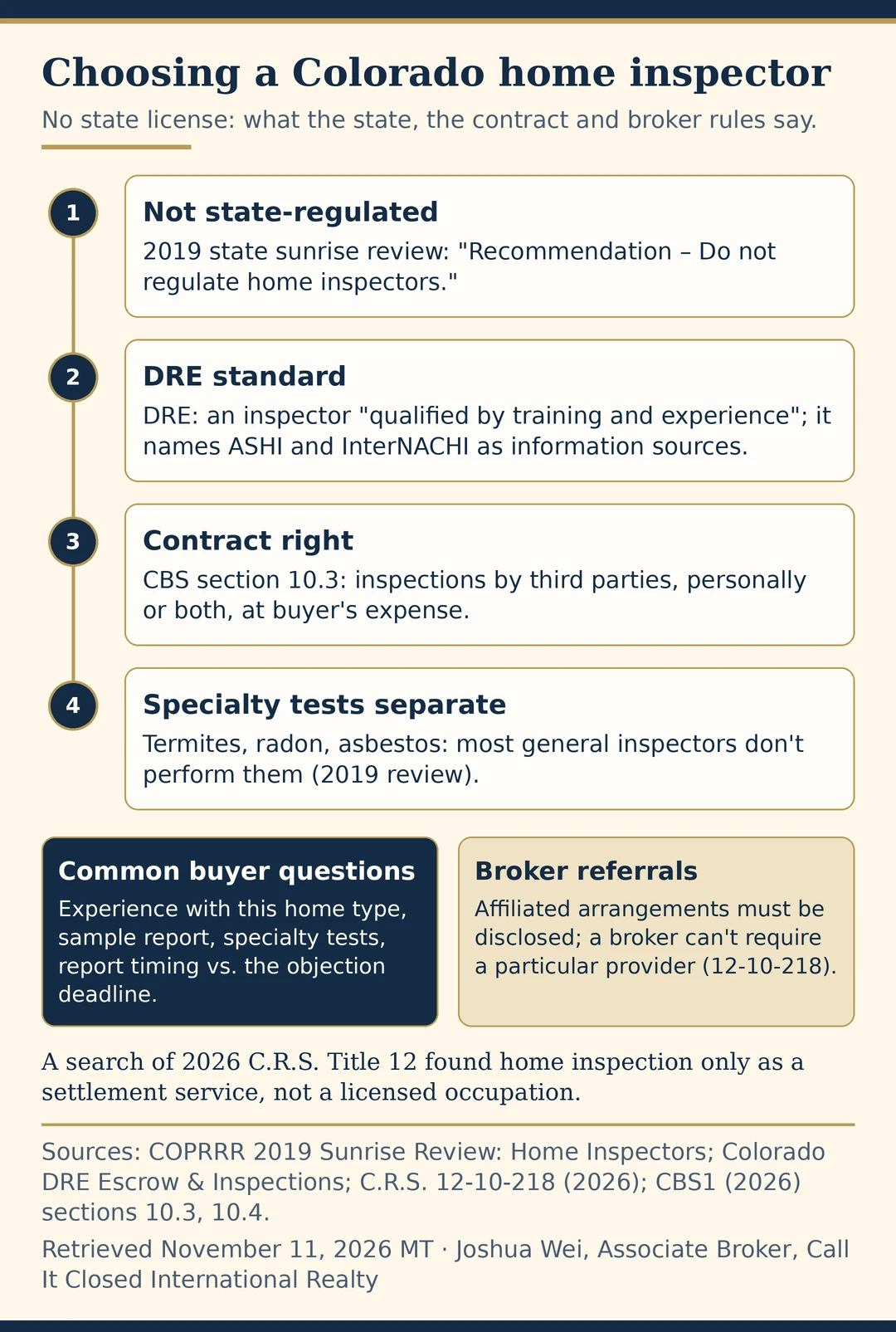
A vertical flow diagram, cream background with navy type and gold accents, titled Choosing a Colorado home inspector. Subtitle: No state license: what the state, the contract and broker rules say. 4 numbered steps: 1, Not state-regulated: 2019 state sunrise review: "Recommendation – Do not regulate home inspectors."; 2, DRE standard: DRE: an inspector "qualified by training and experience"; it names ASHI and InterNACHI as information sources; 3, Contract right: CBS section 10.3: inspections by third parties, personally or both, at buyer's expense; 4, Specialty tests separate: Termites, radon, asbestos: most general inspectors don't perform them (2019 review). Two cards: Common buyer questions: Experience with this home type, sample report, specialty tests, report timing vs. the objection deadline; and Broker referrals: Affiliated arrangements must be disclosed; a broker can't require a particular provider (12-10-218). A note says: A search of 2026 C.R.S. Title 12 found home inspection only as a settlement service, not a licensed occupation. Sources: COPRRR 2019 Sunrise Review: Home Inspectors; Colorado DRE Escrow & Inspections; C.R.S. 12-10-218 (2026); CBS1 (2026) sections 10.3, 10.4. Retrieved November 11, 2026 MT. Joshua Wei, Associate Broker, Call It Closed International Realty.
Sources: 2019 Sunrise Review (opens in a new tab); DRE Escrow & Inspections (opens in a new tab)
Cream background, navy text, gold rules. Numbered navy circles on a gold spine with white step cards, two branch cards (navy and tan), a note, and a source footer.
The figure above sets out what the state review, the DRE page, the contract and broker rules say.
Why Colorado decided not to license inspectors
A sunrise review is the state's test of whether a job needs regulating before the legislature creates a license. The 2019 report explains that the General Assembly set up the process "as a way to determine whether regulation of a certain profession or occupation is necessary before enacting laws for such regulation."
The review weighed the examples of harm that the people asking for licensing submitted. It concluded that "harm does occur, however, the possibility for a consumer to be harmed is remote. Consequently, the argument for regulation is tenuous."
The report also puts the work in context. It says "real estate closings averaged more than 300 per day in 2018 in Colorado," and that "A home inspector plays a large role in both the price negotiations of a property and the peace of mind of a purchaser."
For a buyer, the result is practical. No state agency screens inspectors before they take your money. The review notes that "there are no federal laws or regulations regarding home inspections or home inspectors."
Some trades that work on a house are licensed, though. The review says the Division of Professions and Occupations "licenses multiple construction professionals including plumbers and electricians as well as plumbing and electrical contractors," and that "General contractors are licensed at the municipal level, if they are licensed at all." So when an inspector refers an item to a plumber or an electrician, that follow-up professional may hold a state license you can look up. The inspector does not.
What does the contract say about inspections?
The Colorado Real Estate Commission's Contract to Buy and Sell Real Estate (Residential), 2026 (opens in a new tab), section 10.3, says the buyer "has the right to have inspections (by one or more third parties, personally or both)" of the property, at the buyer's expense.
Under section 10.4, the buyer "is responsible for payment for all inspections, tests, surveys, engineering reports, or other reports performed at Buyer's request" and must pay for any damage the work causes.
The 2019 review notes: "Whether or not that inspection is performed by a professional inspector is left to the discretion of the homebuyer."
What can the buyer object to?
Section 10.3 is broad. The buyer may act if the physical condition of the property, "including, but not limited to, the roof, walls, structural integrity of the Property, the electrical, plumbing, HVAC and other mechanical systems of the Property," is unsatisfactory.
The same section also reaches the inclusions, utilities and communication services, "any proposed or existing transportation project, road, street or highway," and "any other activity, odor or noise (whether on or off the Property)." The test is "in Buyer's sole subjective discretion."
The three inspection deadlines
The contract gives the buyer two paths, and choosing one closes the other:
- Inspection Termination Deadline (section 10.3.1). On or before this date, the buyer can notify the seller in writing "that this Contract is terminated due to any unsatisfactory condition, provided the Buyer did not previously deliver an Inspection Objection."
- Inspection Objection Deadline (section 10.3.2). On or before this date, the buyer can "deliver to Seller a written description of any unsatisfactory condition that Buyer requires Seller to correct." Section 10.3.1 adds that the buyer's "Right to Terminate under this provision expires upon delivery of an Inspection Objection to Seller."
- Inspection Resolution Deadline (section 10.3.3). If the parties have not agreed in writing on a settlement by this date, "this Contract will terminate on Inspection Resolution Deadline unless Seller receives Buyer's written withdrawal of the Inspection Objection before such termination."
The Division of Real Estate's forms page (opens in a new tab) posts an "Inspection Objection Notice (for use on and after January 1, 2026)" and an "Inspection Resolution" form for those steps.
Missed deadlines and earnest money
Timing matters. Under section 24.1, if a notice to terminate is not received by the deadline, the buyer "accepts the specified matter, document or condition as satisfactory and waives the Right to Terminate under such provision." It adds: "Any Notice to Terminate delivered after the applicable deadline specified in the Contract is ineffective and does not terminate this Contract."
If the contract is terminated, section 24.2 says "all Earnest Money received hereunder must be timely returned to Buyer," subject to sections 10.4 and 21. Our earnest money guide covers that in more detail.
Section 3.3.1 says a contract "day" means "the entire day ending at 11:59 p.m., United States Mountain Time," unless a Time of Day Deadline is filled in. Under section 3.3.3, a deadline that lands on a weekend or holiday is extended only if the parties checked "Will" in that paragraph. If neither box is checked, "the deadline will not be extended."
A hypothetical timeline
This example is invented, to show how the dates fit together. It is not a recommendation for how long any period should be.
- A buyer and seller in Aurora sign a contract that lists Tuesday, April 6, as both the Inspection Termination Deadline and the Inspection Objection Deadline, and Friday, April 9, as the Inspection Resolution Deadline. They fill in no Time of Day Deadline.
- The buyer's general inspection is booked for Wednesday, March 31. The inspector flags a furnace that would not light and recommends an HVAC contractor. The buyer also orders a sewer scope.
- To use either inspection right, the buyer has until 11:59 p.m. Mountain Time on April 6 to deliver a written Inspection Objection or a written notice to terminate. Doing neither means accepting the condition under section 24.1.
- If the buyer objects and the parties have not signed a settlement by 11:59 p.m. on April 9, the contract terminates unless the seller has received the buyer's written withdrawal of the objection.
The squeeze in that schedule is the specialist follow-up. If an HVAC contractor or a sewer-line contractor can't come out before the objection date, the buyer either objects without the follow-up report or asks the seller in writing to move the deadline. Our contract deadlines guide walks through the rest of the date table.
What does a general inspection cover?
The review describes a typical report as covering:
- heating, central air conditioning, and the interior plumbing and electrical systems
- the roof, attic, walls, ceilings, floors, windows and doors
- the foundation, basement and other structural elements
It says "The purpose of a pre-purchase home inspection is to note irregularities and areas of concern for the homebuyer, not to recommend remedies."
The Division of Real Estate's page gives a longer list. Its exterior items include "Foundation (cracks and settling)," "Roof (damage, poor installation, shingles, vents, gutters)" and "Grading (yard slope and drainage)." Interior items include "Electrical (wiring, outlets, circuits, electrical panel)," "Attic (structure, openings, insulation)" and "Basement (cracks, water damage, mold)."
The same page says a thorough inspection can tell a buyer "If a problem is a safety issue, major defect, or minor defect," which items "need replacement and which ones should be repaired or serviced," and which are "fine for now, however, they should be monitored closely." Those three buckets are a useful way to sort a long report before you decide what goes into an Inspection Objection.
Specialized tests are separate. The review says tests for "termites, radon, or asbestos" are inspections that "require singular skills and most home inspectors do not perform them." The DRE page adds that "there may be a need for additional experts to assist with a follow-up of issues noticed by the home inspector."
Add-on tests to ask about
These are separate tests a buyer may want to discuss with an inspector. Each has its own guide on this site:
- Radon. The review notes that the EPA "recommends that a home be tested for radon when buying or selling." See the radon testing guide.
- Sewer line and roof. A general inspection looks at the roof it can see and the plumbing inside the house. See sewer scopes and roof inspections.
- Expansive soils. Cracks and settling are on the DRE list. A structural engineer is a separate hire. See the swelling soils guide.
- Asbestos, lead and meth. Each has its own rules and testers. See the asbestos, lead paint and water line and meth testing guides.
How to vet an inspector when the state doesn't
Without a state license, the buyer does the screening. The DRE page names two places to start: "Information concerning home inspectors can be found with the American Society of Home Inspectors, and the International Association of Certified Home Inspectors."
The 2019 review summarized what those groups asked of members at the time. These requirements are as the review reported them in 2019. Check each association's current rules directly.
- ASHI. The review lists three levels. The top "certified" level required "Passing the National Home Inspector Examination," "Performing 250 fee-paid home inspections that meet or exceed the ASHI Standard of Practice," and "Completing 20 hours of continuing education annually."
- InterNACHI. Its certified professional inspector qualification required "Passing an examination," "Completing a code of ethics course," "Completing a standards of practice course," and "Submitting four simulated inspection reports."
- NAAHI. Membership required "Completing 90 hours of accredited home inspector education or a minimum of 25 paid inspections."
The review found that "The required common elements among these certifying organizations are completion of an educational component, passing an examination, and adhering to defined standards and scopes of practice." A membership tells you the inspector agreed to a written standard. It is not a state license.
Read the inspection agreement before you sign it
The inspector's own agreement sets what you can recover if something is missed. One example in the 2019 review describes an inspector who turned off a furnace in a vacant home. The pipes later froze and burst, and "As per the contract, the homeowner could only obtain a refund of the cost of the inspection rather than damages."
Read the agreement's scope, any exclusions, and any limit on liability before the inspection day. If a term worries you, a Colorado real estate attorney can explain what it means.
Conflicts of interest
The review also describes an inspector who told a buyer "that his sons owned a construction company and they could easily remedy the situations." The review notes that no harm resulted in that example, but that standards of practice under a licensing program would likely "prohibit conflicts of interest such as recommending a specific contractor to fix noted issues." Ask any inspector up front whether they, or anyone connected to them, would bid on the repairs.
Questions to ask an inspector
- What training and experience do you have with homes like this one, in age and type? The DRE standard is "training and experience."
- Do you belong to a professional association? The DRE page names the American Society of Home Inspectors and the International Association of Certified Home Inspectors as sources of information.
- Which specialized tests do you do yourself, and which do you refer out?
- Can I see a sample report?
- When will I get the report, given my contract's Inspection Objection Deadline?
- Will you go into the attic and crawlspace, and walk the roof if it's safe? If not, what will the report say about those areas?
- What does your agreement say about liability, and will you send it to me before the inspection day?
- Do you, or does anyone connected to you, do repair work?
A checklist for inspection day
- Confirm the utilities are on, so the furnace, water heater and appliances can be run. Ask that systems be left as they were found. Two examples in the 2019 review involve heat left off after an inspection, and in one the pipes later froze.
- Bring your contract dates. Note the Inspection Objection, Termination and Resolution Deadlines and any Time of Day Deadline.
- Walk the house with the inspector if you can, and ask which items are safety issues, which are major defects and which are minor. These are the DRE's three categories.
- Write down every referral to a specialist, and book those follow-ups the same day.
- Remember section 10.4. The buyer pays for the work and for any damage it causes, and must not let liens attach to the seller's property.
If you're the seller
The contract gives the inspection right to the buyer, but sellers live with the results. Under section 10.1, the seller delivers the Commission's Seller's Property Disclosure "completed by Seller to Seller's actual knowledge." Under section 10.2, if the seller "discovers an adverse material fact after the date of this Contract, Seller must timely disclose such adverse fact to Buyer."
Section 10.4 also protects the seller from the buyer's inspection work. The buyer "must pay for any damage that occurs to the Property" from that work and "agrees to indemnify, protect and hold Seller harmless." The section says it "does not apply to items performed pursuant to an Inspection Resolution."
What a seller has to disclose after a buyer's inspection report is a legal question for the seller's attorney. Our Seller's Property Disclosure guide covers the form itself.
Can my broker steer me to an inspector?
C.R.S. 12-10-218 addresses referrals. Under (2)(b), if a licensee is part of an affiliated business arrangement, "the licensee shall disclose the existence of the affiliated business arrangement to the party the licensee represents at the time of making the referral." Under (2)(c), a licensee "shall not require the use of an affiliated business arrangement or a particular provider of settlement services."
The statute's list of settlement services in (1)(c) includes "Home inspection services" and also "Pest and fungus inspections." Under (2)(d), "No licensee shall give or accept any fee, kickback, or other thing of value" under an agreement that settlement-service business involving an affiliated business arrangement will be referred. A broker can suggest names. You choose.
Frequently asked questions
Does Colorado license home inspectors?
The 2019 state review concluded "Do not regulate home inspectors." A search of the 2026 Title 12 for this article found no home-inspector licensing article.
Who pays for the inspection?
CBS section 10.4 says the buyer "is responsible for payment for all inspections, tests, surveys, engineering reports, or other reports performed at Buyer's request."
Does a home inspection include radon?
The state review says tests for "termites, radon, or asbestos" are inspections that "require singular skills and most home inspectors do not perform them."
Can I inspect the house myself?
The CBS allows inspections by third parties, personally, or both.
Does an inspector tell me how to fix things?
The review says the purpose is to note concerns, "not to recommend remedies."
Must my broker disclose an affiliated inspector?
C.R.S. 12-10-218(2)(b) says "the licensee shall disclose the existence of the affiliated business arrangement to the party the licensee represents at the time of making the referral."
What happens if I miss the Inspection Objection Deadline?
Under CBS section 24.1, a party who doesn't give notice by the deadline "accepts the specified matter, document or condition as satisfactory and waives the Right to Terminate under such provision."
If I object, can I still walk away?
Section 10.3.1 says the right to terminate under that provision "expires upon delivery of an Inspection Objection." If the objection isn't resolved in writing by the Inspection Resolution Deadline, the contract terminates unless the seller receives your written withdrawal first.
Do I get my earnest money back if the contract terminates?
CBS section 24.2 says "all Earnest Money received hereunder must be timely returned to Buyer," subject to sections 10.4 and 21.
Related notes
- Sewer scopes and roof inspections in Denver and Aurora: what they catch that a general inspection can miss
- Checking permit history before you buy in Denver or Aurora: where to look and what unpermitted work can mean
- Home warranties in a Colorado home sale: what the law requires, what to read, and what a warranty isn't
- Colorado purchase contract deadlines
Sources and method
Official sources, retrieved November 11 and 13, 2026, America/Denver:
- COPRRR 2019 Sunrise Review: Home Inspectors (opens in a new tab), dated October 15, 2019: cover letter, Profile of the Profession, Summary of Current Regulation, Analysis and Recommendations, Conclusion
- Colorado Division of Real Estate, Escrow & Inspections (opens in a new tab)
- Colorado Division of Real Estate, contracts and forms (opens in a new tab)
- Colorado Revised Statutes 2026, Title 12 (opens in a new tab): 12-10-218; text search for "home inspect"
- Colorado Real Estate Commission CBS1 (2026) (opens in a new tab): sections 3.3, 10.1 to 10.4, 24.1, 24.2
Quotations are verbatim. Association membership requirements are as the 2019 review reported them, not current rules. The timeline example is hypothetical. Local licensing of contractors and specialty testers isn't covered here.
This note is general education from a Colorado real estate broker with Call It Closed International Realty. When you're under contract, I'll help you line up inspections around your deadlines.
Disclaimer
This article is general information only. It is not legal, tax, lending, insurance, appraisal, inspection, or financial advice, and it is not a substitute for advice about your situation. Joshua Wei is a Colorado real estate broker, not an attorney. Reading this article does not create a client relationship, an agency relationship, or an attorney-client relationship with Joshua Wei or with Call It Closed International Realty.
Laws, program rules, interest rates, insurance terms, tax figures, and other details change. Examples in this article are hypothetical illustrations unless a source is named for a specific, dated figure. Information in this article is believed accurate as of November 13, 2026 and is not guaranteed. No result is promised, and you should not rely on this article as the last word for your situation.
Before you act, confirm the point with the official source linked or cited in this article, and talk with a licensed professional who can apply the rule to your facts. That may be a licensed attorney, a tax professional, a lender, an insurance agent, a home inspector, or another licensed professional, depending on the question. Links to third-party websites and publications are provided for reference only. They are not an endorsement, and their content can change.
If you already have a brokerage relationship with another broker, this is not a solicitation.
Joshua Wei, Associate Broker, Call It Closed International Realty, Colorado license FA.100108558. Equal Housing Opportunity.