September 1, 2026 · Colorado · Selling · FSBO · Disclosures
Selling your Colorado home without a broker? The disclosures state and federal law still require
For-sale-by-owner sellers in Denver and Aurora still face statutory disclosure rules. The special taxing district, common interest community, radon and metro district requirements in C.R.S. 38-35.7, the buyer's meth-testing right, and the federal lead-based paint rule for pre-1978 homes.
The short answer
In brief: Selling a Colorado home without a broker does not remove the disclosure rules. Several sections of C.R.S. 38-35.7 apply to the contract or the seller directly, not to brokers, such as the special taxing district disclosure required in every residential purchase contract and the common interest community disclosure. Federal lead-based paint rules still apply to most pre-1978 homes.
Several sections of C.R.S. 38-35.7, in the 2026 Colorado Revised Statutes, Title 38 (opens in a new tab), apply to the contract or the seller itself, not to brokers:
- 38-35.7-101: "Every contract for the purchase and sale of residential real property shall contain a disclosure statement" about special taxing districts.
- 38-35.7-102: every contract for a home "in a common interest community" must contain an HOA disclosure.
- 38-35.7-112(2)(a): "Each contract of sale for residential real property must contain the following disclosure" about radon.
- 38-35.7-110(2): an owner selling in a metro district organized on or after January 1, 2000 must provide specific documents to the buyer.
For homes built before 1978, the federal lead-based paint disclosure rule applies to sellers too.
I am a licensed Colorado real estate broker with Call It Closed International Realty. I am not an attorney. This article is about legal requirements, not a pitch. Contract and disclosure questions in a private sale are for a Colorado real estate attorney.
Disclaimer. This article is general information only. It is not legal, tax, lending, insurance, appraisal, inspection, or financial advice, and reading it does not create a client, agency, or attorney-client relationship. Laws, rates, programs, and figures change. Confirm the official source, and talk with a licensed attorney, tax professional, lender, insurance agent, or inspector before you act. Joshua Wei is a Colorado real estate broker, not an attorney. He is an Associate Broker with Call It Closed International Realty, license FA.100108558. Equal Housing Opportunity.
 Full size (opens in a new tab)
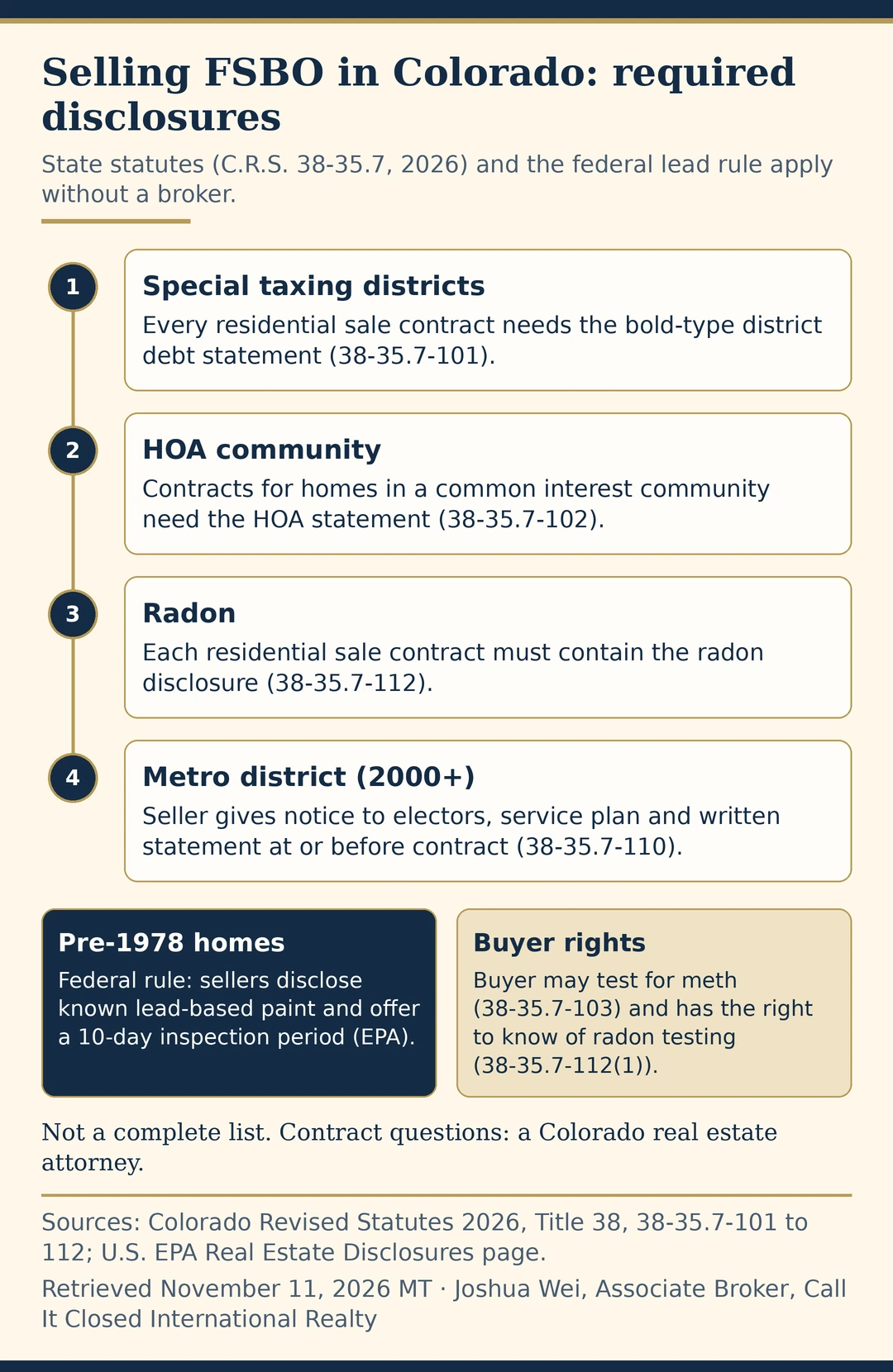
A vertical flow diagram, cream background with navy type and gold accents, titled Selling FSBO in Colorado: required disclosures. Subtitle: State statutes (C.R.S. 38-35.7, 2026) and the federal lead rule apply without a broker. 4 numbered steps: 1, Special taxing districts: Every residential sale contract needs the bold-type district debt statement (38-35.7-101); 2, HOA community: Contracts for homes in a common interest community need the HOA statement (38-35.7-102); 3, Radon: Each residential sale contract must contain the radon disclosure (38-35.7-112); 4, Metro district (2000+): Seller gives notice to electors, service plan and written statement at or before contract (38-35.7-110). Two cards: Pre-1978 homes: Federal rule: sellers disclose known lead-based paint and offer a 10-day inspection period (EPA); and Buyer rights: Buyer may test for meth (38-35.7-103) and has the right to know of radon testing (38-35.7-112(1)). A note says: Not a complete list. Contract questions: a Colorado real estate attorney. Sources: Colorado Revised Statutes 2026, Title 38, 38-35.7-101 to 112; U.S. EPA Real Estate Disclosures page. Retrieved November 11, 2026 MT. Joshua Wei, Associate Broker, Call It Closed International Realty.
Sources: C.R.S. 2026 Title 38 (opens in a new tab); EPA lead disclosure (opens in a new tab)
Cream background, navy text, gold rules. Numbered navy circles on a gold spine with white step cards, two branch cards (navy and tan), a note, and a source footer.
The figure above lists the disclosures by source, with state statutes and the federal rule shown separately.
Why skipping a broker doesn't skip these rules
Several of these statutes say outright that the duty belongs to the seller. Section 38-35.7-101(2) says: "The obligation to provide the disclosure set forth in subsection (1) of this section shall be upon the seller." If the seller fails to provide it, "the purchaser shall have a claim for relief against the seller for all damages to the purchaser resulting from such failure plus court costs."
Section 38-35.7-102(2)(a) uses the same opening words for the HOA disclosure. It gives the buyer a claim "for actual damages directly and proximately caused by such failure plus court costs," and adds that "It shall be an affirmative defense to any claim for damages brought under this section that the purchaser had actual or constructive knowledge of the facts and information required to be disclosed."
Two other statutes deal with private sales head-on. The water-source rule in 38-35.7-104(1)(a)(II) covers contracts and disclosures "not subject to the real estate commission's jurisdiction." The oil-and-gas rule in 38-35.7-108(1)(b) does the same. And the radon and meth statutes define the homes they cover to include a "home sold by the owner."
Special taxing districts
C.R.S. 38-35.7-101(1) requires every residential sale contract to include, in bold type, a statement that begins: "SPECIAL TAXING DISTRICTS MAY BE SUBJECT TO GENERAL OBLIGATION INDEBTEDNESS THAT IS PAID BY REVENUES PRODUCED FROM ANNUAL TAX LEVIES ON THE TAXABLE PROPERTY WITHIN SUCH DISTRICTS."
The statement goes on to tell buyers where to look. It says buyers "SHOULD INVESTIGATE THE SPECIAL TAXING DISTRICTS IN WHICH THE PROPERTY IS LOCATED BY CONTACTING THE COUNTY TREASURER, BY REVIEWING THE CERTIFICATE OF TAXES DUE FOR THE PROPERTY, AND BY OBTAINING FURTHER INFORMATION FROM THE BOARD OF COUNTY COMMISSIONERS, THE COUNTY CLERK AND RECORDER, OR THE COUNTY ASSESSOR."
The statute says the disclosure must be "in bold-faced type which is clearly legible and in substantially the following form." In a private sale, someone has to make sure the contract you sign actually contains it.
HOA communities
C.R.S. 38-35.7-102(1) requires a bold-type statement in contracts for homes in a common interest community. It begins: "THE PROPERTY IS LOCATED WITHIN A COMMON INTEREST COMMUNITY AND IS SUBJECT TO THE DECLARATION FOR SUCH COMMUNITY."
The rest of the statement warns that the governing documents "WILL IMPOSE FINANCIAL OBLIGATIONS UPON THE OWNER OF THE PROPERTY, INCLUDING AN OBLIGATION TO PAY ASSESSMENTS OF THE ASSOCIATION," and that if the owner doesn't pay, "THE ASSOCIATION COULD PLACE A LIEN ON THE PROPERTY AND POSSIBLY SELL IT TO PAY THE DEBT."
The seller also has a document duty. Under 38-35.7-102(2)(b), "Upon request, the seller shall either provide to the buyer or authorize the unit owners' association to provide to the buyer, upon payment of the association's usual fee," the community's governing and financial documents. The list is the one in the most recent Commission contract as of the contract date. Our condo and HOA due diligence guide walks through what those documents are.
Radon
Under C.R.S. 38-35.7-112(1), "A buyer of residential real property has the right to be informed of whether the property has been tested for elevated levels of radon." The required contract disclosure says "The Colorado Department of Public Health and Environment strongly recommends that ALL home buyers have an indoor radon test performed before purchasing residential real property."
The same disclosure ends: "The seller of residential real property is required to provide the buyer with any known information on radon test results of the residential real property."
Section 112(2)(b) then lists what the contract or the seller's disclosure must include:
- whether "a radon test or tests have been conducted"
- "The most recent records and reports pertaining to radon concentrations"
- "A description of any radon concentrations detected or mitigation or remediation performed"
- whether "a radon mitigation system has been installed"
- "An electronic or paper copy of the most recent brochure published by the department of public health and environment" about radon in real estate transactions
The statute's definition of residential real property includes "A home sold by the owner." The Division of Real Estate's forms page (opens in a new tab) also links a "Buyer Radon Disclosure Form (pursuant to SB23-206) -prepared by the Colorado Bar Association," listed there as a non-Commission form. For the testing side, see our radon testing guide.
Metro districts
Under C.R.S. 38-35.7-110(2), the seller of a home in a metro district organized on or after January 1, 2000 must, "concurrently with or prior to the execution of a contract to sell the property," give the buyer:
- the district's notice to electors;
- its service plan; and
- a written statement the statute describes.
That written statement covers the district's authority to issue debt, "The maximum debt service mill levy the metropolitan district is permitted to impose under the service plan," any separate operating mill levy, and fees. It must say that the district's actions "may increase costs to residents living in the metropolitan district."
Section 110(2) also calls for:
- "An estimate of the dollar amount of property taxes levied by the metropolitan district that are applicable to the property for collection during the year in which the sale occurs"
- "A copy of the most current certificate of taxes due or tax statement issued by the county treasurer"
The estimate comes with a required bold statement that begins: "This estimate only provides an illustration of the amount of the new property taxes that may be due and owing." Under 110(5), "A seller is deemed to have complied with this section as long as the disclosures required by this section are based upon a good-faith effort to provide accurate estimates and information."
A separate section, 38-35.7-111, adds the district's website. The seller must give the buyer "the official website established by the metropolitan district," on the Commission-approved Seller's Property Disclosure "or other concurrent writing."
If you aren't sure whether your home is in a metro district, the certificate of taxes due from the county treasurer lists the taxing entities. Our metro districts vs. HOAs guide explains the difference.
Water source
Section 38-35.7-104 requires disclosure of the home's drinking-water source. For contracts outside the Commission's jurisdiction, 104(1)(a)(II) says each "listing contract, contract of sale, or seller's property disclosure for residential real property that is not subject to the real estate commission's jurisdiction" shall contain a bold-type statement in substantially the same form.
That form begins "THE SOURCE OF POTABLE WATER FOR THIS REAL ESTATE IS:" and gives checkboxes for a well, a water provider (with contact details), or another source. Under 104(1)(b), if the source is a well, "the seller shall also provide with such disclosure a copy of the current well permit if one is available." Section 104(2) again says "The obligation to provide the disclosure set forth in subsection (1) of this section shall be upon the seller." Our well and septic guide covers well homes in Arapahoe County.
Oil and gas
Section 38-35.7-108(1)(b) says each contract of sale or seller's property disclosure for residential property "that is not subject to the real estate commission's jurisdiction must contain a disclosure statement in bold-faced type that is clearly legible in substantially the same form" as the Commission version.
That statement begins: "THE SURFACE ESTATE OF THE PROPERTY MAY BE OWNED SEPARATELY FROM THE UNDERLYING MINERAL ESTATE, AND TRANSFER OF THE SURFACE ESTATE MAY NOT INCLUDE TRANSFER OF THE MINERAL ESTATE."
Section 108(2) limits the scope: the disclosure "does not create a duty to investigate or disclose that does not otherwise exist for the seller." See our mineral rights guide for the buyer's side.
Meth testing
C.R.S. 38-35.7-103(1) says "A buyer of residential real property has the right to test the property for the purpose of determining whether the property has ever been used as a methamphetamine laboratory." The statute sets testing standards and, if the results show contamination that hasn't been remediated, a right to terminate.
The seller has a disclosure duty too. Section 103(3)(a) says "the seller shall disclose in writing to the buyer whether the seller knows that the property was previously used as a methamphetamine laboratory." A seller who knew and failed to disclose is liable under 103(3)(b) for remediation costs, certain health-related costs, and "Reasonable attorney fees for collection of costs from the seller." Under 103(3)(c), the buyer must sue "within three years after the date on which the buyer closed the purchase."
There is an exception in 103(4) for property that was remediated to state standards and received certificates of compliance. The statute's definition in 103(5) includes a "home sold by the owner." See our meth disclosure guide.
Lead-based paint (pre-1978 homes)
The EPA's lead disclosure page (opens in a new tab) says "The Lead-based Paint Disclosure Rule requires sellers, landlords, real estate agents and property managers to provide specific information about known lead-based paint and lead-based paint hazards before prospective renters and homebuyers sign a lease or contract." It also says sellers must "Provide homebuyers a 10-day period to conduct a paint inspection or risk assessment," which the parties can change in writing or the buyer can waive.
The rule itself is in 40 CFR Part 745, Subpart F (opens in a new tab). Under section 745.107, the seller "shall provide the purchaser or lessee with an EPA-approved lead hazard information pamphlet" and "shall disclose to the purchaser or lessee the presence of any known lead-based paint and/or lead-based paint hazards." The same section says "Nothing in this section implies a positive obligation on the seller or lessor to conduct any evaluation or reduction activities."
Under section 745.113, "Each contract to sell target housing shall include an attachment" with the Lead Warning Statement and the other listed elements. The seller "shall retain a copy of the completed attachment" for "no less than 3 years from the completion date of the sale."
EPA's page lists situations where the rule does not apply. They include "Foreclosure sales," "Housing built after 1977," and housing tested by a certified inspector or risk assessor "and found to be lead-based paint free." EPA links sample seller disclosure forms on the same page. See our lead paint and water line guide.
What about the Commission's forms?
C.R.S. 38-35.7-104 and 38-35.7-108 direct the Real Estate Commission to require water-source and oil-and-gas disclosures in contracts and disclosures "subject to the commission's jurisdiction." The Commission's forms, including the Seller's Property Disclosure, are posted on the Division of Real Estate forms page (opens in a new tab). Whether and how to use them in a private sale is a question for your attorney.
Two statutes point back to that form even in a private sale. The metro district website rule in 38-35.7-111 refers to the "Colorado real estate commission approved seller's property disclosure or other concurrent writing." The radon rule in 112(2)(b) lets the required radon items go in the contract "or seller's property disclosure."
A private-sale disclosure checklist
| Item | When it applies | Source | |---|---|---| | Special taxing district statement | Every residential sale contract | C.R.S. 38-35.7-101 | | Common interest community statement and documents on request | Home is in an HOA or other common interest community | C.R.S. 38-35.7-102 | | Water source statement, plus well permit if available | Residential property as defined in 104(3); private-sale version in 104(1)(a)(II) | C.R.S. 38-35.7-104 | | Oil and gas statement | Private-sale version in 108(1)(b) | C.R.S. 38-35.7-108 | | Metro district documents, statement and tax estimate | District organized on or after Jan. 1, 2000; before or at contract signing | C.R.S. 38-35.7-110 | | Metro district website | Same districts | C.R.S. 38-35.7-111 | | Radon contract statement, known test information and CDPHE brochure | Every residential sale | C.R.S. 38-35.7-112 | | Written statement on known meth-lab use | Every residential sale, with the 103(4) exception | C.R.S. 38-35.7-103 | | Lead pamphlet, known-hazard disclosure, contract attachment, 10-day evaluation period | Most pre-1978 housing, unless exempt | 40 CFR 745.107, 745.110, 745.113 |
This table lists the statutes covered in this article. It is not a complete list of every disclosure that could apply to a particular home.
These statutes are not the whole picture. Colorado sellers can also be held responsible for not telling a buyer about a known problem that would matter to a buyer, such as a known leak, a foundation problem, or past water damage, even if no specific statute or form question asks about it. The Commission's Seller's Property Disclosure form warns that a seller's "failure to disclose a known adverse material fact affecting the Property or occupant may result in legal liability," and that such a fact "must be disclosed whether there is a specific item on this SPD or not." Many private sellers use that form, or a similar written disclosure, to put what they know in writing. Ask a Colorado real estate attorney what you should disclose and how.
A hypothetical walk-through
This example is invented, to show how the rules stack up. It is not advice for any real sale.
An owner is selling a townhome built in 1972 in Aurora without a broker. The home is in an HOA and gets water from a city utility. The owner tested for radon four years ago and installed a mitigation system. The county tax statement shows a metro district organized in 2004.
- The contract needs the special taxing district statement, the common interest community statement, and the radon statement.
- The water-source statement lists the provider, and the oil-and-gas statement goes in the contract or the disclosure.
- Before or when the contract is signed, the owner provides the metro district's notice to electors, service plan, written statement, tax estimate, a current certificate of taxes due, and the district's website.
- On radon, the owner discloses the old test, gives the most recent report, describes the mitigation system and includes the CDPHE brochure.
- Because the home was built before 1978, the owner gives the EPA pamphlet, discloses any known lead-based paint, attaches the Lead Warning Statement to the contract, offers the 10-day evaluation period unless the buyer waives it in writing, and keeps the signed attachment for at least three years.
- If the buyer asks, the owner provides or authorizes the HOA to provide the governing and financial documents, upon payment of the association's usual fee.
Buying from an owner who isn't using a broker
Buyers have rights in these statutes even when nobody else is checking. Questions worth asking a private seller in writing:
- Does the draft contract contain the special taxing district, radon and, if it applies, HOA statements?
- Is the home in a metro district organized on or after January 1, 2000? If so, where are the documents 38-35.7-110 lists?
- What is the water source? If it's a well, can I see the current well permit?
- Has the home been tested for radon? Can I have the most recent report and the CDPHE brochure?
- Was the home built before 1978? Where is the lead disclosure attachment, and how long is the evaluation period?
- Do you know whether the property was ever used as a meth lab?
Who holds the earnest money and runs closing is a separate question. The Division of Real Estate's escrow page (opens in a new tab) says the term escrow also describes "a title company or attorney that is hired to handle the closing of the real estate transaction."
Related: Denver and Aurora radon testing guide (opens in a new tab).
Related: Aurora property tax and metro district buyer checklist (opens in a new tab).
Frequently asked questions
Do FSBO sellers in Colorado have to include a radon disclosure?
C.R.S. 38-35.7-112(2)(a) says each contract of sale for residential real property must contain it.
Does the special taxing district disclosure apply if I'm not in a metro district?
Section 38-35.7-101 applies to "Every contract for the purchase and sale of residential real property."
What do I give a buyer if my home is in a newer metro district?
C.R.S. 38-35.7-110(2) lists the notice to electors, the service plan and a written statement, provided "concurrently with or prior to the execution of a contract."
Is lead paint disclosure only for brokers?
EPA says the rule "requires sellers, landlords, real estate agents and property managers" to provide the information.
Can a buyer test for meth?
C.R.S. 38-35.7-103(1) says a buyer "has the right to test the property."
Do I have to disclose my water source if I'm not using a broker?
C.R.S. 38-35.7-104(1)(a)(II) covers listing contracts, contracts of sale and seller disclosures "not subject to the real estate commission's jurisdiction," and 104(2) puts the obligation on the seller.
Do I have to test for lead before selling?
40 CFR 745.107 says "Nothing in this section implies a positive obligation on the seller or lessor to conduct any evaluation or reduction activities." It does require disclosure of known lead-based paint and hazards.
How long do I keep the lead disclosure?
Under 40 CFR 745.113, the seller keeps a copy of the completed attachment "for no less than 3 years from the completion date of the sale."
Who can review a private-sale contract?
A Colorado real estate attorney. This article lists statutes; it doesn't apply them to a particular sale.
Related notes
- Selling in Denver or Aurora? What Colorado's Seller's Property Disclosure asks, and what "actual knowledge" means
- Closing costs in Denver and Aurora: what is set by law, what is negotiated, and what to read on the forms
- Sell your Denver home this winter, or wait for spring? What the monthly data show.
- Colorado's TD-1000 and the documentary fee
Sources and method
Official sources, retrieved November 11 and 13, 2026, America/Denver:
- Colorado Revised Statutes 2026, Title 38 (opens in a new tab): C.R.S. 38-35.7-101, 102, 103, 104, 108, 110, 111, 112
- U.S. EPA, Real Estate Disclosures about Potential Lead Hazards (opens in a new tab)
- 40 CFR Part 745, Subpart F (eCFR) (opens in a new tab): sections 745.107, 745.110, 745.113
- Colorado Division of Real Estate, contracts and forms (opens in a new tab)
- Colorado Division of Real Estate, Escrow & Inspections (opens in a new tab)
Quotations are verbatim. The all-caps statutory text is quoted as printed, in excerpts. The walk-through is hypothetical. This isn't a complete list of every possible disclosure.
This note is general education from a Colorado real estate broker with Call It Closed International Realty. If you decide you'd like help with your Denver or Aurora sale, I'm available. Either way, the disclosures above still apply.
Added November 19, 2026, after an expert review, and checked that day: Colorado Real Estate Commission, Seller's Property Disclosure (Residential), SPD19, Mandatory Use Date January 1, 2026 (opens in a new tab).
Disclaimer
This article is general information only. It is not legal, tax, lending, insurance, appraisal, inspection, or financial advice, and it is not a substitute for advice about your situation. Joshua Wei is a Colorado real estate broker, not an attorney. Reading this article does not create a client relationship, an agency relationship, or an attorney-client relationship with Joshua Wei or with Call It Closed International Realty.
Laws, program rules, interest rates, insurance terms, tax figures, and other details change. Examples in this article are hypothetical illustrations unless a source is named for a specific, dated figure. Information in this article is believed accurate as of November 19, 2026 and is not guaranteed. No result is promised, and you should not rely on this article as the last word for your situation.
Before you act, confirm the point with the official source linked or cited in this article, and talk with a licensed professional who can apply the rule to your facts. That may be a licensed attorney, a tax professional, a lender, an insurance agent, a home inspector, or another licensed professional, depending on the question. Links to third-party websites and publications are provided for reference only. They are not an endorsement, and their content can change.
If you already have a brokerage relationship with another broker, this is not a solicitation.
Joshua Wei, Associate Broker, Call It Closed International Realty, Colorado license FA.100108558. Equal Housing Opportunity.